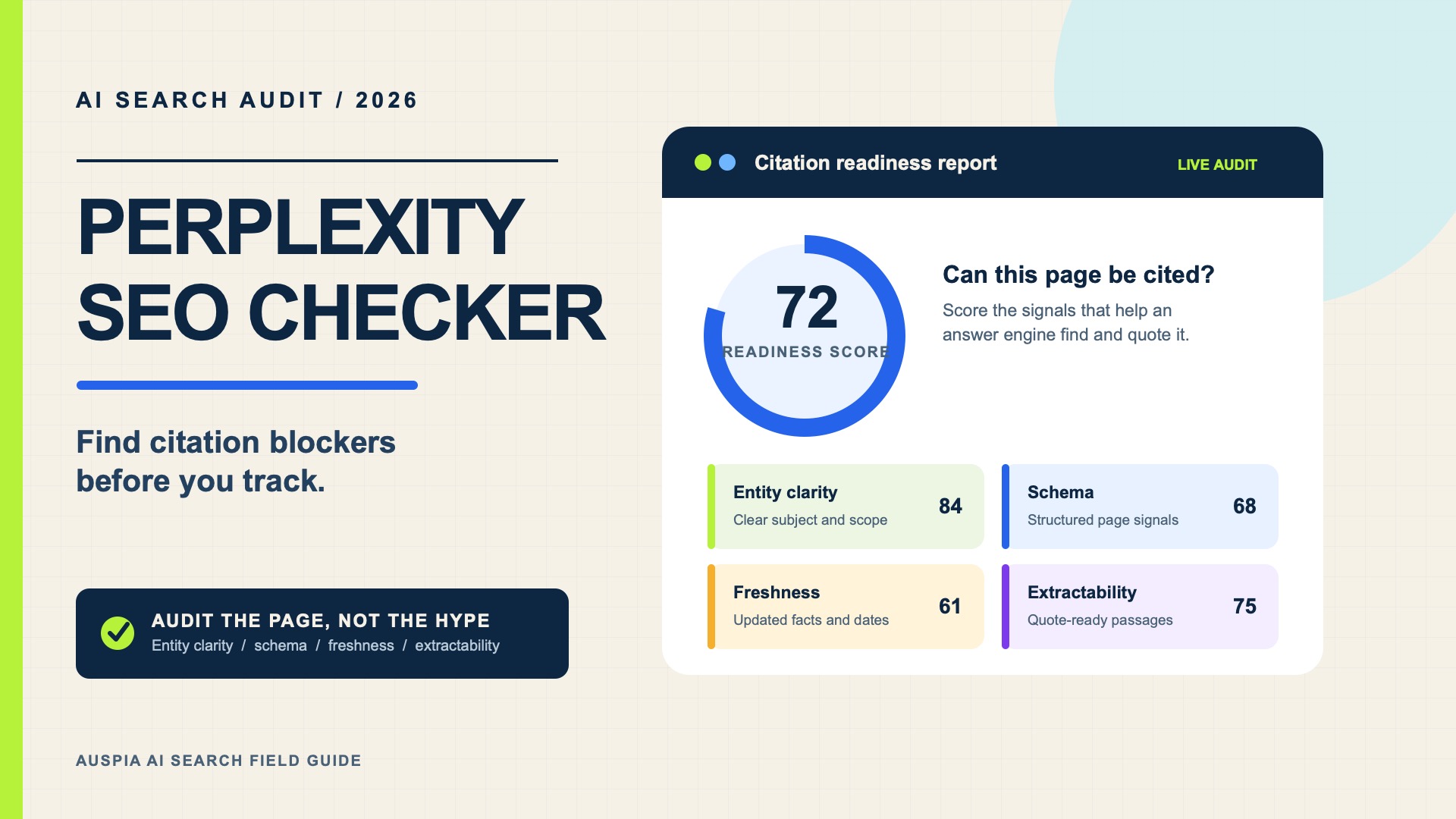
A Perplexity SEO checker is a diagnostic tool that tells you whether Perplexity's answer engine can find, understand, and cite your pages — and, more usefully, why it does not. Unlike a traditional rank tracker, it does not report a position on a search results page; it scores the machine-readability, factual density, and citation-readiness of your content, then points at the specific gaps blocking citations.
If you publish in a category where buyers ask Perplexity for recommendations, a checker is the cheapest way to stop guessing. This guide explains what a Perplexity SEO checker actually measures, how it differs from a rank tracker, what features matter, and how to run a five-step audit using Auspia's free GEO Score Checker.
Why a Perplexity SEO checker is a different category from a rank tracker
Perplexity does not rank pages in the traditional sense. For each query it retrieves roughly 5–10 candidate pages and cites only 3–5 of them, after passing them through a multi-stage pipeline that scores relevance, recency, entity clarity, and single-topic focus. A page can rank #1 on Google and still never be cited, because it fails one of those retrieval or absorption stages.
That is why the "checker" category exists separately from "tracking" tools:
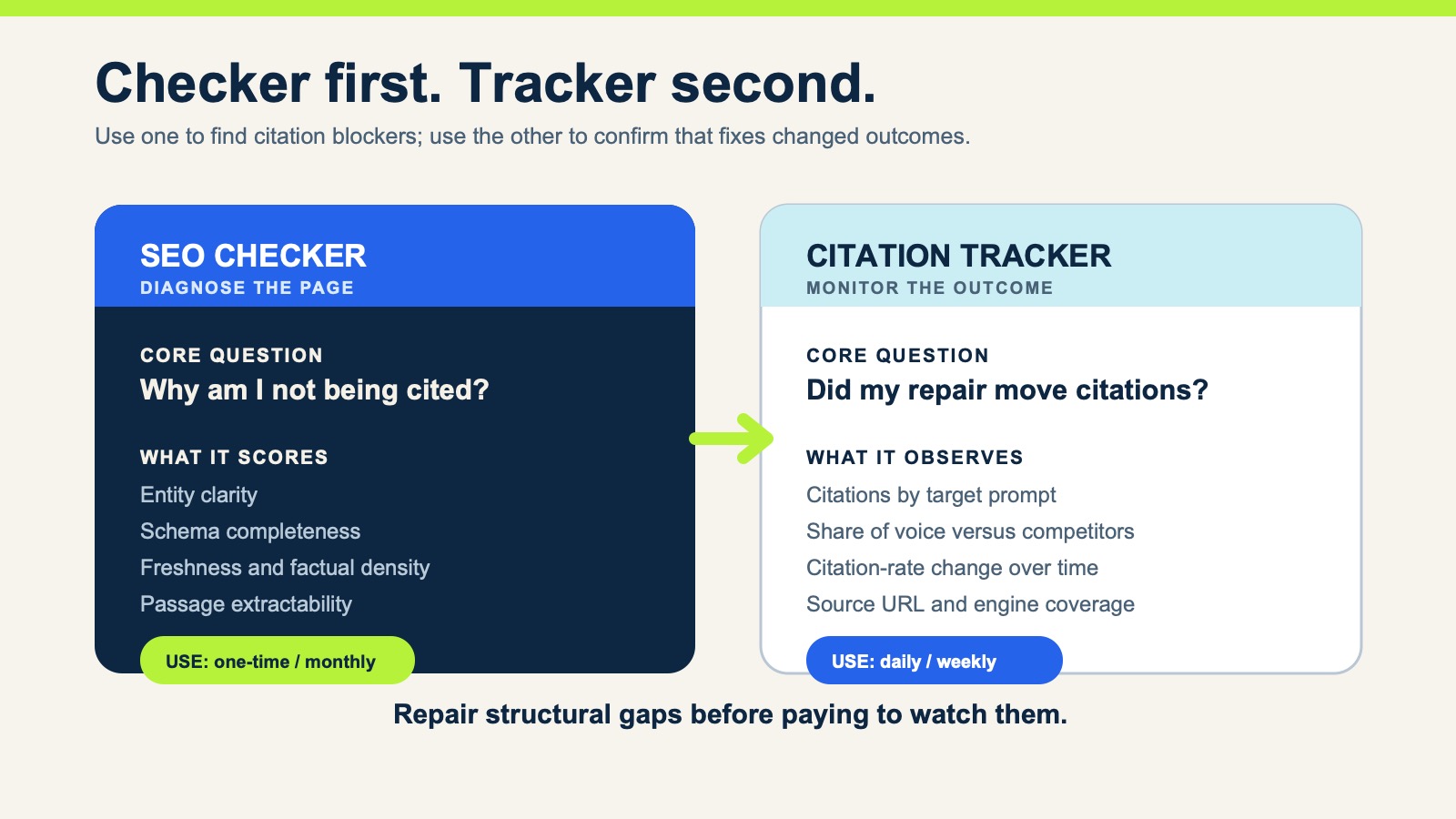
- A Perplexity SEO checker is a diagnostic. It scans your page (or domain) and scores it across the dimensions Perplexity uses to decide whether to cite you — entity clarity, passage extractability, schema completeness, factual density, freshness, and source authority. It answers "why am I not being cited?" and tells you what to fix. Most run a one-time or monthly deep audit.
- A Perplexity SEO tracker is a monitor. It watches live Perplexity queries over time and reports whether your citation rate changed this week. It answers "did my fix move the needle?" and runs daily or weekly.
You usually need both, but in the right order. Run a checker first to find and repair the structural blockers; subscribe to a tracker only after your score is high enough that fixes will produce a measurable lift. Paying for daily tracking on a page that fails the basic diagnostic is how teams burn budget without moving citations.
What a Perplexity SEO checker should measure (feature scorecard)
Not every tool that labels itself a "Perplexity SEO checker" actually isolates Perplexity. Many blend all AI engines into one vague "AI visibility" score, which hides the engine-specific citation behavior that matters. Use this scorecard to evaluate any tool before trusting its output.
Dimension | What good looks like | Why it matters |
|---|---|---|
Perplexity isolation | Reports Perplexity citations separately from ChatGPT, Gemini, AI Overviews | Citation logic differs by engine; a blended score hides where you actually win or lose |
Citation vs mention | Distinguishes a cited link from a brand mention in prose | A mention is good; a clickable citation is measurable and drives referral traffic |
Entity clarity score | Flags whether your page names the entity precisely and consistently | Perplexity eliminates pages with ambiguous entity focus before it cites anything |
Passage extractability | Checks whether answer-length passages can be quoted without distortion | The LLM only cites what it can quote cleanly, so dense, hedging-free passages win |
Schema completeness | Audits JSON-LD (Article, FAQ, Person, dateModified) | Schema signals freshness and entity structure; |
Factual density | Counts specific numbers, dates, and original data | Perplexity favors verifiable facts over hedged opinion |
Source-page attribution | Tells you which URL Perplexity used when citing you | Lets you see which content formats actually earn citations |
Freshness signal | Flags pages older than 30–90 days | Citation rate decays sharply after ~90 days without a refresh |
Competitor share of voice | Shows how often competitors are cited in your target prompts | The single most useful number: tells you if a rival owns 60% of your prompts while you hold 10% |
Exportable data | CSV/JSON export for cross-referencing and client reporting | Manual transcription of AI answers is not a workflow |
If a tool covers fewer than six of these, treat it as a tracker or a brand-mention monitor, not a checker.
The two tool types and when to use each
Need | Tool type | Example cadence | Typical cost |
|---|---|---|---|
Find out why you are not cited | Checker (diagnostic audit) | One-time, then monthly deep audit | Free baseline; ~$99/mo for competitor benchmarking |
Confirm a fix lifted your citations | Tracker (live monitoring) | Daily or weekly | ~$29/mo and up |
Manage hundreds of keywords/locations in bulk | Enterprise visibility platform | Automated daily | ~$199/mo per index |
One-time spot check, no signup | Free checker + manual query | As needed | $0 |
A practical stack for a small team: run a free checker to set a baseline and fix structural issues, then add a low-cost tracker once your checker score clears ~70. For high-value B2B keywords where Perplexity's index updates within 24–48 hours, upgrade to automated daily tracking with citation alerts.
How to run a 5-step Perplexity visibility audit with a checker
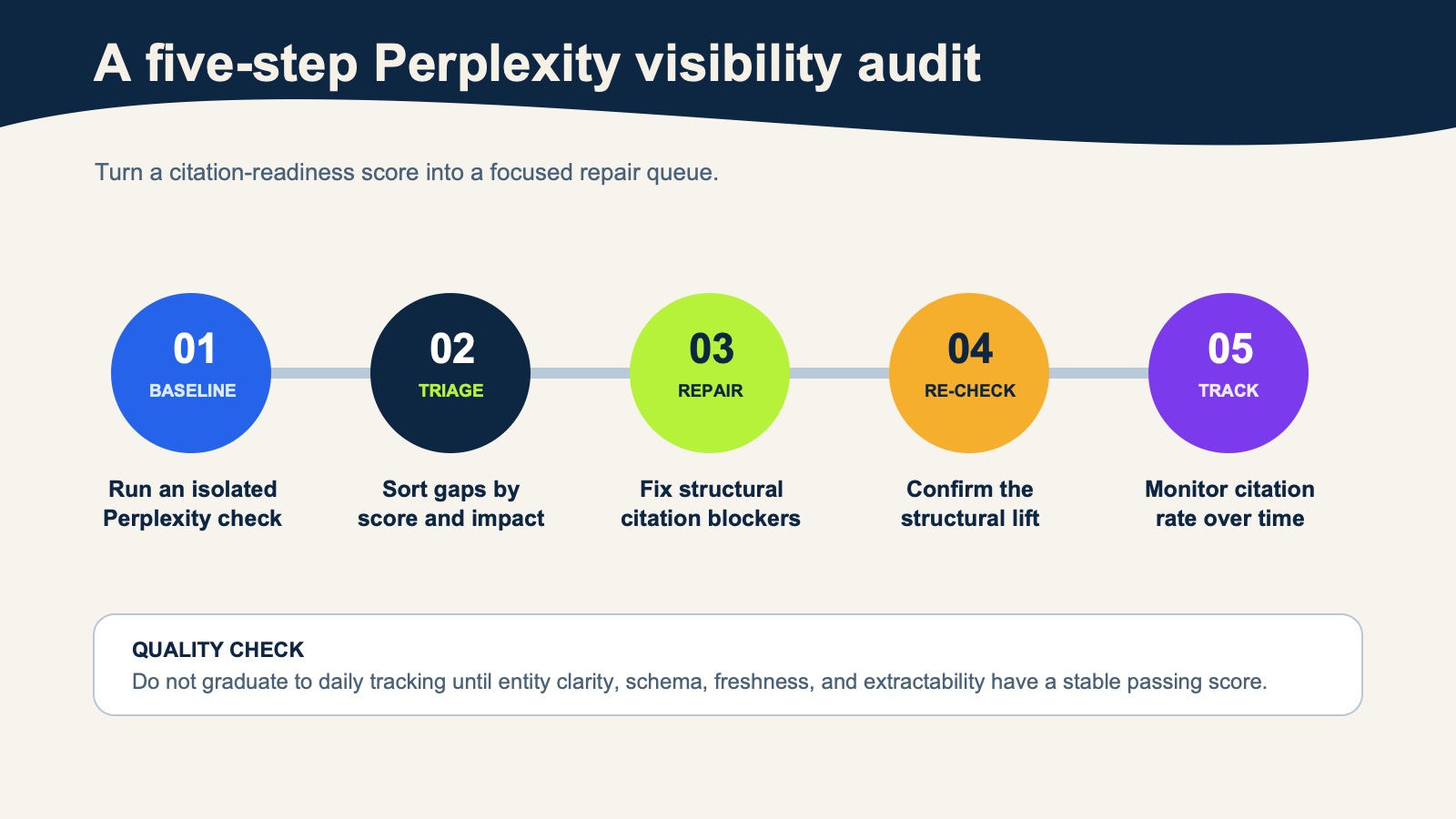
A checker is only useful if it produces a repair queue. Use this five-step workflow to turn a score into action.
1. Set a baseline with a Perplexity-isolated check
Run your domain through a Perplexity-specific checker. Capture the overall score and the per-dimension breakdown. If the checker blends engines, also run a manual control: query Perplexity in a private window with five target prompts and record which URLs it cites. This gives you a raw citation baseline that no tool can manipulate.
2. Triage by score, not by gut
Sort dimensions by score. Below 60 means structural fixes will move the needle; above 70 means you can graduate to tracking. The two dimensions that most often silently fail are entity clarity (your page never names the entity precisely, so Perplexity cannot decide what the page is about) and passage extractability (your key claim is buried in a long paragraph with hedging language, so the LLM cannot quote it without distortion).
3. Repair the cheap structural blockers first
These five fixes are low-effort and lift almost every score:
- Put the direct answer in the first paragraph, stated definitively ("The best X is Y"), not hedged.
- Name the entity exactly and consistently across the page — no synonym swapping.
- Update
dateModifiedin your JSON-LD every time you refresh content; the recency boost is real. - Add FAQ and Article schema if missing.
- Place evidence (a number, a date, a source) within one paragraph of each claim.
4. Re-run the checker to confirm the structural lift
Re-audit the same URL after the repairs. The checker should show a jump in entity clarity, schema completeness, and passage extractability. If it does not, your "fix" changed prose without changing machine-readability — go back and tighten the entity naming.
5. Graduate to tracking only after the score clears your threshold
Once the checker reports a stable score above your threshold (commonly 70 for content sites, higher for competitive B2B), subscribe to a tracker and watch citation rate over two to four weeks. If citations rise, you have proven the checker's diagnosis was correct; if they do not, the blocker is authority or freshness, not structure — return to the checker's source-authority dimension.
Using Auspia's GEO Score Checker
Auspia's free GEO Score Checker runs a generative-engine-optimization audit on your domain and scores the dimensions that decide whether AI answer engines can retrieve and cite you. It is the diagnostic step in the workflow above.
To use it for a Perplexity-focused audit:
- Enter your domain or a specific strategic URL.
- Read the overall GEO score and the per-dimension breakdown (entity clarity, passage extractability, schema, factual density, freshness).
- Export or screenshot the results as your baseline.
- Work through the repair queue the checker produces — it prioritizes the gaps most likely to block citations.
- Re-run the check after each major repair cycle to confirm the lift.
For competitive context, the GEO Checker Leaderboard shows how brands in your category rank across generative engines, so you can see whether a competitor is capturing the citations you are missing. Pair the leaderboard's share-of-answer data with your own checker score to decide whether to invest in structural fixes (your score is low) or in authority and freshness work (your score is high but competitors outrank you).
Structured data and citation rate: the connection
A common checker finding is "schema incomplete." Many teams assume schema is irrelevant because AI engines read it as text on a page rather than processing it in a special way. That misreads the evidence. Schema does three things that directly affect citations, even if the engine treats it as plain text:
- It signals freshness via
dateModified, which triggers the recency boost Perplexity applies to content updated within the last ~30 days. - It reinforces entity clarity by declaring the page's
@type, author, and publication date in a machine-readable block — useful when the HTML prose is ambiguous. - It improves overall machine-readability, which helps the retrieval and reranking stages decide what your page is about.
The practical rule: keep JSON-LD clean and accurate (Article, FAQ, Person), update dateModified on every refresh, and do not treat schema as optional decoration. A checker that flags schema gaps is pointing at one of the cheapest citation levers you have.
Case pattern: a 3x citation lift from a checker-driven repair
Consider a B2B analytics vendor whose content ranked on page one of Google but earned zero Perplexity citations for its category's recommendation prompts. A checker diagnostic revealed three blockers:
- Entity ambiguity — the page described the product category using three different noun phrases, so Perplexity could not pin down the entity the page represented.
- No direct answer — the key recommendation was buried in the seventh paragraph, hedged with "may be suitable for."
- Stale `dateModified` — the schema showed a date 14 months old, well past the recency window.
The repair was structural, not a rewrite: the team named the entity consistently, moved a definitive answer to the first paragraph, added FAQ schema, and updated dateModified on the refresh. Within three weeks, the same five target prompts cited the page in three of them — a roughly threefold lift in citation rate — without any new backlinks or new content. The checker diagnosed the problem; the tracker confirmed the win.
This is the typical pattern. The biggest lever is never the software itself; it is the structural repair the checker surfaces. The tools tell you where you stand, but the work of creating direct-answer content, implementing schema, and earning citations is what actually gets you cited.
Common Perplexity SEO checker mistakes
- Treating a blended "AI visibility" score as a Perplexity score. If the tool does not isolate Perplexity, you cannot diagnose Perplexity-specific blockers.
- Confusing a brand mention with a citation. A mention in prose is not a clickable source link; only citations are reliably measurable and drive referral traffic.
- Tracking before diagnosing. Paying for daily monitoring on a page that fails entity clarity wastes budget on a page that will never be cited regardless of how often you watch it.
- Refreshing prose without updating `dateModified`. If you rewrite a paragraph but leave the schema date stale, you forfeit the recency boost.
- Chasing score without checking competitor share of voice. A high score is meaningless if a competitor is cited in 60% of your prompts while you hold 10%. The share-of-voice number is the one that maps to business outcomes.
FAQ
Is there a free Perplexity SEO checker? Yes. Auspia's GEO Score Checker runs a free generative-engine audit, and a manual private-window Perplexity query with five target prompts costs nothing and gives a raw citation baseline.
How often should I run a Perplexity SEO check? Run a deep diagnostic audit monthly for structural assessment. For competitive B2B niches, weekly checks are the minimum viable frequency because Perplexity's index can shift within 24–48 hours of a content or PR change.
What score should I aim for? Below 60, structural fixes will produce a clear lift. Above 70, graduate to tracking. For competitive B2B keywords, aim higher and pair the score with competitor share-of-voice data from the leaderboard.
Do I need a checker and a tracker? Usually both, in order. A checker diagnoses and repairs; a tracker confirms the fix moved citations. Running a tracker on an un-diagnosed page burns budget without moving the needle.
Does structured data help with Perplexity citations? Indirectly but meaningfully. AI engines read schema as text, but dateModified signals freshness, @type reinforces entity clarity, and clean JSON-LD improves machine-readability. Keep it accurate and update it on every refresh.
Author: Alice Monroe, AI SEO Tools Analyst covering 150+ tools at Auspia. Alice writes about AI search visibility tooling, checker workflows, and how growth teams turn diagnostics into citation lifts.