The source-page rewrite problem
Most pages are written to persuade humans after the click. Perplexity-ready content also has to work before the click, when an AI answer system is deciding which sources are useful enough to cite.
That does not mean writing for bots. It means making the page easier for both humans and AI systems to understand, verify, and reuse accurately.
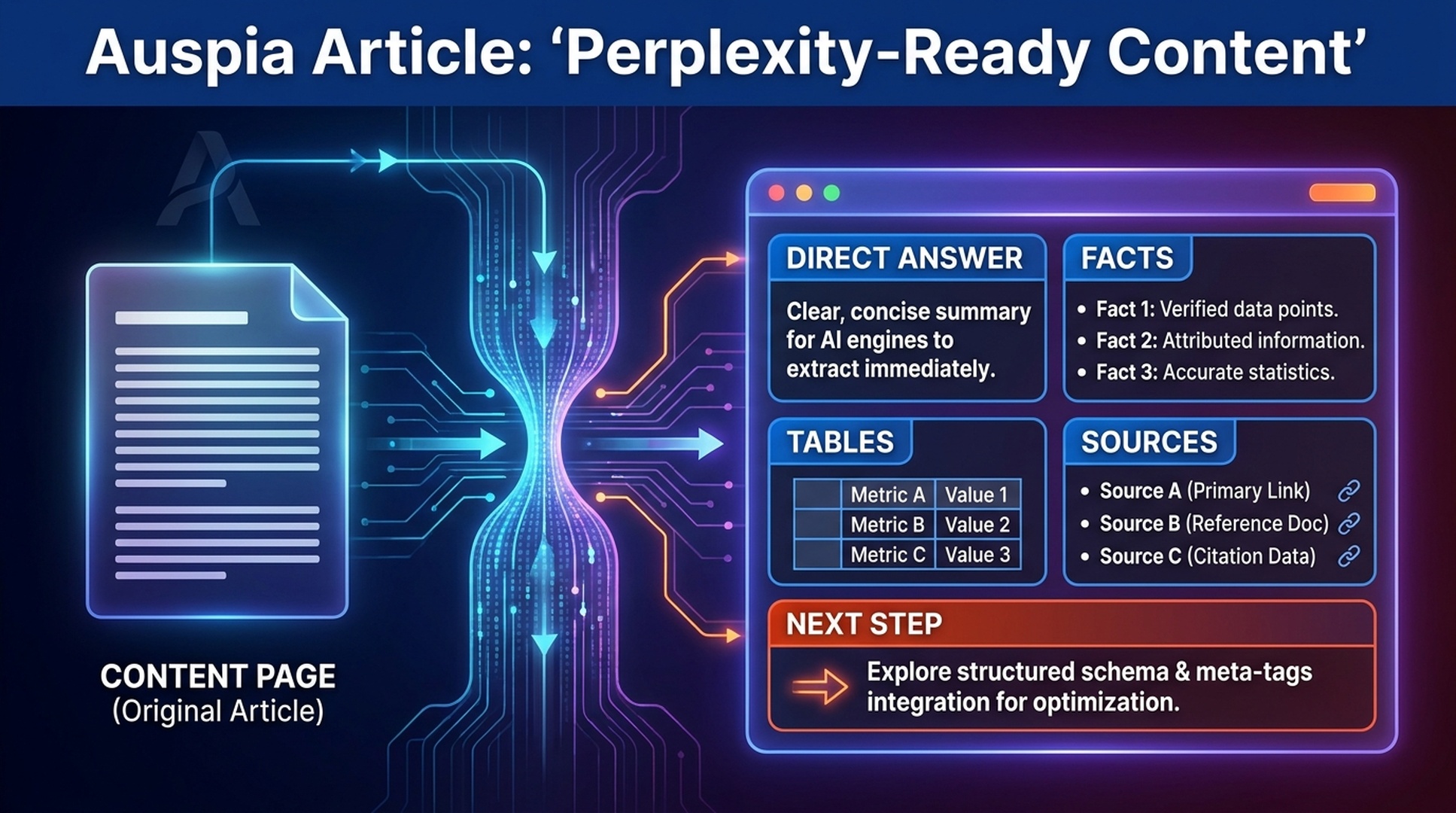
A Perplexity-ready page usually has four traits:
Trait | What it means in practice |
|---|---|
Direct answer | The page answers the core question early, without making the reader hunt. |
Extractable structure | Definitions, tables, bullets, and examples are easy to lift into an answer. |
Verifiable detail | Claims include facts, dates, sources, constraints, or examples. |
Clear next step | A visitor who clicks from Perplexity knows what to do next. |
If a page is full of brand language but thin on specific facts, it may still read well to a casual visitor. It will be weak source material.
What Perplexity-ready content is not
Perplexity-ready content is not keyword stuffing, generic FAQ padding, or a long article generated from a prompt list.
It is also not a guarantee of citations. Perplexity does not publish a full source-selection formula, and citation behavior can shift by query, freshness, location, and source availability.
The safer goal is source readiness: make the page accessible, specific, structured, and useful enough that it can support an answer when the query fits.
This is where AEO, SEO, and GEO overlap. SEO helps the page get discovered. AEO makes the answer clear. GEO connects that answer to brand visibility, citations, and referral traffic.
Anatomy of a citation-ready page
A citation-ready page has a different shape from a generic blog post.
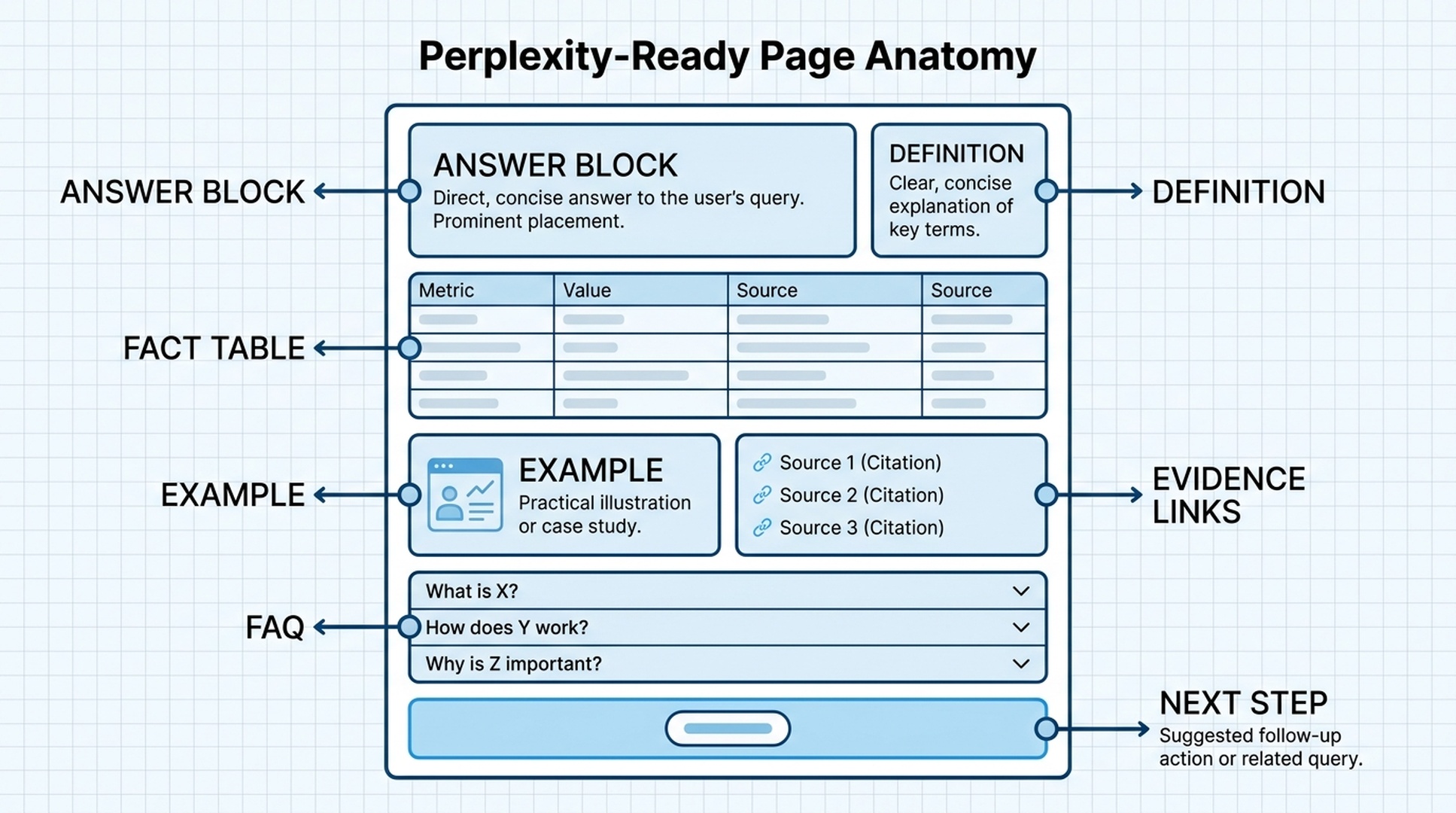
Use this structure as a starting point:
Page element | Purpose |
|---|---|
Direct answer block | Gives Perplexity and the reader a concise summary of the page's claim. |
Clear definition | Helps with "what is" and comparison prompts. |
Scope and audience | Explains who the answer applies to and who it does not apply to. |
Fact table | Makes product, method, or category details easy to extract. |
Example section | Shows the concept in a concrete scenario. |
Evidence links | Supports claims with official docs, data, research, or credible sources. |
Comparison criteria | Helps answer evaluation prompts without vague "best" language. |
Freshness signal | Shows when the page was updated if the topic changes. |
FAQ | Answers real follow-up questions, not filler. |
Next step | Sends Perplexity visitors to a tool, checklist, demo, or deeper guide. |
You do not need every element on every page. Product pages, docs pages, and blog guides need different layouts. But the principle is the same: make the page useful as evidence.
Start with an answer block
Do not bury the answer under a long introduction.
A strong answer block should be short, specific, and bounded. It should say what the thing is, why it matters, and what the reader should do next.
Weak version:
AI search is changing how people discover brands, and companies need to adapt their content strategies to stay visible in this new landscape.
Stronger version:
Perplexity-ready content is content structured so Perplexity can retrieve, summarize, and cite it accurately. It usually includes a direct answer, clear definitions, specific facts, source links, and a next step for readers who click through from an AI answer.
The stronger version names the entity, explains the action, and gives concrete components. It is easier to cite and harder to misread.
Add facts that can survive extraction
AI answers often compress source material. If your page uses vague claims, the compressed answer will be vague too.
Replace abstract claims with extractable facts.
Vague claim | Citation-ready version |
|---|---|
"Our tool improves AI visibility." | "The tool checks whether target prompts mention the brand, cite the target URL, and describe the company accurately." |
"We support global teams." | "The workflow supports English, Japanese, Korean, Simplified Chinese, and Traditional Chinese article checks." |
"This method works for B2B." | "This method is best for B2B SaaS pages where buyers compare vendors, features, integrations, and evidence before booking a demo." |
"We use advanced analytics." | "The report tracks brand mentions, cited URLs, citation position, answer sentiment, referral sessions, and assisted conversions." |
Specificity does not make the writing dry. It makes it trustworthy.
Use tables for answer extraction
Tables are useful because they force comparison, scope, and criteria into a format that is easy to scan.
Good Perplexity-ready tables include:
Table type | Best use |
|---|---|
Definition table | Explaining terms, entities, acronyms, and categories |
Comparison table | Comparing tools, methods, platforms, or use cases |
Checklist table | Turning advice into reviewable tasks |
Signal table | Mapping AI visibility signals to actions |
Prompt table | Mapping user questions to source pages |
Measurement table | Showing what to track and why |
Do not add tables just for formatting. Add them when they clarify the answer.
Write examples that do real work
Examples help Perplexity and humans understand the boundary of a claim.
A weak example says, "For example, a SaaS company can use this strategy to improve visibility."
A stronger example says:
A payroll software company targeting Perplexity prompts such as "best payroll tools for remote teams" should not only publish a product page. It should also create a comparison guide, a contractor-payment FAQ, an integrations page, and a public help article explaining supported countries and tax forms. Those pages give Perplexity more specific source material than a generic homepage.
That example has a category, prompt, page types, and the reason those assets matter.
Build a source block for claims
Perplexity-ready pages should separate opinion, evidence, and action.
Use a source block when the page relies on external facts:
Claim type | Source support to include |
|---|---|
Platform behavior | Official docs or help center pages |
Market data | Survey, benchmark, report, or public dataset |
Technical guidance | Standards, official documentation, or reproducible test result |
Product capability | Public docs, changelog, help article, or product page |
Comparison claim | Clear criteria and dated review methodology |
For Perplexity articles, cite Perplexity's own Help Center or documentation when explaining citations, crawlers, or API behavior. Avoid repeating secondhand claims when the official source is available.
Before-and-after content rewrite
Here is a practical rewrite pattern.
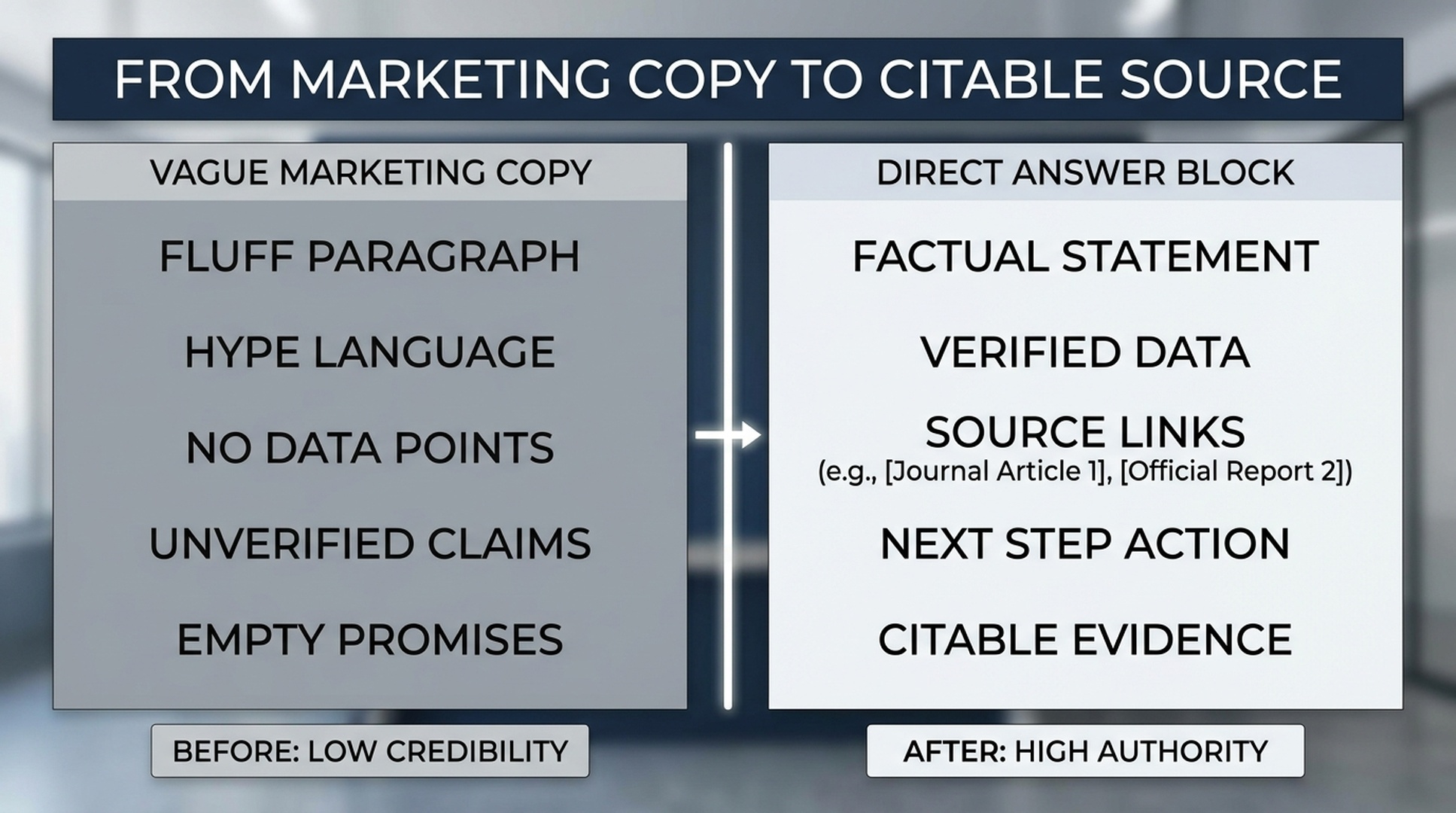
Before:
Our platform helps brands succeed in the AI search era with powerful insights and advanced optimization workflows.
After:
Auspia helps growth teams measure AI search visibility across prompts, brand mentions, cited URLs, answer accuracy, and referral traffic. Teams use it to identify which pages are cited by AI answer systems, where competitors appear, and which technical or content gaps should be fixed first.
Why the second version works better:
Improvement | What changed |
|---|---|
Clear category | It explains what Auspia is used for. |
Specific metrics | It names prompts, mentions, cited URLs, accuracy, and referrals. |
Concrete user | It names growth teams. |
Actionable outcome | It explains what teams do with the information. |
Less hype | It removes vague words like "powerful" and "advanced." |
This is not only cleaner writing. It is better source material.
Page-type patterns for Perplexity-ready content
Different pages need different structures.
Page type | Best Perplexity-ready addition |
|---|---|
Blog guide | Add an answer block, fact table, examples, and source links. |
Product page | Add product category, audience, use cases, integrations, limitations, and proof. |
Comparison page | Add criteria, dated methodology, and honest fit guidance. |
Docs page | Keep setup steps public, crawlable, and specific. |
Tool page | Explain what the tool checks, what inputs it needs, and what output users get. |
Case study | Separate background, action, evidence, and outcome. Avoid vague success claims. |
Glossary page | Define the term, show examples, related terms, and common mistakes. |
Start with pages that already matter commercially. A perfect glossary page is less useful than a good product, comparison, or technical guide that supports real buyer prompts.
After the content structure is fixed, run the Perplexity SEO audit checklist to catch access, entity, evidence, and measurement gaps. For technical crawl issues, use the PerplexityBot SEO guide.
Publishing checklist
Use this before publishing a page you want Perplexity to cite.
Check | Pass criteria |
|---|---|
Core answer | The page answers the main question in the first few paragraphs. |
Entity clarity | Brand, category, audience, and product facts are consistent. |
Extractable sections | The page includes tables, bullets, definitions, or examples where useful. |
Evidence | External claims link to credible sources. |
Freshness | Dates are included when the topic changes over time. |
Crawl access | The page is public, indexable, and not blocked by robots.txt or WAF. |
Conversion path | The next step matches the user's likely research intent. |
Measurement | The target prompt group and success metric are defined. |
If the page fails more than two of these checks, fix it before chasing more content volume.
FAQ
What is Perplexity-ready content?
Perplexity-ready content is content structured so Perplexity can retrieve, understand, summarize, and cite it accurately. It usually includes a direct answer, clear definitions, specific facts, tables, examples, source links, and a useful next step.
Is Perplexity-ready content the same as SEO content?
No. SEO content usually targets search intent and rankings. Perplexity-ready content also needs to work as source material inside an AI-generated answer. The best pages do both.
Do FAQs help with Perplexity citations?
FAQs can help when they answer real follow-up questions clearly. They do not help when they repeat keywords or add generic filler. Use FAQs to clarify buyer questions, technical constraints, definitions, and measurement issues.
Should every article start with a direct answer?
Most Perplexity-targeted pages should give a clear answer near the top. It does not have to be formulaic. A short answer block, diagnosis, decision memo, or checklist can all work if the main answer is easy to extract.
How long should Perplexity-ready content be?
Length is less important than usefulness. A page should be long enough to answer the question, show evidence, define terms, and guide the next action. A short, specific page can be more useful than a long vague one.
Does adding tables guarantee citations?
No. Tables help extraction and comparison, but they do not guarantee citations. Perplexity still depends on query fit, source availability, credibility, freshness, and retrieval behavior.
Sources
- Perplexity Help Center: How does Perplexity work?
- Perplexity Docs: Perplexity crawlers
- Perplexity Docs: API overview
Auspia takeaway
Perplexity-ready content is not a new writing gimmick. It is good source writing.
Answer the question early. Use specific facts. Show examples. Add tables when they clarify. Link to sources when claims need support. Give the visitor a next step after the citation click.
If your page would help a human researcher quote you accurately, it is much closer to being useful for Perplexity too.
Author: Nora Whitfield, AEO Specialist for 800+ Answer Patterns at Auspia. Nora writes about answer engine optimization, extractable summaries, FAQ design, and content that answers questions clearly.