Quick answer
A high-quality GEO article in 2026 is not a longer SEO article with a few AI keywords added. It is a page built so answer engines can identify the main question, extract a direct answer, verify the evidence, understand the brand or entity behind the claim, and reuse specific sections without rewriting the whole page.
For growth teams, the practical rule is simple: write every important page as both a human guide and an AI-ready source file. The reader should get a useful answer in the first minute. The AI system should be able to lift a definition, checklist, comparison, or FAQ answer without guessing what you meant.
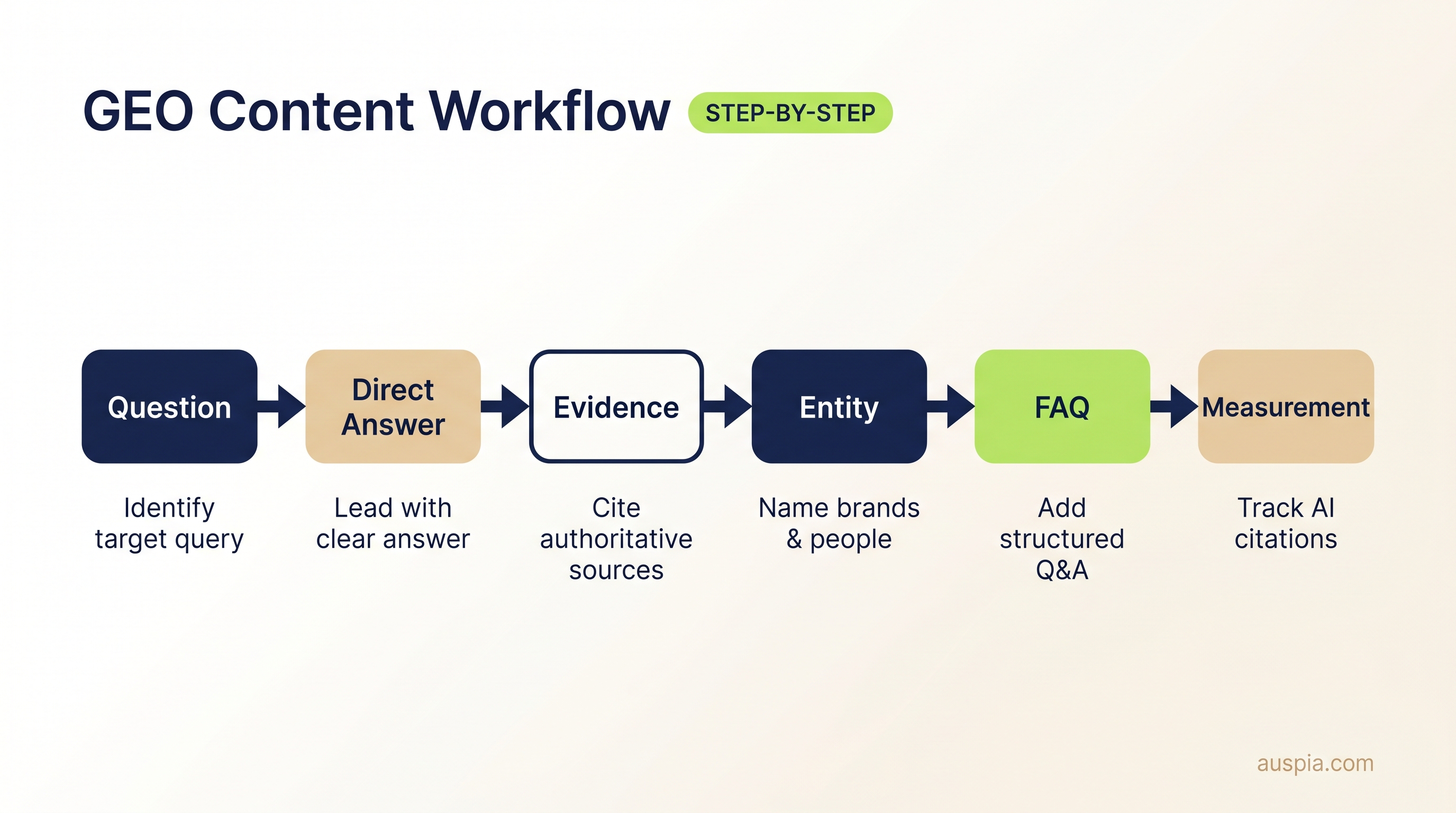
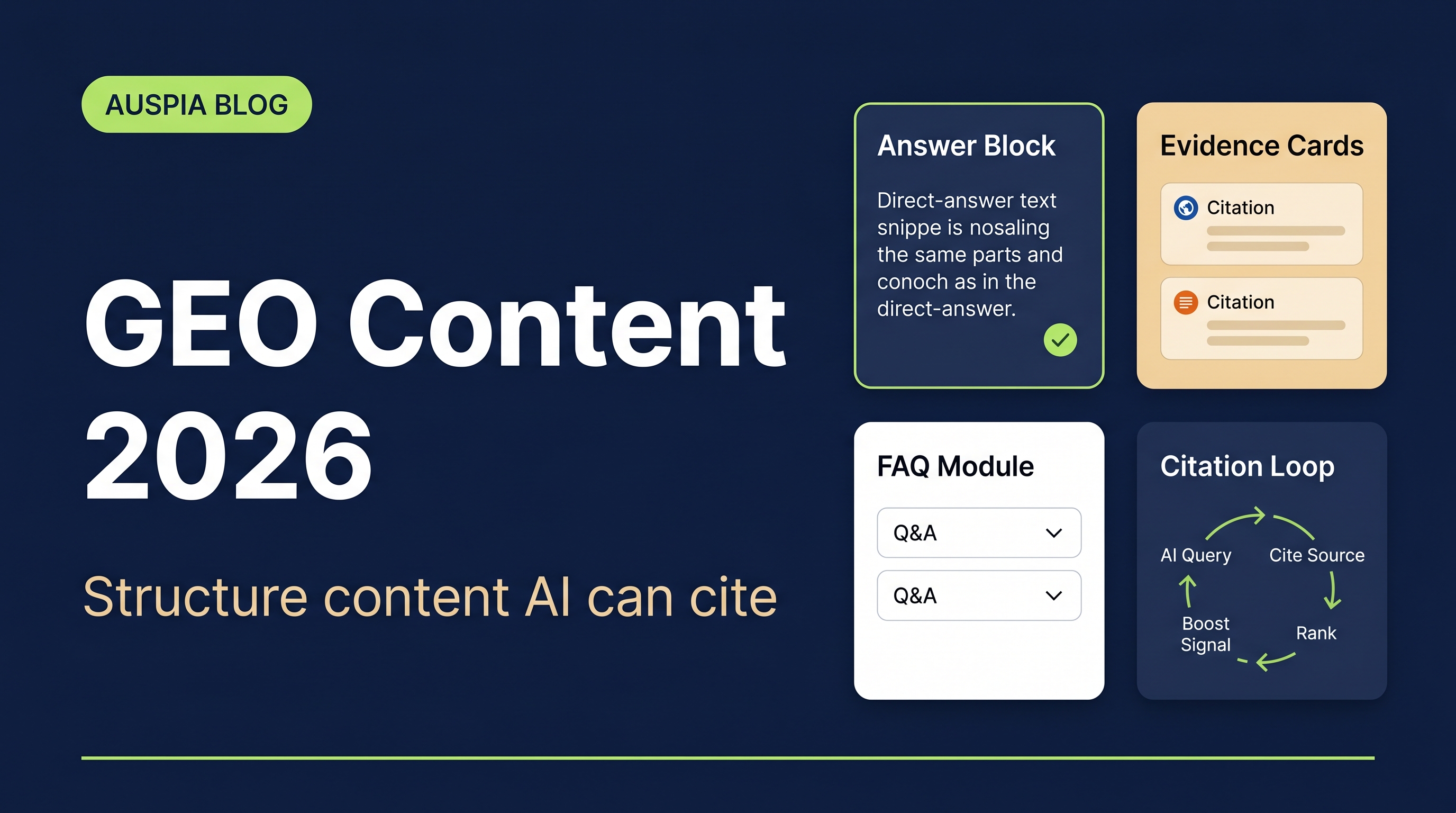
The 2026 GEO content workflow: start with the question, then make the answer, evidence, entity context, FAQ, and measurement loop easy to extract.
What changed in 2026
Search behavior keeps moving from keyword entry to question asking. People ask ChatGPT, Perplexity, Gemini, Google AI Overviews, and vertical AI tools for a short answer, a recommendation, a comparison, or a next step. These systems do not read a page the way a loyal blog reader does.
They look for usable information blocks.
That changes the writing job. A page still needs a clear title, useful prose, internal links, and basic technical SEO. But if the goal is AI visibility, the page also needs source-like qualities: clean definitions, stable facts, named entities, visible evidence, explicit constraints, and sections that answer real questions.
The common mistake is treating GEO as a formatting trick. Add a FAQ. Add schema. Mention ChatGPT a few times. That is not enough. The stronger approach is to make the page easier to parse, easier to trust, and easier to quote.
What is a high-quality GEO article?
A high-quality GEO article is structured content that an AI answer system can use as source material when responding to a user's question.
It usually has five traits:
- A clear question or task at the top.
- A direct answer before the long explanation.
- Separate sections for definitions, steps, mistakes, examples, and FAQs.
- Verifiable support such as product details, public sources, screenshots, benchmarks, or transparent assumptions.
- Consistent entity information, including the brand, product, category, use case, audience, and limits.
That last point matters more than many teams expect. AI systems need to know what a page is about and who the information belongs to. A page that says "our platform" twenty times but never clearly states the brand, category, audience, and use case is harder to reuse in an answer.
GEO writing is not the same as SEO writing
SEO and GEO overlap, but they do not optimize for exactly the same extraction behavior.
Content type | Main reader | Common goal | Weakness when used alone |
|---|---|---|---|
Traditional blog article | Human reader | Engagement, education, shares | May be too narrative for AI extraction |
SEO article | Search crawler and human searcher | Ranking for a query | Can become keyword-heavy and thin on evidence |
GEO article | Human reader and AI answer system | Being understood, cited, recommended, or summarized | Can feel robotic if the writer forgets the human reader |
The best version combines all three. It has the usefulness of a good article, the discoverability of SEO, and the clarity of a source page.
Auspia's view is that GEO should not replace SEO. It should raise the standard for pages that already deserve to rank, especially pages that answer buying questions, define categories, compare options, or explain how a product solves a specific problem.
The 2026 GEO article framework
Use this framework when writing a new page or refreshing an existing one.
1. Start with the question the page answers
A GEO article should make its target question obvious. The title does not always need to be a literal question, but the intent should be unmistakable.
Good title patterns:
- How to write GEO content in 2026
- What is agent readiness, and how should a website prepare?
- GEO vs SEO: what should growth teams change first?
- How do AI answer engines choose sources?
Weak title patterns:
- The future of content is here
- Unlocking visibility in the AI era
- A comprehensive guide to digital excellence
Those vague titles may sound polished, but they make the page harder to classify. In 2026, clarity beats cleverness.
2. Put the answer before the argument
The opening should not make the reader wait. Give the usable answer first, then explain the reasoning.
A practical opening formula:
Sentence | Job |
|---|---|
Sentence 1 | Define the problem or question. |
Sentence 2 | Give the answer or recommendation. |
Sentence 3 | State when the advice applies. |
For example:
"A GEO article is content written so AI answer systems can extract, verify, and cite useful sections. The strongest GEO pages combine direct answers, evidence, entity clarity, and FAQs. This approach is most useful for category pages, product explainers, comparison pages, and problem-solving guides."
That is not flashy. It is useful. AI systems tend to prefer useful.
3. Build sections as independent answer blocks
Do not bury five ideas inside one long paragraph. Split the page into clean blocks that can stand on their own.
A good section usually has:
- One heading that names the sub-question.
- One short direct answer.
- One explanation or example.
- One supporting detail, table, checklist, or source.
This helps readers scan. It also gives answer engines cleaner extraction units.
4. Replace adjectives with evidence
A page that says a product is "powerful, seamless, and industry-leading" gives an answer engine very little to work with. A page that shows the product's supported use cases, integrations, workflow, pricing assumptions, limitations, and comparison criteria is more useful.
Use evidence like:
- Public documentation.
- Named product features.
- Dated benchmarks or experiments.
- Real examples with context.
- Screenshots with annotations.
- Customer-facing claims that are already visible on your site.
- Clear assumptions when data is illustrative.
Do not invent numbers. Do not imply guaranteed AI citations. GEO is about increasing the chance that a page can be understood and reused, not forcing answer engines to cite it.
5. Add entity clarity on purpose
AI systems need stable facts. Every important page should make these facts easy to find:
Entity field | Example |
|---|---|
Brand | Auspia |
Category | SEO, GEO, AEO, and AI search tools |
Audience | Growth teams, marketers, founders, SEO operators |
Problem solved | Improving website visibility in search and AI answer systems |
Product relationship | Tools, audits, checkers, workflows, and educational guides |
Limits | Does not guarantee rankings or citations |
If the page is about a product, include the product name, what it does, who it is for, and what it should not be used for. If the page is about a category, define the category and name related terms. If the page is a comparison, state the criteria before the verdict.
6. End with a reusable summary and FAQ
The end of the article should not be a motivational speech. Use it to compress the page into answer-ready material.
A strong close includes:
- A short summary of the core recommendation.
- A checklist or decision rule.
- FAQ answers written in plain language.
- A logical next step, such as checking a page with the AI Search Visibility Checker.
FAQs work when they answer real questions. They fail when they repeat the same keyword in five slightly different ways.
Common GEO writing mistakes
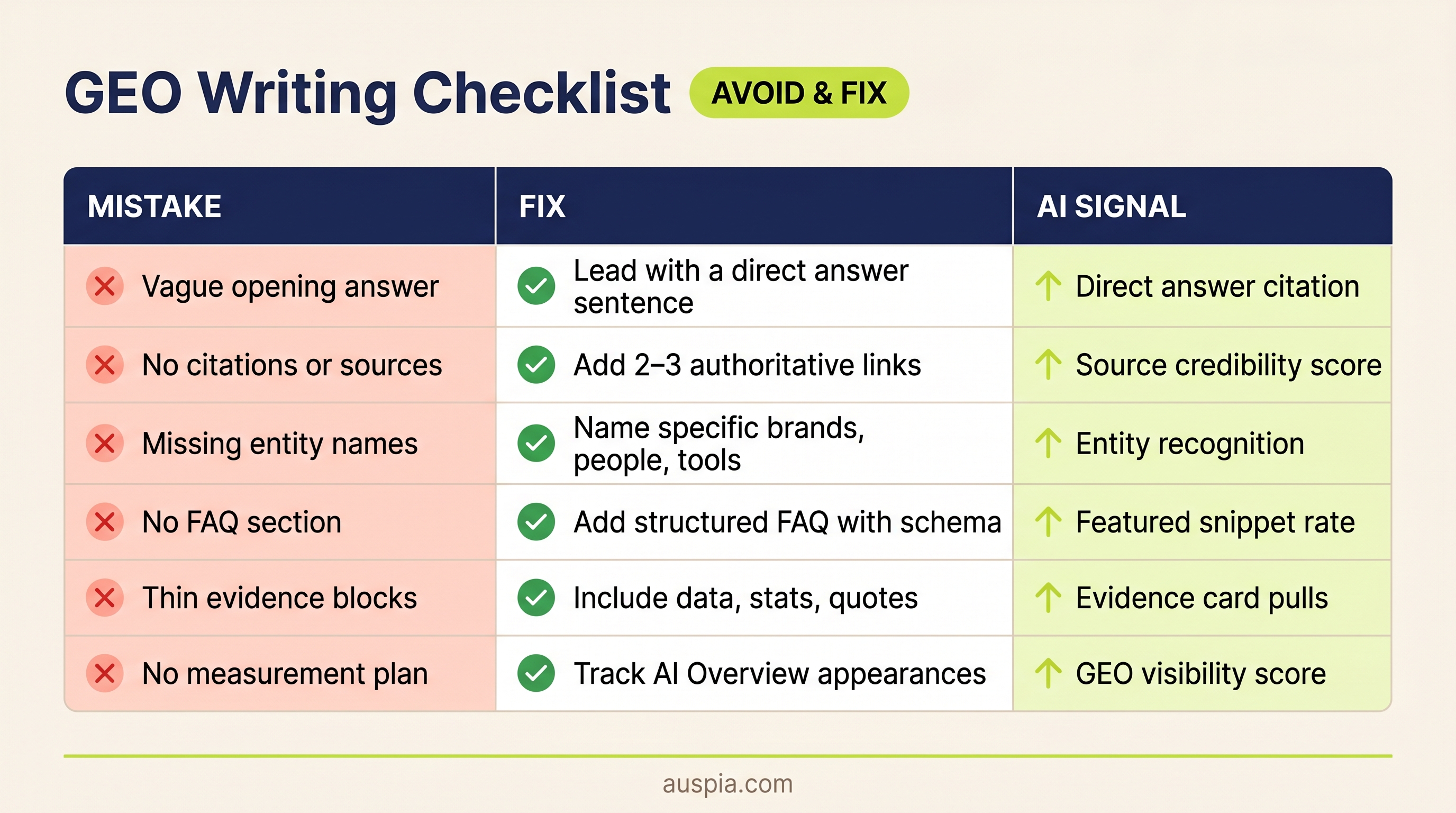
Use the mistake-fix-signal matrix when reviewing a draft before publication.
Mistake | Why it hurts AI visibility | Better approach |
|---|---|---|
Keyword stuffing | The page looks repetitive but not more useful. | Use the main term naturally and answer adjacent questions. |
Long subjective intros | The answer is buried below opinion or brand storytelling. | Put the direct answer in the first section. |
No evidence | The claim is hard to verify or quote. | Add public sources, examples, data, screenshots, or clear assumptions. |
Mixed topics in one section | The page is hard to split into answer blocks. | Give each sub-question its own section. |
No brand/entity facts | The AI system may not connect the claim to the right brand or category. | Add clear entity facts and consistent product/category language. |
Robotic formatting | Humans bounce, skim poorly, or distrust the content. | Keep structure, but write in a natural voice. |
One uncomfortable truth: some GEO advice online makes articles almost unreadable. That is a bad trade. If real buyers do not trust the page, an AI citation will not save it.
A practical writing template
Use this structure for a 1,200 to 2,000 word GEO article.
Title
Use a clear query-led title.
Example: "How to write GEO content in 2026: a practical framework for AI citations"
Opening answer
Write two or three short paragraphs that answer the main question directly.
Definition section
Define the main concept in one plain paragraph. If the concept has related terms, add a small table.
Why it matters
Explain the traffic, conversion, or visibility impact. Keep it concrete. Do not say "AI is changing everything" unless you can explain what changed for the reader.
Framework or steps
Break the method into 4 to 7 steps. Each step should include the action, the reason, and a small example.
Mistakes or constraints
Show what not to do. This section is often easier for AI systems and human readers to reuse because it maps directly to risk questions.
Checklist
Add a short checklist before publication:
- Does the first section answer the main question?
- Can a reader identify the brand, category, audience, and use case?
- Does each major section answer one sub-question?
- Are claims supported by evidence or clearly labeled assumptions?
- Does the page include FAQs that match real search or buyer questions?
- Can the page be measured with prompt checks, citation checks, or search performance data?
FAQ
Write 4 to 6 questions. Answer each in 2 to 5 sentences.
How to measure whether a GEO article works
GEO measurement is still less standardized than traditional SEO reporting, so do not pretend one metric tells the whole story. Use a small set of checks:
Metric | What to check | Useful tool or method |
|---|---|---|
AI answer visibility | Does the brand or page appear for target prompts? | Prompt checks across ChatGPT, Perplexity, Gemini, and Google AI Overviews |
Citation quality | Is the page cited, summarized, or mentioned accurately? | Manual citation review or AI visibility reports |
Search performance | Are impressions, clicks, and query coverage improving? | Google Search Console and Bing Webmaster Tools |
Engagement | Do readers scroll, click, save, or convert? | Analytics and conversion tracking |
Entity consistency | Do AI answers describe the brand correctly? | Brand prompt audits and entity fact checks |
This is where many teams should start small. Pick 20 buyer prompts, publish or refresh the relevant pages, then check the same prompts every two to four weeks. If the answers change, record what changed. If nothing changes, inspect whether your content has enough evidence, entity clarity, and third-party support.
Where Auspia fits
Auspia focuses on the operating side of SEO, GEO, AEO, and AI search. The point is not to publish more pages for the sake of publishing. The point is to build pages that can be found, understood, evaluated, and improved.
For teams starting now, the fastest path is usually:
- Audit the pages that already answer high-intent questions.
- Rewrite the opening sections so each page gives a direct answer.
- Add evidence, entity facts, FAQs, and comparison tables where useful.
- Test the page against real AI prompts.
- Refresh the page when AI answers misrepresent the brand or skip the source.
If you want a quick diagnostic, run a few priority URLs through Auspia's GEO Score Checker and compare the results with your target prompt set.
FAQ
What is GEO content?
GEO content is content designed to be understood and reused by generative answer systems. It still needs to be useful for human readers, but it also makes definitions, evidence, entity facts, and answers easy for AI systems to extract.
Is GEO content different from SEO content?
Yes, but the two should work together. SEO helps a page become discoverable in search. GEO helps the page become usable as a source for AI-generated answers, summaries, and recommendations.
Do I need to publish new GEO articles every day?
No. A smaller set of strong, well-structured pages usually beats a high-volume stream of shallow posts. Start with pages that answer high-intent buyer questions or define your product category.
Can AI write GEO articles?
AI can help with outlines, draft sections, FAQ ideas, and structure. A human still needs to add real examples, product truth, evidence, judgment, and editing. Purely generic AI text is rarely strong source material.
What should I update first on an existing article?
Rewrite the first section so it gives a direct answer. Then add cleaner headings, evidence, entity facts, and a real FAQ. If the page is important for sales, add a comparison table or decision checklist.
How long does it take for GEO improvements to show up?
There is no fixed timeline. AI answer systems update differently across platforms, and citations are influenced by retrieval, authority, freshness, and the broader web. Measure changes over weeks, not days, and track the same prompts consistently.
Final takeaway
The best GEO articles in 2026 read like useful guides and behave like clean source material. They answer the question early, separate ideas clearly, support claims with evidence, identify the right entities, and give answer systems reusable sections.
That is the standard worth aiming for: clear enough for a human to trust, structured enough for AI to cite, and honest enough to hold up when someone checks the source.
Author: Priya Nair, LLM Content Optimization Researcher at Auspia. Priya writes about LLM-ready content, answer synthesis, and practical content structures for AI search visibility.