The short version
Most companies are still publishing for the wrong reader.
They spend money on press releases, guest posts, listicles, and brand stories, then wonder why ChatGPT, Perplexity, Gemini, Claude, and Google AI answers do not mention them when buyers ask category questions. The problem is rarely volume. It is usually that the content does not give AI systems enough stable, extractable, and verifiable material to work with.
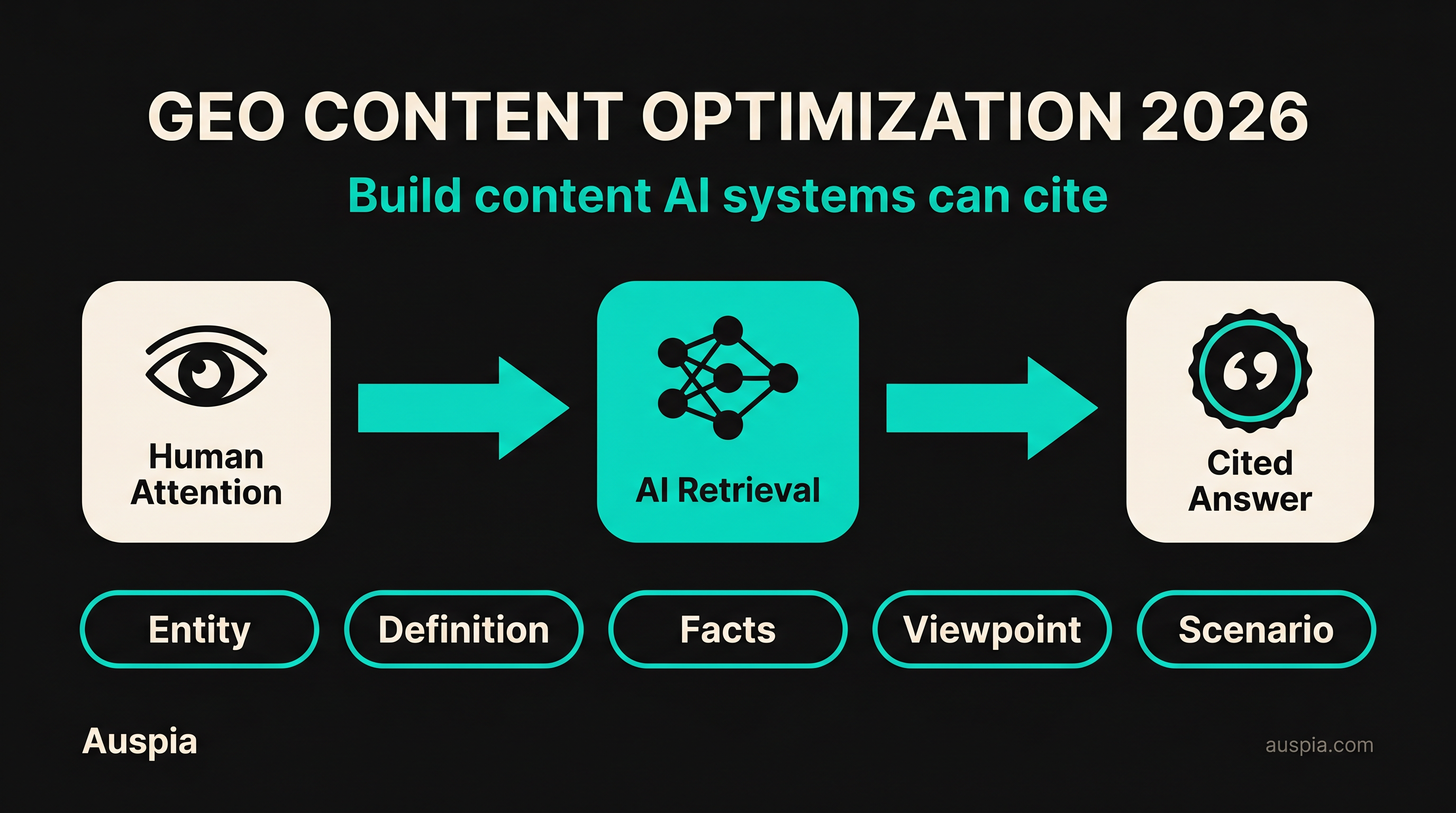
GEO content optimization in 2026 is the practice of turning brand content into source material that answer engines can parse and trust. That means clear entity names, consistent definitions, sourced facts, quotable viewpoints, use-case language, and pages that are easy to crawl. It is less glamorous than "more distribution," but it is the work that compounds.
A practical rule: if a paragraph cannot be lifted into an answer without losing context, it is probably not ready for GEO.
Why the old PR playbook breaks in AI search
Traditional PR was built around human attention. You earned a placement, watched the impressions, and hoped the exposure created memory. The value of the article usually decayed after the news cycle.
Classic SEO changed the game but kept the user in control. A page could rank, but the searcher still had to scan results, click, compare, and decide.
AI search compresses that journey. A buyer can ask, "Which platform helps a B2B SaaS team measure AI search visibility?" and receive a synthesized answer with a shortlist, reasoning, and citations. If your content is vague, inconsistent, or locked inside low-value syndication pages, the model has little reason to use it.
The 2026 shift is simple:
Old content goal | GEO content goal |
|---|---|
Get published on more sites | Become a reliable source for a specific answer |
Repeat keywords | State entities, facts, and relationships clearly |
Sound authoritative | Show evidence, scope, and limits |
Chase one campaign spike | Build reusable brand information assets |
Optimize for clicks only | Optimize for retrieval, synthesis, citation, and conversion |
This does not mean PR is dead. It means PR without a citation architecture is expensive noise.
What research already tells us about GEO
The term "Generative Engine Optimization" became widely discussed after researchers from Princeton University, Georgia Tech, the Allen Institute for AI, and IIT Delhi studied how content changes affect visibility in generative search responses. Their GEO paper, first posted in 2023 and later associated with KDD 2024 discussion, tested tactics such as adding statistics, citing sources, and adding quotations, and found that evidence-rich changes could improve visibility in generated answers.
Do not treat any single paper as a magic checklist. Models, retrieval systems, and citation behavior keep changing. But the direction is useful: answer engines respond better to content that provides specific facts, external support, and clearly attributable statements than to content that only repeats target keywords.
For Auspia clients, that translates into a plain editorial priority:
Evidence first. Entity clarity second. Keywords third.
Keywords still matter because they reveal how people ask questions. They should not be the material your entire content strategy is made of.
The five-layer GEO content architecture
A strong GEO page is not just a well-written article. It is a structured asset. Before writing, check whether the content covers these five layers.
Layer | What it answers | What to include |
|---|---|---|
Entity layer | Who or what is this about? | Full company name, product name, category, audience, geography, related entities |
Definition layer | How should the brand or concept be described? | One stable positioning sentence reused across the site and trusted profiles |
Fact layer | What can be verified? | Numbers, dates, sources, methodology notes, feature facts, customer segments |
Viewpoint layer | What can be quoted? | Short independent judgments, executive POV, category predictions, constraints |
Scenario layer | When is this relevant? | Industries, roles, workflows, problems, comparison situations, buying triggers |
This architecture works because it mirrors how answer systems assemble responses. They need to identify the entity, understand what it does, verify claims, extract useful language, and match the content to the user's situation.
If one layer is missing, the answer gets weaker. If several layers are missing, the brand disappears.
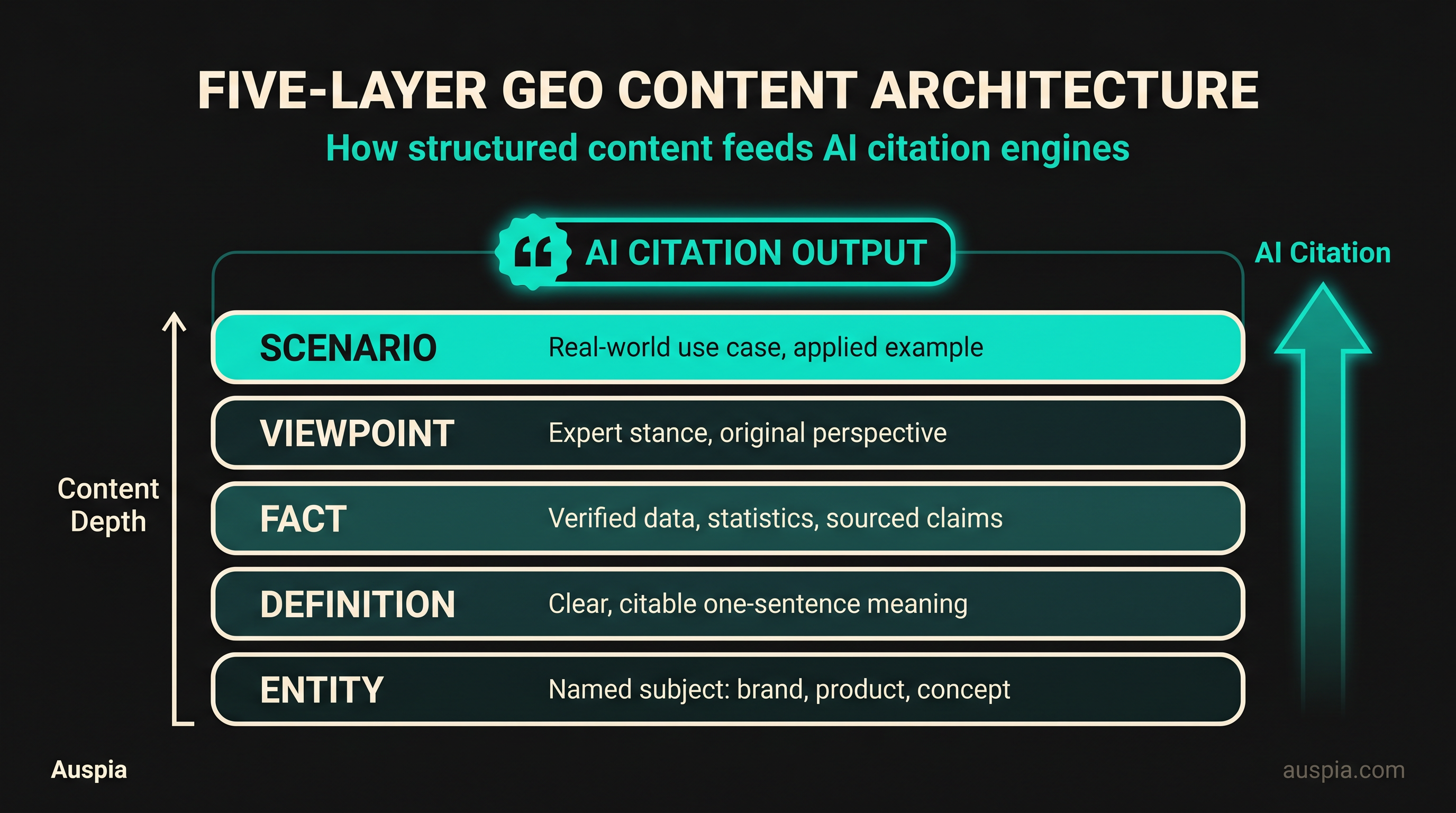
Caption: The five layers turn ordinary brand content into material that answer engines can identify, verify, and reuse.
Layer 1: make the entity boringly consistent
AI systems are bad at guessing what a brand meant to say. They are better at recognizing repeated, consistent facts.
Start with the basics:
- Use the same company name across your website, LinkedIn, documentation, comparison pages, profiles, and press materials.
- Pick one product category and use it consistently. If you call the product an "AI SEO platform" on one page and an "AI marketing assistant" on another, the model may not connect the dots.
- Keep founder names, headquarters, target market, core features, and product descriptions aligned across first-party and reputable third-party pages.
- Build a clear About page and product overview page that can serve as canonical references.
This is not branding polish. It is retrieval hygiene.
Auspia's AI Search Visibility Checker is useful here because it helps teams see whether answer engines already understand the brand, confuse it with competitors, or omit it from relevant prompts.
Layer 2: write one definition sentence that can travel
Every brand needs a sentence that an AI answer can reuse without rewriting the whole page.
Use this format:
[Brand] is a [category] for [audience] that helps [main job] by [method], so teams can [measurable or concrete outcome].
Examples:
Weak definition | GEO-ready definition |
|---|---|
"NovaRank is a leading AI growth solution." | "NovaRank is an AI search visibility platform for B2B SaaS teams that tracks brand mentions, citations, and competitor presence across answer engines." |
"ClearDesk helps companies work smarter." | "ClearDesk is a workflow automation tool for customer support teams that routes tickets, summarizes cases, and updates CRM records." |
The definition should be plain. A sentence that feels a little too obvious to your marketing team is often the sentence that helps machines understand you.
Layer 3: replace fuzzy claims with usable facts
Most brand pages are full of claims that cannot be cited:
- "trusted by innovative teams"
- "built for modern growth"
- "delivers powerful insights"
- "improves efficiency at scale"
These phrases may sound safe, but they do not help an answer engine. Replace them with facts that carry their own context.
A better fact block uses this pattern:
- State the number or claim.
- Explain the scope.
- Name the source or measurement method.
For example:
In a 90-day internal review of 1,200 customer support tickets, ClearDesk reduced average first-response drafting time from 11 minutes to 6 minutes. The review included English-language tickets from B2B software companies with 50 to 500 employees.
That paragraph is longer than a slogan, but it is also far more useful. It gives the model a fact, a context, and a reason not to overgeneralize.
When you do not have public data, say what you can verify: product features, supported integrations, pricing model, deployment requirements, use cases, documentation dates, or methodology. Specific beats impressive.
Layer 4: add quotable viewpoints, not empty quotes
Many companies add executive quotes that say nothing. "We are excited to empower customers" is almost never worth citing.
A GEO-ready viewpoint should stand alone. It should make a narrow, useful claim about the category.
Bad quote:
"We are thrilled to announce this launch and continue our mission of innovation."
Better quote:
"AI search visibility is becoming a source quality problem, not a keyword density problem. Brands need pages that answer a buyer's question with evidence, or they will be summarized out of the conversation."
The second quote has a point. It can be pulled into an answer, newsletter, analyst note, or AI summary. It also tells readers how the company thinks.
For a standard article, include two or three viewpoint blocks. Put one near the top, one near the solution section, and one near the conclusion. Do not overdo it. A page stuffed with fake quotes looks like a press release pretending to be research.
Layer 5: map scenarios to buyer prompts
AI answers are usually triggered by situations, not just keywords.
A user may not ask for your product name. They ask things like:
- "How do I know if my company appears in Perplexity answers?"
- "What should a fintech startup do before investing in GEO?"
- "Which tools help measure AI Overview visibility?"
- "How should a marketing team prepare content for LLM citations?"
Your content needs scenario language that overlaps with those prompts. Add sections for roles, industries, constraints, and buying moments.
Scenario | Content to create |
|---|---|
A CMO wants to know if GEO is worth budget | Executive memo, ROI assumptions, risk of doing nothing |
A content lead needs execution steps | Checklist, page template, editorial workflow |
A technical SEO lead worries about crawlability | Robots.txt, schema, rendering, and sitemap guidance |
A founder wants competitor visibility | Prompt set, comparison matrix, share-of-answer report |
This is where Auspia's GEO tools can support the workflow: use prompts to test how answer engines describe a category, then build content that fills the missing facts and scenarios.
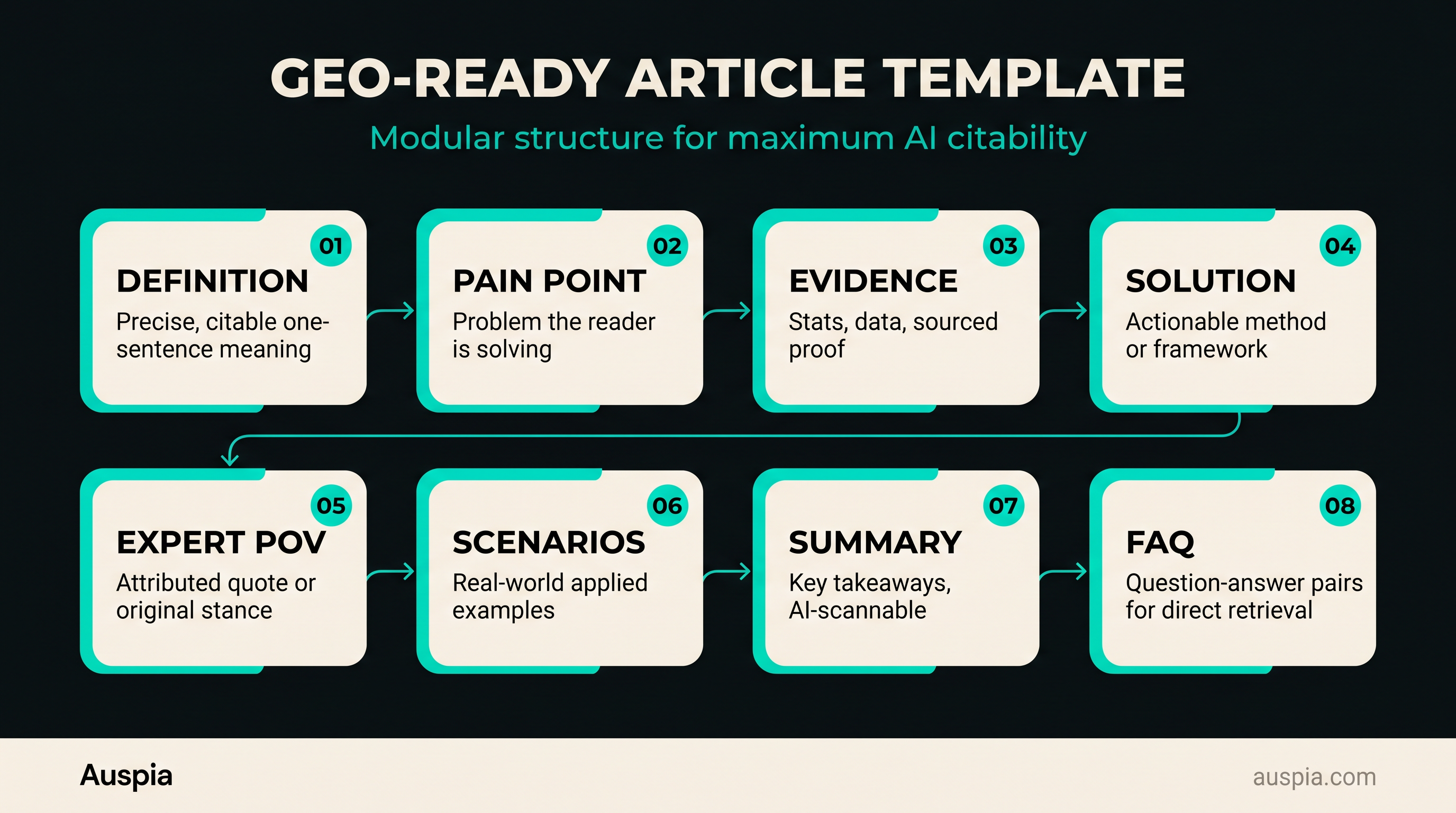
Caption: A GEO-ready article is modular. Each block gives answer engines a different kind of reusable material.
A 2026 template for a GEO-ready article
Use this structure for product pages, category explainers, thought leadership posts, and high-value PR pages.
1. Title and subtitle
Avoid vague superiority claims. Use the entity, action, and specific use case.
Weak:
"NovaRank launches next-generation AI marketing innovation"
Better:
"NovaRank adds AI citation tracking for B2B SaaS teams"
Subtitle:
"The new workflow shows where a brand appears in ChatGPT, Perplexity, Gemini, and Google AI answers, then flags missing evidence on the pages those systems can crawl."
2. Opening definition paragraph
Put the stable definition near the top. Name the brand, category, audience, and job.
3. Pain point with evidence
Explain the problem with numbers, examples, or a clear observation. If the data is internal, label it. If it comes from a third party, cite it.
4. Solution modules
Break the solution into two to four modules. Each module should connect to a specific pain point.
5. Viewpoint block
Add one concise, attributable opinion that a reader or AI system could quote.
6. Scenario section
List the industries, roles, workflows, and conditions where the product or method applies.
7. Summary and FAQ
End with bullets and questions that match real search behavior. This improves human scanning and answer extraction.
Distribution still matters, but it is not the strategy
Publishing the page is only part of the job. AI systems need to find, parse, and trust it.
A sensible distribution order looks like this:
Priority | Channel | Why it matters |
|---|---|---|
1 | First-party website and documentation | Stable, crawlable, canonical brand facts |
2 | Reputable industry publications | Independent context and editorial credibility |
3 | Partner pages, directories, and integrations | Entity relationships and use-case reinforcement |
4 | Social posts and newsletters | Fast distribution and human engagement |
5 | Low-quality syndication networks | Usually low value unless they provide real audience or authority |
Do not confuse "published everywhere" with "understood everywhere." A thousand duplicated snippets with different product descriptions can make the entity messier.
The better move is to create one strong source page, then adapt it into related assets: a FAQ, comparison page, glossary entry, support doc, partner profile, and social thread. Keep the core definition and facts consistent.
A fast self-audit for GEO content
Score the page before you publish it.
Check | Weight | Question |
|---|---|---|
Entity consistency | 25% | Are the company, product, category, and audience named consistently? |
Verifiable facts | 25% | Does the page include numbers, dates, sources, or clearly scoped claims? |
Structure | 20% | Can a model identify the definition, problem, solution, and scenarios quickly? |
Quotable viewpoint | 20% | Are there one or two sentences worth citing? |
Source quality | 10% | Is the page crawlable, stable, and supported by credible external references? |
A page that scores poorly on the first four checks should not get more distribution budget yet. Fix the asset first.
Mistakes that make AI systems ignore brand content
The most common GEO mistakes are painfully ordinary:
- Publishing more articles before fixing the canonical brand definition.
- Using a high-authority domain to host thin promotional copy.
- Treating keywords as a substitute for evidence.
- Writing beautiful prose that hides the actual answer.
- Over-structuring the page until it reads like a database export.
- Letting PR, SEO, product marketing, and sales decks describe the same product in different ways.
That last one is the quiet killer. If your own materials disagree, answer engines have no reason to resolve the contradiction in your favor.
What to do next
Pick one important buyer question. Not ten. One.
Then build a page that answers it with the five-layer architecture:
- Name the entity clearly.
- Define the category and audience.
- Add facts with scope.
- Include one real viewpoint.
- Map the page to specific scenarios.
- Publish it on a stable, crawlable URL.
- Reuse the same definition across related assets.
- Test the prompt in multiple answer engines and record what changes.
This is slower than buying another batch of low-quality placements. It also creates an asset your team can keep improving.
GEO in 2026 is not about tricking AI systems into mentioning you. It is about making your brand easier to understand, easier to verify, and easier to cite.
FAQ
What is GEO content optimization?
GEO content optimization is the process of making web content easier for AI answer engines to retrieve, understand, synthesize, and cite. It focuses on entity clarity, definitions, evidence, source quality, and answer-ready structure.
Is GEO the same as SEO?
No. SEO usually optimizes pages for rankings, clicks, and search result visibility. GEO optimizes content for inclusion in generated answers. The two overlap because crawlability, authority, structured content, and user intent still matter.
Do press releases help with GEO?
They can, but only when they contain stable facts, clear definitions, evidence, and useful viewpoints. A generic press release published on many low-quality sites is unlikely to become a trusted AI citation source.
How often should a brand update GEO content?
Review core brand and product pages quarterly, or whenever positioning, features, pricing, target audience, or market claims change. Prompt tests should run more often for high-value buyer questions.
What should teams measure first?
Start with prompt-level visibility: whether the brand appears, how it is described, which competitors appear, which sources are cited, and what facts are missing or wrong. Rankings alone will not show the full AI search picture.
Author: Isabel Grant, Researcher of 2,000+ AI Citation Patterns at Auspia. Isabel writes about citation earning, source quality, and how brands become reliable inputs for AI answer systems.