A local review program should survive the bad review
The test of a review program is not whether it produces a stream of five-star screenshots. It is whether the business can ask every eligible customer for honest feedback, respond in public without making the situation worse, and use recurring comments to improve the service.
That standard works for customers, Google Maps, and the teams responsible for local growth. It also keeps a business out of the two habits that create the most risk: paying for reviews and steering unhappy customers away from the public review request.
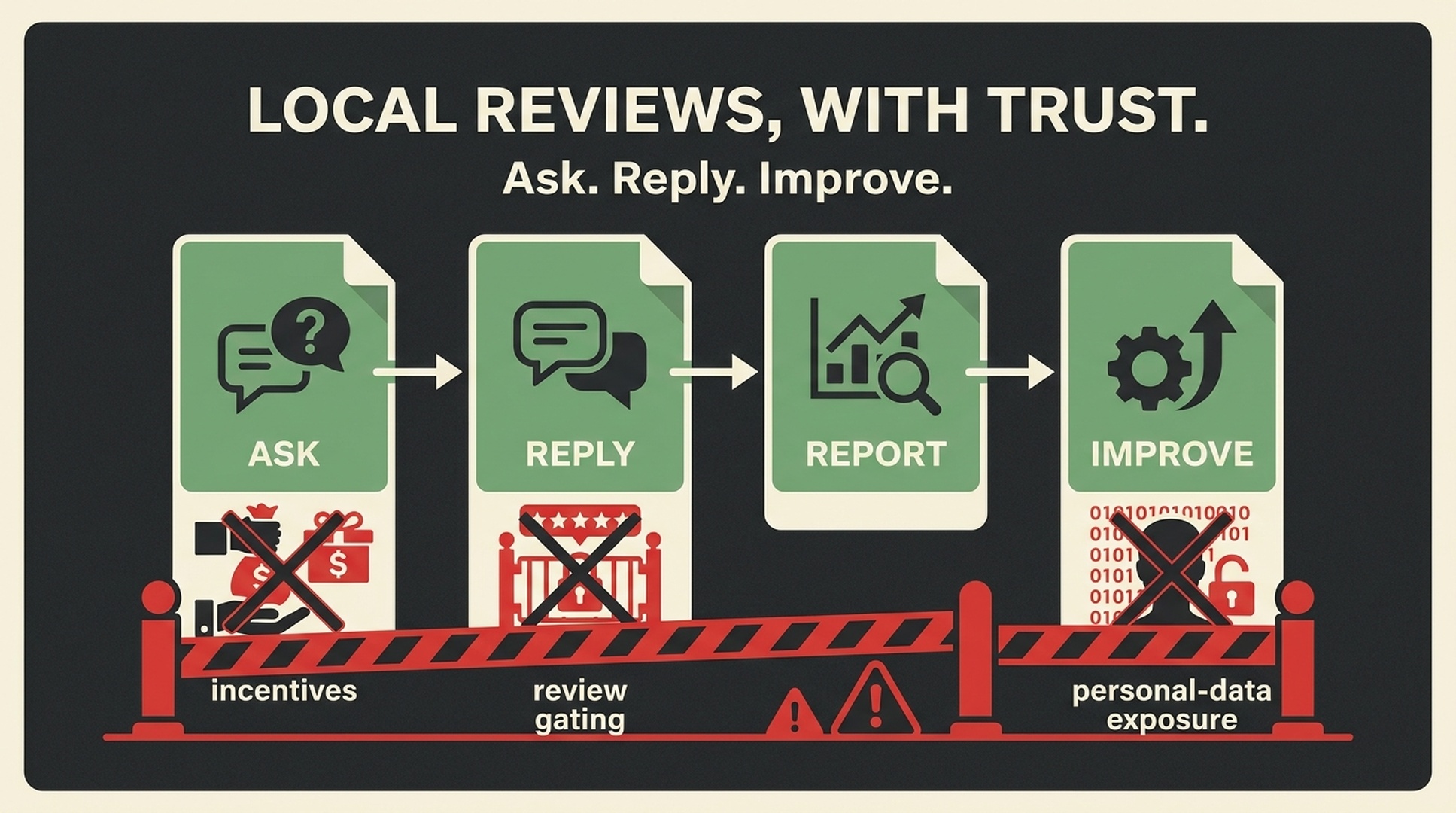
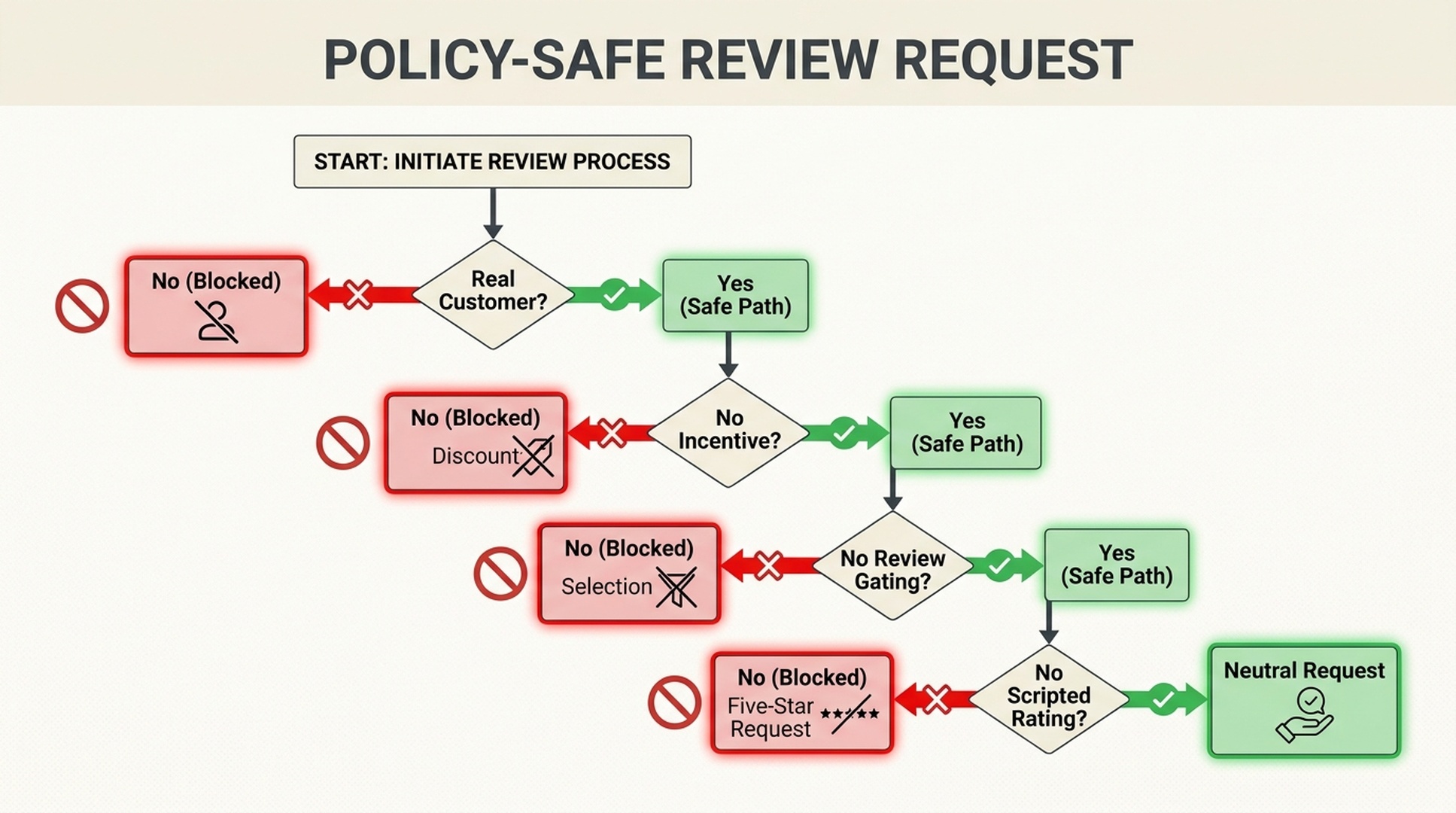
Google's policy is direct. A review or rating should reflect an actual, genuine, unbiased experience. Google permits businesses to ask customers for reviews using a link or QR code. It prohibits incentives in exchange for reviews, edits, or removal of negative reviews. It also prohibits selectively soliciting positive reviews and pressuring customers to use particular language.
For a local business, the goal is a review system that produces reliable evidence about the customer experience:
A weak objective | A stronger operating objective |
|---|---|
Get more five-star reviews this month | Ask eligible customers for honest feedback after a real experience |
Eliminate all negative reviews | Resolve real service failures and report only content that violates policy |
Make reviewers mention target keywords | Let customers describe their experience in their own words |
Reply quickly with a template | Reply promptly, privately verify the facts, and write a short useful public response |
Track average rating only | Track recency, themes, response coverage, operational defects, and qualified customer actions |
What Google permits, prohibits, and leaves to your judgment
The safest review process begins with a policy line that every owner, manager, front-desk worker, technician, and agency partner can understand.
Practice | Policy position | Operating guidance |
|---|---|---|
Send a review link or QR code after a real visit, purchase, or completed service | Permitted | Use the same neutral request for eligible customers, regardless of expected rating |
Ask for an honest review | Permitted | Say that feedback helps future customers and the business improve |
Offer a discount, gift card, refund, contest entry, or free item for a review | Prohibited | Keep customer recovery and review requests separate |
Ask only happy customers for a public review while routing unhappy customers to a private form | Prohibited review gating | Ask the same eligible group; use a separate feedback channel for service recovery, not as a filter |
Require the review to mention a staff member, city, service, or star rating | Prohibited pressure on review content | Do not script the customer's words |
Respond to a review professionally | Recommended | Keep the reply brief, useful, and within privacy boundaries |
Flag a review that appears to violate content policy | Permitted | Save the evidence, use the reporting route, and do not promise removal |
The last row is important. A review is not removable just because the business disagrees with it or considers it unfair. Google advises businesses to flag reviews that violate its policies. A calm operational response is usually better than treating every negative review as a removal case.
Build one neutral request that the whole team can use
Review programs break when each employee invents a different ask, when the request comes before the service is complete, or when managers reward staff for a target number of five-star reviews. Use a short, consistent message and a defined trigger.
Choose the right moment
The request should follow a genuine customer experience, not interrupt it. For a restaurant, that might be after the visit. For a contractor, it may be after the work is completed and the customer has received the final walkthrough. For a dental or healthcare-adjacent practice, make sure the process respects applicable privacy and professional rules. For a retail store, consider the point at which the customer has had a reasonable chance to use the product or resolve an issue.
Do not ask a customer to write a review while they are under pressure at the counter, in an examination room, or beside a technician. Google specifically says merchants should not require or pressure users to leave ratings or write reviews on the premises.
Use language that does not manipulate the outcome
Here is a safe starting template:
Thanks for choosing [Business Name]. If you have a moment, would you share an honest review of your experience? Your feedback helps future customers and helps our team improve: [review link]
The template is intentionally plain. It does not ask for five stars, suggest phrases to include, mention an incentive, or imply that only satisfied customers should respond.
For a follow-up, send one respectful reminder only if it makes sense for the service and relationship. Repeated requests can feel like pressure. Keep internal service-recovery outreach separate from the public review request so it cannot become a hidden screening mechanism.
Turn review replies into public customer care
A public reply has two audiences: the reviewer and the next person reading the profile. The next reader is often deciding whether the business seems attentive, honest, and safe to contact.
Google's own guidance for replies is useful: be professional and polite, keep it short and simple, make the response count, stay conversational rather than promotional, and share a helpful update or answer when appropriate.
A practical reply framework
Use this sequence, then adapt it to the actual review:
- Acknowledge the specific feedback.
- Thank the customer without turning the reply into an ad.
- Add one accurate, non-sensitive detail if it helps a future reader.
- When something went wrong, state the next step without debating the customer in public.
Review situation | Good public response moves | What to avoid |
|---|---|---|
Detailed positive review | Thank the customer, reference the service or visit generally, and reinforce a real standard | Repeating the same sales pitch or offering a promotion in the reply |
Brief positive review | Say thanks and keep it short | Demanding more detail or asking the reviewer to change the rating |
Negative review with a clear service issue | Acknowledge concern, apologize for the experience where appropriate, and offer an offline contact path | Sharing account details, arguing over facts, blaming staff, or asking for removal |
Review that seems mistaken | State the business's intent calmly and invite a private conversation | Calling the reviewer a liar or disclosing information to prove a point |
Suspected fake or policy-violating review | Flag through Google, retain internal evidence, and publish only a careful reply if needed | Asking employees, friends, or customers to retaliate with reviews |
For a service business, a reply should never confirm a customer's address, appointment time, diagnosis, financial details, or other personal information. For regulated categories, have a trained owner or compliance reviewer approve templates and sensitive replies.
Negative reviews need a triage process, not a panic button
Negative reviews are uncomfortable, but they often identify problems that a local business can fix: missed arrival windows, unclear estimates, billing surprises, poor handoffs, accessibility failures, menu availability, or slow follow-up. A business that responds professionally can still build trust even when it cannot change the review.
Set a simple triage rule:
Review type | First internal action | Public action | Escalation |
|---|---|---|---|
Credible complaint about service | Confirm the account or job facts and owner | Acknowledge, apologize where appropriate, and offer an offline route | Operations lead if the issue is recurring or serious |
Privacy, safety, discrimination, or regulated-service concern | Preserve the review and relevant records; notify the appropriate internal owner | Use a short, careful response or wait for approved language | Compliance, legal, clinical, or senior operations review |
Apparent policy violation | Capture the URL, screenshots, and account context | Flag it; do not promise a removal | Profile owner tracks status and any follow-up |
Extortion or demand for payment to remove a review | Preserve evidence and follow Google's applicable reporting process | Do not negotiate through the public reply | Owner, legal counsel, or fraud process as appropriate |
Unclear or anonymous complaint | Search internal records without assuming identity | Invite a private conversation without disclosing information | Operations review if no match is found |
The public response is not the investigation. Treat it as an acknowledgement and a route to a proper resolution. Keep the investigation, facts, and customer details out of the review thread.
Use review themes to improve pages and operations
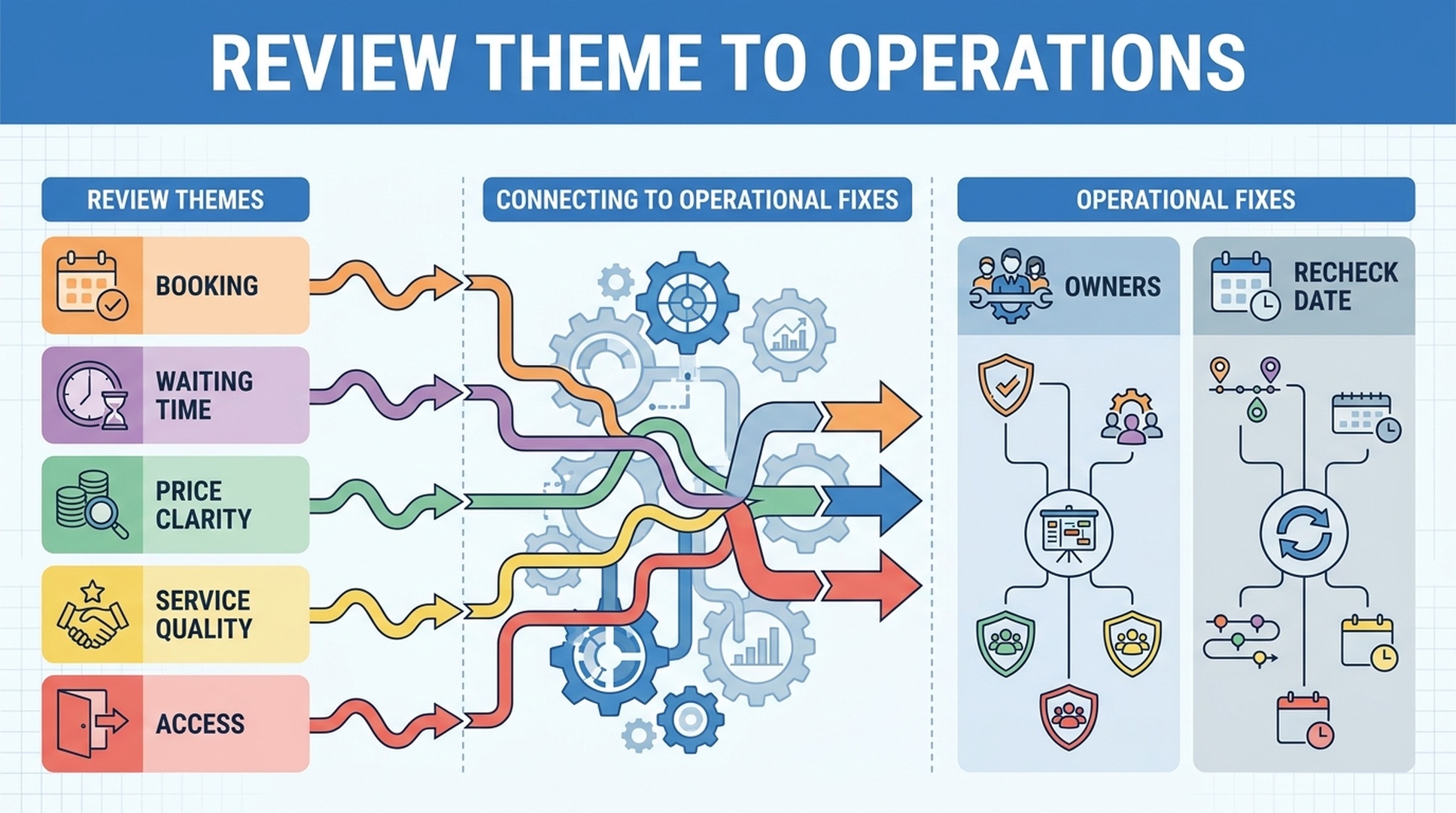
Reviews can tell a local business what customers value in language the business might not use internally. That makes them valuable input for operations, service pages, FAQs, training, and AI-search accuracy checks.
The right way to use this material is to analyze themes, not copy customer wording onto a page as if it were marketing copy. Review themes are evidence of questions and friction. They are not permission to overstate results.
Review theme | What it may reveal | Action to consider |
|---|---|---|
Customers mention fast arrival or easy scheduling | Response-time or booking clarity matters to buyers | Publish accurate availability expectations and improve booking flow |
Customers praise a particular service or property type | The business has a credible specialization | Add a factual service section or case example if it can be substantiated |
Customers repeatedly ask about price | Estimates, fees, or scope are unclear | Improve pricing explanations, quote FAQs, and team scripts |
Customers mention a neighborhood or service area | Geographic fit is part of the decision | Confirm the service boundary and add useful local context where real |
Customers complain about communication | Handoffs or updates are failing | Fix the operating process before producing more reputation content |
Customers compare the business with alternatives | Decision criteria are missing from the website | Add a transparent selection guide, limitations, or process explanation |
This is where local SEO and GEO meet real service quality. An AI answer may summarize availability, service area, pricing expectations, or reputation based on public information. If the business's website says one thing and review themes repeatedly say another, the public record is not coherent. Fix the service first, then update the explanation.
Measure trust without rewarding manipulation
An average rating is useful but incomplete. It can also push teams toward unhealthy behavior when it becomes the only target. Use a scorecard that shows whether review activity is genuine, current, and connected to customer outcomes.
Metric | What it helps you understand | Watch-out |
|---|---|---|
Review volume from eligible customers | Whether the request process is reaching real customers consistently | Do not set employee incentives around star ratings or exact review counts |
Review recency | Whether customers see recent evidence of the current experience | A short burst after a campaign does not replace steady service quality |
Rating distribution | Whether sentiment has changed over time | Do not treat every rating below five as a failure or a removal case |
Response coverage and time | Whether the business acknowledges customers promptly | Fast generic replies can be less helpful than thoughtful ones |
Theme frequency | Which strengths and defects customers repeat | Read samples; automated sentiment labels can miss context |
Resolution rate for valid complaints | Whether the business fixes underlying problems | Do not require a reviewer to revise or remove a review after recovery |
Qualified local actions | Whether review trust supports calls, bookings, directions, or orders | Separate better lead quality from raw visibility volume |
For an agency, report review work as a customer-trust operating system, not as a promise to manufacture a rating. Include the policy boundary in the client brief. If a client asks for incentives, review gating, competitor reviews, or employee-posted reviews, the correct answer is no.
How reviews fit into Maps and AI visibility
Google says that more reviews and positive ratings can help a business's local ranking, but it does not publish a review-weight formula. Review work should therefore improve the business's public evidence and customer confidence first, while local visibility remains one possible outcome.
For AI search, keep the claim narrower. No review strategy guarantees a recommendation or citation. Detailed, genuine reviews may make it easier for customers and systems to see themes around services, locations, responsiveness, and trust. The exact effect will vary by platform, query, business category, and the sources an answer system uses.
Use review themes as one input when testing local AI prompts:
- Does an answer describe the right service area?
- Does it name services the business actually provides?
- Does it repeat outdated or inaccurate reputation claims?
- Does it send customers toward the correct booking or contact path?
If the answer is wrong, repair the public facts across the profile, website, directories, and relevant third-party pages. Do not try to manipulate review text to force a keyword or a recommendation.
The 30-day review reset
This plan repairs a weak or inconsistent process without creating a sudden, suspicious campaign.
Timeframe | Work | Owner | Output |
|---|---|---|---|
Days 1-3 | Audit the current request message, review links, staff scripts, review themes, response backlog, and policy risks | Owner plus customer-experience lead | Baseline review inventory and risk list |
Days 4-7 | Write one neutral request, choose the post-experience trigger, train staff, and define sensitive-review escalation | Customer-experience lead | Approved request workflow and reply guardrails |
Days 8-14 | Start sending the neutral request to eligible customers; clear the review response backlog by priority | Frontline team with manager review | Consistent outreach and response log |
Days 15-21 | Classify recurring themes and assign one operational owner to each material defect | Operations lead | Theme report with corrective actions |
Days 22-30 | Check whether profile, service pages, FAQs, and booking paths match what customers repeatedly ask or praise | Marketing and operations | Updated fact list and next-month test plan |
The reset should feel boring. That is a good sign. A review process should be part of normal customer care, not a short-lived campaign that appears only when rankings fall.
Use this framework to separate operational facts, customer trust, relevant evidence, and answer-quality checks.
Use the timeline as an operating sequence, not as a ranking guarantee.
FAQ
Can a business offer a discount for a Google review?
No. Google prohibits incentives such as payment, discounts, free goods, or services in exchange for posting a review, changing a review, or removing a negative review.
Is it okay to ask only satisfied customers for a public review?
No. Google prohibits selectively soliciting positive reviews. Use the same neutral request for eligible customers and improve the private service-recovery process without using it to filter who receives a public review request.
Can I ask a customer to mention a service or employee in a review?
Do not require or pressure a customer to include specific content. Google says merchants should not request that specific content be included. Customers can choose what they want to say about a genuine experience.
Should every negative review receive a reply?
Most deserve a timely review and a thoughtful response, but the right public action depends on the facts and risk. Privacy, safety, legal, clinical, or discrimination issues may need internal escalation before a reply. A response should never disclose customer information.
Can an unfair Google review be removed?
You can flag a review that violates Google's content policies, but disagreement or dissatisfaction alone does not establish a policy violation. Preserve evidence, use the reporting route, and avoid promising the customer or internal team that Google will remove it.
Do detailed reviews improve AI-search visibility?
They may make business and customer-experience facts more visible on the public web, but no review format guarantees an AI mention or recommendation. Keep the focus on genuine feedback, factual consistency, and good customer service.
Continue the local search series
Use these related guides to move from diagnosis to an operating plan:
- Local search ranking factors in 2026
- Google Business Profile optimization in 2026
- How to measure local search and AI visibility
Sources
- Google Business Profile Help, Tips to get more reviews. Source for requesting reviews with a link or QR code, valuing balanced reviews, and Google's reply guidance.
- Google Maps User Generated Content Policy, Prohibited and restricted content. Source for genuine experiences, fake engagement, incentives, review gating, pressure on review content, and rating manipulation.
- Google Business Profile Help, Report inappropriate reviews on your Business Profile. Source for flagging reviews that violate content policies rather than seeking removal because a business disagrees.
- Google Business Profile Help, Tips to improve your local ranking on Google. Source for Google's statement that more reviews and positive ratings can help local ranking.
Author: Miles Donovan, Local AI Search Analyst Across 500+ Service Queries at Auspia. Miles writes about local visibility, service-area pages, local reputation, and practical ways to make a business easier for search and AI systems to understand.