The short answer
Some people still say GEO is a large-company game. Big brands have more backlinks, more PR, more budget, more agencies, and more data.
I do not buy it.
In 2026, Generative Engine Optimization is one of the few traffic opportunities where a small business can still compete with depth instead of spend. AI answer systems do not show your company because you bought a search ad. They mention you when your public content helps answer a specific question with enough clarity, proof, and context.
That is the opening for smaller companies.
A large brand can own the broad category query. A small business can own the messy buyer question: "best fractional CFO for a seed-stage SaaS company," "how to choose a heat pump installer in a cold climate," "which compliance automation tool works for a 40-person fintech team," or "what should a boutique hotel include in a 2026 direct booking strategy?"
Those questions may not have huge search volume. That is exactly why they matter. They are specific, commercial, and often ignored by big teams.
Why GEO is a real small business opportunity in 2026
Traditional SEO has never been perfectly fair. It rewards useful content, yes, but it also rewards age, domain strength, links, publishing volume, and the ability to absorb slow compounding work.
GEO changes the shape of the competition.
AI search systems such as ChatGPT, Perplexity, Gemini, Claude, and Google AI Overviews are not only looking for pages to rank. They are assembling answers. That means they need pages, profiles, reviews, definitions, comparisons, case examples, and third-party confirmation that can be used as source material.
A small business has three advantages here:
Small business advantage | Why it matters for GEO |
|---|---|
Direct customer knowledge | You know the questions buyers actually ask before they buy. |
Faster publishing | You can answer a new question this week instead of sending it through five approval layers. |
Specific expertise | Narrow, practical answers are easier for AI systems to extract than broad brand copy. |
Local or niche proof | Real service areas, examples, constraints, and customer scenarios make content more believable. |
Large companies have brand gravity. Small companies have ground truth.
And GEO rewards ground truth more often than people think.
AI does not care how much you spent on ads
This is the part many marketers still miss.
You can spend a fortune on paid search for "CRM software" or "commercial roofing" or "SEO agency." That may help you get clicks from Google ads. It does not automatically make ChatGPT recommend your company when a user asks, "What CRM should a 12-person consulting firm use if the owner hates complex setup?"
The answer system needs material it can use. It needs a reason to include you.
That reason might be:
- a clear comparison page;
- a pricing explainer that does not dodge the real question;
- a local service page with specific constraints;
- a case-style article with a believable before-and-after;
- an FAQ that answers the question directly;
- consistent brand information across your site, profiles, and third-party mentions.
A small business does not need to outspend a large brand to create that. It needs to out-answer it.
This is why GEO should not be treated as a vanity trend. Done well, it turns hard-won expertise into answer material.
The long-tail question is where small businesses win
Big companies often skip the questions that actually create pipeline.
They write category pages, thought leadership posts, and safe explainers. Those are useful, but they rarely answer the awkward buyer questions in full:
- "How much should a 30-person company budget for SOC 2 readiness?"
- "Should a local law firm use WordPress or Webflow in 2026?"
- "What is the difference between a marketing consultant and a fractional CMO?"
- "Which HVAC system makes sense for a coastal property with salt exposure?"
- "What should I ask before hiring a B2B podcast agency?"
These queries look small in keyword tools. In AI search, they can be powerful because the user is not browsing casually. They are narrowing a decision.
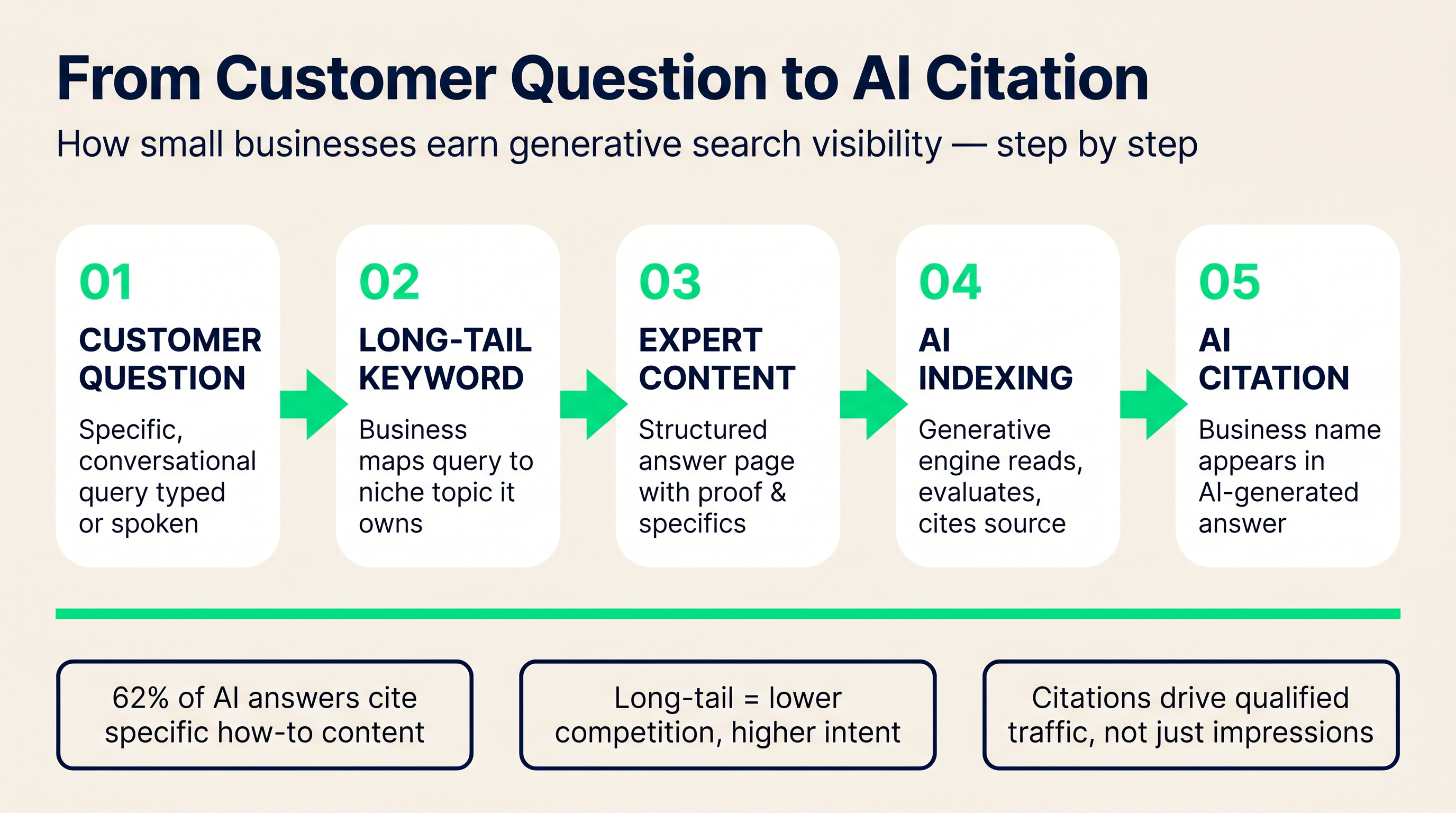
A good GEO page for these questions should do five things:
- Give the direct answer in the first few sentences.
- Explain the trade-offs without hiding the uncomfortable parts.
- Use examples that match real buyer situations.
- Include proof, such as screenshots, process notes, pricing ranges, constraints, or methodology.
- Make the brand entity clear, so the model understands who is speaking and why they are relevant.
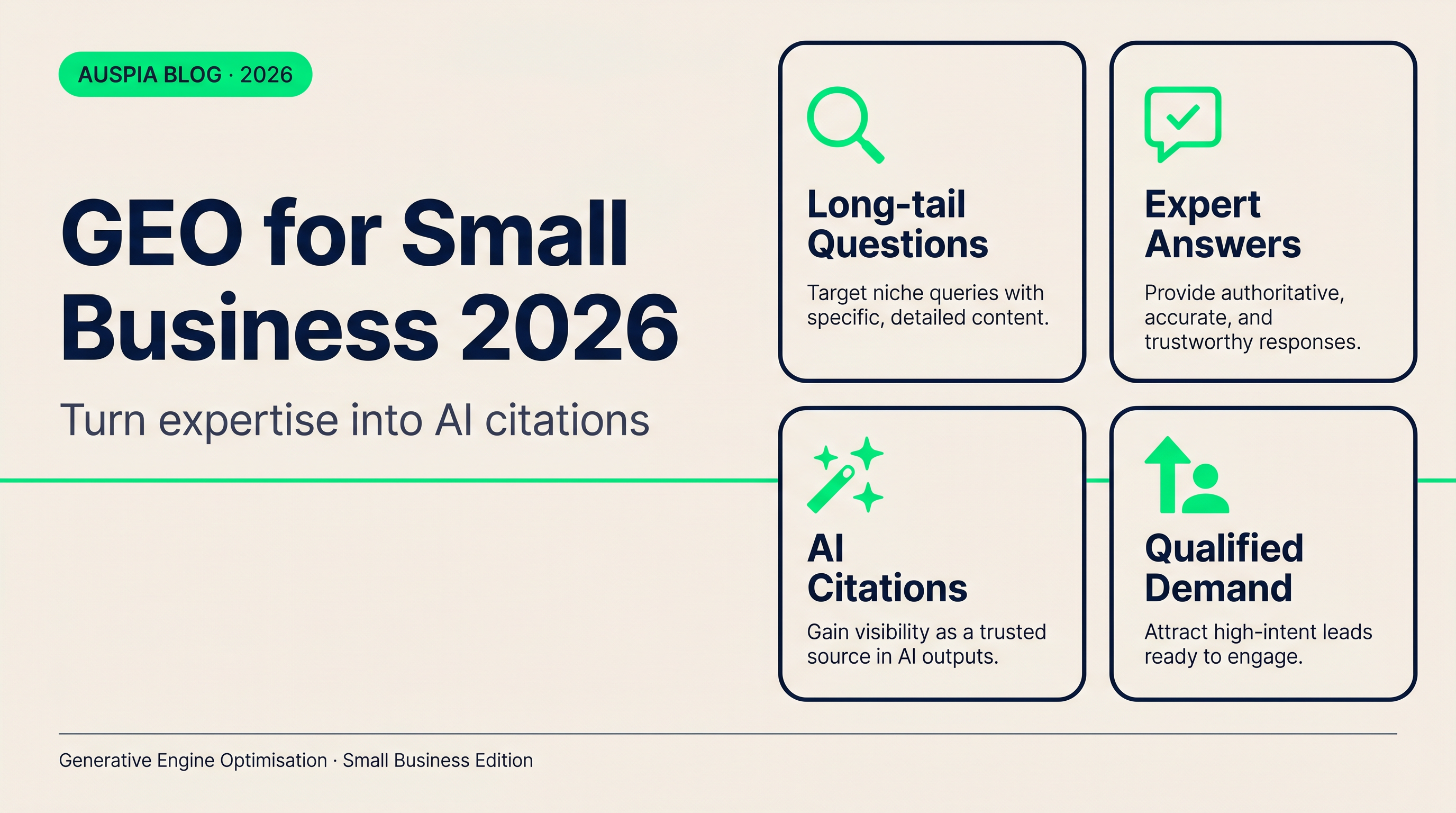
What GEO can actually do for a small business
GEO is not magic. It will not make a weak offer famous overnight. It will not force AI systems to cite a thin page. It also will not replace the basics: crawlable pages, useful site structure, clear positioning, and credible public proof.
But it can help small businesses in four practical ways.
It turns expertise into discoverable assets
Many small companies have strong expertise trapped inside calls, proposals, Slack threads, emails, and founder memory. GEO pushes that knowledge onto public pages where AI systems can retrieve it.
A good starting point is to list the 50 questions customers ask before they buy. Then answer each one like a specialist, not like a brochure.
It helps brands appear in recommendation-style answers
When someone asks an AI assistant for providers, tools, agencies, local services, or niche products, the answer often leans on public evidence. If your site has a clear service page, a strong about page, third-party mentions, reviews, and answer-ready content, you give the system more to work with.
No single page guarantees a mention. A small cluster of consistent evidence is much stronger.
It improves conversion even when the visitor comes from Google
The same content that helps AI systems understand you also helps human buyers. A page that answers pricing, fit, trade-offs, process, and alternatives will usually convert better than a vague service page.
That is the hidden upside of GEO: even if AI citations take time, the content can still improve SEO, sales enablement, and demo quality.
It gives small teams a measurable learning loop
A small business can test GEO without a huge program. Pick 20 buyer prompts. Run them in ChatGPT, Perplexity, Gemini, and Google AI mode where relevant. Track whether your brand appears, which competitors appear, and what sources are cited.
Then improve the missing pages.
Auspia's AI Search Visibility Checker is useful for this kind of prompt-level visibility review because the question is not "are we ranking?" It is "are we part of the answer?"
The 2026 small business GEO opportunity map
The best GEO opportunities are not always where the largest keywords are. They sit where expertise, buyer intent, and weak existing content overlap.
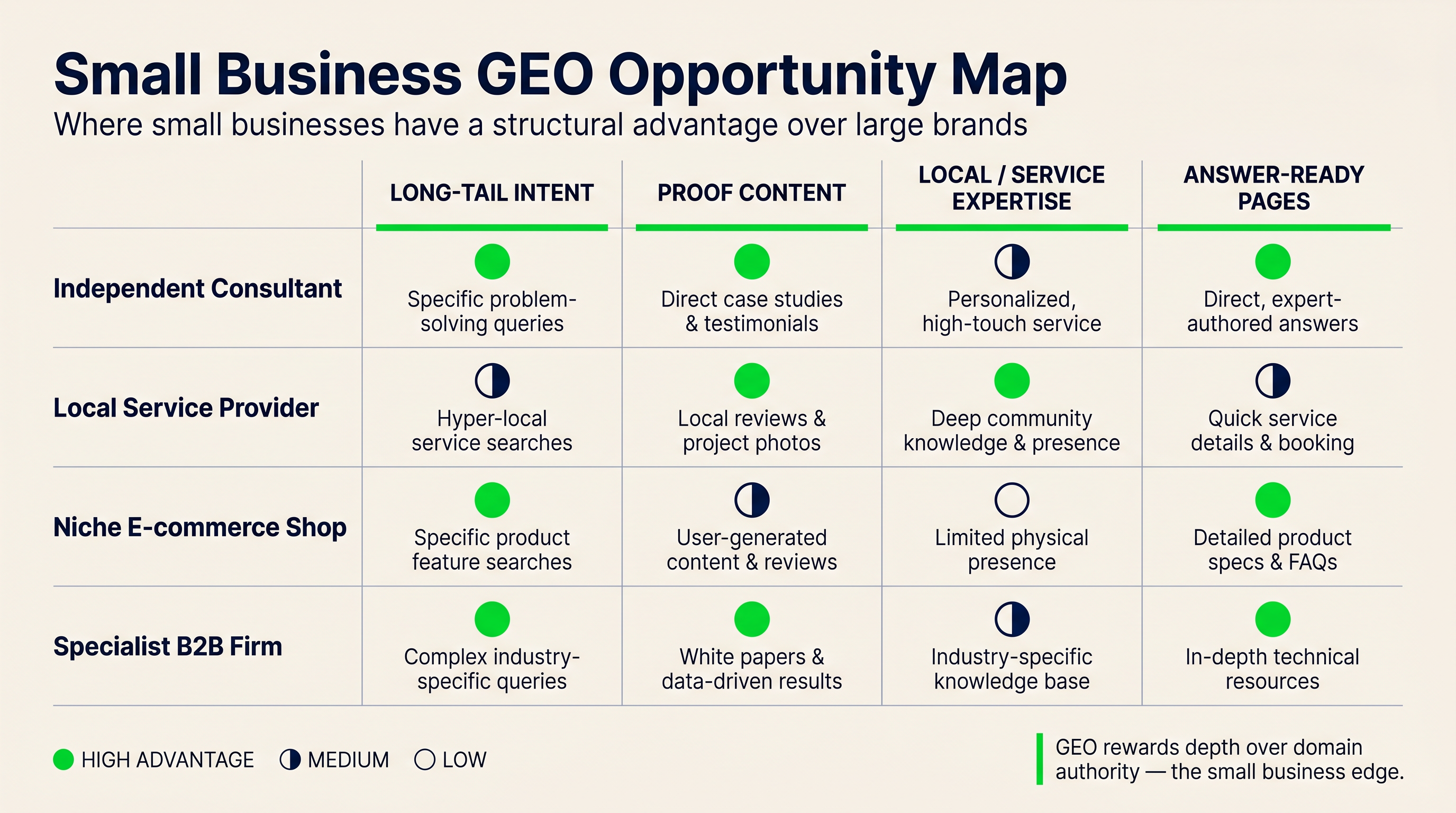
Use this quick map:
Opportunity | Example page | Why AI may use it |
|---|---|---|
Specific buyer questions | "How to choose a cybersecurity consultant for a 25-person startup" | Clear question, clear decision context, high commercial intent. |
Local expertise | "Best insulation options for homes in Minneapolis winters" | Location-specific constraints make generic national content weaker. |
Niche comparison | "HubSpot vs Pipedrive for boutique B2B agencies" | AI answers often need balanced comparison material. |
Process proof | "Our 14-step commercial roof inspection checklist" | Concrete methodology is easier to cite than claims. |
Pricing transparency | "What does managed IT support cost for a 40-person company?" | Buyers ask pricing questions constantly; many competitors avoid them. |
Entity clarity | "About Acme Analytics: what we do, who we serve, where we operate" | Models need consistent brand facts before they can confidently mention you. |
A large brand can publish on these topics too. But in practice, many do not. They avoid specificity because specificity creates legal, sales, or brand-review friction.
That friction is your opening.
A simple 30-day GEO sprint for small teams
Do not start by rewriting your entire website. Start with a tight sprint.
Week 1: collect the questions
Pull questions from sales calls, contact forms, support tickets, Reddit threads, LinkedIn comments, competitor FAQs, Google Search Console, People Also Ask, and customer emails.
Score each question on two axes:
- Does a real buyer ask this before purchasing?
- Can we answer it better than the current public results?
Pick the top 20.
Week 2: build answer-ready pages
Create or improve pages that answer the highest-intent questions. Each page should have:
- a direct answer near the top;
- a short table or checklist;
- one specific example;
- a section on when your solution is not the right fit;
- visible author, company, and update information;
- internal links to the relevant service, tool, or contact page.
Do not over-polish the page until it becomes empty. Plain, specific, slightly opinionated content often beats generic brand-safe copy.
Week 3: strengthen entity and proof signals
Make sure your brand facts are consistent across the web: name, category, description, location, audience, services, founder names if public, product names, and pricing model if relevant.
Then add proof. Reviews, case pages, industry directory profiles, partner listings, podcast mentions, guest articles, public templates, benchmark reports, and community answers can all help. The point is not to spam the web. The point is to create corroboration.
Week 4: test prompts and repair gaps
Run your 20 buyer questions through major AI answer surfaces. Record:
- whether your brand appears;
- which competitors appear;
- which sources are cited;
- what facts the answer gets wrong;
- what page you need to create or improve.
Then repeat monthly.
Common mistakes small businesses make with GEO
The biggest mistake is treating GEO as a trick.
Adding an llms.txt file is useful, but it will not save thin content. FAQ schema is useful, but it will not make a vague answer trustworthy. Publishing 100 low-quality AI articles will probably make your brand less useful, not more citable.
Watch for these traps:
Mistake | Better move |
|---|---|
Writing broad posts like "What is digital marketing?" | Answer a buyer question your team hears every week. |
Copying competitor topics without adding experience | Add your own process, constraints, examples, and decision rules. |
Optimizing only the website | Build consistent proof across profiles, directories, reviews, and credible mentions. |
Measuring only organic clicks | Track AI mentions, citations, referral traffic, and branded search lift. |
Expecting instant citations | Treat GEO as a monthly learning loop, not a one-time publish button. |
So, should small businesses invest in GEO in 2026?
Yes, if they have real expertise and can publish useful answers.
No, if they only want a shortcut.
That is the honest version.
GEO is attractive for small businesses because it gives them a way to compete on usefulness, specificity, and speed. But the companies that benefit will not be the ones that rename old SEO posts and call them AI-ready. They will be the ones that answer the questions buyers actually ask, show their work, keep their brand facts consistent, and measure whether they are being included in AI-generated answers.
If your competitor does this first, the next AI answer in your category may mention them and not you.
If you do it first, GEO can turn your small company's expertise into a public asset that AI systems can understand, retrieve, and cite.
That is worth a small bet in 2026.
FAQ
Is GEO only for big companies?
No. Big companies have more authority signals, but small businesses often have better niche expertise, faster publishing cycles, and more specific customer knowledge. Those are useful advantages in AI search.
How is GEO different from SEO?
SEO usually focuses on ranking pages in search results. GEO focuses on making your brand and content usable in generated answers from systems such as ChatGPT, Perplexity, Gemini, Claude, and Google AI Overviews. The two overlap, but the measurement is different.
What should a small business publish first?
Start with buyer questions. Pricing explainers, comparison pages, local service guides, checklists, and process pages usually work better than broad awareness posts.
How long does GEO take?
There is no fixed timeline. A practical first sprint takes 30 days, but AI mentions and citations usually require repeated testing, content improvement, and stronger third-party proof over time.
Do I need special technical files like llms.txt?
They can help, but they are not enough. Technical access, structured data, and llms.txt support discoverability. The real asset is still specific, credible, answer-ready content.
Author: Bennett Hayes, Applied GEO Analyst Across 400+ Implementation Reviews at Auspia. Bennett writes about practical GEO execution, audits, and implementation notes for teams that need clear next steps instead of theory.