Quick answer
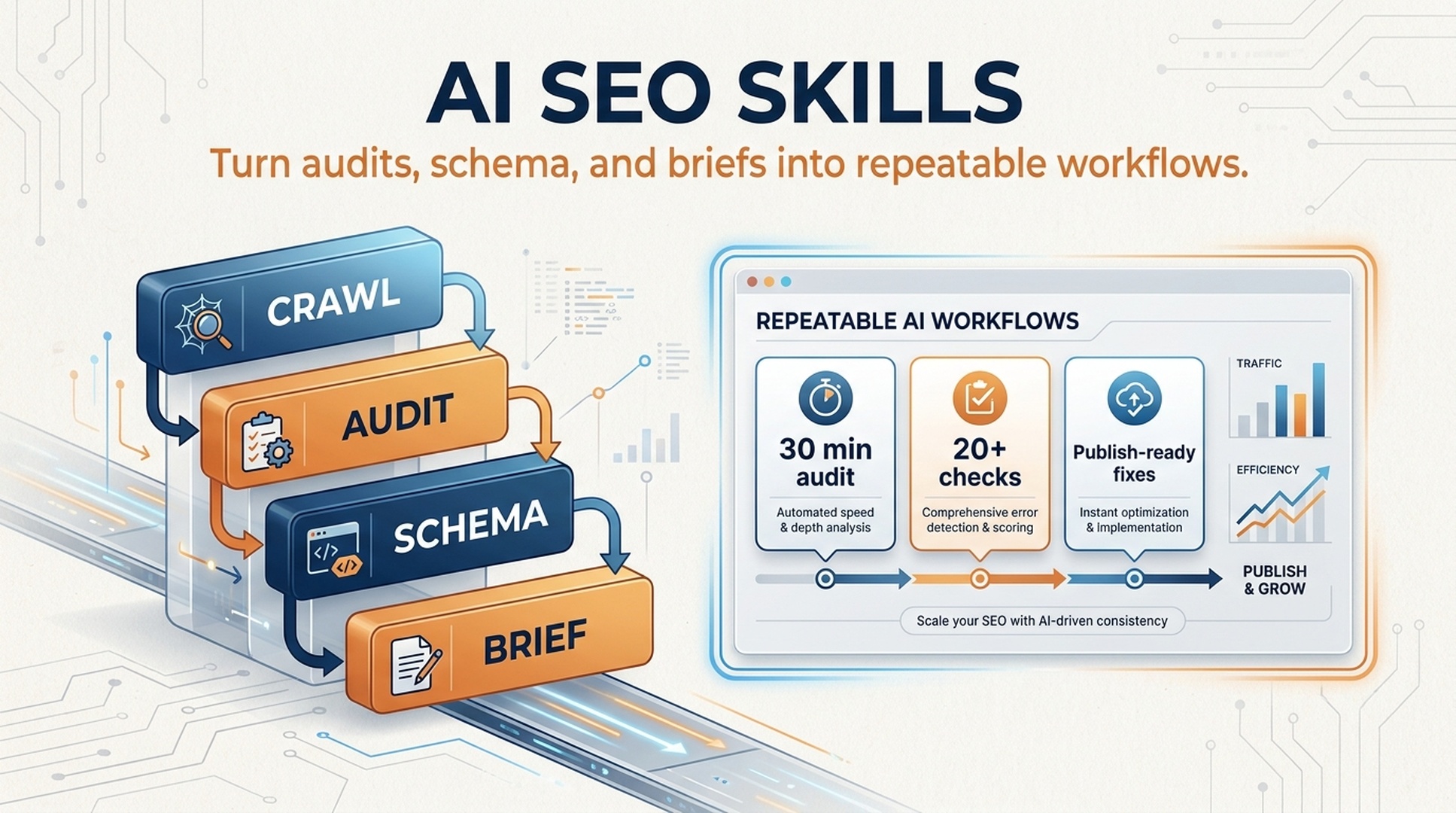
An AI SEO skill system is a repeatable workflow that lets an AI coding assistant crawl pages, inspect files, write metadata, generate schema, and hand fixes to developers without rebuilding the process every time. It will not replace SEO judgment. It can replace a lot of slow SEO operations: first-pass audits, missing tag checks, structured data drafts, content briefs, and QA reports.
The useful shift is simple: stop asking a general chatbot for SEO advice. Give the assistant a narrow skill with tools, rules, and a handoff format. That turns "please optimize this site" into a working system your team can run every week.
Why SEO teams are moving from prompts to skills
Most teams have tried the prompt approach by now. Someone writes a long SEO prompt, pastes a URL, asks for issues, and gets a decent-looking checklist. The problem shows up on the second or third run.
The output changes. The assistant forgets the team's standards. It recommends fixes without seeing the actual source code. It says "add schema" but does not check whether schema already exists. The work still needs a person to verify everything.
A skill-based setup is different. A skill is a small operating package for the AI assistant. It can include:
- The SEO checklist the assistant must follow
- The tools it may use, such as web fetch, search, file scan, or Lighthouse data
- Examples of good metadata, schema, briefs, and developer handoffs
- Rules about what not to do, such as black-hat tactics or invented search volume
- A final output format that developers and content teams can use directly
That sounds less glamorous than "build an autonomous agent." Good. SEO operations do not need theater. They need consistent work that can survive Monday morning, a messy CMS, and a backlog of 300 pages.
What an AI SEO skill can actually do
A good SEO skill is not just a prompt with a fancier name. It is closer to an SOP that has hands.
For example, an AI coding assistant with an SEO skill can inspect a live page, read the local codebase, compare the two, and produce a fix plan. If it has write access, it may also patch title tags, Open Graph metadata, image alt text, sitemap routes, or structured data templates.
Here are the most practical jobs to automate first:
SEO job | What the skill checks | What the team gets |
|---|---|---|
Technical audit | Status codes, indexability, titles, descriptions, canonicals, headings, broken links, image alt text | Prioritized issue list with file paths or URLs |
Schema drafting | Page type, entity names, author, dates, FAQ, breadcrumbs, article fields | JSON-LD draft with validation notes |
Content brief | Search intent, competing pages, missing sections, FAQ opportunities | Writer-ready brief with headings and examples |
Metadata refresh | Duplicate titles, weak descriptions, missing social previews | New title, meta description, and OG copy |
Developer handoff | Source location, expected behavior, QA steps | Ticket-style output instead of vague advice |
Auspia's view: the first win is not "AI writes SEO strategy." The first win is that your recurring SEO chores become runnable.
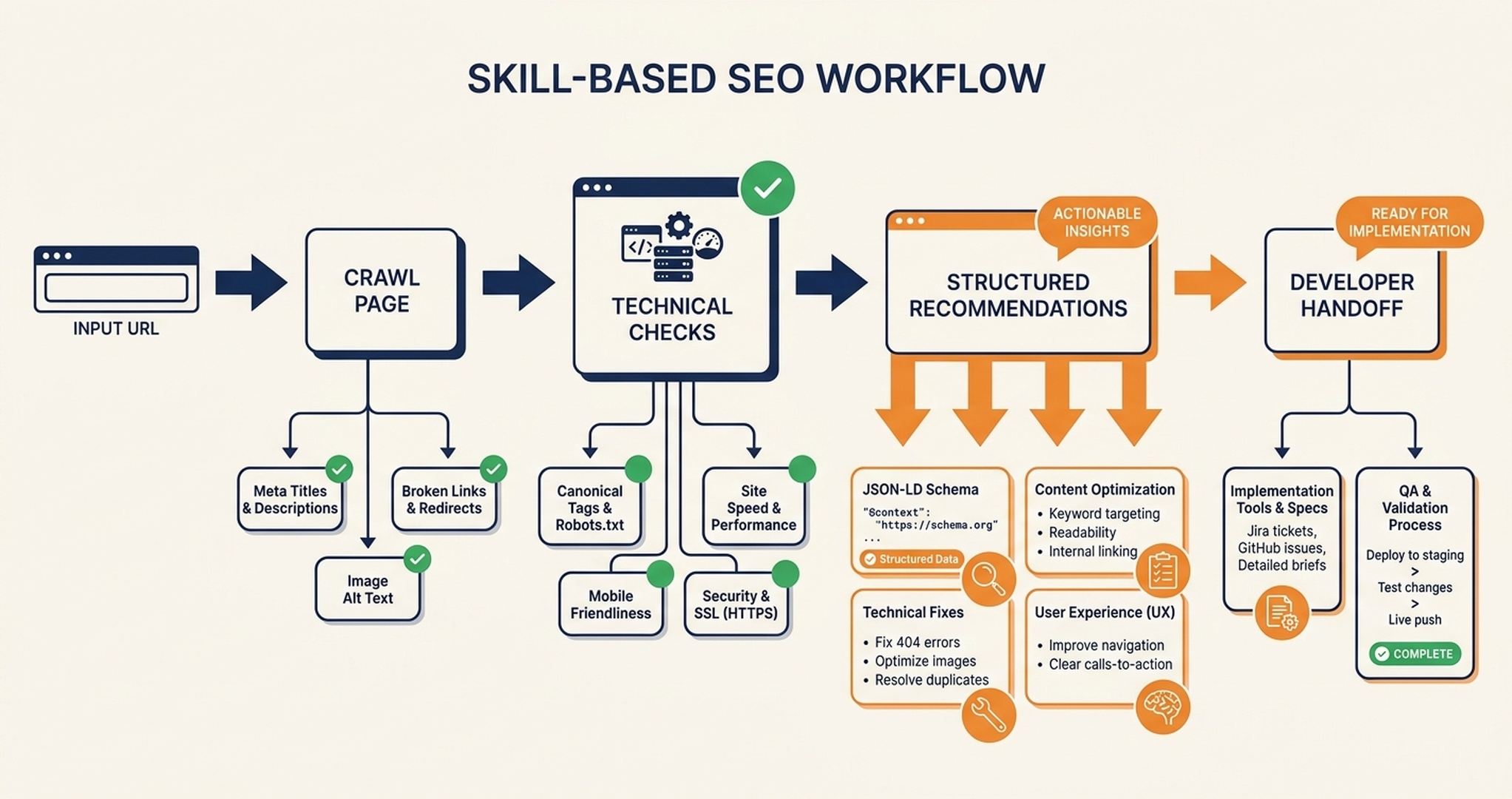
The stack: assistant, skill, tools, and evidence
A skill-based SEO system has four layers.
First, there is the AI assistant. This might be a coding assistant in a repository, an internal automation runner, or a workspace agent that can call tools.
Second, there is the SEO skill. This is where the team puts its standards. For example: always check canonical tags before recommending redirects; never invent keyword volume; prefer structured handoffs; flag uncertain items instead of pretending.
Third, there are tools. The assistant needs to fetch pages, inspect HTML, scan project files, call SEO APIs when available, and maybe run performance tests. Without tools, it is guessing from partial context.
Fourth, there is evidence. This is the part many teams skip. Every recommendation should point to a URL, file path, crawl result, SERP observation, or validation result. If the AI cannot show why a fix matters, it should mark the item as a hypothesis.
A simple audit flow might look like this:
- Crawl the target URL and collect HTML, status, canonical, robots directives, headings, links, and media.
- Scan the codebase for the template or route that generates the page.
- Compare the live page with the site's SEO standards.
- Produce fixes in priority order.
- Include a QA checklist the developer can run after the patch.
That is not magic. It is just the work an SEO specialist already does, packaged so the assistant can repeat it.
Three workflows worth building first
1. Website SEO audit
Start with one URL or one section of the site. The skill should check the basics before it gets clever:
- Is the page indexable?
- Does the canonical point to the right URL?
- Is the title unique and specific?
- Does the meta description match the page intent?
- Is there one clear H1?
- Are important images missing alt text?
- Are internal links broken or thin?
- Does structured data exist, and does it match the page type?
The output should not be a long essay. A useful audit has severity, evidence, fix, owner, and QA step.
Example handoff:
Severity | Issue | Evidence | Fix | QA |
|---|---|---|---|---|
High | Canonical points to staging URL |
| Set canonical to production URL | Re-fetch page and inspect canonical |
Medium | Missing meta description | Home route template | Add 145-160 character description | Check SERP preview length |
Low | Two images lack alt text | Hero and feature card | Add descriptive alt text | Run image accessibility check |
This is where teams often feel the speed difference. A human still reviews the work, but the first pass is no longer a two-day manual sweep.
2. Schema generation
Schema is a perfect skill job because the rules are structured and mistakes are common.
The skill can inspect the page type, collect required fields, draft JSON-LD, and explain what is missing. For a blog post, it may prepare Article or BlogPosting schema. For a tool page, it may suggest SoftwareApplication. For a FAQ section, it may generate FAQPage only if the questions are visible on the page.
The important constraint: schema should describe real page content. It should not create fake reviews, fake ratings, or invisible FAQs. A useful skill should refuse those shortcuts.
3. Keyword brief and content plan
A keyword brief skill should not just say "write a comprehensive guide." It should turn evidence into a writing plan.
A stronger brief includes:
- Primary intent and secondary intents
- Searcher sophistication level
- Competing page patterns
- Sections that appear repeatedly in top results
- Missing angles your site can credibly cover
- Internal links to add
- FAQ questions worth answering
- What not to claim without proof
If you connect keyword data tools, the skill can also include volume, difficulty, and SERP features. If you do not have those tools, it should be honest and label the brief as qualitative.
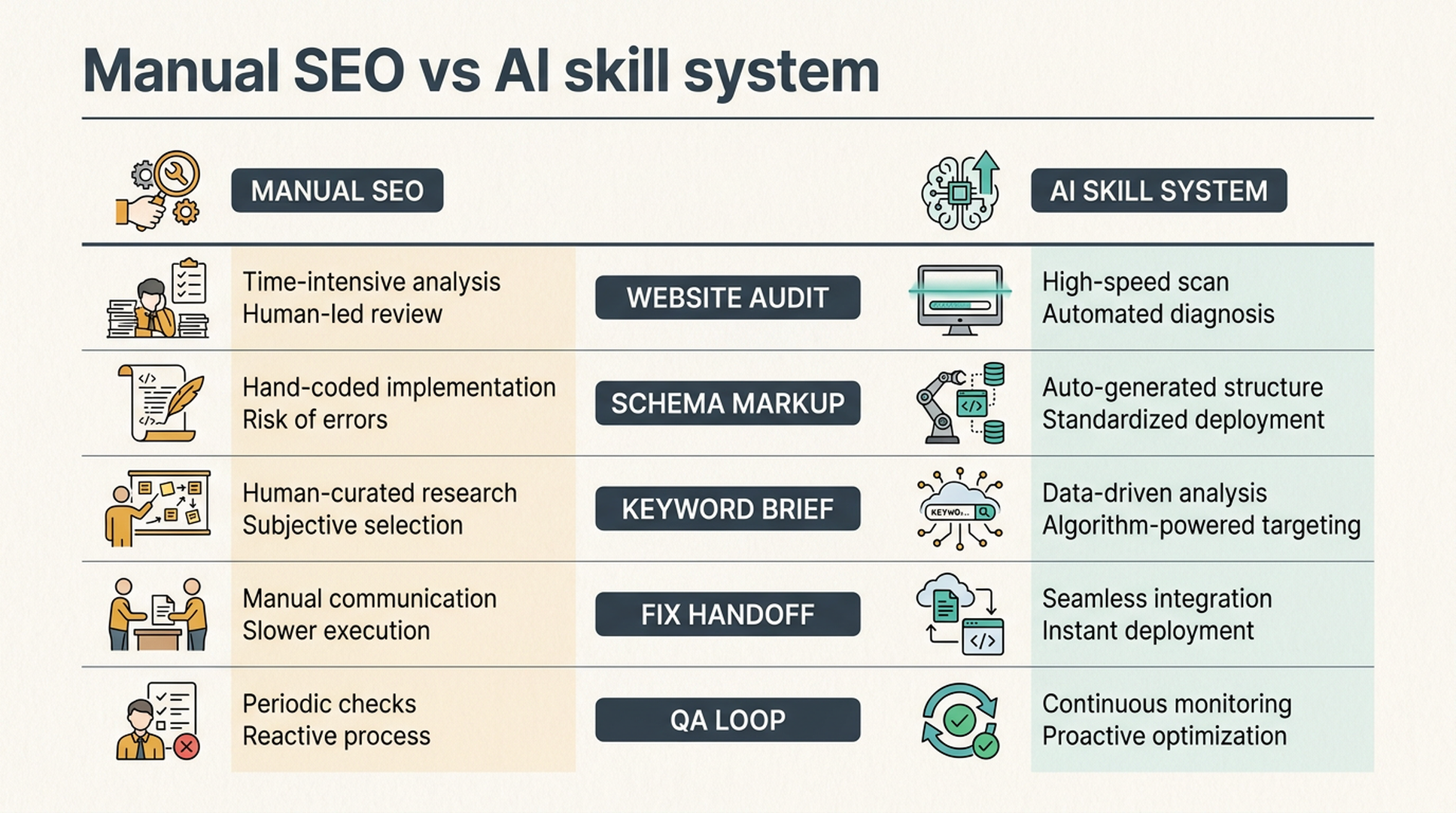
How this changes the SEO role
The lazy version of this story is "AI replaces an SEO specialist." That is not quite right.
AI replaces parts of the SEO specialist's calendar. It is very good at repetitive inspection, formatting, first drafts, and cross-checking. It is less good at deciding which market to enter, which pages deserve investment, how to position a product, or when a technically valid recommendation is not worth engineering time.
So the role shifts.
Instead of manually checking 100 pages for missing descriptions, the SEO lead defines the standard and reviews the exceptions. Instead of rewriting the same schema template again, the team builds a schema skill and spends review time on accuracy. Instead of asking developers to interpret vague SEO advice, the assistant produces a ticket with file paths and QA steps.
That is a better use of human attention.
Cost and speed: what to expect
The biggest savings usually come from reducing coordination, not from replacing a salary line item.
A recurring audit that used to require an SEO specialist, a developer, and a content manager can become a weekly run with a review meeting. Metadata refreshes can move from spreadsheet work to batch proposals. Schema updates can move from "we should do this someday" to pull requests.
Still, teams should avoid fake precision. If someone claims every SEO workflow becomes 100 times faster, ask which workflow, which site, and what quality bar. A small static site is different from a multilingual marketplace with faceted navigation.
Use this rough expectation instead:
Workflow | Manual baseline | AI skill-assisted target |
|---|---|---|
Single-page SEO audit | 30-90 minutes | 5-15 minutes plus review |
Blog schema draft | 30-60 minutes | 5-10 minutes plus validation |
Metadata refresh for 50 pages | 1-2 days | 1-3 hours plus approvals |
Content brief | 1-3 hours | 20-45 minutes with data review |
The assistant should save time, but the review step stays. That review is where brand, accuracy, and prioritization live.
How to build your first SEO skill
Start small. Pick one workflow your team repeats often and turn it into a skill.
A practical first version might include:
Name: seo-page-audit
Purpose: Audit one URL and produce developer-ready SEO fixes.
Tools: Web fetch, file search, optional performance report.
Rules:
- Check indexability, canonical, title, description, H1, headings, images, internal links, schema.
- Cite evidence for every issue.
- Do not recommend speculative fixes without labeling them.
- Output severity, issue, evidence, fix, owner, and QA step.
Handoff: Markdown table plus JSON summary.
Then test it on five pages:
- A homepage
- A product or tool page
- A blog post
- A category page
- A page with known SEO issues
Do not judge the skill by whether the first run is perfect. Judge it by how easy it is to improve. If the assistant misses canonicals, add that rule. If it writes vague fixes, add a stronger handoff example. If it invents data, forbid unsupported metrics.
This is the advantage of skills over one-off prompts. The system gets better every time you encode what the reviewer had to correct.
Where Auspia fits
Auspia is built for teams that want SEO, GEO, and AI search work to become operational, not occasional. The same pattern applies beyond traditional SEO.
For AI search visibility, a skill can check whether a page clearly states entities, claims, sources, authorship, and answer-ready summaries. For AEO, it can test whether sections answer real questions directly. For technical SEO, it can inspect crawlability, metadata, and structured data before pages ship.
If you want a fast starting point, run your site through the Website SEO Score Checker and compare the findings with your current SEO checklist. For AI answer readiness, use the AI Search Visibility Checker to see where your content is easy or hard for answer engines to understand.
The goal is not to let AI make every decision. The goal is to make your best SEO process repeatable.
Checklist for a reliable AI SEO skill
Use this before you trust the workflow in production:
- The skill has a narrow job, not a vague "do SEO" instruction.
- It can inspect live pages or source files instead of relying only on pasted context.
- Every recommendation includes evidence.
- The output is usable by a developer, writer, or SEO lead without translation.
- It refuses black-hat tactics and unsupported claims.
- It separates confirmed issues from hypotheses.
- It includes QA steps after the fix.
- A human owner reviews changes before publishing.
If your skill passes those checks, it is no longer a clever prompt. It is part of your operating system.
FAQ
Can an AI SEO skill replace an SEO specialist?
It can replace a lot of repetitive SEO work, but not the whole role. Strategy, prioritization, brand judgment, and final QA still need a human owner.
What is the difference between an SEO prompt and an SEO skill?
A prompt is a one-time instruction. A skill is a reusable package with rules, tools, context, examples, and a standard output format.
Do I need a coding assistant to use this approach?
A coding assistant helps because SEO fixes often live in templates, routes, and content files. You can still apply the skill pattern in no-code workflows, but code access makes audits and fixes more concrete.
What should teams automate first?
Start with single-page audits, schema drafts, metadata refreshes, and content briefs. These are structured enough for AI support and easy for humans to review.
How does this connect to GEO and AI search?
The same skill pattern can check whether content is answer-ready: clear entities, direct answers, cited claims, structured sections, and crawlable pages. That helps both traditional SEO and AI search visibility.