The short version
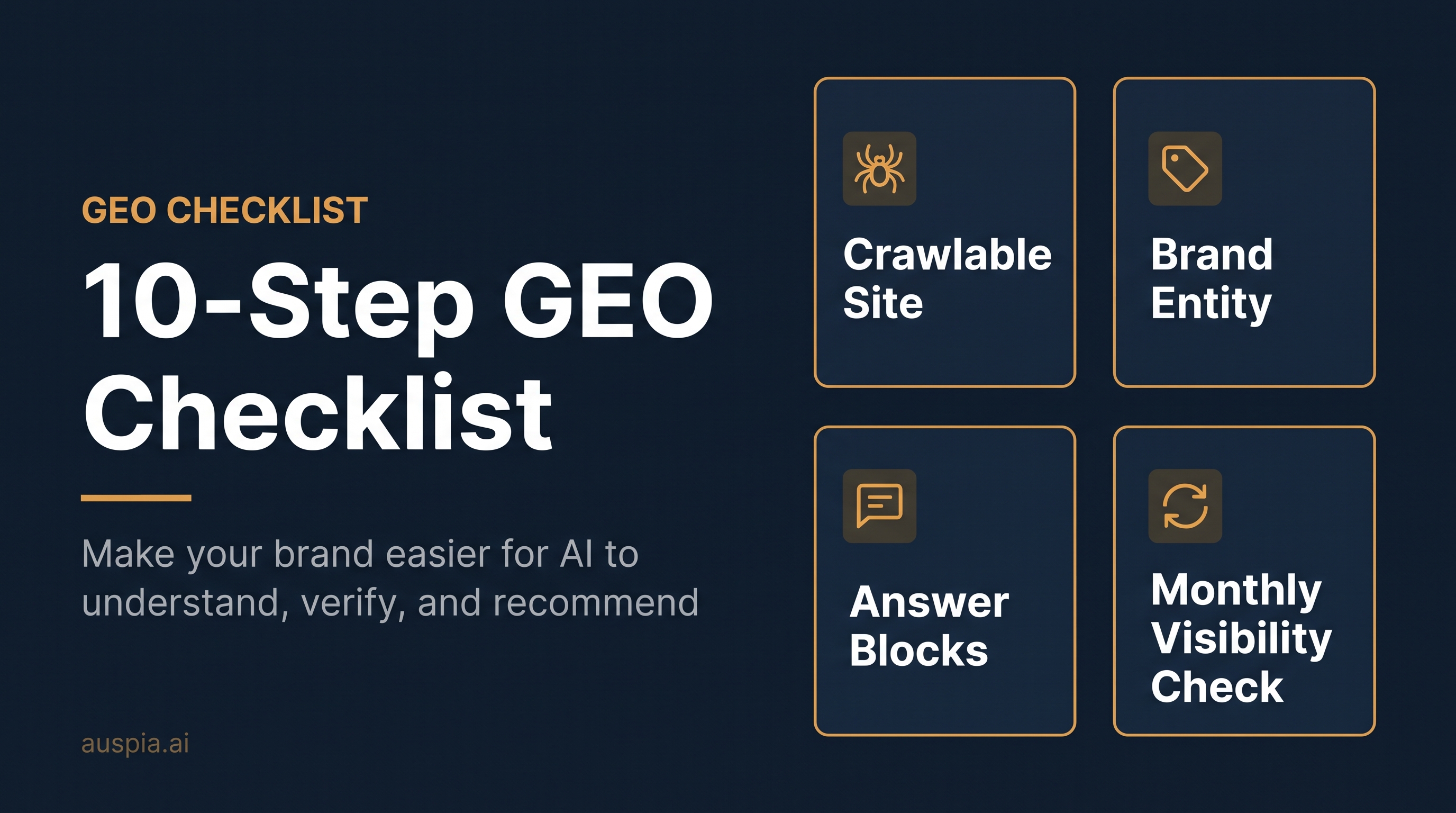
If you want AI systems to recommend your brand, start with the boring assets first: a crawlable website, one consistent brand definition, structured product answers, credible third-party proof, and a monthly visibility check.
This is not a trick for forcing ChatGPT, Perplexity, Gemini, or Google AI Overviews to mention you. It is a way to make your brand easier to understand, easier to verify, and safer to cite when a user asks, "Which product should I choose?" or "Who is good for this problem?"
Small brands can do this. In some categories, they may even move faster than large brands because they can fix their website, rewrite product pages, and collect evidence without waiting for six departments to agree on a sentence.
What GEO means in plain English
GEO, or generative engine optimization, is the work of making your brand and content easier for AI answer systems to find, understand, compare, and cite.
A search engine can rank a page even when the brand story is messy. AI answer systems are less forgiving. They have to synthesize an answer. If your website says one thing, your marketplace listing says another, and your press article uses a third description, the model has a simple option: skip you.
Auspia's view is simple: GEO starts as brand infrastructure before it becomes content marketing.
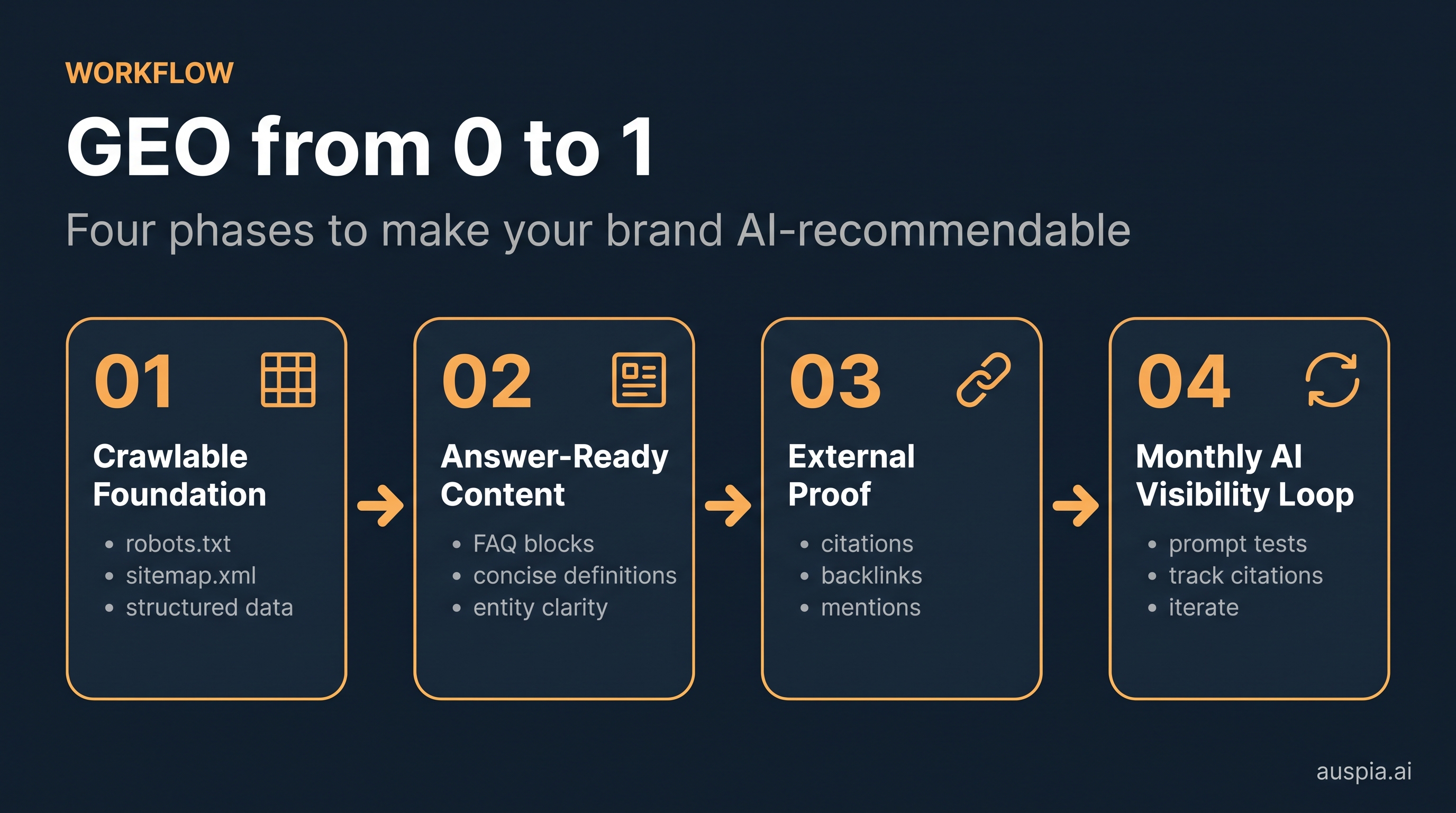
Caption: A practical GEO workflow starts with a crawlable source of truth, then builds answer-ready content, outside proof, and a monthly visibility loop.
Phase 1: make the brand crawlable
Task 1: build a five-page trust site
You do not need a huge website to start. You need five pages that answer the basic questions a human, crawler, and AI system would ask:
Page | What it must answer |
|---|---|
Homepage | What the brand does, who it serves, and why it exists |
Product or service page | What is sold, how it works, who it is for, and what the limits are |
About page | Legal name, brand story, location or operating scope, and contact points |
FAQ page | The real questions buyers ask before they trust you |
Resource hub | Educational articles that explain the category, problem, and decision criteria |
Acceptance standard: every page has its own URL, loads cleanly on mobile, is not blocked by robots.txt or noindex tags, and can be rendered without hiding the main content behind scripts.
If you are unsure whether AI crawlers and search engines can access the site, test it with the Robots.txt AI Crawler Checker.
Task 2: write one brand definition and reuse it everywhere
Create a compact brand definition that includes:
- Brand name
- Category
- Primary audience
- Core method, ingredient, technology, or process
- Use case
- Differentiated claim you can actually support
Example:
"Northline is a B2B inventory forecasting platform for mid-market retailers. It uses sales history, supplier lead times, and seasonal demand signals to help operations teams reduce stockouts without overbuying."
That sentence is not flashy. Good. AI systems do not need your slogan first. They need the entity.
Acceptance standard: the same definition appears on the homepage, about page, product page, press boilerplate, directory profiles, partner bios, and sales collateral. Do not let one page call you "AI planning software" while another says "supply chain automation suite" unless both are intentionally defined.
Task 3: add basic structured data
At minimum, add Organization schema, Product or Service schema, FAQPage schema where appropriate, and Article schema on educational posts.
Acceptance standard: test representative pages with Google's Rich Results Test or Schema Markup Validator. Fix errors before chasing new mentions.
Structured data will not magically make an AI cite you. It does reduce ambiguity, and ambiguity is one reason smaller brands get ignored.
Phase 2: turn product copy into answer blocks
Task 4: rewrite the product page around six buyer questions
Most product pages are built for persuasion. GEO-ready product pages need persuasion plus extraction. Use six H2 sections:
- What is this?
- How does it work?
- Who is it for?
- When should someone not use it?
- How is it different from alternatives?
- What proof supports the claim?
Each answer should be short enough to quote and specific enough to compare. Use bullets, comparison tables, and named constraints. Avoid long brand monologues.
Bad: "Our platform transforms the way teams unlock modern growth."
Better: "The platform monitors 40 inventory signals daily and alerts planners when a SKU is likely to fall below the reorder threshold within 14 days."
Task 5: publish three citation-ready resource articles
Do not start with generic thought leadership. Start with decision-support content that AI systems can use inside an answer.
For a cybersecurity tool, this could be:
- "SOC 2 monitoring vs. security questionnaires: which one does a vendor need first?"
- "How to evaluate vendor risk software before your first enterprise deal"
- "A checklist for reducing security review delays in B2B sales"
Each article should include one clear conclusion, one comparison table or checklist, one external source or standard when relevant, and one natural path back to the product.
Acceptance standard: each article is at least 1,000 words, has extractable headings, avoids unsupported claims, and includes an FAQ section only when the questions are real.
For teams building this workflow, Auspia's AI Search Visibility Checker can help track whether the content starts appearing in AI-style recommendation prompts.
Phase 3: create proof outside your own website
Task 6: build neutral entity profiles
Depending on your market, this may include Crunchbase, G2, Capterra, Product Hunt, LinkedIn company pages, industry directories, GitHub, documentation portals, partner directories, or marketplace listings.
The point is not to spam profiles. The point is to give AI systems independent places to verify the same basic facts.
Acceptance standard: each profile uses the same brand definition, links back to the official website, and avoids claims you cannot prove.
Task 7: earn one serious third-party review
A review that helps GEO is not a paid puff piece with ten adjectives. It is a credible outside evaluation that describes the problem, explains the testing method, shows what worked, and names tradeoffs.
For a project management app, a useful review might compare onboarding time, reporting depth, integrations, and team fit against two alternatives. For a health product, it should be more careful, evidence-based, and clear about what it is not allowed to claim.
Acceptance standard: the review is published on a real site, indexed by search engines, and includes enough details that a reader can tell a person actually evaluated the product.
Task 8: collect story-shaped customer proof
Do not ask customers for "a good review." Ask for the story:
- What problem did you have before?
- What did you try first?
- What changed after using the product?
- What almost stopped you from buying?
- Who would you recommend it to, and who should not use it?
Short praise is nice for a landing page. Detailed stories are better for AI retrieval because they contain problems, use cases, language, and outcomes.
Acceptance standard: collect 3 to 5 customer stories over 200 words each. Publish them where your buyers actually look: review platforms, community threads, case-study pages, partner pages, or marketplace listings.
Phase 4: run a monthly AI visibility check
Task 9: create your first prompt test sheet
Pick 20 prompts your buyers might ask before choosing a product. Include category prompts, comparison prompts, problem prompts, and alternative prompts.
Prompt type | Example |
|---|---|
Category | "What are good tools for vendor risk management?" |
Comparison | "How does [brand] compare with [competitor]?" |
Problem | "How can a small SaaS team reduce security review delays?" |
Alternative | "What are alternatives to spreadsheets for inventory forecasting?" |
Run the prompts in the AI systems your buyers use. For many teams this means ChatGPT, Perplexity, Gemini, Claude, Google AI Overviews, or category-specific assistants. Record whether your brand appears, whether the description is accurate, which sources are cited, and which competitors show up instead.
Acceptance standard: save screenshots and build a simple visibility log. Do not rely on memory. AI answers change.
Task 10: repeat the check once a month
Monthly GEO work is not complicated, but it does need rhythm.
- If an AI answer cites an old article, refresh that article.
- If it misunderstands your category, fix your brand definition and entity profiles.
- If it recommends competitors because they have clearer comparison content, publish a stronger decision guide.
- If it ignores you completely, check crawlability, third-party proof, and whether your content answers real buyer prompts.
Acceptance standard: update the visibility log every month and attach actions to each gap. GEO without a review loop becomes guesswork.
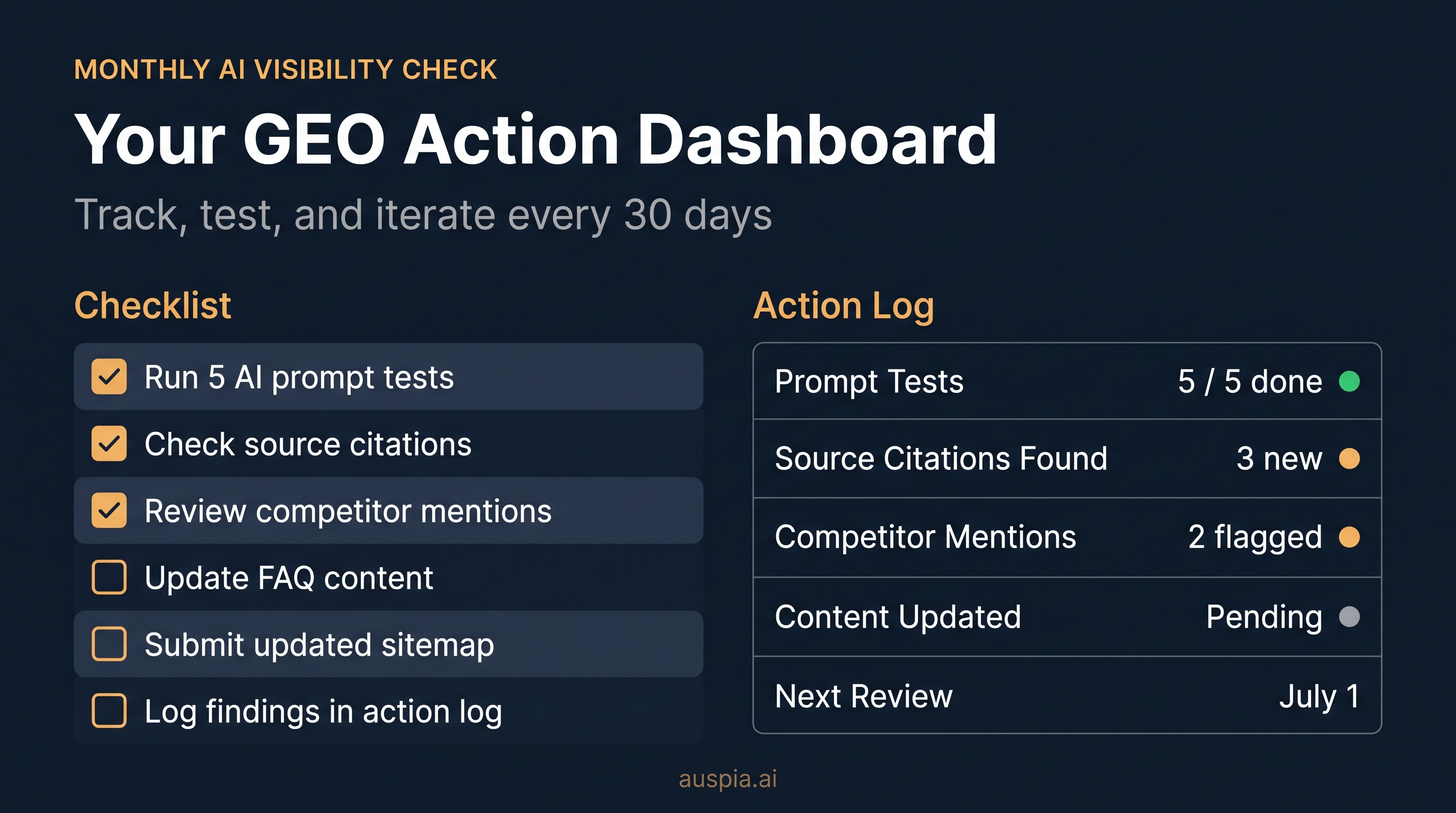
Caption: Track prompt visibility, citation sources, competitor mentions, and the next action for each GEO gap.
The three mistakes that slow teams down
Mistake 1: writing claims an AI system cannot safely repeat
"Best," "most advanced," and "revolutionary" are weak unless the page also shows evidence. AI answer systems tend to prefer specific, supportable language.
Use this instead: "Built for teams with 50 to 500 employees," "connects to NetSuite and Shopify," or "includes a 14-day implementation checklist."
Mistake 2: letting brand facts drift
A small mismatch can create real confusion. Your website says "compliance automation." Your LinkedIn page says "security questionnaire software." Your directory profile says "AI governance platform." Maybe all three are related, but the system has to decide what you are.
Make the primary category stable first. Add secondary language after that.
Mistake 3: buying visibility before fixing the source of truth
Press mentions, guest posts, and social buzz help only when the core entity is clear. If your site is thin, blocked, outdated, or full of vague claims, outside mentions have less to anchor to.
Fix the source first. Then distribute.
A practical 30-day schedule
Week | Work | Output |
|---|---|---|
Week 1 | Crawlability, brand definition, five-page trust site audit | One clean source of truth |
Week 2 | Product page rewrite and schema fixes | Six answer blocks plus valid structured data |
Week 3 | Three citation-ready resources | Comparison, checklist, and decision-guide content |
Week 4 | Entity profiles, review outreach, prompt tracking | External proof and first AI visibility baseline |
This schedule is aggressive but realistic for a small team if the product positioning is already clear. If not, spend the first week only on category language and buyer prompts. A confused foundation will make every later task slower.
FAQ
How long does GEO take to work?
For a new or small brand, expect months, not days. Crawlability and clearer content can be fixed quickly, but third-party proof, citations, and AI answer behavior need time to accumulate and change.
Can a small brand appear in AI recommendations?
Yes, but usually not because it published one clever article. Smaller brands need a clear entity, crawlable pages, answer-ready content, and credible proof outside their own website.
Is GEO different from SEO?
GEO overlaps with SEO, but the output is different. SEO often targets rankings and clicks. GEO targets understanding, retrieval, citation, and recommendation inside AI-generated answers.
Should every page be written for AI first?
No. Write for buyers first, then structure the page so AI systems can extract the same useful answers. If the page becomes robotic, it will be worse for humans and not necessarily better for AI.
What should we measure first?
Start with prompt visibility, description accuracy, cited sources, competitor mentions, and the pages that AI systems appear to rely on. Traffic is useful later, but early GEO work needs diagnostic metrics.
Author: Martin Hayes, GEO Playbook Builder for 200+ Execution Checklists at Auspia. Martin writes about practical GEO workflows, audit checklists, and operating habits that help growth teams turn AI visibility into repeatable work.