Direct answer
If a local service brand is doing GEO for the first time, do not start by scheduling 30 educational posts. Start with one working table: real customer questions on the left, public proof on the right.
That table shows whether an AI answer system can explain who you are, where you serve, what you can safely claim, what a customer should expect, and which details still need human confirmation. In most first-time GEO projects, the biggest gap is not volume. It is that the brand's public pages cannot answer the first five questions a customer would ask before booking.
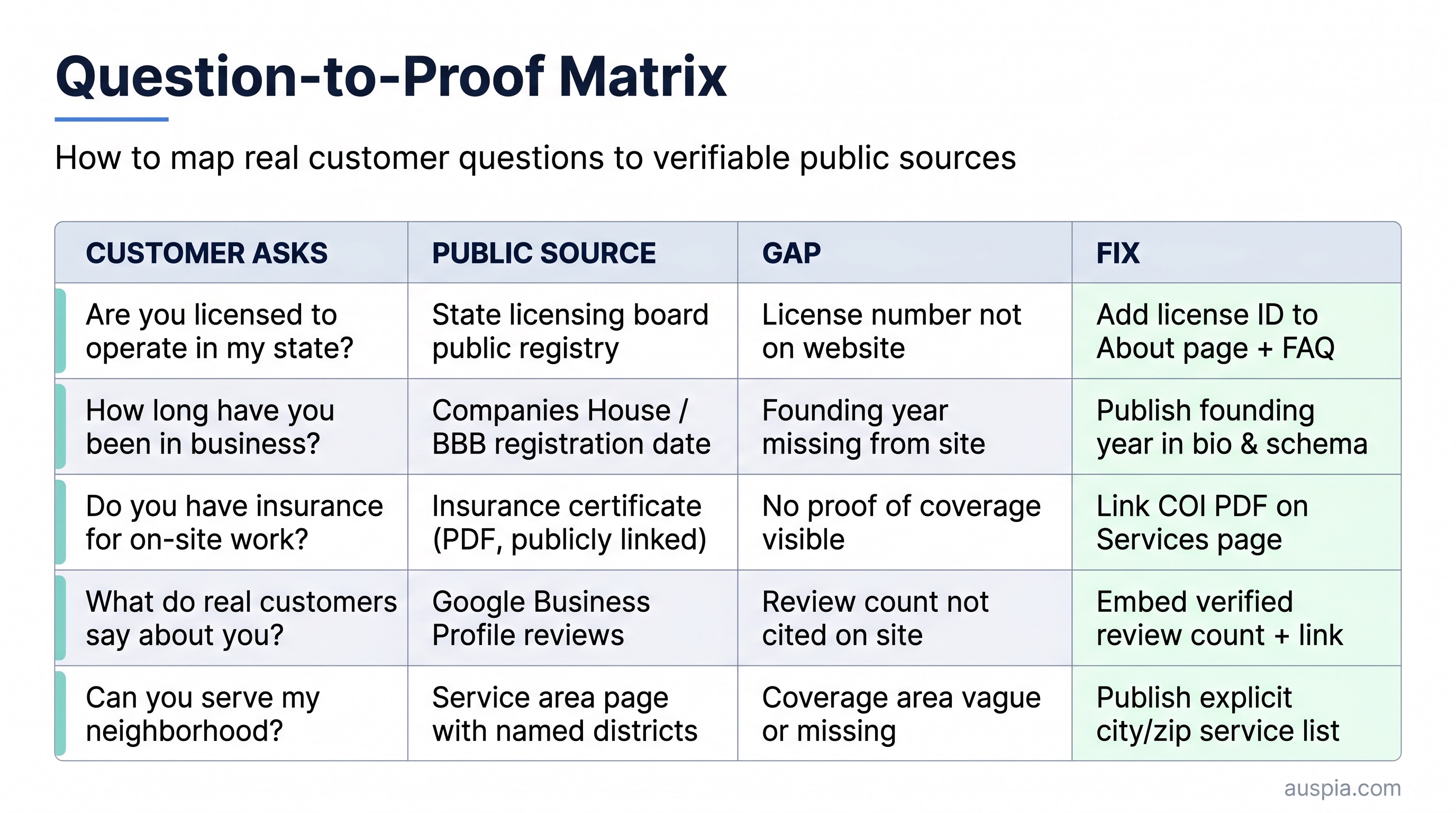
The first GEO worksheet should map customer questions to public sources, not blog topics to publishing dates.
Why first-time GEO feels confusing
GEO, or generative engine optimization, is the work of making a brand easier for AI answer systems to understand, describe, compare, and cite.
Traditional SEO asks: can someone find your page when they search a keyword?
GEO asks a slightly different question: when someone asks ChatGPT, Perplexity, Gemini, Google AI Overviews, or another AI answer surface for a recommendation or explanation, does the answer describe your brand accurately?
For a local service business, that question is no longer abstract. A homeowner may ask an AI assistant which HVAC company handles emergency repairs near them. A patient may ask how to compare orthodontic clinics. A small business owner may ask which bookkeeping firm works with restaurants. A parent may ask what to expect before a child's first dental visit.
Those are not neat keyword searches. They are messy decision questions. They include constraints, location, timing, budget, trust, risk, and personal context.
That is why first-time GEO often goes wrong. The team hears "AI visibility" and immediately starts producing more content. More service pages. More FAQs. More blogs. More explainers.
Some of that may help later. But if your public materials cannot answer the questions people already ask before contacting you, publishing more generic articles will not fix the problem.
Customers ask more specific questions than your service menu
Most businesses organize content from the inside out. They start with their service categories:
Internal category | What the website usually says | What the customer actually asks |
|---|---|---|
Emergency plumbing | 24/7 service and experienced technicians | "Can someone come tonight, what counts as an emergency, and what is the call-out fee?" |
Orthodontics | Clear aligners and braces | "How do I know whether aligners will work for my case, and what happens at the first visit?" |
Wealth planning | Personalized financial advice | "Do you work with first-time business owners, how are fees charged, and are you a fiduciary?" |
Family law | Divorce and custody representation | "What should I prepare before a consultation, and what can you not promise me?" |
Home cleaning | Professional deep cleaning | "Do you bring supplies, are cleaners insured, and what is not included?" |
A service menu is tidy. Real questions are not.
The customer is not only asking what the service is. They are asking whether they qualify, how the first step works, who will handle it, what it may cost, what evidence supports the claim, what is safe to decide online, and what needs a professional review.
If your website only says "trusted team," "premium service," and "personalized solutions," an AI answer has very little to work with. It may describe you in bland terms, skip you entirely, or mix your details with another brand.
That is not because the AI has a grudge against your company. It is because your public evidence is thin.
The first worksheet: customer question x public proof
Before writing a content calendar, build a simple table.
The left side is the question a customer might ask. The right side is where your public material answers it. If there is no source, mark it as a gap.
Customer question | Public source that answers it | Gap status | Fix |
|---|---|---|---|
"Do you serve my area?" | Service area page | Partial | Add neighborhood/city coverage and exceptions |
"Who will handle the appointment?" | Team bio page | Missing | Add role, specialty, license where appropriate, and service scope |
"What happens during the first visit?" | New customer page | Missing | Add step-by-step first-visit process |
"How much does it usually cost?" | Pricing or FAQ page | Partial | Explain ranges, variables, exclusions, and when a quote is required |
"What should I not expect?" | Service page or policy page | Missing | Add limitations and cases that require in-person review |
"Can this result be guaranteed?" | Compliance-safe FAQ | Missing | Explain what can be assessed, not promised |
"Are you insured, licensed, or certified?" | About page, footer, trust page | Partial | Link to public registries or describe verification path |
"How do I book or prepare?" | Booking page | Partial | Add preparation checklist and cancellation rules |
This is boring work. It is also where GEO starts becoming useful.
A content calendar says, "We plan to publish." A question-to-proof table says, "We know what the market needs answered, and we know where the answer lives."
That distinction matters for AI search. Generative systems tend to synthesize answers from retrievable, consistent, and specific sources. If the source material is vague, the answer will be vague too.
What most teams discover in the first audit
The first audit usually reveals four problems.
The first problem is that service pages describe the offer but not the decision boundary. A page may say the company provides "same-day repair," but it does not say which cases qualify, which areas are covered, or what happens after hours.
The second problem is that expert or staff pages are too thin. Many local businesses show names, headshots, and broad titles. They rarely explain who handles which cases, what languages they support, what certifications are relevant, or which situations should be routed elsewhere.
The third problem is price language. Teams either hide pricing completely or publish a low entry price without explaining what changes the final cost. That creates a weak answer surface. AI systems can still mention price, but they may rely on third-party directories, reviews, or outdated snippets.
The fourth problem is risk language. Businesses in healthcare, finance, legal, home services, education, and other trust-heavy categories must be careful. GEO does not reward exaggerated certainty. It rewards clear, verifiable information.
Safe claims beat louder claims
A risky first instinct is to make every page sound more persuasive. "Best in the city." "Guaranteed results." "The safest option." "Unmatched expertise." "Always cheaper."
That language is weak for two reasons.
First, it is often unsupported. AI answer systems may avoid or flatten unsupported superlatives.
Second, in regulated or trust-sensitive sectors, it can create real compliance and reputation risk. A dental clinic should not promise outcomes before an examination. A law firm should not imply guaranteed case results. A financial advisor should not suggest performance certainty. A contractor should not claim universal safety without conditions.
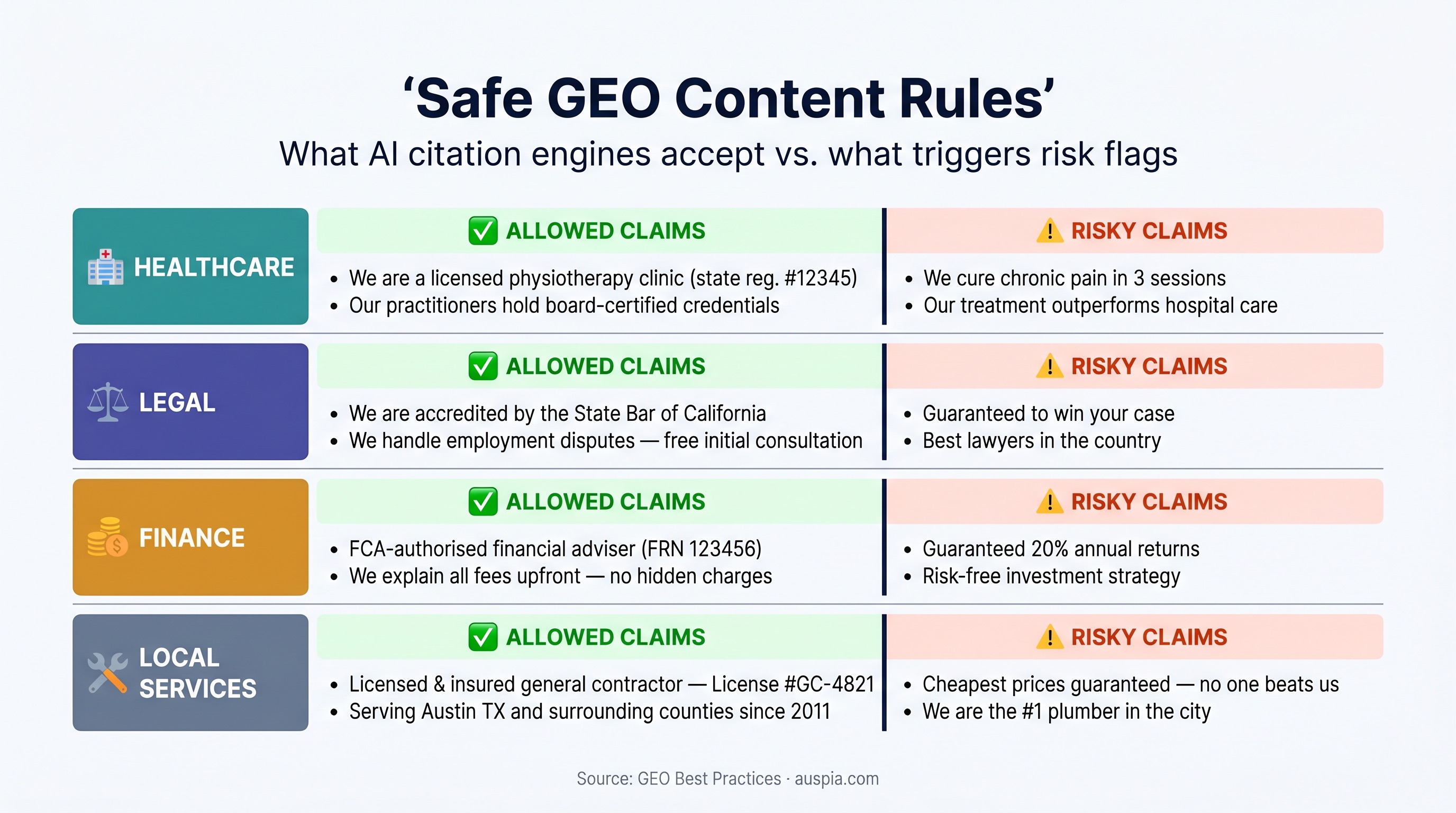
For trust-heavy categories, the safest GEO improvement is usually clearer evidence and boundaries, not stronger adjectives.
A stronger page says:
- what the service includes
- who the service is for
- what must be checked before a recommendation
- what information the customer should bring
- what credentials or registrations can be verified
- what price variables change the estimate
- what outcomes cannot be promised
That is less flashy. It is also more useful to customers and easier for AI systems to summarize without inventing missing details.
A first-time GEO workflow for local services
Here is a practical starting workflow.
Step 1: collect real customer questions
Use five sources:
Source | What to collect |
|---|---|
Sales calls and booking chats | Pre-booking objections, eligibility questions, timing concerns |
Search Console and site search | Existing query language and pages that already attract demand |
Google Business Profile and reviews | Repeated trust signals, complaints, location questions |
Competitor FAQs | Questions your market already expects answered |
AI answer tests | Prompts people might ask before choosing a provider |
For AI answer tests, keep prompts natural. Do not only test "best [service] near me." Try prompts like:
- "How do I choose a tax advisor for a small restaurant?"
- "What should I ask before hiring a roof repair company?"
- "Can clear aligners fix every orthodontic case?"
- "What should I know before booking a family law consultation?"
- "Which home cleaning services are safe for a house with pets?"
You are not trying to trick the model. You are trying to see what information it needs.
Step 2: map every question to a public source
For each question, find the page that should answer it. If the answer lives only in a salesperson's head, it is not GEO-ready. If it appears only in a PDF nobody links to, it is probably weak. If it appears on three pages with different wording, that is an entity consistency problem.
Good source candidates include:
- service pages
- about pages
- staff or expert bio pages
- pricing and insurance pages
- process pages
- location pages
- FAQ pages
- policy pages
- public certification or license pages
- third-party profiles with consistent details
This is where tools like Auspia's AI Search Visibility Checker can help. Use prompt checks to see whether AI systems already mention your brand, then compare the answer against your public proof.
Step 3: fix pages before writing new posts
If the audit shows missing answers, fix the foundation first.
A local clinic may need clearer first-visit instructions. A law firm may need a better consultation page. A contractor may need service-area boundaries. A financial advisor may need fee language and fiduciary disclosures. A tutoring business may need grade-level and curriculum details.
Only after those pages are clear should you build new educational content around the questions.
Step 4: make the answer easy to extract
A good GEO page is not just long. It is easy to quote, summarize, and verify.
Use:
- short answer blocks near the top of the page
- tables for pricing variables, eligibility, and process steps
- consistent names for services, locations, and staff roles
- FAQ entries that answer real questions directly
- schema where it fits, especially Organization, LocalBusiness, FAQPage, Person, Service, and Review markup
- links from educational articles back to the service or proof page
This overlaps with strong SEO, but the emphasis is different. You are not only optimizing for ranking. You are reducing ambiguity for answer systems.
What not to put in the first content calendar
A first GEO calendar should not be a pile of generic definitions.
Avoid starting with topics like:
- "What is plumbing?"
- "Benefits of hiring a lawyer"
- "Why dental health matters"
- "Top 10 reasons to clean your home"
- "What is financial planning?"
Those may be fine in a broad content strategy, but they rarely solve the first GEO problem for a local service brand.
Better first topics look like this:
Weak topic | Better GEO topic |
|---|---|
"What is emergency plumbing?" | "What counts as a plumbing emergency, and what should you do before a technician arrives?" |
"Benefits of orthodontics" | "Clear aligners vs braces: what can be decided online and what requires an exam?" |
"Why hire a tax advisor?" | "What documents should a small business prepare before a first tax advisory call?" |
"Family law basics" | "What a first family law consultation can and cannot answer" |
"House cleaning tips" | "What is included in a move-out cleaning service, and what costs extra?" |
The better topics match real decision moments. They also give AI answer systems specific material to cite or synthesize.
A simple 7-day starter plan
For a team doing GEO for the first time, this is enough to start.
Day | Task | Output |
|---|---|---|
1 | Gather 30 real customer questions | Raw question list |
2 | Group questions by service, trust, price, process, and fit | Question clusters |
3 | Map each question to an existing public source | Question-to-proof table |
4 | Mark missing, weak, or conflicting answers | Gap list |
5 | Rewrite the top 3 service or process pages | Updated public proof |
6 | Add structured FAQs and internal links | Extractable answer blocks |
7 | Test 10 AI prompts and compare answers against your sources | Baseline AI visibility notes |
Do not overcomplicate the first week. The goal is not to become visible everywhere. The goal is to stop being vague where customers are already specific.
FAQ
What is GEO for a local service business?
GEO is the work of making your public information clear enough for AI answer systems to understand, describe, and recommend your business accurately. For local services, that usually means better service pages, staff details, location coverage, pricing explanations, process pages, and trust evidence.
Should we start GEO by publishing blog posts?
Usually no. Start by checking whether your existing public pages answer real customer questions. If the core pages are vague, more blog posts will often create more content without better AI visibility.
How is GEO different from SEO?
SEO focuses on helping pages rank and earn traffic from search engines. GEO focuses on helping AI answer systems synthesize accurate answers about your brand, services, eligibility, limitations, and evidence. The two overlap, but GEO puts more pressure on clarity, consistency, and retrievable proof.
What pages matter most for first-time GEO?
Start with service pages, location pages, about pages, team bios, pricing or fee pages, process pages, FAQs, and policy pages. These pages usually contain the facts an AI system needs before it can describe the business accurately.
Can GEO create compliance risk?
Yes, if the content uses unsupported claims, guaranteed outcomes, fake authority, or aggressive competitor comparisons. Trust-heavy sectors should focus on clear scope, evidence, limitations, and professional review requirements.
Auspia takeaway
First-time GEO is not a publishing race. It is a clarity audit.
Before you ask AI systems to mention your brand, make sure your public information gives them something accurate to say. Start with customer questions. Map them to public proof. Fix the gaps. Then build the content calendar.
That order is slower for the first few days, but it saves months of publishing content that sounds active and answers very little.
Author: Victor Lane, GEO Audit Specialist with 300+ Readiness Reviews at Auspia. Victor writes about readiness audits, checklists, scorecards, and practical diagnostics for teams preparing for AI search visibility.