What Is GEO? The Complete Guide to Generative Engine Optimization
One-sentence definition: GEO (Generative Engine Optimization) is the methodology for making your content the source that AI models (ChatGPT, Perplexity, Gemini, Claude) cite when answering user questions.
What GEO Actually Means
GEO stands for Generative Engine Optimization.
"Generative engines" are AI search tools built on large language models:
- International: Perplexity, ChatGPT Search, Google AI Overviews, Gemini
- Regional: Various local AI search platforms
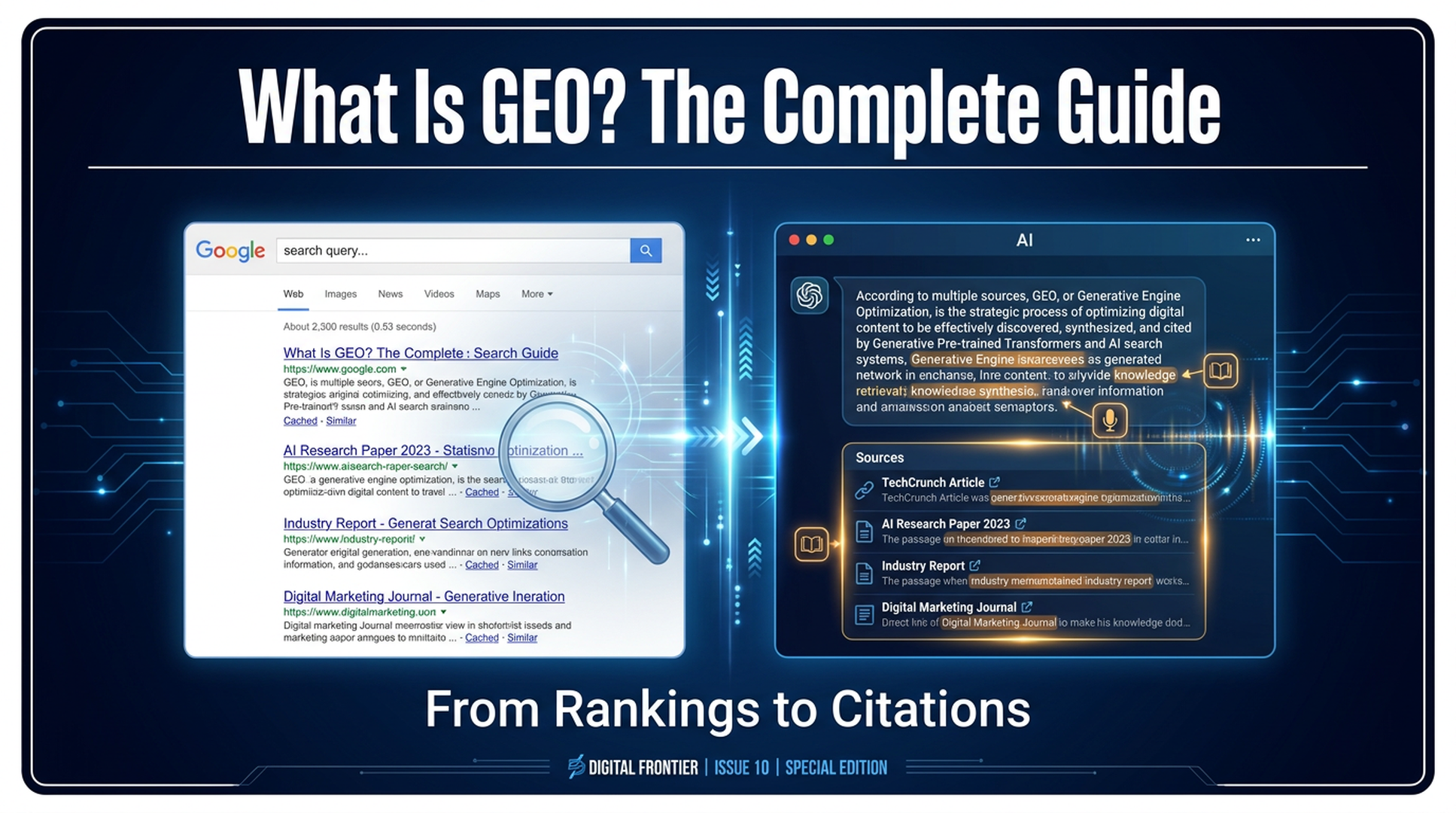
The fundamental difference from traditional search engines: they don't return a list of links. They generate a direct answer and cite the sources they deem most credible and relevant.
GEO solves one problem: how do you become the source that gets cited?
Why GEO Exists Now
To understand why GEO matters, you need to see what's changing.
Traditional search flow: User asks question → Search engine returns links → User clicks through to websites. In this model, if your page ranks on the first page, you get traffic.
AI search flow: User asks question → AI generates answer directly → Answer includes citation sources. In this model, users often don't need to click any links—the answer is already on the page.
This creates two effects:
First, traditional SEO traffic is declining. Even if your rankings haven't dropped, if user questions get answered directly by AI, they don't need to visit your page. That's why many site owners are seeing traffic decline even though rankings stayed the same.
Second, a new exposure channel has emerged. When AI cites your content, your brand name and website link appear in AI's answer. This is a new form of traffic and credibility—users see AI citing you, which dramatically boosts your perceived authority.
GEO exists because AI search is capturing search traffic. The question is: do you let AI cite you, or do you become invisible?
GEO vs. Traditional SEO: The Core Differences
Dimension | Traditional SEO | GEO |
|---|---|---|
What you optimize for | Search engine crawlers (algorithms) | AI model comprehension and citation mechanisms |
Core signals | Keyword density, backlink count, page speed, click-through rate | Content authority, structural clarity, question coverage completeness |
Exposure format | Blue link list, users click actively | Citation in AI answers, passive exposure |
Success metrics | Rankings, organic traffic, CTR | Citation frequency, brand mention count, AI-sourced traffic |
Content requirements | Keyword coverage, page structure, internal/external links | Data density, authoritative citations, FAQ coverage, structured headings |
Time to impact | Optimization typically takes weeks to months | Content can be picked up and cited by AI immediately after publishing |
These aren't opposing approaches. Content that's GEO-friendly is usually good for traditional SEO too—high-quality, well-structured, authoritative content is what search engines have always wanted.
But the reverse isn't true: content optimized for keyword density performs poorly under AI citation selection criteria.
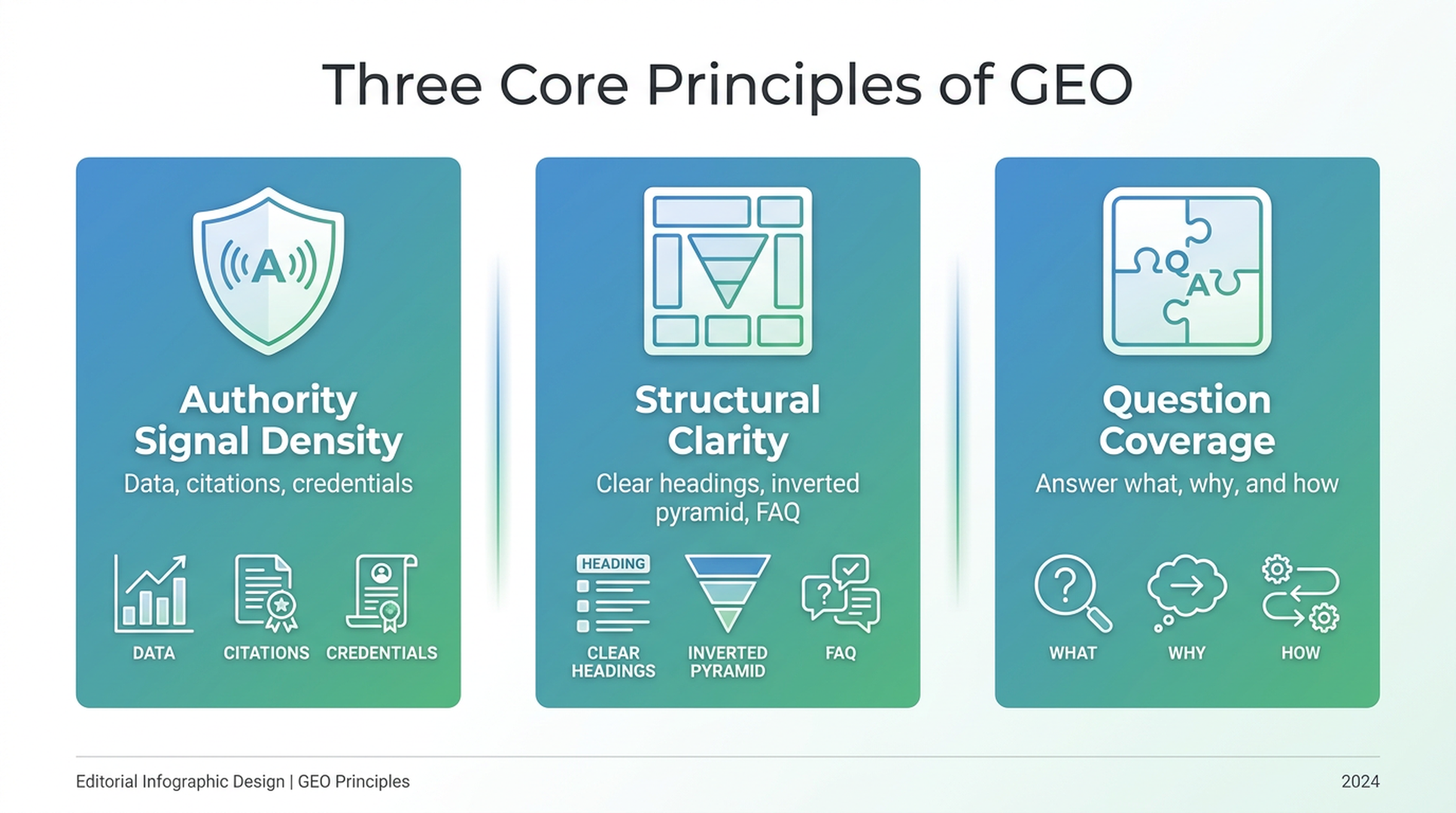
The Three Core Principles of GEO
Principle 1: Authority Signal Density
AI models strongly prefer content that's verifiable when selecting citations. Specifically, these elements significantly increase citation probability:
- Specific data: Numbers and sources beat vague descriptions
- Authoritative citations: Reference industry reports, academic research, known institutions
- Clear source attribution: "According to Semrush's 2024 report" is far more authoritative than "data shows"
- Author credentials: Clearly display the author's experience and qualifications on the page
❌ Low-authority writing: "AI search is becoming more popular, many people are using it."
✅ High-authority writing: "According to BrightEdge 2024 research, over 57% of search queries now trigger AI-generated answers, nearly doubling year-over-year."
Principle 2: Structural Clarity
AI understands content more like "scanning" than "reading." It needs to determine in seconds: what's this article's core argument? What questions does each section answer?
How to improve structural clarity:
- Use clear H2/H3 headings so article structure is immediately visible
- Put core conclusions at the start of paragraphs (inverted pyramid structure), not after setup
- Use FAQ sections to make implicit user questions explicit
- Present important content in lists or tables, not buried in long paragraphs
- Add a one-sentence definition or summary at the article start
Principle 3: Question Coverage Completeness
When someone searches "what is GEO," they have a chain of unspoken follow-up questions:
- How is GEO different from SEO?
- Do I need to do GEO?
- Where do I start?
- What tools are available?
If your content only answers "what is it" without extending to "why it matters" and "how to do it," AI will consider the coverage incomplete and cite content with fuller coverage instead.
This is why comprehensive long-form content outperforms fragmented content in the GEO era—it naturally covers a more complete question chain.
Common Misconceptions About GEO
Misconception 1: "GEO will replace SEO"
It won't. They serve different exposure channels and will coexist for a long time. The correct understanding: SEO handles traditional search engine exposure, GEO handles AI search engine exposure. You need both.
Misconception 2: "If content quality is good, it will naturally get cited"
Quality is necessary but not sufficient. AI has specific citation preferences (authority signals, structure, completeness). High-quality but poorly structured content gets cited less often than moderately good content with clear structure. You need both quality and structure.
Misconception 3: "GEO only works for English content"
It's true that GEO research is more mature for English, but AI search platforms in other languages have their own citation mechanisms. Many markets are still blue ocean for GEO optimization.
Misconception 4: "Getting cited by AI will directly bring massive traffic"
Direct click traffic from AI citations is currently limited (users may not click source links), but it delivers brand exposure and credibility endorsement. Long-term value exceeds short-term traffic value.
Where to Start: Practical Advice
After working in SEO for years, my assessment of GEO: this isn't a trend you can wait out.
Traditional SEO changes are usually gradual, giving practitioners time to adapt. But AI search penetration is moving faster, especially among highly educated, high-income user groups—exactly the audience most B2B and premium B2C brands care about most.
I've seen teams with strong rankings but zero citations in Perplexity and ChatGPT Search. They're invisible to these users.
From a practical standpoint, here's where to start: open Perplexity, search for your most important brand terms or core keywords, and see if AI's answer includes you.
If not, that's your GEO starting point.
GEO doesn't require starting from scratch. It's an upgrade to existing SEO content. Start with your highest-traffic articles, apply the three principles, and observe the changes.
The GEO Implementation Checklist
Content Audit
- Do your core pages include specific data with sources?
- Do you have FAQ sections that directly answer common user questions?
- Can each paragraph stand alone as a complete information unit?
- Is content regularly updated to maintain freshness?
Structure Optimization
- Are heading levels clear and logical (H1/H2/H3)?
- Are key conclusions placed at paragraph beginnings?
- Are important points presented in lists or tables?
- Does the article open with a clear definition or summary?
Authority Building
- Does your brand appear in industry media or platform coverage?
- Are there positive mentions in communities, forums, and social platforms?
- Are you publishing consistently in your domain?
- Are author credentials and experience clearly displayed?
Measurement
- Do you regularly query AI tools to check if your brand appears?
- Are you tracking AI mention rates, not just search rankings?
- Are you monitoring citation share across different AI platforms?
FAQ
What does GEO stand for? GEO stands for Generative Engine Optimization. It's the practice of optimizing content so AI-powered search and answer systems (ChatGPT, Perplexity, Gemini, Claude) cite and recommend it when answering user questions.
How is GEO different from SEO? SEO optimizes for search engine rankings and clicks. GEO optimizes for AI citations and mentions in generated answers. SEO targets blue links in search results; GEO targets being the source AI references. Both matter, but they require different optimization approaches.
Why does GEO matter now? AI search is capturing traditional search traffic. Even if your rankings haven't dropped, traffic may be declining because AI answers questions directly. When AI cites your content, you get brand exposure and credibility. When it doesn't cite you, you're invisible to these users.
What are the three core principles of GEO? Authority signal density (data, citations, credentials), structural clarity (clear headings, inverted pyramid, FAQ sections), and question coverage completeness (answering not just "what" but "why" and "how").
Does GEO work for non-English content? Yes. While GEO research is more mature for English, AI search platforms in other languages have their own citation mechanisms. Many markets are still blue ocean for GEO optimization.
How do I measure GEO success? Regularly query AI tools with your brand terms and core keywords. Track whether you appear in answers. Monitor citation frequency over time. Bing Webmaster Tools now offers GEO reporting with citation share data. Focus on AI mention rates, not just traditional search rankings.