Quick answer
SEO is not dead. The operating model has changed.
Generative Engine Optimization (GEO) is not one tactic, one plugin, or one content format. It is a working system that helps AI answer engines read your pages, understand your claims, trust your evidence, and cite your brand when users ask high-intent questions.
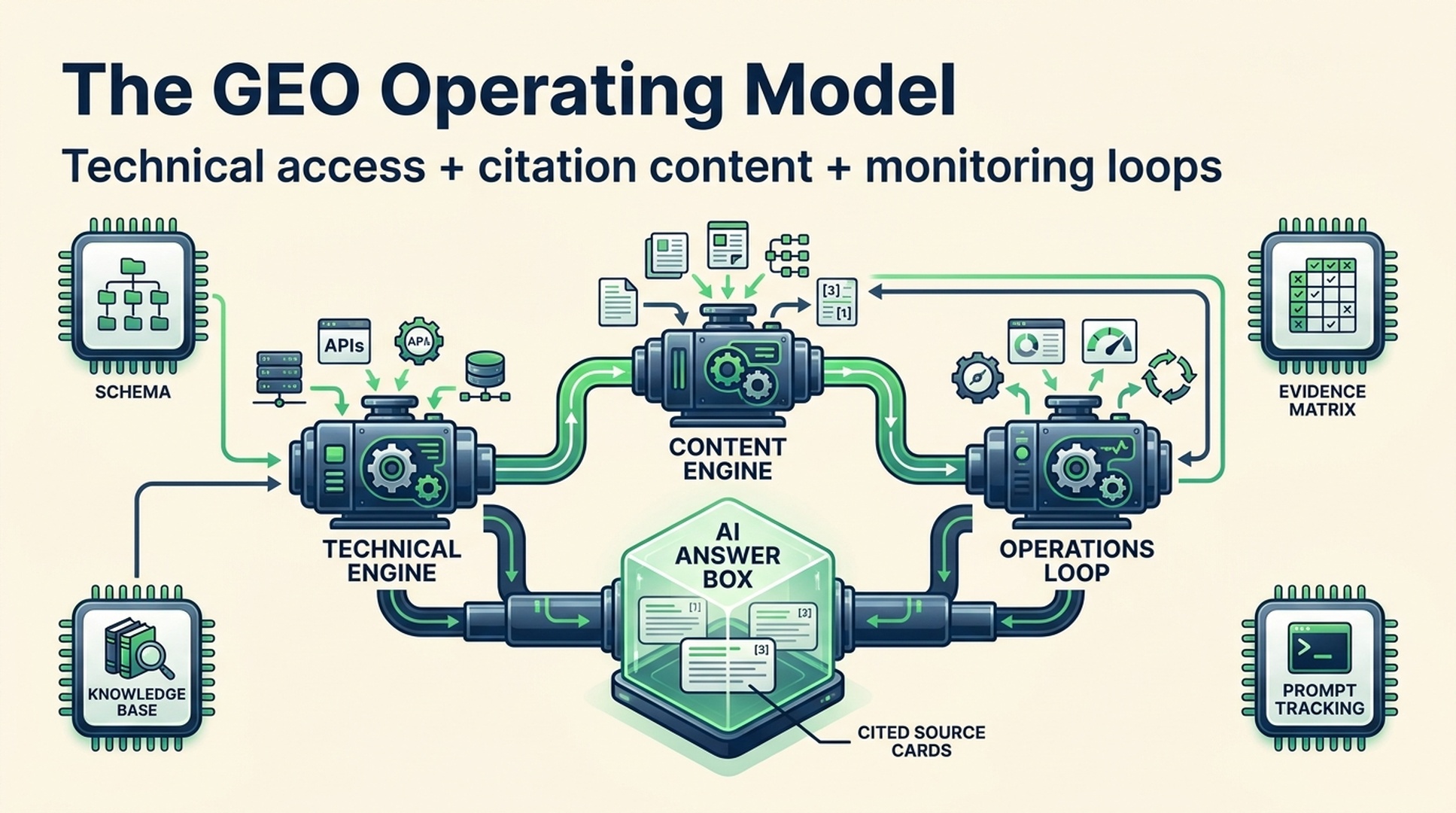
The practical GEO operating model has three workstreams:
- Technical access: make pages crawlable, structured, and machine-readable.
- Citation content: create answer blocks, proof assets, comparisons, FAQs, and knowledge pages.
- Operations loop: monitor prompts, track cited sources, refresh stale claims, and correct inaccurate AI summaries.
If SEO was mostly about winning the click, GEO is about becoming a trusted part of the answer.
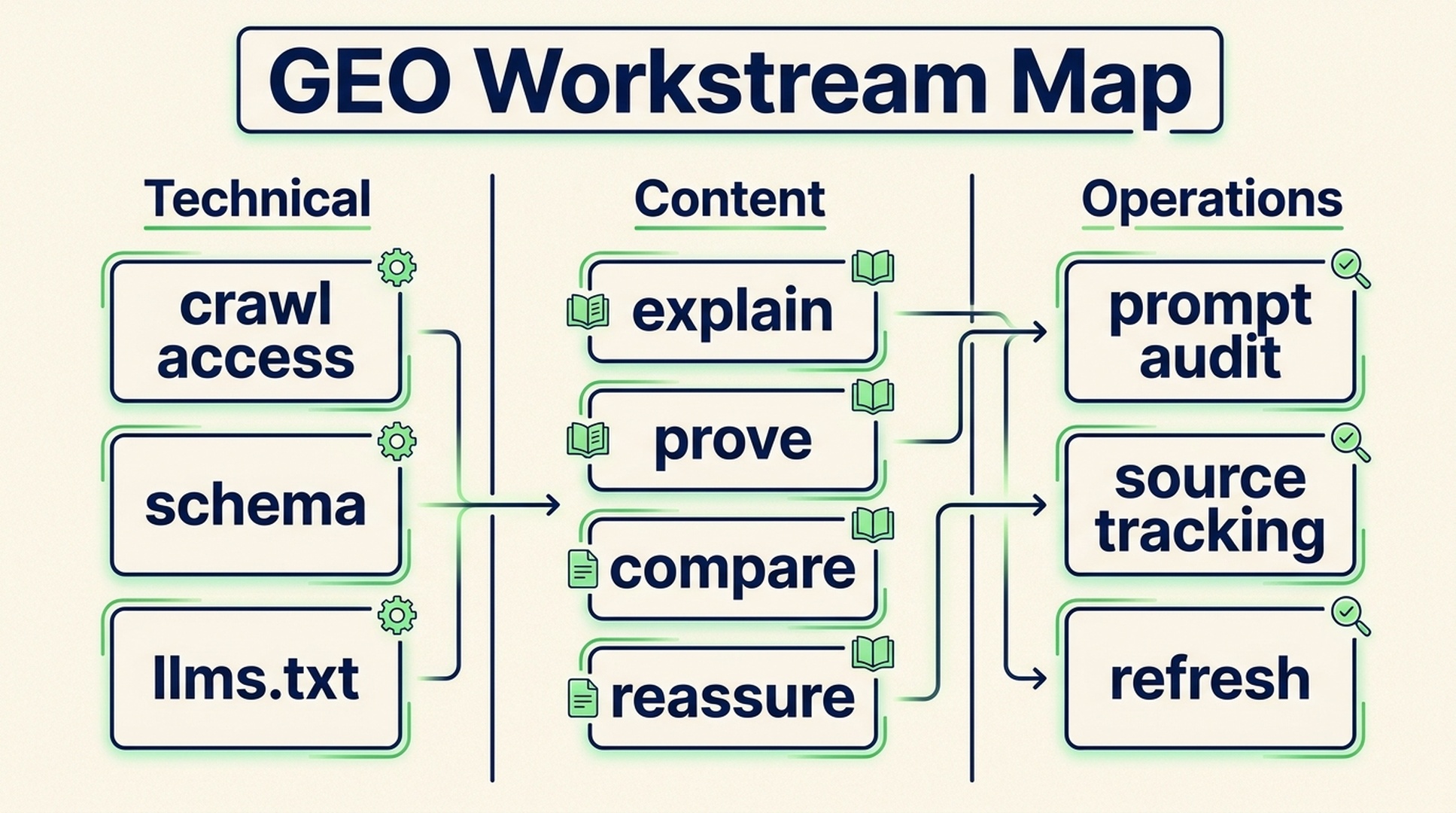
GEO works when technical access, content, and operations move together. A schema plugin alone will not fix weak source material.
Why the old SEO playbook is not enough
Search used to be a list of options. A user searched a keyword, scanned a results page, clicked a few links, and made a judgment.
AI search compresses that path. A user asks, "Which phone charges fastest without overheating?" or "Which payroll platform works for a US startup hiring in Germany?" The answer engine reads sources, synthesizes the response, and may recommend a short list before the user ever visits a website.
That shift changes the job of marketing content.
Ranking still matters. Crawl access still matters. Links still matter. But AI systems need more than a page that can rank. They need passages that can be retrieved, facts that can be checked, and sources that are consistent across the web.
A brand can rank well and still be absent from AI answers if its useful information is buried, vague, outdated, or unsupported. A smaller brand can sometimes earn AI mentions if it answers a narrow question more clearly than larger competitors.
GEO vs SEO: the real difference
The simplest distinction is this:
SEO helps users find you. GEO helps AI systems recommend or cite you.
Dimension | Traditional SEO | GEO |
|---|---|---|
Core goal | Rank and earn clicks | Become a trusted source in generated answers |
Main reader | Search engine crawler and human searcher | Retrieval system, LLM, and human reader |
Main assets | Optimized pages, links, topic clusters | Structured data, answer blocks, knowledge base, proof assets |
Main metrics | Rankings, impressions, CTR, organic sessions | AI mentions, citation share, answer accuracy, AI referrals |
Advantage | Authority, relevance, technical health | Extractability, evidence, consistency, source trust |
This is not a clean replacement. GEO sits on top of SEO. If your site cannot be crawled, if canonical tags are broken, if pages duplicate each other, or if your content is thin, GEO has a weak foundation.
Workstream 1: the technical engine
The technical engine makes your content readable by machines. It does not make weak content persuasive, but it lowers the cost for AI systems to understand what each page contains.
Start with five checks.
Crawl access
Review robots.txt, sitemap.xml, canonical tags, noindex rules, and blocked resources. Important public pages should be easy to crawl. Private, duplicate, or low-value pages should be handled deliberately.
Schema markup
Use schema that matches the page. Most commercial sites should start with Organization, Product, Service, Article, FAQPage, BreadcrumbList, and Review where appropriate. Do not add irrelevant schema just because it exists.
Clean page structure
Use semantic headings, HTML text, descriptive tables, and accessible image alt text. Avoid putting critical specifications only inside images or videos. If a video matters, add a transcript.
llms.txt
Add a short /llms.txt file that points to your best pages and explains what each page contains. Treat it as a map for AI systems, not a substitute for good content.
Speed and stability
A slow or fragile page is a bad source. Fix render-blocking problems, mobile usability, broken links, and heavy scripts on the pages you want AI systems to read.
If you need a quick first pass, run a technical audit with tools such as a Website SEO Score Checker, then manually inspect the pages that matter most for revenue.
Workstream 2: the content engine
The content engine turns pages into citable assets. The goal is not to publish more. The goal is to answer buyer questions with enough clarity and proof that an AI system can safely use the answer.
For most brands, the best content matrix has five jobs.
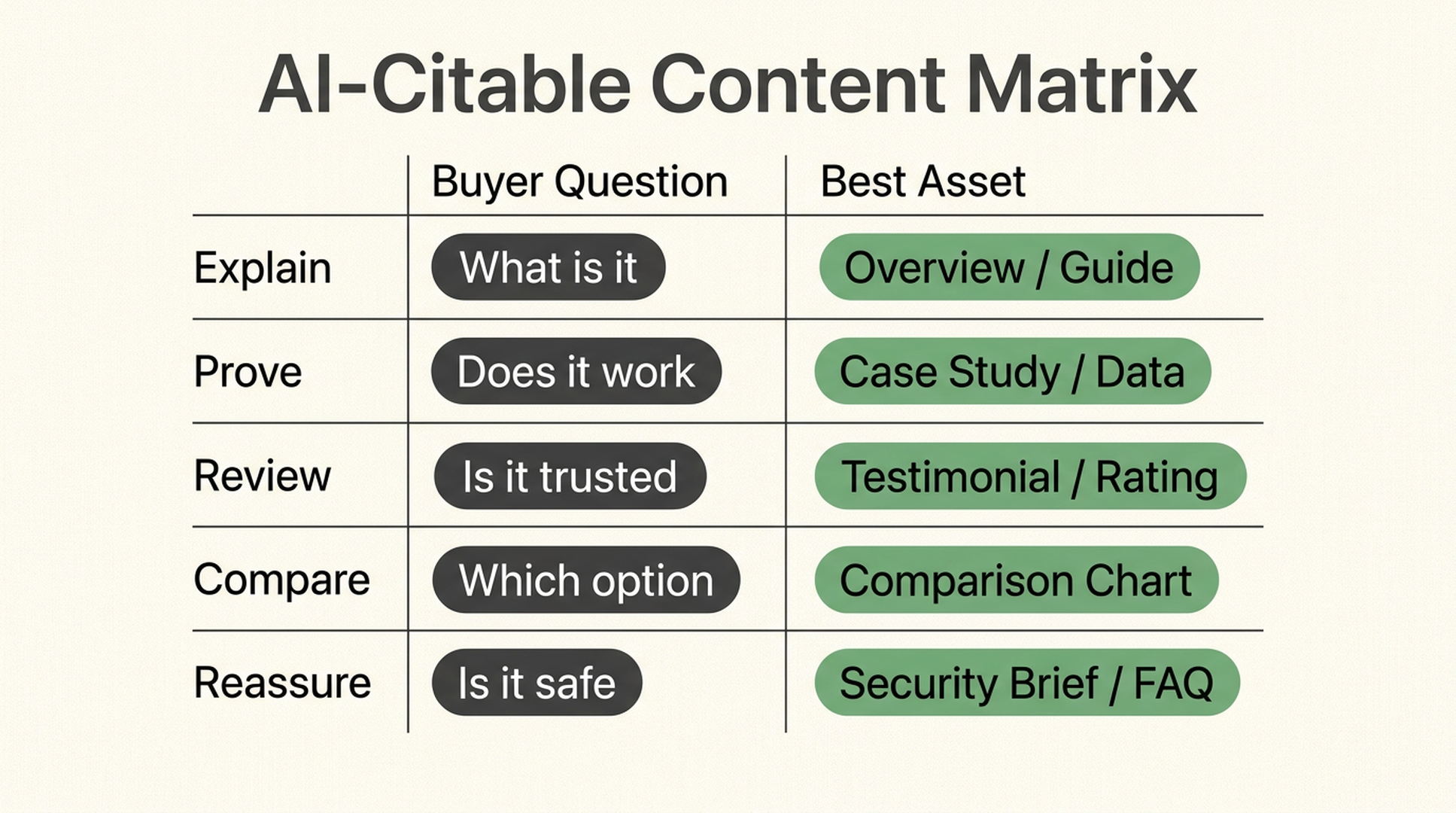
Build content around the questions an answer engine has to solve: explain, prove, review, compare, and reassure.
Explain: what is it?
Create guides that define the category, the problem, the use case, and the product in plain language. Avoid internal jargon. If a buyer would not say the phrase, do not make it the heading.
Example asset: "What is revenue intelligence software?" with a clear definition, who uses it, what data it needs, and when a spreadsheet is enough.
Prove: does it work?
Publish evidence that supports claims. This can include benchmarks, case studies, test methods, customer examples, certification details, or product documentation.
A strong proof asset includes context. "5-minute setup" is weak unless you explain the setup, required permissions, sample size, date, and limits.
Review: is it trusted?
AI systems may compare your claims with reviews, community discussions, and third-party profiles. Keep those profiles accurate. Encourage detailed customer reviews that mention use case, company size, outcome, and constraints.
Compare: which option should I choose?
Comparison pages are important because buyers ask comparison prompts. Write them honestly. Name who each option is best for. Include dated facts. Admit where a competitor may be a better fit.
That honesty often makes the page more useful and more citable.
Reassure: is it safe?
Every serious purchase has objections. Address them directly. For software, that may mean security, compliance, migration, support, pricing, and vendor lock-in. For ecommerce, it may mean safety, durability, shipping, returns, and warranty.
A page that answers the risk question can win the final mile of an AI recommendation.
Workstream 3: the operations loop
GEO is not a one-time launch. AI answers change as models, indexes, sources, and competitors change.
The operations loop has four parts.
Prompt audit
Create a fixed prompt set. Include buyer questions, comparison prompts, problem prompts, risk prompts, and competitor prompts. Run them in the AI tools your audience uses.
Track the basics: brand mentioned, cited URL, competitors mentioned, answer accuracy, and missing sources.
Source tracking
When an AI answer cites a source, log it. Is it your site, a review platform, a directory, a partner page, a forum, or a media article? This tells you which source pools matter in your category.
Content refresh
Update stale claims, old pricing language, retired integrations, and outdated screenshots. Add dateModified where your CMS supports it. AI systems and human buyers both punish stale pages.
Negative-answer defense
Some prompts will surface objections or outdated criticism. Do not try to bury them with fluff. Publish factual clarification pages, update documentation, respond on review platforms, and make the current policy easy to cite.
A three-phase rollout plan
Use a three-phase loop instead of a vague GEO initiative.
Phase | Goal | Output |
|---|---|---|
1. Diagnose and build | Understand current AI visibility and fix technical access | Prompt audit, source map, schema plan, priority page list |
2. Publish and distribute | Create citable assets across owned and trusted third-party sources | Guides, FAQs, comparison pages, proof assets, profile updates |
3. Monitor and improve | Learn which sources are cited and refresh the system | GEO dashboard, monthly content refresh, competitor gap list |
Auspia’s rule: do not scale content before diagnosis. If AI systems already cite a competitor's review profile for your core prompts, publishing 30 blog posts may not solve the source gap. You may need better directory data, stronger documentation, or third-party proof.
Example: applying GEO to a product category
Take a fictional fast-charging smartphone brand. A user asks:
Which phone charges fastest but is still safe for long-term battery health?
A GEO program should not answer that with one generic article. It should create a source system.
Buyer concern | Content asset | Proof needed |
|---|---|---|
How does fast charging work? | Technology explainer | Plain-language mechanism and diagrams |
Does it really charge faster? | Benchmark page | Test setup, temperature, device model, timing |
Does it damage the battery? | Safety FAQ | Battery health data, warranty terms, limits |
Which model should I buy? | Comparison guide | Model table, price, charging specs, use case |
Do real users trust it? | Review summary | Long-term reviews, common complaints, support response |
The same pattern works for SaaS, local services, healthcare, education, financial tools, and B2B manufacturing. The question changes. The operating model does not.
Metrics that matter
SEO teams know how to track rankings and clicks. GEO needs a broader scorecard.
Metric | Why it matters |
|---|---|
AI mention rate | Shows whether your brand appears in answer outputs |
Citation share | Shows whether your owned or preferred sources are used |
Answer accuracy | Shows whether AI systems describe you correctly |
Source diversity | Shows whether you have proof beyond your own site |
Prompt coverage | Shows which buyer questions you can answer |
AI referral traffic | Shows measurable visits from AI surfaces where available |
Assisted conversions | Shows whether AI-sourced visits contribute to pipeline or sales |
Do not wait for perfect attribution. Start tracking the signals you can see now.
Common mistakes
The first mistake is thinking technical markup is the whole job. Schema helps machines read a page, but it cannot create proof where none exists.
The second mistake is producing content without a prompt map. If you do not know the questions buyers ask, you will publish pages that answer nobody.
The third mistake is ignoring third-party sources. AI systems often lean on review platforms, directories, documentation, media, and community discussions. Your website is the center, not the whole universe.
The fourth mistake is treating GEO as a campaign. It is closer to an operating rhythm: audit, publish, distribute, monitor, refresh.
Auspia takeaway
The new playbook is not "SEO is dead." The new playbook is "SEO plus GEO operations."
Technical access lets AI systems read you. Citable content gives them something useful to quote. Operations keep your source trail accurate as models and competitors change.
Start with ten prompts, ten pages, and ten source profiles. Fix those before scaling. That is how GEO becomes an operating model instead of another marketing slogan.
FAQ
What is a GEO operating model?
A GEO operating model is the repeatable system a team uses to improve AI search visibility. It combines technical access, structured content, evidence, third-party source management, prompt monitoring, and content refresh.
Is GEO only technical SEO?
No. Technical SEO is one part of GEO. GEO also requires direct answer writing, credible proof, third-party consistency, and monitoring of how AI tools mention and cite the brand.
What should a brand optimize first?
Start with the pages and prompts closest to revenue: product pages, comparison pages, pricing, documentation, case studies, FAQs, and the third-party profiles AI tools already cite in your category.
How often should GEO content be refreshed?
Refresh high-intent pages monthly or quarterly, depending on the category. Update pricing, claims, integrations, screenshots, schema, and dates whenever the underlying facts change.
Can GEO work without third-party mentions?
It can start with owned content, but third-party mentions usually improve trust. Review sites, partner pages, directories, analyst mentions, and community discussions help AI systems verify your claims.
How do I know which AI sources matter?
Run a prompt audit and log cited sources. If the same review site, directory, documentation page, or media source appears repeatedly, that source pool matters for your category.