Executive summary
A lot of GEO advice sounds confident and still misses the point.
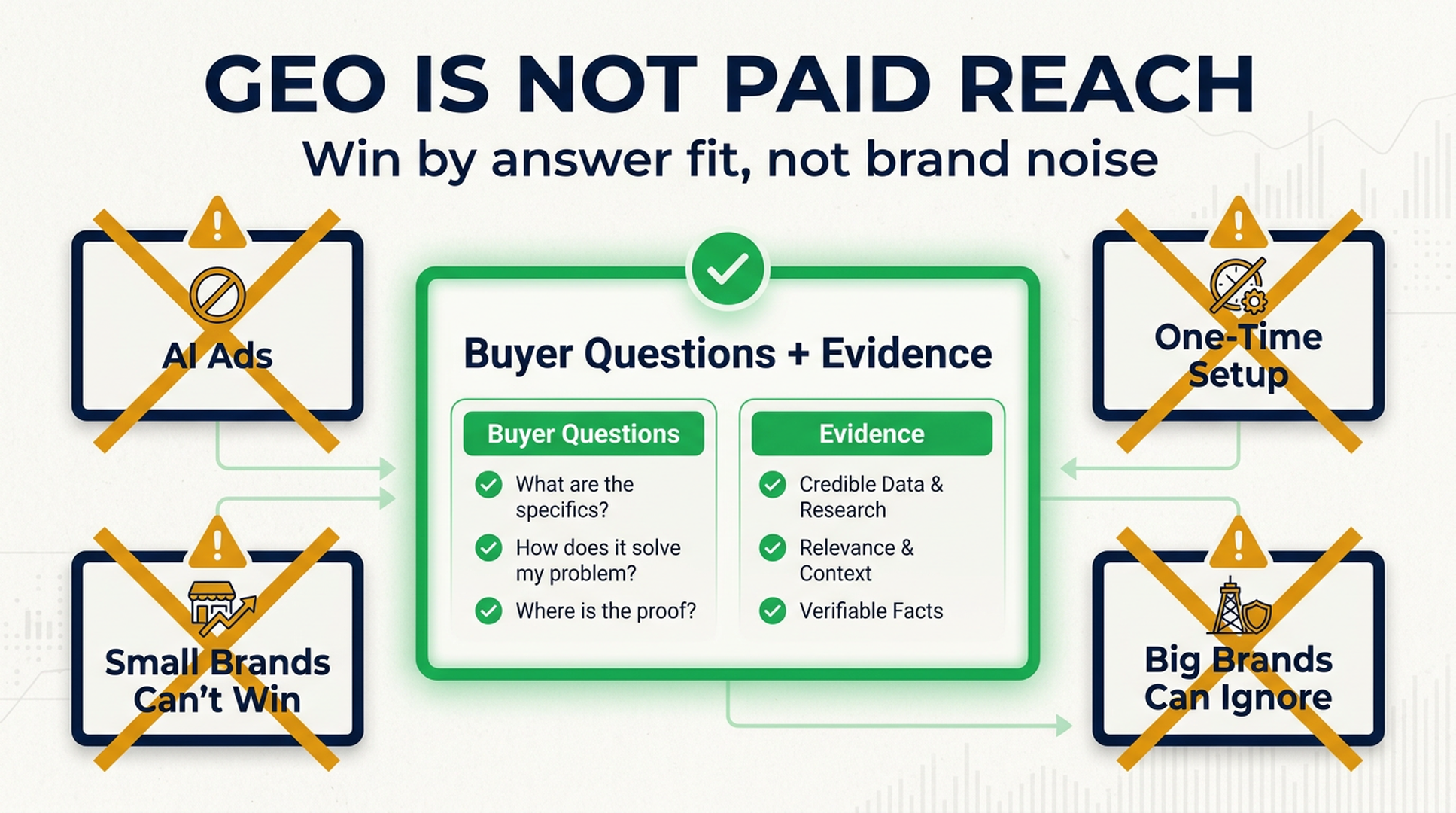
GEO is not AI advertising. It is not a switch you turn on once. It is not reserved for big brands. And big brands cannot ignore it just because people already know their names.
The practical job is simpler and harder: translate what your company says into the questions your buyers actually ask, then create enough accurate, current, and useful source material for AI systems to understand when your brand is a good recommendation.
If you only remember one thing, make it this: GEO is won by answer fit, not by brand noise.

Misconception 1: GEO is AI advertising
Paid search is simple to understand. You buy visibility. If the budget is high enough and the campaign is managed well, you can appear in front of the right audience.
AI answers do not work that way.
When a user asks ChatGPT, Perplexity, Google AI Overviews, Gemini, or Copilot for help choosing a product, the system is not running the same auction logic as a search ad. It is trying to answer a question with information it can retrieve, understand, and trust.
That changes the job for marketers.
Most companies describe products in company language:
Company language | Buyer language |
|---|---|
"Enterprise-grade AI workflow orchestration" | "Can this help my team automate weekly reporting?" |
"Omnichannel customer engagement platform" | "How do I reduce support tickets without losing customer context?" |
"Advanced GEO and AEO optimization suite" | "Why is my brand missing from AI search answers?" |
"Proprietary performance framework" | "How long will setup take, and what do I need to change?" |
GEO starts when you bridge that gap.
Your page has to say what the product does in terms a buyer would use while asking an AI system for advice. That means use-case pages, FAQs, comparison tables, setup guides, proof points, and honest limitations. Not slogan-heavy landing pages.
A useful test: if a real customer would never type your headline into an AI assistant, rewrite it.
Misconception 2: GEO is a one-time setup
Some teams treat GEO like a launch checklist. Publish a few pages. Add schema. Mention AI search in the headline. Run a visibility check. Done.
That is too shallow.
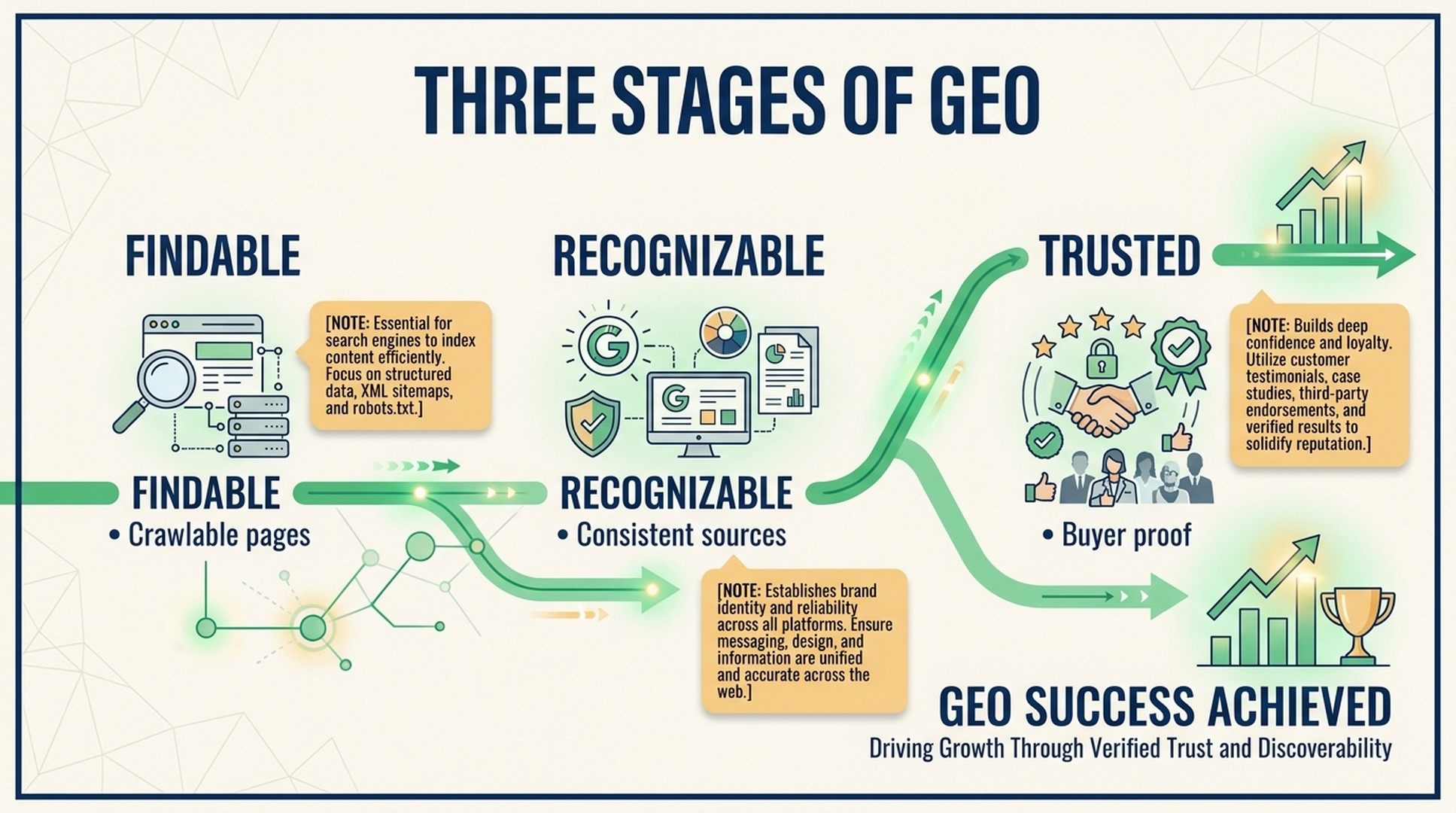
GEO usually has three stages.
Stage | What it means | What to do |
|---|---|---|
AI can find you | Your pages and profiles are crawlable and relevant | Fix technical access, publish answer-ready pages, update third-party profiles |
AI can recognize you | Your brand appears consistently across sources | Align product descriptions, categories, proof points, and use cases |
Users can trust you | The recommendation makes sense after the click | Show evidence, current details, limitations, and a clear next step |
The third stage is where many teams fail. They chase AI mentions, but the source experience behind the mention is weak. A buyer clicks through and sees vague copy, outdated screenshots, thin claims, or no proof.
That is not a GEO win. It is a leaky first impression.
GEO compounds when a brand keeps improving the source base: product pages, documentation, review profiles, case studies, comparison pages, videos, transcripts, and community answers. Search engines and AI systems may update their indexes at different speeds, but stale information eventually becomes a liability.
Set a maintenance rhythm. Important GEO pages should be reviewed at least quarterly, and faster if your product, pricing, integrations, or positioning change.
Misconception 3: small brands cannot win
Small brands often assume GEO is another game where bigger companies buy the best spots.
That is the old advertising reflex talking.
AI systems are trying to solve the user's problem. A large brand has advantages: more mentions, more links, more reviews, more public data. But a smaller brand can still become the better answer for a specific question.
That specificity matters.
A small SaaS company probably will not win a broad query like "best CRM." But it may compete for:
- "best CRM for a three-person immigration law firm"
- "CRM with WhatsApp follow-up for Latin America sales teams"
- "simple CRM for founders who hate pipeline admin"
- "HubSpot alternative for a bootstrapped agency under $100 per month"
The smaller the company, the more precise the source strategy should be.
Small brands should focus on:
- Narrow use cases where they have a real advantage.
- Detailed pages that answer one buyer question well.
- Honest comparisons against larger tools.
- Customer proof from a specific segment.
- Founder or expert content that explains the problem better than generic category pages.
- Third-party profiles where the category and use case are accurate.
A small brand does not need to be the answer for everyone. It needs to be a credible answer for the right situation.
Misconception 4: big brands can ignore GEO
Big brands have the opposite problem. They assume awareness will carry over into AI answers.
Sometimes it will. Often it will not.
AI systems do not only ask, "Who is famous?" They also weigh freshness, relevance, specificity, evidence, and fit for the user's query. A well-known brand with stale pages can lose a narrow recommendation to a smaller competitor with clearer documentation and sharper use-case content.
This is especially true when the user asks for constraints:
- "Which tool is best for a small team?"
- "Which vendor supports this integration?"
- "Which option is easiest to implement in two weeks?"
- "Which platform is better for regulated industries?"
- "Which service has transparent pricing?"
A big brand that only publishes broad messaging leaves gaps. Smaller competitors can fill those gaps with precise source pages.
Big brands should audit where their public information is too generic. They often need more practical pages, not more brand pages: implementation guides, segment-specific comparisons, FAQ hubs, migration notes, pricing explainers, and current documentation.
Brand awareness helps. It does not replace answer quality.
The better way to think about GEO
The cleanest way to understand GEO is this:
GEO turns company knowledge into answer-ready source material.
That source material has to satisfy three audiences at once.
Audience | What they need |
|---|---|
AI systems | Crawlable, structured, consistent information |
Human buyers | Clear answers, proof, tradeoffs, and next steps |
Your team | A maintainable system for updating facts over time |
If a page only satisfies the AI system, it may become spam. If it only satisfies the brand team, it may be too vague to retrieve. If it only satisfies one campaign, it will decay.
GEO works best when it becomes part of the publishing standard.
Before publishing a page, ask:
- Which buyer question does this answer?
- Would a non-expert understand the answer in 30 seconds?
- Does the page include proof near the claim?
- Does the page say when the product is not a fit?
- Is the same fact consistent across our website, docs, reviews, and profiles?
- Can AI systems access the content without friction?
These questions sound basic. That is the point. Most GEO problems are basic source problems wearing a new name.
A 10-point GEO reality check
Use this quick audit before investing in more content.
Check | Good sign | Warning sign |
|---|---|---|
Buyer language | Pages use the words customers use | Pages use only internal product language |
Direct answer | The conclusion appears near the top | The page opens with brand storytelling |
Use-case fit | Specific segments and scenarios are named | The product is "for everyone" |
Evidence | Claims have examples, data, docs, or proof | Claims rely on adjectives |
Freshness | Dates, screenshots, pricing, and integrations are current | Old pages contradict current product reality |
Structure | Definitions, tables, FAQs, and lists are easy to parse | Long blocks of promotional copy dominate |
Third-party consistency | Profiles and directories match owned pages | Review sites, listings, and social bios disagree |
Technical access | Crawlers can reach the important pages | Important answers sit behind scripts, PDFs, or gated flows |
Click experience | The page helps the user decide | The page only tries to capture a lead |
Maintenance | Owners and review cycles are clear | Nobody owns the page after launch |
If you score poorly, do not start with a new content calendar. Fix the pages closest to revenue first.
How Auspia would start
For most teams, the first GEO sprint should be boring in the best way.
- Pick five buyer questions that affect revenue.
- Search those questions in several AI systems and record what appears.
- Identify whether your brand is absent, misdescribed, or poorly supported.
- Update one page per question with a direct answer, proof, FAQ, and next step.
- Clean the third-party profiles that AI systems might use.
- Re-test monthly and track answer accuracy, not just mentions.
An AI search visibility checker can help you find the first set of gaps, but manual review still matters. Read the answers like a buyer would. If the AI answer mentions you but the reasoning is weak, you still have work to do.
Auspia takeaway
GEO is not paid reach. It is not a shortcut. It is not only for large brands.
It is the work of making your company easier to understand at the moment a buyer asks for help.
Small brands can win narrow, high-intent questions by being more specific than larger competitors. Big brands can lose those same questions when their public sources get stale or too generic.
The best move is not to chase every AI mention. Start by translating your product into buyer language. Then build the source pages that make the recommendation obvious.
That is GEO without the hype.
FAQ
Is GEO just another kind of advertising?
No. Advertising buys placement. GEO improves the source material AI systems may use when answering user questions. It depends on relevance, evidence, structure, consistency, and accessibility.
Can a small brand compete in GEO?
Yes, especially on narrow buyer questions. Small brands should focus on specific use cases, clear proof, accurate third-party profiles, and pages that answer real questions better than broad category pages.
Why can a big brand lose in AI search?
A big brand can lose when its content is too generic, outdated, or poorly matched to the user's constraints. AI systems often need specific answers, not just brand awareness.
How long does GEO take?
Some fixes can improve visibility quickly once pages are crawled or retrieved, but durable GEO takes repeated improvements across owned pages, documentation, third-party profiles, and proof assets.
What is the first page to update for GEO?
Start with the page closest to a high-intent buyer question. Usually that is a use-case page, comparison page, FAQ page, pricing explainer, or product page that already gets qualified traffic.