Quick answer: GEO is moving from readable pages to callable data
Agent search changes the job of GEO.
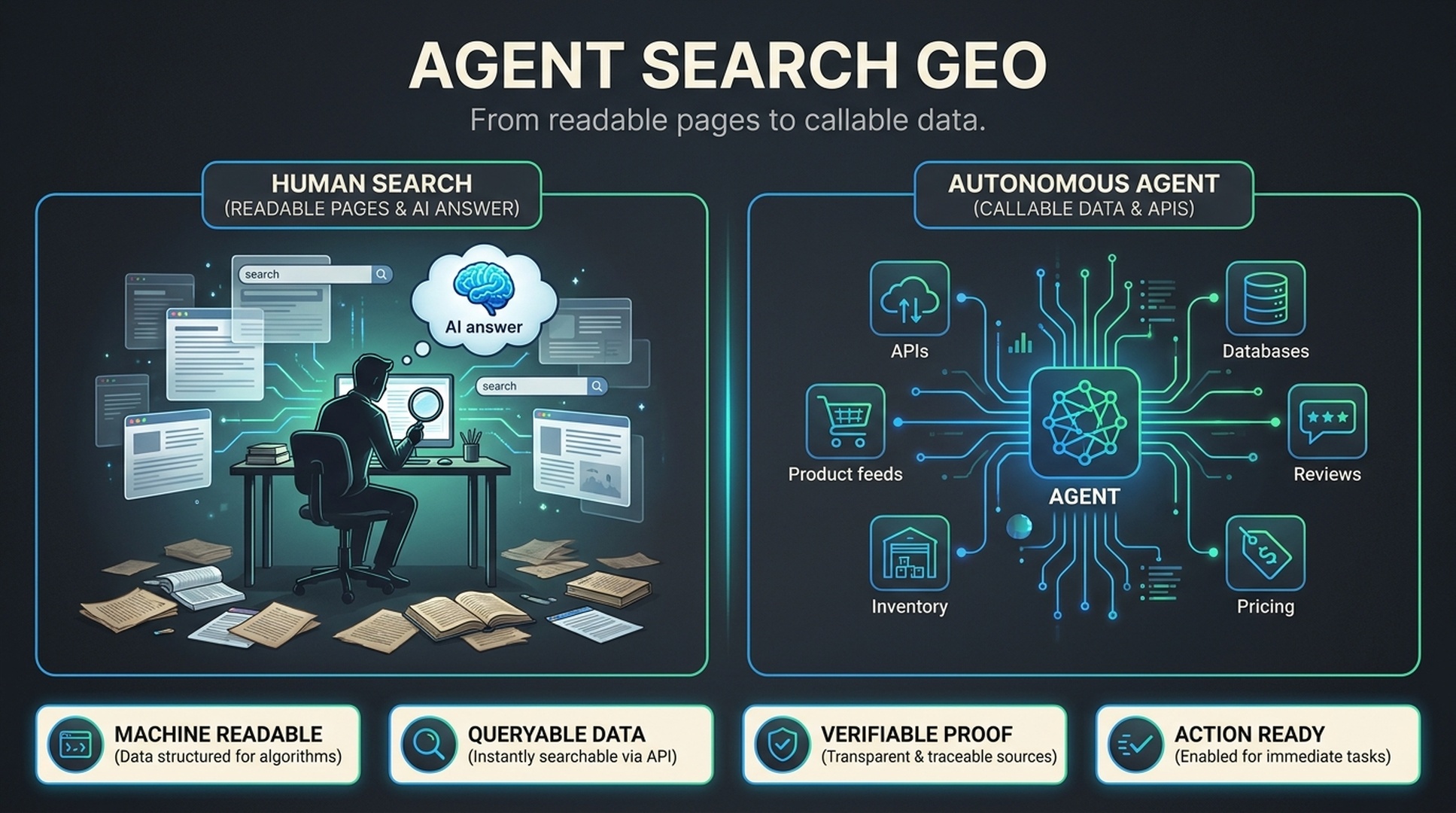
Classic GEO asks whether an AI answer can find, understand, cite, and recommend your brand. Agent search asks a harder question: can an autonomous agent query your data, verify it, and use it to complete a task for the user?
That difference sounds technical, but it is commercial. A buyer reading an AI answer may click a cited article. An agent booking software, comparing vendors, checking inventory, or building a shortlist may never read an article at all. It will call APIs, inspect structured feeds, compare fields, verify reviews, and choose the path that is easiest to execute.
So the next version of GEO is not only about being mentioned. It is about being usable.
This article explains what agent search means for SEO, GEO, AEO, and AI visibility, and how teams can prepare before the channel becomes crowded.
What agent search means
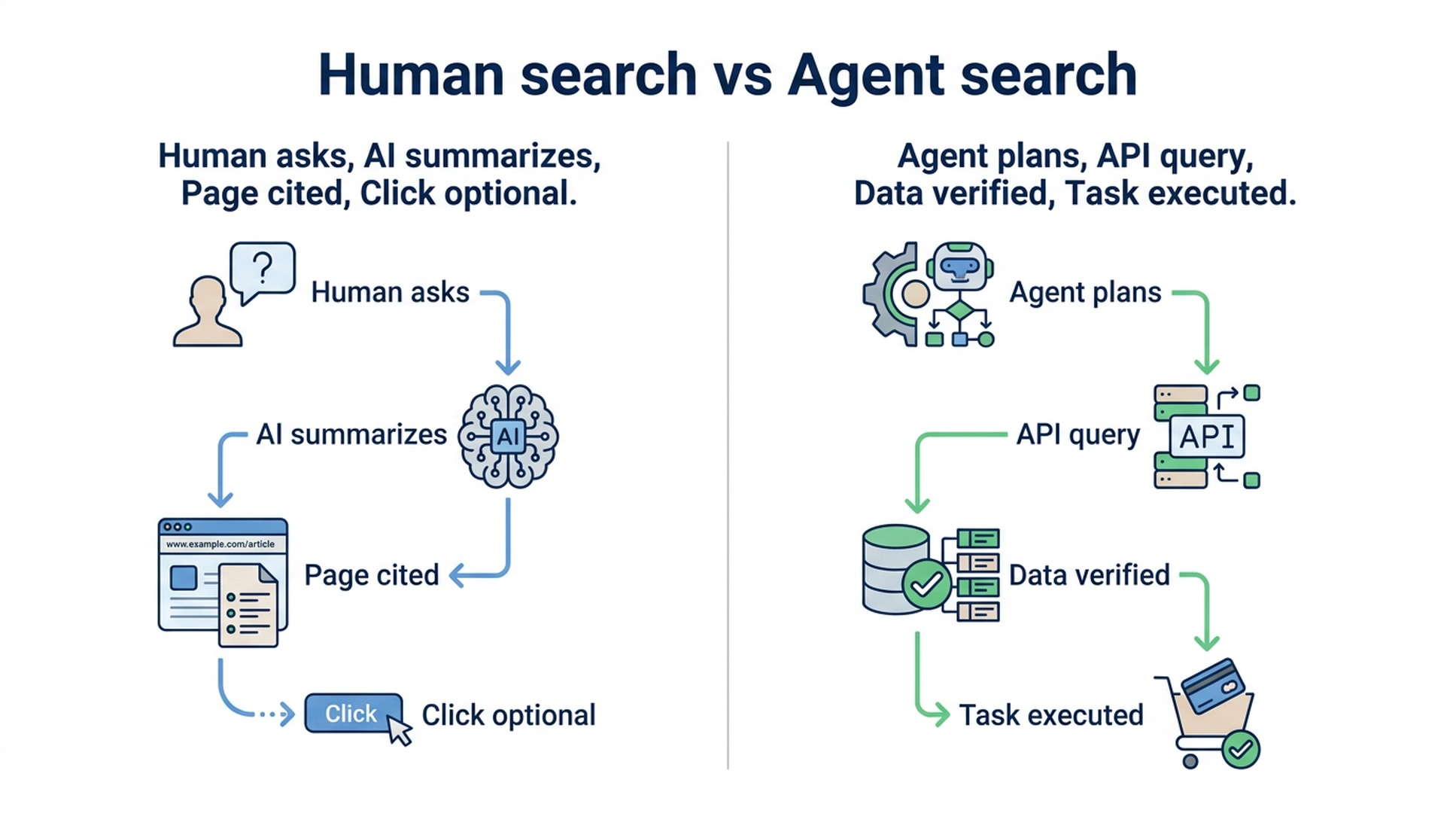
Human search is built around attention. A person types a query, scans results, reads snippets, opens pages, and decides what to trust.
AI search compresses that behavior. A person asks a question, the system summarizes sources, and the user may or may not click through.
Agent search goes one step further. The "user" of search is no longer only a person. It may be an AI agent trying to complete a task:
- find a hotel that matches budget, dates, ratings, and location;
- compare payroll tools for a 200-person remote company;
- choose a supplier with current certifications and delivery capacity;
- check product availability, price, warranty, and return policy;
- prepare a shortlist of vendors for a procurement workflow.
In those cases, the agent does not want a poetic brand story. It wants clean facts, stable identifiers, dates, prices, constraints, evidence, and an action path.
A blog post can still influence the answer layer. But when the agent reaches the execution layer, a structured product feed beats a beautiful paragraph.
The three gaps most GEO programs miss
Most GEO work today still assumes a human is near the end of the journey. That assumption is becoming weaker. Agent search exposes three gaps.
Gap | Human-search GEO | Agent-search GEO |
|---|---|---|
Consumer | A human reads or scans an AI answer | An agent parses, queries, and executes |
Source unit | Page, article, review, directory listing | API, database, feed, schema, endpoint |
Goal | Visibility and citation | Usability, verification, and action |
The first gap is the reader. A human may notice tone, positioning, and narrative. An agent mostly ignores those signals unless they map to extractable facts. This does not mean writing stops mattering. It means writing is only one interface.
The second gap is the source. In AI search, you compete to be cited. In agent search, you compete to be queried. That is a different kind of visibility. If your price, availability, product coverage, locations, or eligibility rules only live inside messy page copy, the agent may choose a competitor with cleaner data.
The third gap is the goal. GEO has focused on presence: does the brand appear in the answer? Agent search adds action: can the system do something useful with the brand?
From "AI can read us" to "agents can use us"
A simple example makes this clearer.
Imagine a traveler asks an agent: "Book me a quiet hotel near the conference venue, under $250 per night, with late check-in and free cancellation."
A traditional article titled "Best hotels near the convention center" may help an AI answer explain the neighborhood. It may even earn a citation. But the booking agent needs current availability, room types, cancellation rules, distance, ratings, and payment flow.
If one hotel has readable content but no accessible structured data, and another has a clean availability feed plus reliable reviews, the second hotel has the advantage at the moment of action.
The same pattern applies outside travel:
Category | Human-readable asset | Agent-usable asset |
|---|---|---|
SaaS | "Best CRM for startups" guide | Feature matrix, pricing API, integration docs, security questionnaire |
Ecommerce | Product description page | SKU feed, inventory status, shipping rules, review metadata |
Local services | Service-area landing page | Location schema, appointment slots, price bands, verified reviews |
B2B services | Thought leadership article | Capability taxonomy, case evidence, industry certifications, contact endpoint |
Financial products | Educational guide | Eligibility rules, rates, disclosures, calculator inputs |
The future will not choose one side. Strong brands will need both: content for humans and structured data for machines.
Data readiness becomes part of GEO
Auspia's view is that agent search adds a new layer to GEO: data readiness.
Data readiness means your brand information is not trapped in prose, PDFs, screenshots, or JavaScript-only pages. It can be retrieved, compared, checked, and used by systems that do not browse the web like a human.
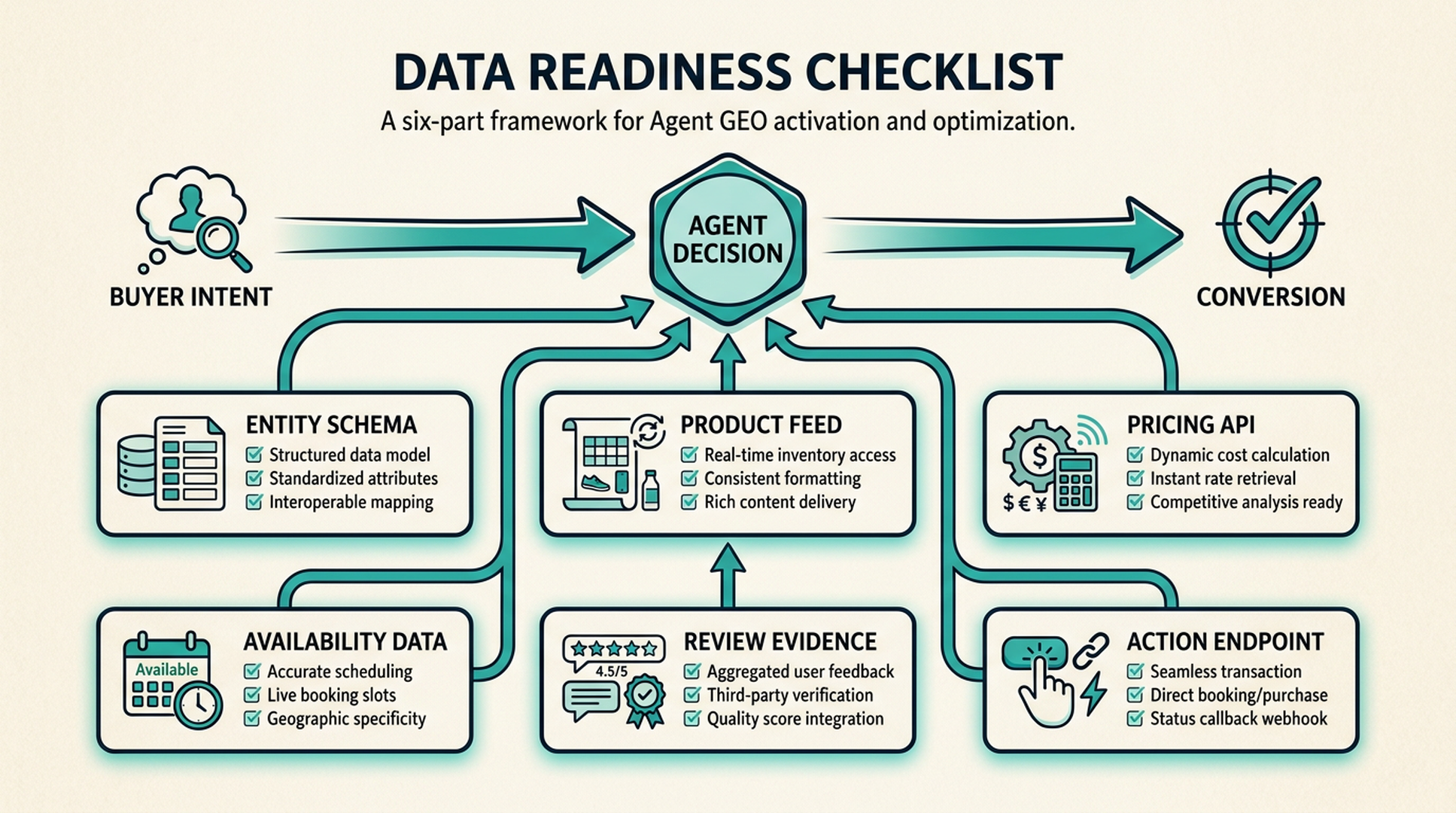
Start with six areas.
Area | What to prepare | Why it matters |
|---|---|---|
Entity schema | Organization, product, person, local business, FAQ, review, and offer markup where accurate | Helps systems identify what the brand is and how facts connect |
Product or service feed | Clean attributes, categories, IDs, availability, regions, and use cases | Gives agents a queryable source instead of a vague page |
Pricing and eligibility data | Price ranges, plans, exclusions, conditions, and update dates | Reduces uncertainty in comparison and shortlist tasks |
Review evidence | Traceable reviews with dates, sources, ratings, segments, and moderation rules | Helps agents judge trust without relying only on brand claims |
Documentation and policy pages | API docs, support docs, returns, compliance, security, and SLAs | Lets agents verify details before recommending action |
Action endpoints | Booking, checkout, demo request, quote request, callback, or integration flow | Turns visibility into task completion |
This is not a call to publish private business data everywhere. It is a call to separate three layers: public facts, partner-accessible data, and protected internal data. Agent readiness does not mean reckless openness. It means intentional access.
Why content teams need a new habit
Content teams are used to asking, "Is this useful to the reader?"
Keep asking that. But add a second question: "Can this be converted into parameters?"
A buying guide should still explain how to choose. It should also expose the decision rules in a clean way. For example:
Human wording | Machine-friendly version |
|---|---|
Best for growing teams |
|
Works well for regulated industries |
|
Good for budget-conscious buyers |
|
Available in major cities |
|
Strong customer support |
|
This is where SEO, product marketing, analytics, and engineering need to work together. The content team knows buyer language. Product and data teams know the source systems. GEO teams need both.
How to prepare for agent search without overbuilding
Most companies do not need a giant agent platform this quarter. They need a practical readiness pass.
Here is a sane sequence.
1. Audit the tasks agents may perform for your buyers
Do not start with technology. Start with buyer intent.
List the tasks someone might delegate to an agent:
- "Find the best tool for this use case."
- "Compare these vendors and explain the tradeoffs."
- "Check whether this product is available in my region."
- "Book the first available appointment."
- "Find suppliers that meet these compliance rules."
- "Prepare a shortlist for my team."
Then rank the tasks by revenue impact and feasibility. A task with high purchase intent and clear data requirements is a good first target.
2. Map the data each task requires
For each task, ask what an agent would need to know.
A vendor comparison task may need product category, feature support, company size fit, pricing, security certifications, integrations, reviews, and recent updates. A booking task may need location, availability, service duration, eligibility, price, cancellation rules, and payment options.
If that data exists only in scattered copy, put it into a structured source.
3. Fix entity consistency first
Before building APIs, make sure basic facts agree across the web.
Your company name, product names, category, headquarters, service areas, executive names, pricing language, and support claims should not contradict each other across your site, documentation, Google Business Profile, review platforms, partner directories, and knowledge bases.
Agents are good at spotting conflicts. They are not always good at resolving them in your favor.
4. Make important pages extractable
Some brands fail the easy part. Their key content is locked in images, bloated scripts, gated PDFs, or tables that render only after a client-side interaction.
For GEO and agent readiness, your most important facts should be available in clean HTML, structured data, documentation pages, feeds, or API responses. Check robots rules, crawler access, canonical tags, schema accuracy, and whether AI systems can see what humans see.
Auspia's Robots.txt AI Crawler Checker and LLMs.txt Generator / Checker can help with the technical access layer.
5. Build a measurement loop
Do not wait for perfect attribution. Start with observable signals.
Track whether AI systems mention your brand, cite your sources, understand your category, compare you accurately, and describe your action path correctly. Then test agent-like prompts: "Find a vendor that can do X," "Which option should I choose if Y matters?" or "Can I book this service tonight?"
Use the AI Search Visibility Checker to create a baseline, then repeat the same prompt set monthly.
What not to do
Do not turn every article into a data dump. Humans still need clarity, context, and judgment.
Do not expose sensitive data just because agents may want it. Public facts, partner data, and private data need different access rules.
Do not fake reviews, inventory, certifications, or availability. Agent systems will increasingly cross-check claims. Fake confidence becomes a liability.
Do not assume one platform defines the whole category. Google, ChatGPT, Perplexity, Claude, vertical agents, browser agents, shopping agents, and enterprise agents will have different retrieval and execution patterns.
Do not treat this as an engineering-only project. If the data is technically clean but commercially meaningless, agents may parse it perfectly and still choose someone else.
Auspia takeaway
GEO 1.0 was about being understood by AI answers. Agent GEO is about being usable by AI workflows.
That shift does not make content obsolete. It makes content infrastructure more important. The winning brands will write clearly for people, structure facts for machines, keep evidence traceable, and provide action paths that agents can complete without guessing.
If you want a starting point, run a one-page audit this week:
- Pick five buyer tasks that could be delegated to an agent.
- List the data each task needs.
- Check whether that data exists in extractable form.
- Test the same task in three AI systems.
- Fix the first missing or inconsistent data layer.
That is not glamorous work. It is also where the next search advantage will come from.
FAQ
What is agent search?
Agent search is information retrieval designed for AI agents that need to plan, query data, verify facts, and complete tasks. It is less about showing pages to humans and more about giving systems usable information.
How is agent search different from AI search?
AI search usually summarizes information for a human. Agent search retrieves and uses information as part of a task, such as comparing vendors, checking availability, booking, buying, or preparing a shortlist.
Does agent search replace GEO?
No. It expands GEO. Brands still need AI answer visibility, but they also need structured, queryable, and verifiable data that agents can use.
What is data readiness in GEO?
Data readiness means brand, product, pricing, availability, review, and action-path information is structured enough for AI systems to retrieve, compare, and use accurately.
Should every company build an API for agents?
Not immediately. Start with clean schema, extractable pages, consistent entity data, product or service feeds, and clear documentation. Build APIs when the task value and data sensitivity justify it.