Executive Summary
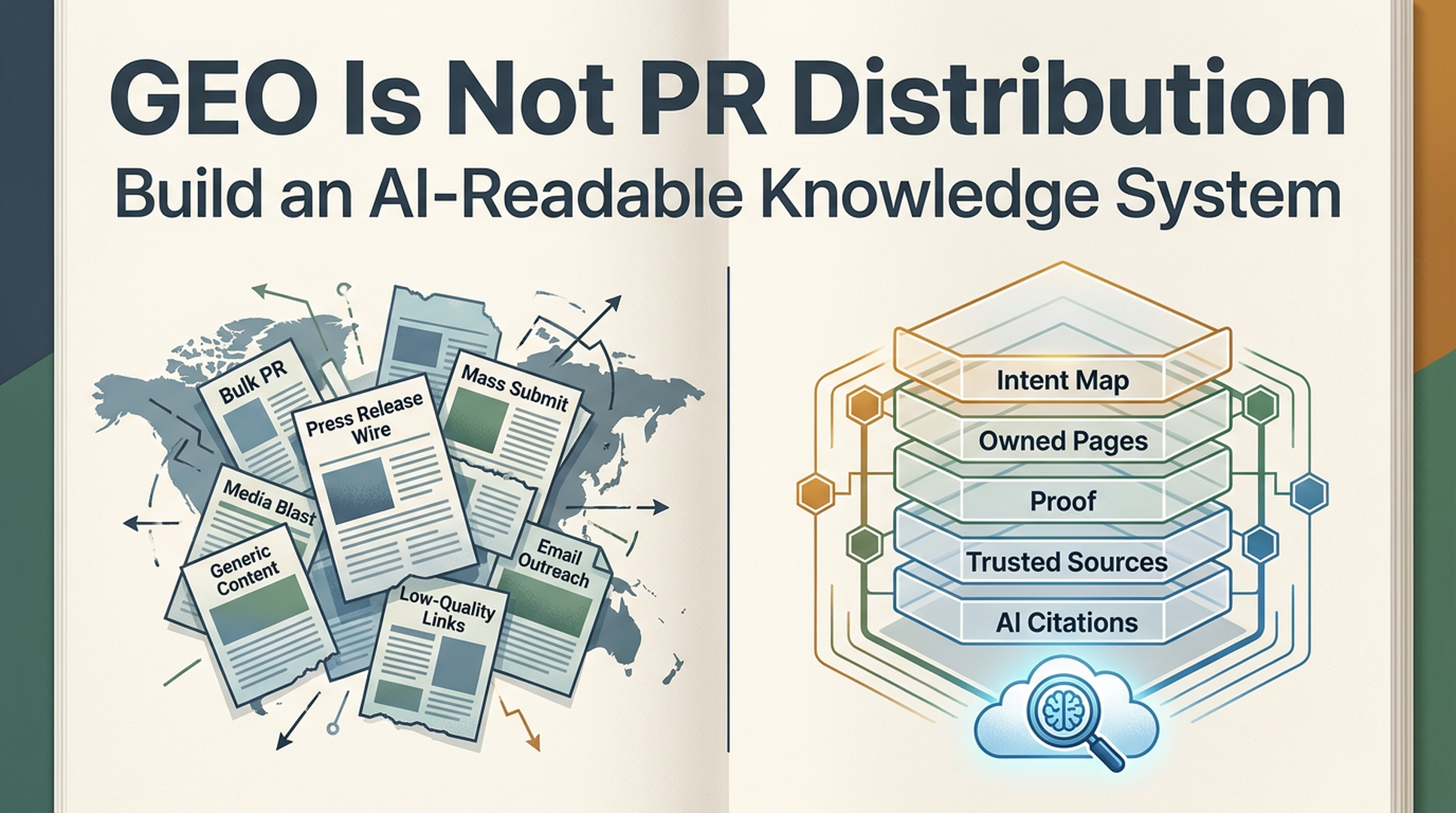
GEO is not bulk PR distribution. It is not the practice of publishing hundreds of lightly rewritten articles across low-quality sites and hoping AI search will pick them up.
That approach misunderstands how AI answer systems work. Generative systems do not need more promotional copy. They need reliable source material: clear explanations, structured buyer questions, credible proof, consistent brand signals, and sources that can be safely cited.
The difference is simple:
- PR-style content tries to persuade the reader.
- GEO content helps AI and users solve a problem.
A press-release campaign may create short-term exposure. A GEO system builds long-term digital assets: category guides, answer-ready pages, comparison resources, FAQ blocks, case studies, documentation, reviews, and source relationships that help AI understand why your brand belongs in an answer.
If your GEO strategy starts with "How many articles can we publish?" it is already pointed in the wrong direction. Start with the knowledge system first.
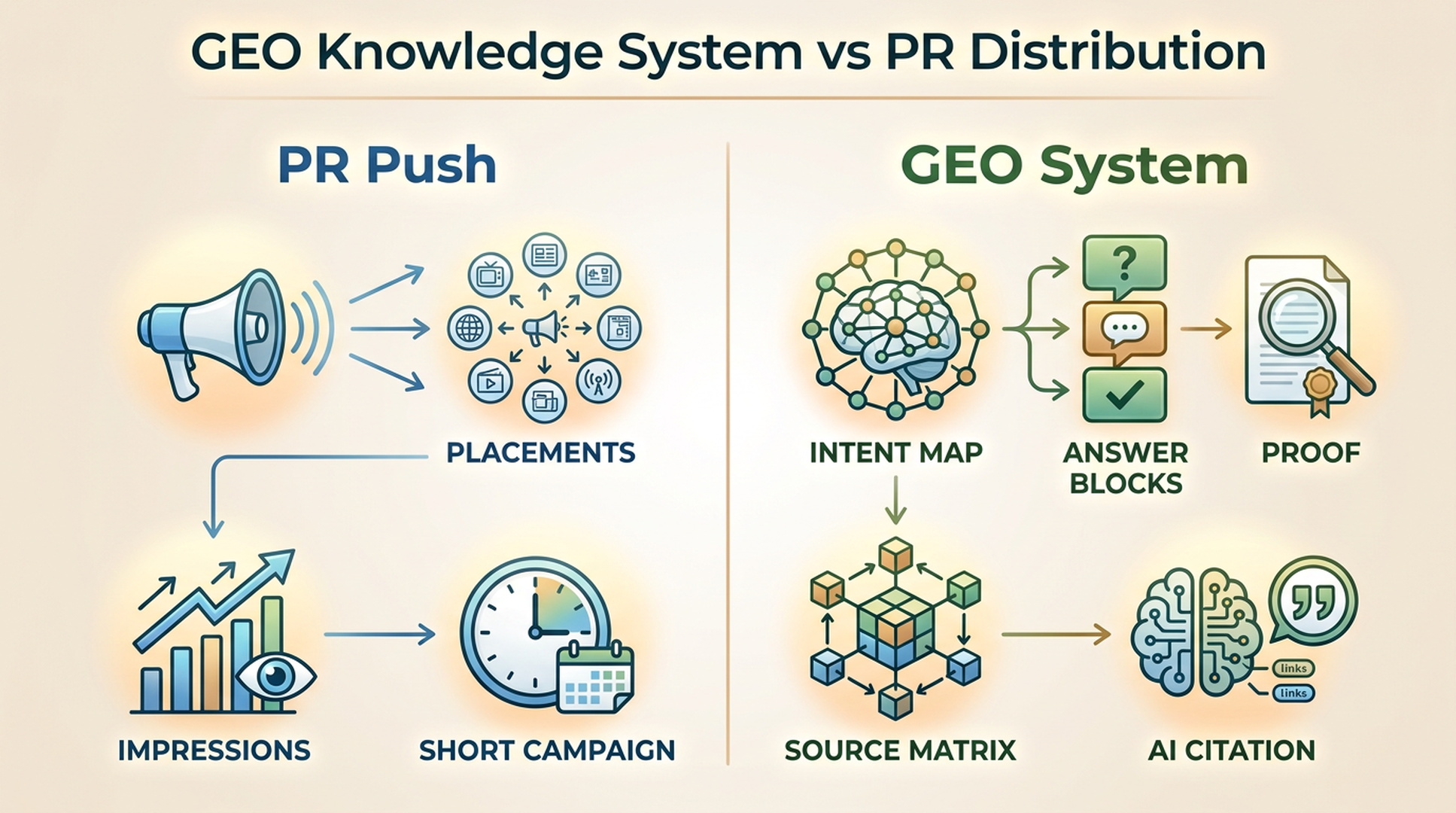
Caption: GEO is not a volume game. It is a source-quality and knowledge-structure game.
Why Teams Confuse GEO With PR Distribution
The confusion is understandable. GEO and PR distribution can look similar on the surface.
Both may involve content production. Both may involve publishing on multiple sites. Both may mention brand names, product categories, and buyer questions. Both may try to influence visibility outside the company website.
But the operating logic is different.
Many teams assume GEO means:
- take the old SEO keyword list
- convert keywords into AI-style questions
- publish many sponsored articles
- repeat the brand name and selling points
- wait for AI systems to cite the content
This usually fails because it produces weak evidence. AI systems are not looking for advertisements dressed as educational content. They are trying to answer the user's question with reliable, relevant, and verifiable information.
A thin advertorial may say:
Acme is the best onboarding platform for modern SaaS teams because it is powerful, easy to use, and trusted by many customers.
A GEO-ready knowledge block says:
Acme is best suited for B2B SaaS companies with 50-500 employees that need to standardize customer onboarding across customer success, implementation, and support teams. It is strongest when the company already uses HubSpot, Salesforce, or Intercom and needs workflow visibility rather than a full CRM replacement.
The second version is more useful because it gives the answer system fit criteria, context, integrations, boundaries, and a specific use case.
GEO and PR Distribution Are Fundamentally Different
Dimension | PR / advertorial distribution | GEO |
|---|---|---|
Primary goal | Short-term exposure and promotional reach | Long-term AI visibility, citations, and answer inclusion |
Content logic | Brand-first selling message | User problem-first knowledge system |
Success metric | Published placements, impressions, clicks | Brand mentions, source citations, answer coverage, description accuracy |
Source strategy | More sites and more articles | Higher-quality sources with clear roles |
Content format | Promotional story, product pitch, news angle | Definitions, comparisons, FAQs, guides, case evidence, decision criteria |
Trust basis | Media presence or repeated messaging | Verifiable claims, consistency, expertise, third-party proof |
Lifespan | Often short campaign window | Compounding digital asset over time |
PR can still support GEO when it creates credible third-party evidence. But PR distribution alone is not a GEO strategy. It is one possible channel inside a larger system.
Principle 1: Build the Knowledge System Before Publishing
The first step in GEO is not writing articles. It is mapping the buyer's intent journey.
A useful GEO knowledge system covers the full decision path:
- Awareness: What is the problem? Why does it matter?
- Exploration: What solution categories exist?
- Evaluation: How should buyers compare options?
- Decision: Which product, vendor, or service fits a specific situation?
- Validation: What proof, reviews, case studies, and limitations support the choice?
For example, a cybersecurity consultancy should not start with ten promotional articles saying it is a trusted security partner. It should build a structured answer set around the buyer's real questions:
- What is SOC 2 readiness for early-stage SaaS companies?
- When should a startup prepare for SOC 2?
- What evidence does an auditor expect?
- How do AWS, GitHub, Okta, and Google Workspace affect readiness?
- How should a founder choose between software-only tools and a consultant-led process?
- What are the most common SOC 2 timeline risks?
- Which parts of the process can be automated, and which require judgment?
That system gives AI search something to work with. It turns isolated content into a coherent public knowledge graph.
Without the system, each article is a loose brick. With the system, each article becomes part of a building.
Principle 2: Become the AI's Industry Explainer, Not Your Own Salesperson
AI answer systems prefer content that helps users make decisions. They are cautious with pages that are obviously promotional and unsupported.
This does not mean brands should avoid talking about themselves. It means self-description should be grounded in useful context.
A good GEO page should answer questions such as:
- Who is this solution for?
- What problem does it solve?
- What alternatives should a buyer consider?
- What criteria should matter?
- What proof supports the claim?
- What are the limitations?
- What should the buyer do next?
The brand appears naturally when it helps answer the question.
Example: Product Pitch vs GEO Answer
Weak product-pitch angle:
Our AI analytics platform is the leading choice for customer success teams that want faster growth.
GEO answer angle:
Customer success teams should consider an AI analytics platform when they have enough product usage, support, and CRM data to identify churn-risk patterns. The platform is most useful when the team already has renewal ownership and a defined intervention workflow. Without clean account-level data, a simpler reporting setup may be more practical first.
The second paragraph may still lead to the product, but it earns that right by helping the user.
Principle 3: Build a Trusted Source Matrix, Not a Content Dump
Many teams assume GEO improves as the number of published pages increases. That is not necessarily true.
AI systems evaluate source quality. A hundred low-quality placements may matter less than five strong sources that define the brand clearly, prove the category fit, and provide independent support.
A source matrix should have roles.
Source layer | Role in GEO | Example assets |
|---|---|---|
Owned authoritative sources | Define the brand, product, category, claims, and proof | Website, About page, product pages, documentation, case studies, research pages |
Expert and author sources | Strengthen experience and expertise | Founder essays, expert bios, webinars, conference talks, bylined guides |
Third-party validation | Support claims outside the brand site | Review platforms, partner pages, customer pages, analyst mentions, independent articles |
Community and social proof | Show real-world usage and objections | Reddit discussions, LinkedIn posts, YouTube reviews, community forums, marketplace reviews |
Conversion and scenario sources | Help buyers decide in context | Comparison pages, implementation guides, calculators, templates, FAQs |
The goal is not to appear everywhere. The goal is for each source layer to reinforce the same evidence pattern.
For a first audit, ask:
- What does our website say we do?
- What do third-party profiles say we do?
- What do customers say we do?
- What do review sites say we do well or poorly?
- What do AI systems currently cite when describing us?
- Are these signals consistent?
If the answers conflict, more content will not fix the problem. Alignment comes first.
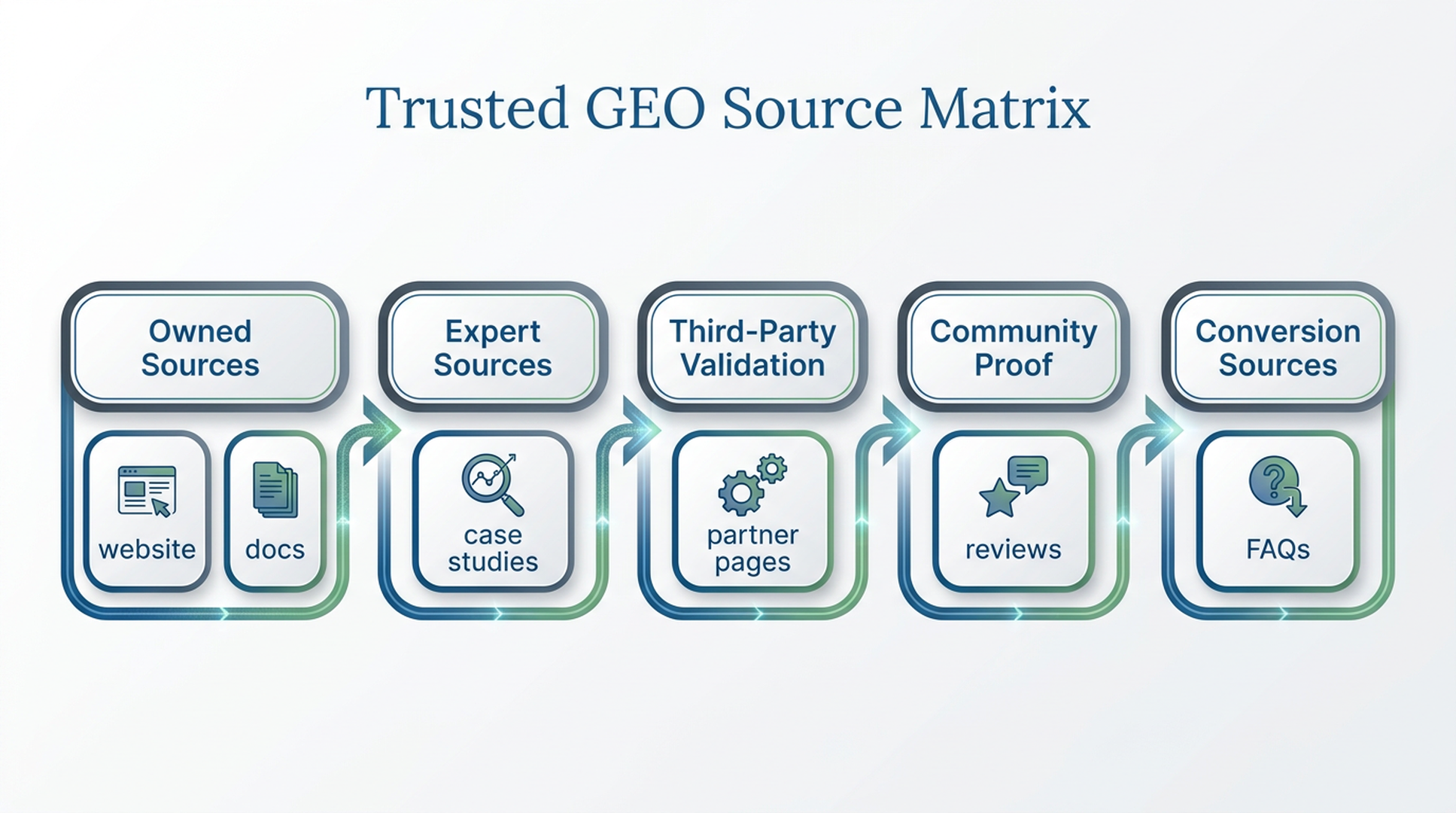
Caption: Strong GEO does not rely on one channel. It builds a source matrix that AI systems can cross-check.
Principle 4: Treat Content as a Long-Term Digital Asset
PR campaigns often operate on short windows. Publish, promote, measure, move on.
GEO content should be treated differently. A useful guide, FAQ, case study, glossary page, or comparison resource can keep working long after the publish date. It can be crawled, cited, summarized, linked, updated, and reused by AI systems in future answers.
This is why quality matters more than volume.
A durable GEO asset usually has these qualities:
- it answers a real user question
- it includes a clear definition or decision framework
- it provides proof or examples
- it uses headings that match natural questions
- it states fit and non-fit conditions
- it links to related pages that complete the topic
- it is updated when facts change
- it is technically accessible to crawlers
- it can be cited without losing context
A thin promotional placement may disappear from attention after a week. A strong knowledge asset can compound.
Principle 5: Stay Real, Specific, and Compliant
GEO punishes unsupported exaggeration over time.
AI answer systems compare sources. If your owned content claims one thing while reviews, documentation, customer comments, or public records suggest another, the system may respond cautiously. It may mention your brand with caveats. It may choose a competitor with clearer evidence.
This is especially important in regulated or high-trust categories such as healthcare, finance, legal services, cybersecurity, insurance, education, and enterprise software.
A GEO-safe claim should include:
- source or evidence
- date or time frame when relevant
- scope and limitations
- method or sample size for data
- clear distinction between fact, opinion, and forecast
- no fabricated customer stories
- no unverifiable superiority claims
Strong GEO does not require brands to sound perfect. It requires brands to sound reliable.
The Auspia GEO System: From Content Push to AI Pull
Traditional promotional marketing often pushes messages toward people who may not be ready. GEO works differently. It helps the brand appear when the user has an active need and asks an AI system for help.
That shift requires a different operating model.
Step 1: Map the Intent System
List the questions your buyers ask across the journey:
- What is this problem?
- Why is it happening?
- What options exist?
- How do I compare vendors?
- What risks should I avoid?
- What proof should I expect?
- Which solution fits my situation?
Group those questions into content clusters.
Step 2: Build the Owned Knowledge Base
Create or improve the core pages that define your brand:
- homepage positioning
- About page
- product or service pages
- use-case pages
- FAQ pages
- comparison pages
- case studies
- documentation or methodology pages
Use clear headings, direct answers, tables, examples, and proof.
Step 3: Strengthen the Source Matrix
Do not publish everywhere at once. Prioritize sources that AI systems and users can trust.
Start with owned pages. Then add high-quality third-party validation: review profiles, partner pages, customer stories, relevant media, independent mentions, and credible community discussions.
Step 4: Make the Content Machine-Readable
Check crawl access, schema, internal links, canonicals, and page rendering. Use tools such as Auspia's AI Search Visibility Checker, Robots.txt AI Crawler Checker, and LLMs.txt Generator / Checker to identify obvious technical blockers.
Step 5: Monitor AI Answers
Track how AI systems describe your brand for your target questions. Monitor:
- whether your brand appears
- whether it is cited
- which source is cited
- whether the description is accurate
- whether competitors dominate the answer
- whether the system adds caveats such as "limited public information"
- whether your content appears for awareness, evaluation, and decision prompts
Use those findings to improve the knowledge system, not just to publish more content.
What to Do This Week
If your team has been treating GEO like PR distribution, start with this reset:
- Pick one important buyer journey.
- List 30 real questions across awareness, exploration, evaluation, decision, and validation.
- Audit whether your website answers each question clearly.
- Identify which claims need proof.
- Update one owned page so it becomes a strong answer source.
- Check whether that page is crawlable and internally linked.
- Ask three AI systems the target questions and record whether your brand appears.
- Create one third-party proof asset or profile update that supports the same story.
That is real GEO progress. Publishing twenty promotional articles is not.
FAQ
Is PR useless for GEO?
No. PR can support GEO when it creates credible third-party evidence, expert mentions, customer stories, or category authority. But bulk promotional placements without useful information are not a complete GEO strategy.
How many articles should a GEO campaign publish?
There is no universal number. The better question is whether your content system covers the buyer's intent journey with clear, credible, and citable answers. Ten strong knowledge assets can outperform hundreds of thin placements.
What makes content citable by AI systems?
Citable content is specific, structured, evidence-backed, and easy to summarize. It usually includes clear definitions, decision criteria, examples, limitations, source references, and question-led sections.
Should GEO content mention the brand?
Yes, but only where the brand helps answer the user's question. GEO content should not hide the brand, but it should not turn every section into a sales pitch.
What is the first step in moving from PR-style content to GEO?
Build an intent map. List the questions buyers ask before choosing a solution, then audit whether your public content answers those questions with useful evidence.
Auspia Takeaway
GEO marketing is not the mass production of advertorials. It is the construction of a brand knowledge system that AI can retrieve, understand, trust, and cite.
The brands that win in AI search will not simply publish the most articles. They will build the most useful public evidence: clear category explanations, honest comparisons, structured FAQs, proof-rich case studies, trusted third-party signals, and technically accessible pages.
In the AI search era, the strongest marketing asset is not a short-lived promotional burst. It is a durable knowledge system that keeps answering buyer questions after the campaign ends.
References
- Google Search Central, "AI Features and Your Website".
- Google Search Central, "Introduction to structured data markup in Google Search".
- Pranjal Aggarwal et al., "GEO: Generative Engine Optimization", arXiv, 2023.