The short version
The value of GEO is not that your brand appears in an AI answer once.
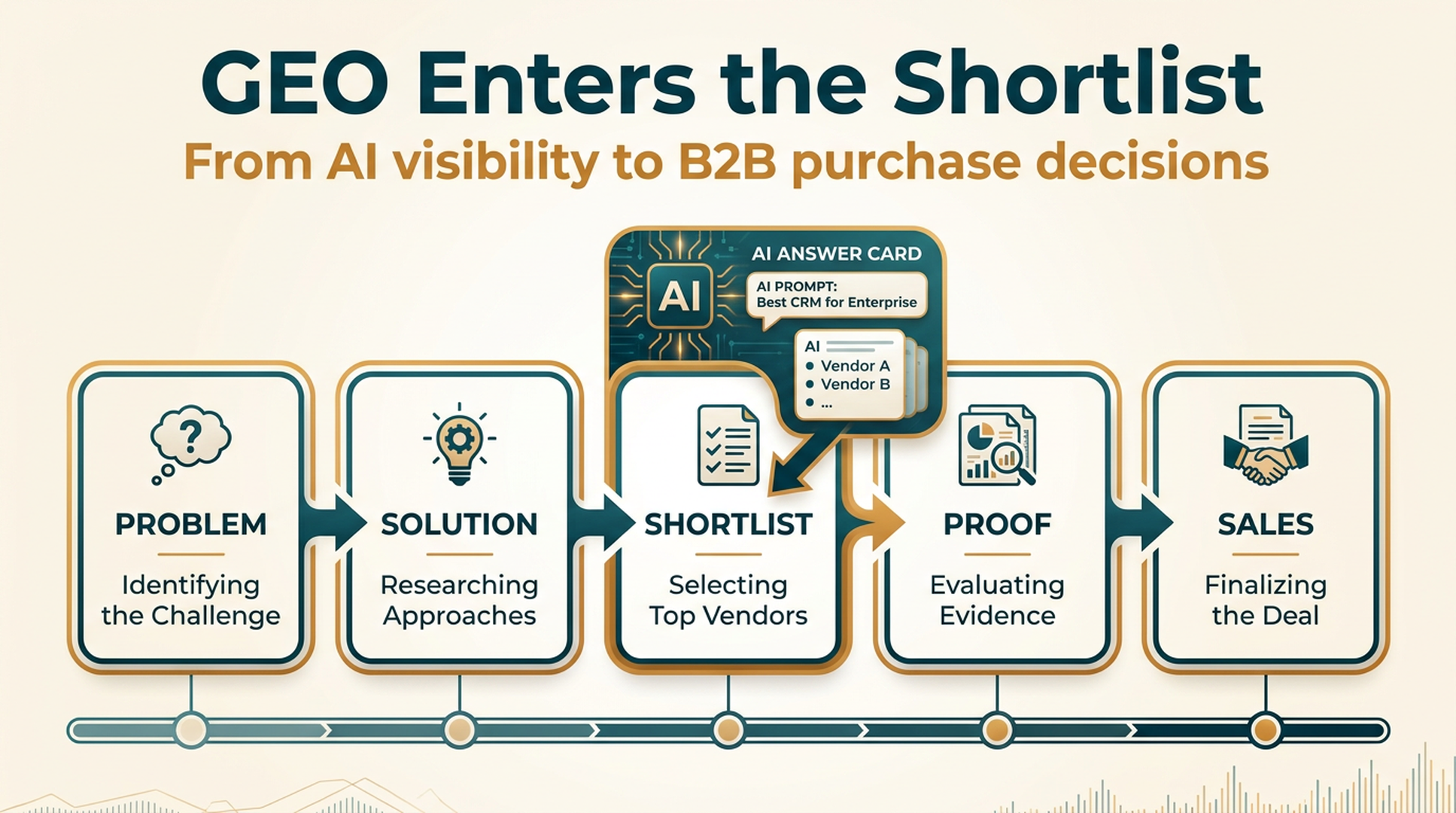
The real value comes earlier: your company enters the buyer's shortlist before the buyer fills out a form, clicks an ad, or speaks to sales.
In B2B, customers rarely buy on impulse. They notice a problem, study possible solutions, compare suppliers, check proof, and only then start a conversation. AI tools are now sitting inside that early research process. Buyers ask ChatGPT, Perplexity, Gemini, Google AI Overviews, and industry-specific assistants what to do, which vendors to consider, and what risks to check.
That changes the job of GEO.
A serious GEO program should not chase surface exposure. It should help AI systems understand:
- what problems your company solves;
- which buyers and scenarios you fit;
- why you are different from alternatives;
- whether public evidence supports your claims;
- when you should appear in supplier, comparison, and solution-selection answers.
If GEO does that well, it does more than create visibility. It moves your brand into the buyer's decision path.
The common misunderstanding: treating GEO as AI exposure
A lot of companies are currently evaluating GEO in the shallowest possible way.
They ask: "Did our brand show up in the AI answer?"
So the work becomes predictable. Publish more articles. Push content to more platforms. Test a few prompts. Capture screenshots when the brand appears. Report that GEO is working.
That is thin proof.
A brand mention can be almost worthless if it appears in the wrong context. A company may show up in a generic answer, yet be absent when the user asks:
- "Which vendor should I shortlist?"
- "What solution fits this use case?"
- "How do I compare these suppliers?"
- "What should I ask before buying?"
- "Which company has proof in my industry?"
Those are the moments that matter.
GEO should answer a harder set of questions:
- Why did the AI system mention the company?
- Did it describe the company accurately?
- Did the mention connect to the company's real offer, use cases, and strengths?
- Did the brand appear in problem, comparison, and supplier-selection prompts?
- Would the answer make a serious buyer more likely to search, visit, ask, compare, or contact?
If the answer is no, the visibility is mostly decoration.
Auspia's view is simple: GEO should be measured by decision influence, not screenshot count.
B2B buying happens before the lead form
Many B2B marketers still talk as if the journey starts when a prospect lands on the website. It does not.
By the time a buyer visits your site, they may already have done the first round of research. They may have asked AI tools to explain the problem, compare approaches, list vendors, summarize risks, and check what questions to ask sales.
A typical B2B decision path looks like this:
Stage | What the buyer is doing | AI-assisted questions |
|---|---|---|
Problem discovery | Realizing something is broken or inefficient | "Why is our organic traffic flat despite publishing weekly?" |
Solution understanding | Learning the available approaches | "What is GEO and how is it different from SEO?" |
Supplier screening | Building an early shortlist | "Which tools help monitor AI search visibility?" |
Proof checking | Validating capability and trust | "What should I check before hiring a GEO agency?" |
Sales contact | Asking for a demo, quote, audit, or proposal | "What questions should I ask this vendor?" |
GEO matters because it works before the obvious conversion point.
A buyer may first discover your category through AI, then search your brand later. Or they may find your website through search, then ask an AI tool whether your company is credible. In both directions, AI answers can shape who gets considered.
This is why a B2B team should stop thinking of GEO as a traffic hack. It is a shortlist strategy.
High-value prompts beat brand prompts
Optimizing only around your brand name is a weak GEO strategy.
People who already know your brand can search for you directly. The harder and more valuable job is showing up before they know you.
For B2B, useful prompt groups usually map to the buying process:
Prompt group | Example prompt | Commercial value |
|---|---|---|
Problem prompts | "Why are AI search tools not citing our website?" | Captures early pain awareness |
Solution prompts | "How should a SaaS team improve AI search visibility?" | Shapes solution framing |
Comparison prompts | "GEO software vs GEO agency: which is better?" | Influences budget and approach |
Supplier prompts | "Best AI search visibility tools for marketing teams" | Helps enter the shortlist |
Evaluation prompts | "What should I check before buying a GEO platform?" | Builds trust before sales contact |
Risk prompts | "Common mistakes in AI search optimization" | Shows judgment and reduces buyer anxiety |
The important shift is from keywords to buying questions.
Traditional SEO asks which terms can rank. GEO asks which questions influence the buyer's next move.
A B2B company should know which prompts belong to each stage, whether the brand appears, how it is described, which sources are cited, and what information is missing.
GEO starts with business information, not content volume
Many companies already have plenty of content.
The problem is that the content is scattered, inconsistent, and written from the company's point of view rather than the buyer's point of view.
Common issues include:
- The company description is broad and says little about the real advantage.
- Product pages list features but do not explain use cases.
- Case studies mention results but do not explain the original problem, constraints, or decision criteria.
- Sales teams know the strongest proof, but the website does not show it.
- Different platforms describe the company in different ways.
- Industry pages lack enough detail for a buyer to understand fit.
- Public information does not connect the brand to specific problems or scenarios.
Publishing more posts on top of that mess does not solve the real issue.
The first step is to rebuild the business information layer so that AI systems and buyers can both understand it.
That means documenting:
- who the company serves;
- which problems it solves;
- which use cases it is best for;
- where it is not a fit;
- what proof supports the positioning;
- which competitors or alternatives buyers compare;
- which objections sales hears repeatedly;
- which sources outside the company validate the story.
Good GEO turns internal knowledge into public, structured, verifiable information.
A five-step GEO workflow for B2B decision influence
Step 1: Diagnose current AI understanding
Before writing anything new, test what AI systems already think about the company.
Use prompts across brand, product, category, comparison, industry, location, and supplier-selection terms. For each prompt, record:
- whether the brand appears;
- whether the description is accurate;
- whether the brand is recommended, merely mentioned, or ignored;
- which sources the answer uses;
- which competitors appear more often;
- whether your real strengths are present or missing.
This step often reveals uncomfortable gaps. The AI may know your brand but misunderstand your category. It may cite an old directory page. It may recommend competitors for high-intent questions while mentioning you only in low-value contexts.
That is useful. Diagnosis prevents blind publishing.
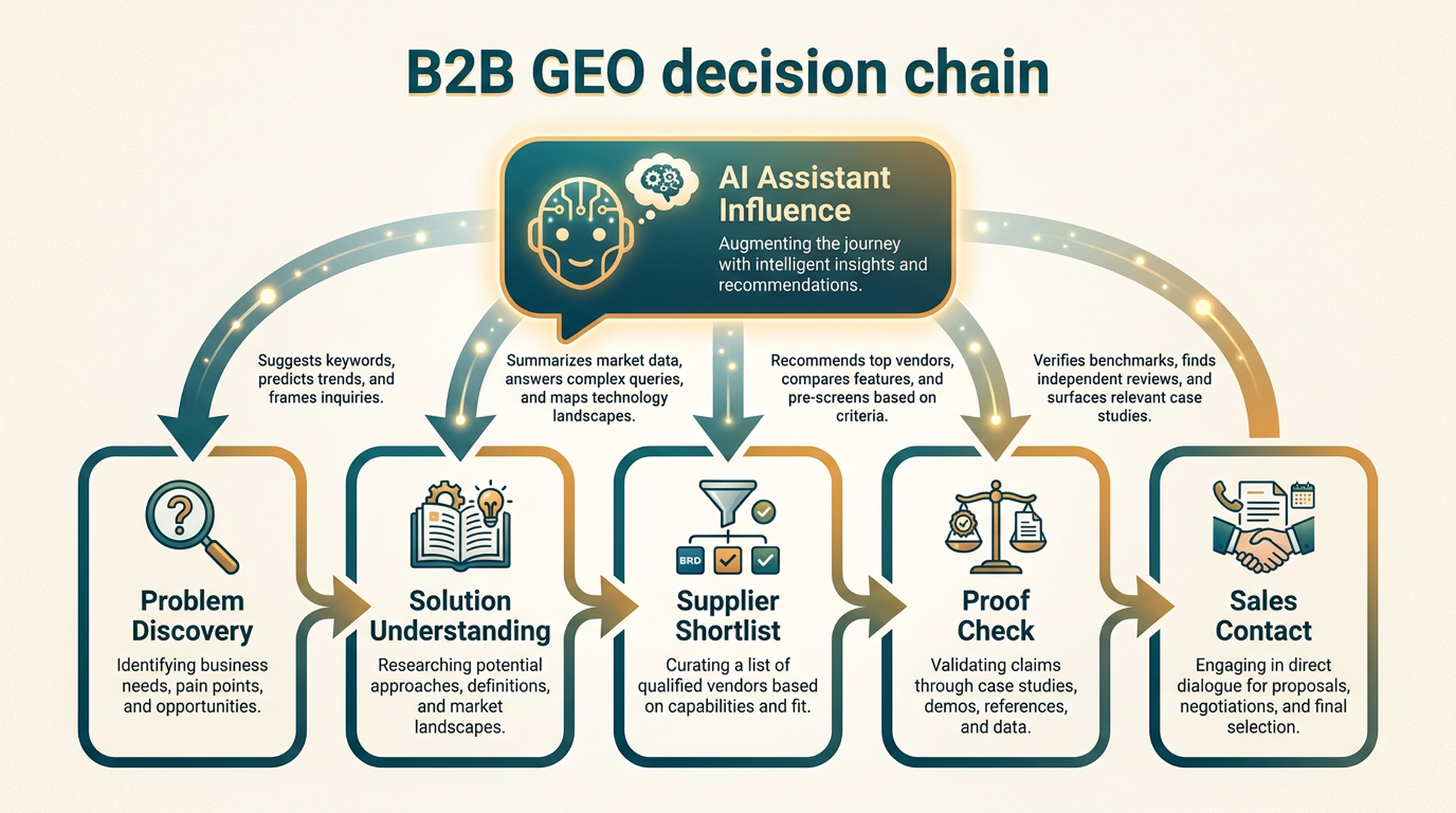
B2B GEO should be mapped to the decision chain, not treated as one-off visibility testing.
Step 2: Build a prompt library around the buying journey
A prompt library is not a random keyword list.
It should reflect real buyers, real roles, and real decision stages. The CFO does not ask the same questions as the marketing lead. A technical evaluator does not ask the same questions as a founder. A procurement team cares about risk, terms, implementation, and proof.
Build prompts by role and stage:
Role | Typical question |
|---|---|
Founder | "What is the fastest way to know if our brand is visible in AI answers?" |
Marketing lead | "Which GEO metrics should we report each month?" |
SEO manager | "How do I optimize existing pages for AI citations?" |
Procurement | "What should we compare before buying AI search visibility software?" |
Sales leader | "How can AI search mentions improve lead quality?" |
This turns the company's product language into the buyer's question language.
Step 3: Convert capability into decision-support content
The goal is not more generic blog content. The goal is content that helps a buyer make a decision.
Useful GEO assets include:
- Problem explainer pages.
- Solution comparison pages.
- Industry-specific use-case pages.
- Evaluation checklists.
- Methodology pages.
- Data-backed benchmarks.
- Product limitation pages that explain fit honestly.
- Case studies that show problem, action, proof, and result.
- FAQ pages that answer sales objections directly.
These assets should be clear enough for a human buyer and structured enough for an AI system to reuse.
If your company claims to be strong in enterprise implementation, show the process. If you claim to be better for agencies, explain the agency workflow. If you claim to improve AI search visibility, define what you measure and how.
The more concrete the content, the easier it is for AI systems to connect you to a buyer need.
Step 4: Create consistency across public sources
AI systems do not only read your website.
They may draw from review sites, partner pages, directories, press mentions, documentation, social profiles, comparison articles, support pages, and community discussions.
If those sources do not agree, the AI answer may become vague or wrong.
A B2B GEO program should check consistency across:
- homepage and product pages;
- LinkedIn and company profiles;
- review platforms;
- marketplace listings;
- documentation and help centers;
- partner or integration pages;
- PR and media mentions;
- author bios and expert pages;
- sales collateral that has been published online.
This work is not glamorous. It matters anyway. AI systems are much more likely to recommend a company when public sources tell a coherent story.
Step 5: Monitor the full conversion chain
A GEO report should not stop at an AI screenshot.
Track four layers together:
Layer | What to monitor |
|---|---|
AI visibility | Mentions, citation frequency, prompt coverage, recommendation presence |
Brand understanding | Accuracy, sentiment, correct use cases, correct differentiation |
Lead quality | More informed inquiries, fewer irrelevant leads, higher demo-to-proposal rate |
Commercial outcomes | Shortlist inclusion, sales-cycle changes, qualified pipeline, closed deals |
This is where B2B GEO becomes useful.
A campaign may not create a huge traffic spike, yet sales may start hearing better questions. Prospects may arrive already knowing the company. Demo calls may spend less time on basic education and more time on specific fit. The number of low-intent inquiries may fall while qualified conversations rise.
That is not failure. In B2B, that may be the point.
How GEO works with SEO, not against it
SEO is still important. It helps buyers find your pages, validates your presence, and supports technical discoverability.
GEO adds another layer: AI-assisted recognition and pre-selection.
A strong B2B path often looks like this:
AI shapes awareness -> search captures demand -> website proves capability -> sales converts the account.
Sometimes the order changes. A buyer may find the website first and then ask AI whether the company is credible. Or they may ask AI for vendors, search the brand, read the website, then ask AI what questions to ask on the demo.
The point is consistency. If AI answers, search results, and website content all reinforce the same positioning, buyers feel less friction.
That is why GEO should not be isolated from SEO. The best programs use both:
- SEO brings crawlable, useful, discoverable pages.
- GEO makes those pages easier for AI systems to understand and cite.
- The website turns interest into trust.
- Sales turns trust into a deal.
What most teams should do next
If you are starting from zero, do not begin by publishing 50 articles.
Start smaller:
- Choose one product line or service category.
- Build 50 buyer prompts across the purchase journey.
- Test those prompts in the AI tools your buyers are likely to use.
- Record where your company appears, where competitors appear, and which sources are cited.
- Rewrite the pages that should answer those prompts.
- Fix inconsistent public profiles and weak third-party descriptions.
- Add a sales-intake field asking how the buyer first researched the category.
- Review the prompt set every month for 90 days.
If you need a starting point, Auspia's GEO and AI search tools can help teams audit visibility, crawlability, and answer readiness before they commit to a larger program.
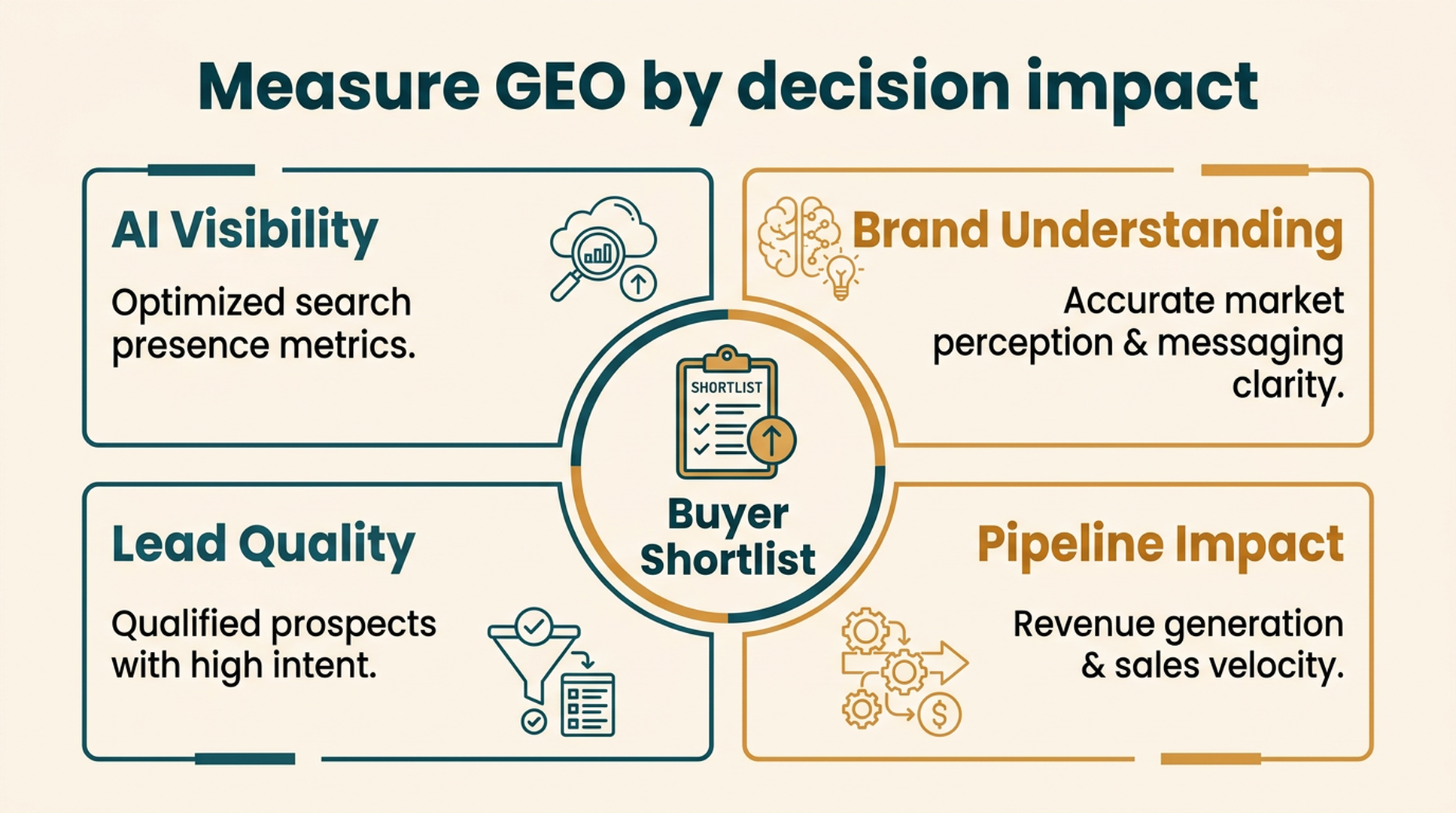
The useful version of GEO is an operating loop that connects AI answers to sales readiness and pipeline quality.
Auspia takeaway
GEO is not about waiting for buyers to find you.
It is about being present while they are still forming the shortlist.
For B2B teams, that makes GEO less like a traffic channel and more like a decision-influence system. The work is part content strategy, part entity cleanup, part source building, part sales enablement, and part measurement.
The brands that benefit most will not be the ones that collect the most AI screenshots. They will be the ones AI systems can describe accurately when a buyer asks the questions that actually precede a purchase.
That is the bar to clear.
When your buyer asks, "Who should we consider?" your company should not be a random mention. It should be a credible candidate.
FAQ
What is the real business value of GEO for B2B companies?
The main value is earlier influence in the buying process. GEO helps a company appear in AI-assisted research, supplier screening, and comparison prompts before the buyer contacts sales.
Is a brand mention in an AI answer enough to prove GEO success?
No. A mention only matters if it appears in relevant buyer scenarios, describes the company accurately, and helps move the buyer toward search, comparison, trust, or contact.
How is B2B GEO different from SEO?
SEO helps pages rank and capture search demand. B2B GEO helps AI systems understand, cite, and recommend the company during problem research, solution comparison, and supplier selection.
What should a B2B company optimize first?
Start with the buyer journey. Build prompts for problem discovery, solution understanding, supplier screening, proof checking, and sales contact. Then improve the pages and public sources that should answer those prompts.
How should GEO performance be measured?
Measure AI visibility, description accuracy, recommendation presence, source consistency, branded search lift, lead quality, and sales-cycle signals together. A screenshot is not a performance report.