Executive Summary
GEO does not have one settled playbook yet. That makes many teams hesitate. It should make them move faster.
Search engine optimization became more standardized over decades: crawlability, keywords, links, technical health, content quality, and authority signals all became familiar operating areas. Generative Engine Optimization is not there yet. AI answer systems differ by platform, citation behavior changes quickly, and every vendor seems to define the field slightly differently.
But the absence of a fixed standard does not mean there are no principles. It means the market is still forming.
For brands, the practical opportunity is this: build a public evidence system before AI answer positions become crowded. Make your expertise clear. Keep your claims consistent. Create content that other sources and AI systems can quote. Treat every useful page, guide, case study, and opinion as a vote for how AI should understand your brand.
The winners of early GEO will not be the teams that stuff more prompts with keywords. They will be the teams that become easier for AI to describe, verify, and recommend.
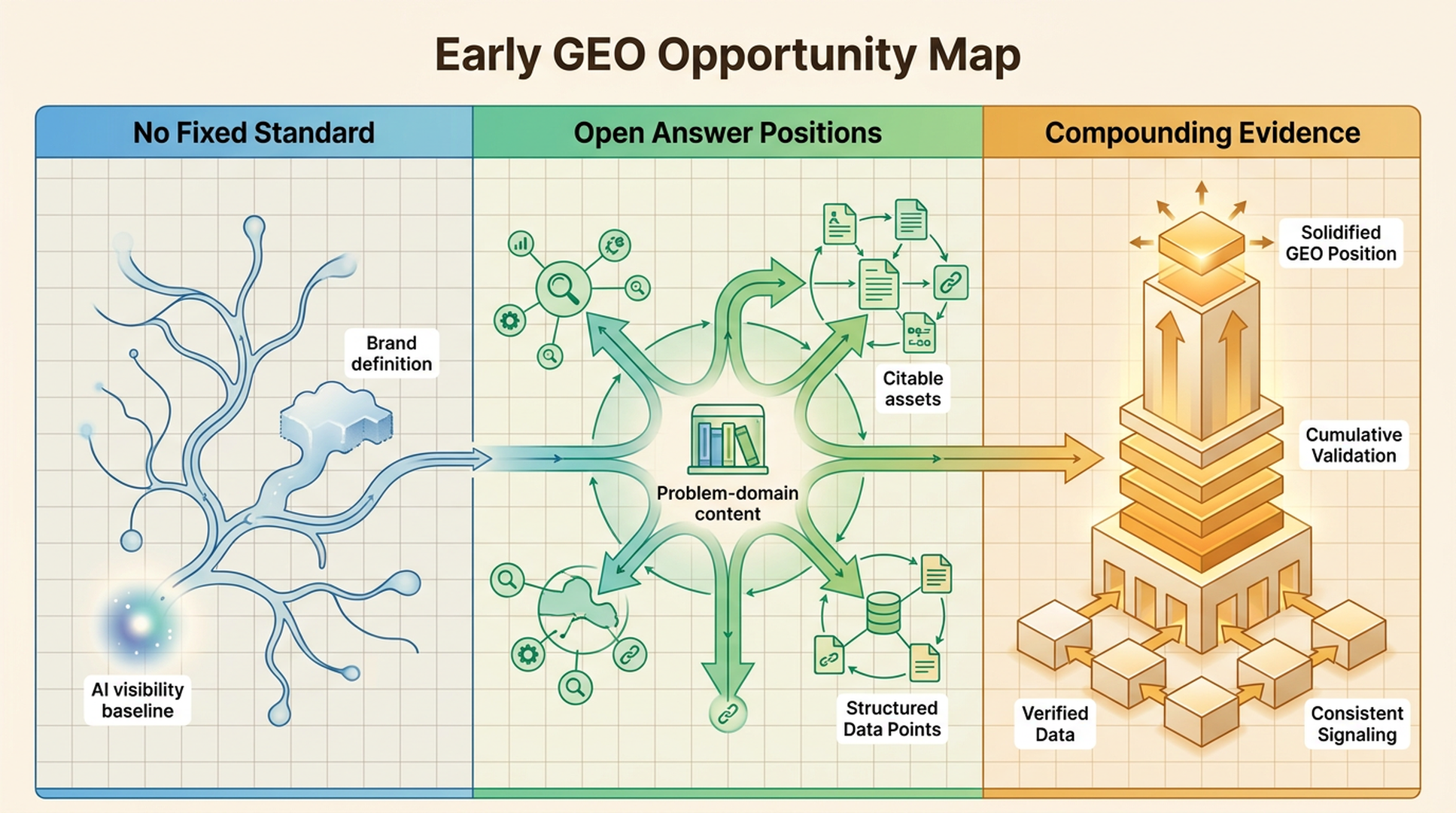
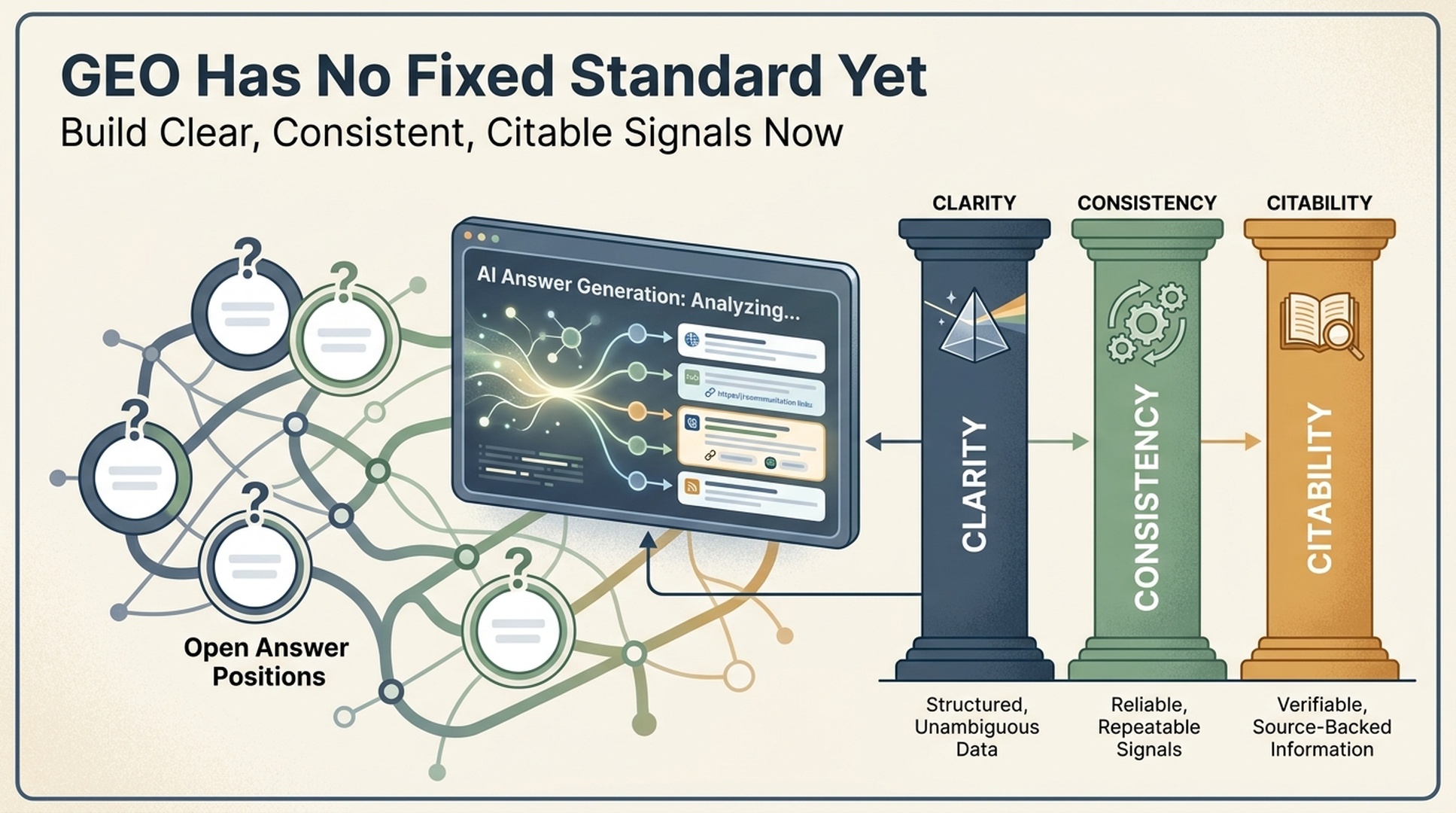
Caption: GEO is early and fragmented. That uncertainty creates room for focused brands to define how AI systems understand them.
The Three Questions Brands Keep Asking About GEO
Most teams new to GEO ask some version of these three questions:
- How is GEO different from SEO?
- What matters most if there is no universal GEO standard?
- Is it too early or too late to start?
The short answer: GEO is different because the recommending layer has changed. The key principles are clarity, consistency, and citability. And no, it is not too late. In many categories, it is still early enough that the first serious public evidence system can become a durable advantage.
GEO Is Not SEO With AI Keywords
A common mistake is to treat GEO as a keyword migration project. Teams take their SEO keyword list, add phrases like "AI," "ChatGPT," or "best tool for," and publish more pages.
That misses the main shift.
SEO often optimizes for a ranking system that returns links. GEO optimizes for answer systems that retrieve, read, compare, and generate. A search engine result page asks the user to choose. An AI answer engine may make the first layer of selection for the user.
That changes what content needs to prove.
SEO emphasis | GEO emphasis |
|---|---|
Rank for a query | Become a reliable source inside an answer |
Match keywords and intent | Match problem context and evidence needs |
Win clicks from search results | Earn citations, mentions, and recommendation language |
Build page authority | Build entity clarity and source trust |
Optimize metadata and links | Optimize extractable claims, proof, and consistency |
A traditional SEO page can rank because it targets a keyword well. A GEO-ready source needs to help the AI answer a user's question safely.
If someone asks, "Which customer onboarding platform is best for a 100-person SaaS company with a small success team?" the AI system is not only looking for the phrase "customer onboarding platform." It needs context: company size, implementation complexity, integrations, evidence, risks, alternatives, and fit criteria.
This is why GEO content has to be more than visible. It has to be understandable and usable.
The Three Signals That Matter While Standards Are Forming
Because GEO does not have one universal standard, teams need principles that work across systems. Auspia recommends focusing on three signals: clarity, consistency, and citability.
1. Clarity: Can AI Explain What You Do in One Sentence?
Clarity is the first test. If an AI system cannot explain what your company does, who it serves, and what problem it solves, it will struggle to recommend you.
Many brands fail this test because their public messaging is too broad:
We empower modern teams with AI-driven transformation.
That sentence sounds polished, but it does not tell AI what category you belong to, what buyer problem you solve, or when you should appear in an answer.
A clearer version would be:
Auspia helps growth teams improve SEO, GEO, AEO, and AI search visibility by auditing public content, crawler access, structured data, and citation gaps.
That sentence gives the model a category, an audience, a problem, and a set of concrete work areas.
Clarity does not mean oversimplifying the business. It means making the core entity legible.
2. Consistency: Do Your Public Signals Tell the Same Story?
AI systems do not read one page in isolation. They may compare your homepage, About page, documentation, blog posts, LinkedIn profile, marketplace listings, reviews, customer pages, and older content.
If those signals conflict, trust weakens.
Examples of inconsistency:
- the homepage says you serve enterprise teams, but public case studies only show small local clients
- LinkedIn describes the company as an agency, but the website describes it as a software platform
- old blog posts say the product is self-serve, while new sales pages emphasize custom implementation
- comparison pages make broad claims that documentation cannot support
- founders describe the company differently across podcasts, profiles, and investor pages
Some evolution is normal. Companies change. But public materials should explain that evolution rather than leave AI systems to reconcile contradictions.
For GEO, consistency is not about repeating identical slogans everywhere. It is about maintaining a stable evidence pattern.
3. Citability: Would Another Source Quote You?
Citability is the strongest signal because it moves beyond self-description.
A citable brand has a viewpoint, data point, framework, example, definition, or proof asset that others can reuse. It is not just present in the category. It contributes something specific.
Weak content says:
AI search is changing marketing, and brands need to adapt.
Citable content says:
A GEO-ready page should answer one buyer question, identify the target audience, state fit and non-fit conditions, provide proof, and use structured sections that can be summarized without losing meaning.
The second statement can be quoted. It has structure and a point of view.
Citability also includes external validation: customer stories, third-party mentions, analyst references, partner pages, community discussions, and independent reviews. AI answer systems are more comfortable citing brands when the claims are supported outside the brand's own website.
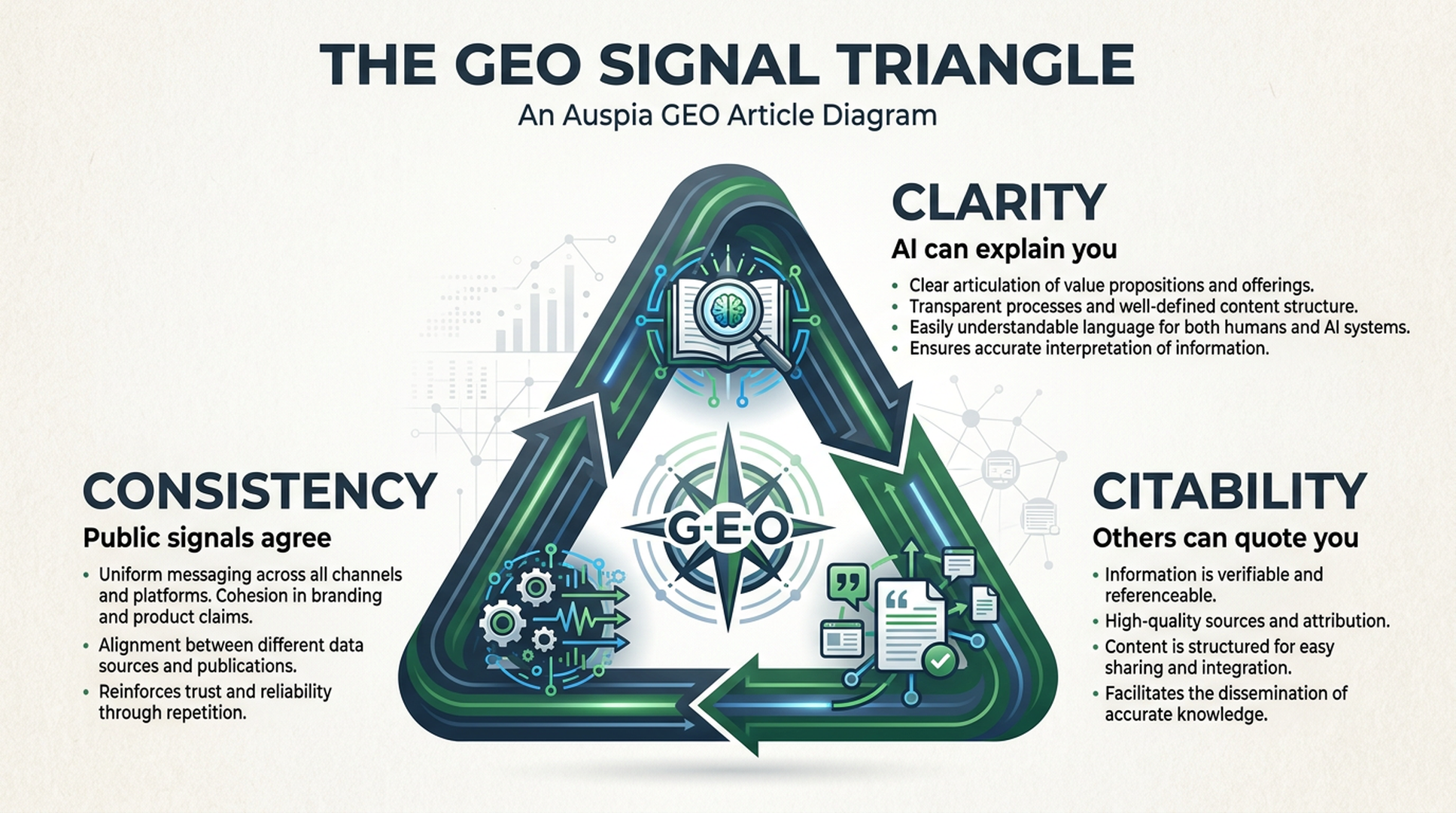
Caption: While GEO standards are still evolving, clarity, consistency, and citability give teams a durable operating model.
Why Starting Now Matters
Many founders and marketing leaders say, "We will start GEO after our content system is ready."
That sounds responsible, but it hides a risk: AI systems are already forming associations.
If your category is active, answer engines are already seeing competitor pages, comparison articles, review platforms, documentation, social discussions, and public case studies. The answer space is not waiting for your brand to be ready. It is being filled by whoever already has clear and accessible evidence.
Starting now does not mean publishing 50 rushed articles. It means creating the first reliable signals.
A useful early GEO program might include:
- one clear brand definition page
- one category explanation page
- three problem-led buyer guides
- two comparison pages with honest fit criteria
- one case study with evidence and limitations
- one FAQ page based on real sales questions
- updated organization and author profiles
- schema and crawl-access checks for key pages
- a monthly AI visibility benchmark
That is enough to begin shaping how AI systems describe the business.
Every Content Asset Is an AI Evidence Vote
In the old content mindset, publishing was the finish line. A team wrote a post, shared it, measured traffic for a few days, and moved on.
In GEO, publishing is the beginning.
Every useful content asset becomes part of the public evidence graph around your brand. It may be crawled, indexed, summarized, cited, quoted, linked, or used as context months later. It can help AI systems infer what you know, what you believe, what customers you serve, and what problems you solve.
That means every article is a vote.
A page about "AI content strategy for enterprise SaaS" votes for one association. A guide about "local SEO for restaurants" votes for another. A case study about "B2B lead generation from technical documentation" votes for another.
If the votes point in too many directions, the brand signal becomes noisy. If they repeatedly point toward the same problem domain, the signal becomes stronger.
This is why content calendars should not be built only from search volume. They should be built from the associations you want AI systems to remember.
The One-Question Test
Before creating more content, ask this:
If an AI system could remember only one thing about our brand, what should it be?
The answer should be specific enough to guide content decisions.
Weak answer:
We are an innovative AI company.
Stronger answer:
We help B2B growth teams improve visibility in search engines, answer engines, and AI-generated recommendations by fixing content, technical access, and citation readiness.
Once you define that sentence, audit your public content. Does each important page reinforce it? Do case studies prove it? Do author bios support it? Do third-party profiles repeat it? Do comparison pages clarify it? Do your tools and guides make it actionable?
If not, GEO work should start with alignment before expansion.
A Practical Early GEO Playbook
Use this sequence if your team wants to start without waiting for the market to standardize.
Step 1: Run an AI Visibility Baseline
Ask several AI systems the same questions:
What are the best companies for [your category]?
Who should a [target customer] consider for [specific problem]?
What does [your brand] do, and what public sources support that description?
Record whether your brand appears, how it is described, which competitors appear, and what sources are used. Tools like an AI Search Visibility Checker can help turn this into a repeatable workflow.
Step 2: Rewrite the Brand Definition
Create one page or section that defines:
- what the company does
- who it serves
- what problem it solves
- what makes it different
- when it is a fit
- when it is not a fit
- what proof supports the claim
This page becomes the anchor for entity clarity.
Step 3: Build Problem-Domain Content
Do not chase every keyword. Build around the real questions your buyers ask before they choose a solution.
For each question, create a knowledge module:
- direct answer
- context
- criteria
- example
- evidence
- boundary
- next action
This turns content into reusable answer material.
Step 4: Create Citable Assets
Citable assets are not always long articles. They can be:
- a named framework
- a checklist
- a benchmark
- a public methodology
- an annotated teardown
- a case-study table
- a glossary definition
- a decision matrix
- a research note
The key is that the asset says something specific enough to be referenced.
Step 5: Make Technical Access Boringly Correct
Check robots.txt, indexability, internal links, structured data, canonical tags, sitemaps, and page rendering. If important pages are blocked or hard to parse, AI visibility will be weaker.
A fast starting point is to review AI crawler access and create an llms.txt file if it fits your site's content strategy. Auspia's Robots.txt AI Crawler Checker and LLMs.txt Generator / Checker can help identify basic issues.
Step 6: Repeat the Baseline Monthly
GEO is not a one-time project. AI answers shift as models, indexes, competitors, and public evidence change.
Track:
- brand mentions
- citation URLs
- answer position
- competitor inclusion
- description accuracy
- source quality
- caveats such as "limited public information"
- changes after publishing new assets
The goal is not to celebrate one lucky answer. The goal is to build a stable pattern.
What Not to Do
Do not wait for a universal standard.
By the time every playbook is obvious, early answer positions may already be occupied.
Do not publish random content just to appear active.
Noisy output can dilute the association you want AI systems to remember.
Do not rely only on your homepage.
AI systems need a broader evidence graph: guides, case studies, documentation, profiles, tools, reviews, and third-party mentions.
Do not overclaim.
AI systems are cautious with unsupported claims. Clear boundaries make a brand safer to recommend.
Do not assume GEO is only technical.
Technical access matters, but the core is public judgment: what you believe, what you know, what you can prove, and whether that signal is consistent.
FAQ
Is GEO too early to invest in?
No. The field is early, but AI answer systems are already shaping buyer perception. Early investment does not need to be large. Start with entity clarity, high-intent content, proof assets, and repeatable AI visibility tracking.
Does GEO have an official standard?
No single universal standard exists yet. Different AI systems retrieve, rank, summarize, and cite sources differently. However, clarity, consistency, credibility, crawl accessibility, and citability are durable principles across platforms.
How is GEO different from SEO?
SEO focuses on helping pages rank and earn clicks. GEO focuses on helping information become reliable source material inside AI-generated answers. The two overlap, but GEO places more emphasis on entity clarity, evidence quality, and answer usability.
How often should a brand publish for GEO?
Consistency matters more than volume. A smaller number of focused, evidence-backed assets will usually help more than frequent generic posts. Each asset should reinforce the association you want AI systems to remember.
What is the first GEO task for a founder or marketing team?
Ask AI systems how they describe your brand and your category. Then decide the one association you want to strengthen. Rewrite core pages and create content assets that repeatedly support that association.
Auspia Takeaway
GEO is in its early, unsettled phase. That is exactly why it matters.
When standards are mature, advantages become expensive. When standards are still forming, focused brands can shape the public evidence that AI systems learn from. The work is not glamorous: clear positioning, consistent public signals, citable ideas, credible proof, and technical access. But those basics compound.
Every content asset is an AI evidence vote. Make sure your votes point in the same direction.
References
- Pranjal Aggarwal et al., "GEO: Generative Engine Optimization", arXiv, 2023.
- Google Search Central, "AI Features and Your Website".
- Google Search Central, "Introduction to structured data markup in Google Search".