Quick answer
GEO does not make SEO obsolete. It makes SEO incomplete.
Search engines still matter because AI answer engines often depend on crawled, indexed, and trusted web content. But the buyer journey is changing. People increasingly ask AI systems full questions, get synthesized answers, and make decisions before opening ten blue links. That means growth teams now have two jobs:
- SEO: help pages get discovered, ranked, and clicked.
- GEO: help pages get retrieved, trusted, cited, and mentioned inside AI answers.
The winners will not be the teams that abandon SEO. The winners will be the teams that turn strong SEO assets into AI-citable knowledge assets.
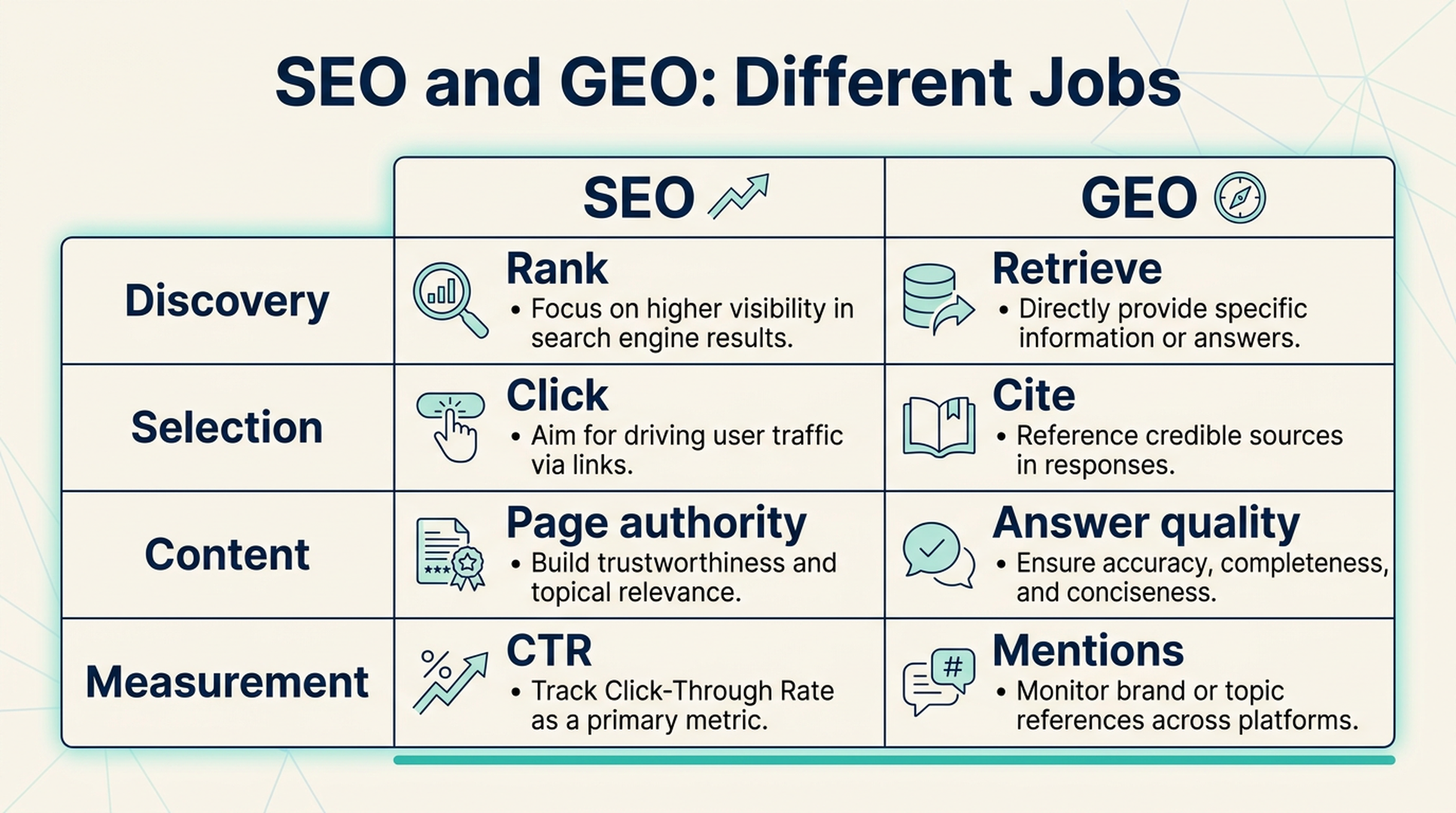
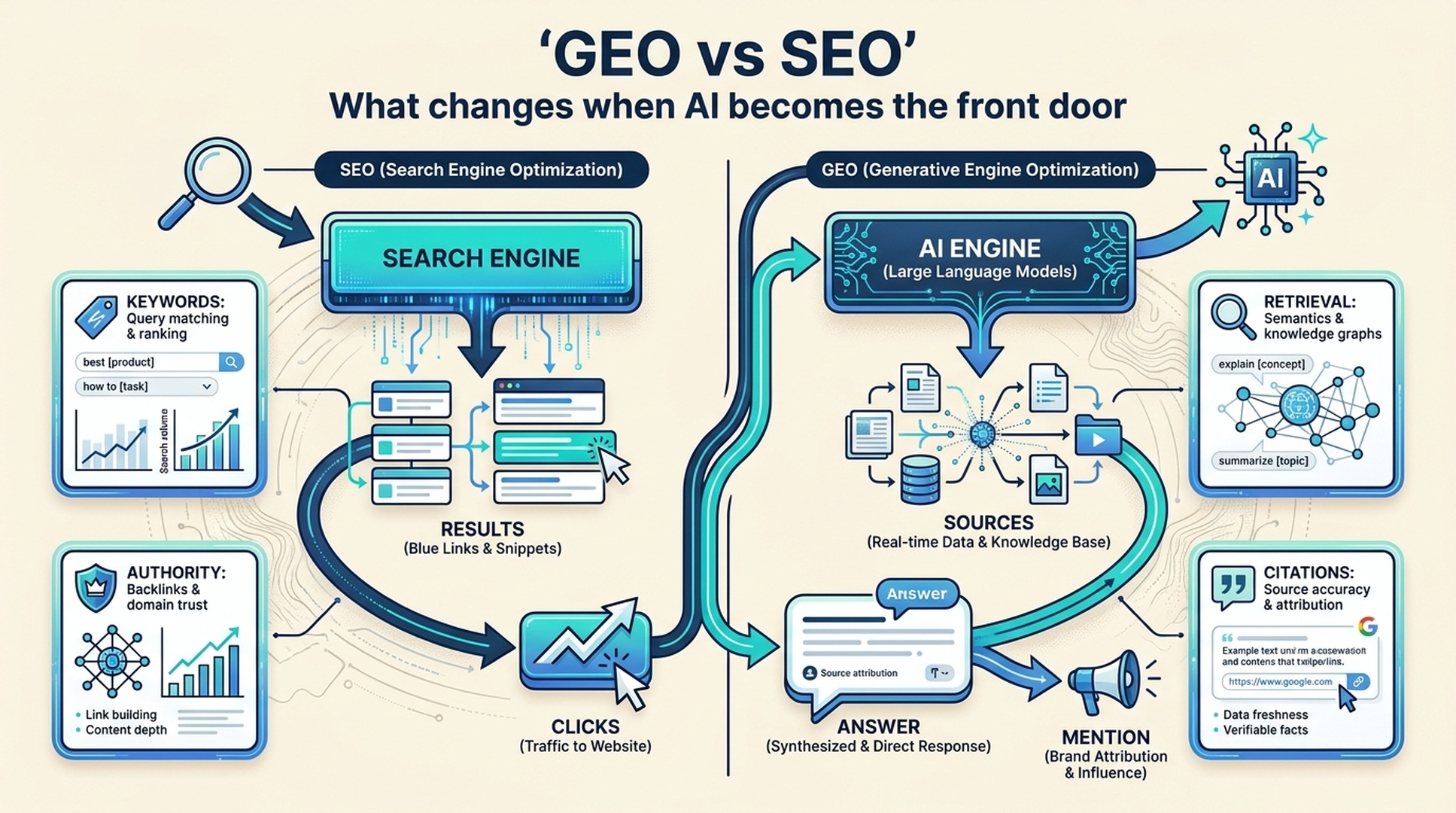
SEO and GEO overlap, but they optimize for different moments in the discovery path.
The search habit is changing
A small behavior change says a lot. When something breaks, many people no longer start with a keyword search. They ask an AI assistant: "Why are the leaves on my indoor plant turning yellow with black spots?" The answer may be imperfect, but the first instinct has changed.
The same thing is happening in commercial search.
A buyer used to type:
best CRM for small business
Now the buyer may ask:
What CRM should a 12-person B2B agency use if we need HubSpot integration, simple reporting, and a setup time under two weeks?
That second query is richer. It includes company size, integration needs, urgency, and constraints. It is also exactly the kind of query an AI answer engine is built to handle.
For marketers, this is the uncomfortable part: the AI answer may form the buyer's shortlist before your paid ad, title tag, or homepage ever appears.
What GEO actually means
GEO stands for Generative Engine Optimization. It is the work of making your content easier for AI answer engines to find, understand, verify, and use in generated responses.
A simple way to compare the two:
Discipline | Main question | Main outcome |
|---|---|---|
SEO | Can users find and click this page in search results? | Rankings, impressions, clicks, organic traffic |
GEO | Can AI systems use this page as a trusted source in an answer? | Mentions, citations, source inclusion, assisted demand |
This distinction matters because an AI system does not read a page like a person scanning a search result. It retrieves passages, checks context, compares sources, and generates an answer. If your page is vague, outdated, blocked, or hard to extract, it may be ignored even if the topic is relevant.
Why GEO matters for brands
GEO matters because AI answers can act like a recommendation layer.
If a potential customer asks, "Which industrial sensor provider works best for food manufacturing plants?" and an AI answer includes your brand with a credible reason, that is more than a mention. It is a form of pre-selection. The buyer sees your brand in context, next to a problem they already care about.
If your brand is missing, the buyer may never know you were a viable option.
This does not mean every AI answer is accurate or every mention produces revenue. The channel is still uneven. Attribution is messy. Some answers cite weak sources. Some tools hallucinate. Still, the direction is clear enough for growth teams to prepare.
Semrush published an AI search traffic study arguing that AI search could become a meaningful traffic source for SEO-related topics over the next few years. Whether the exact timing is early or late, the practical lesson is the same: teams should build AI visibility before the reporting dashboards make the shift obvious.
SEO and GEO are different at the technical level
Traditional SEO is built around crawling, indexing, keyword relevance, page authority, links, user signals, content quality, and technical health.
GEO adds retrieval and synthesis.
In many AI answer systems, the process looks more like this:
- The user asks a natural-language question.
- The system interprets the intent and constraints.
- It retrieves candidate sources from web indexes, browsing tools, partner data, or internal databases.
- It extracts passages that answer the question.
- It generates a response and may cite the sources.
That creates a new optimization problem. Ranking is useful, but not enough. The content must also be passage-level useful.
A strong GEO passage has these traits:
- It answers one clear question.
- It starts with the conclusion.
- It includes specific conditions, numbers, or examples.
- It names the source of important claims.
- It can stand alone if quoted outside the full page.
A weak GEO passage sounds like this:
Our solution empowers businesses with innovative technology to improve outcomes across the digital landscape.
A stronger version sounds like this:
This workflow is best for B2B SaaS teams with 20 to 200 employees that need to track demo requests, trial activation, and sales handoff in one reporting view. It is not a replacement for a full data warehouse.
The second version is less polished, but far easier for an AI system to use.
So, is SEO dead?
No. SEO is not dead. Lazy SEO is in trouble.
Thin keyword pages, generic intros, recycled listicles, and pages that exist only to catch search volume are less useful in an AI-mediated search environment. They are also less useful to humans.
Good SEO still matters for GEO because:
- crawlable pages are easier to retrieve;
- strong internal linking helps machines understand topic relationships;
- backlinks and third-party mentions can support trust;
- structured pages produce better snippets and better AI passages;
- fresh, accurate pages reduce outdated AI references.
The better framing is this: SEO gets your content into the information supply chain. GEO improves the chance that your content becomes part of the answer.
What companies should do first
Do not start by chasing every AI platform separately. Start with the assets you control.
1. Build an authoritative knowledge base
Your website should explain your category, product, use cases, limitations, pricing model, integrations, customer types, and proof points in plain language.
For B2B companies, this usually includes:
- product and solution pages;
- comparison pages;
- documentation;
- case studies with numbers and context;
- FAQ pages;
- glossary or education pages;
- security, compliance, and integration pages.
The goal is not to publish more pages. The goal is to make your best pages easier to cite.
2. Structure content for extraction
AI systems prefer content that is easy to parse. Use descriptive headings, tables, short lists, definition blocks, FAQ sections, and schema. Avoid locking key information inside images, PDFs, videos without transcripts, or decorative carousels.
For important pages, put the answer early. If the section is about "who this product is for," say it in the first sentence. Do not spend four paragraphs warming up.
3. Replace vague claims with verifiable claims
Vague: "trusted by growing teams."
Better: "used by B2B sales teams to route demo requests, score trial accounts, and sync product-qualified leads to HubSpot."
Best, when true: "used by 120 B2B sales teams as of May 2026; the average implementation in our last 30 onboardings took 11 business days."
Only use numbers you can support. GEO rewards evidence, but fake precision will backfire with both readers and AI systems.
4. Earn third-party proof
Your site is not the only source AI systems may consult. Review sites, app marketplaces, partner pages, industry directories, analyst mentions, community discussions, podcasts, and media coverage can all shape how a brand is understood.
Audit those sources. Look for stale positioning, old feature descriptions, outdated pricing, inconsistent category names, and missing product details. A messy public footprint makes your brand harder to recommend accurately.
5. Monitor AI answers directly
Set up a weekly prompt test. Choose 25 to 50 questions your buyers might ask. Run them in the AI tools your audience uses. Track whether your brand appears, what sources are cited, whether the description is accurate, and which competitors appear instead.
This does not need to be complicated at first. A spreadsheet is enough.
A 90-day AI search plan
Use the first three months to build a durable foundation instead of chasing shortcuts.
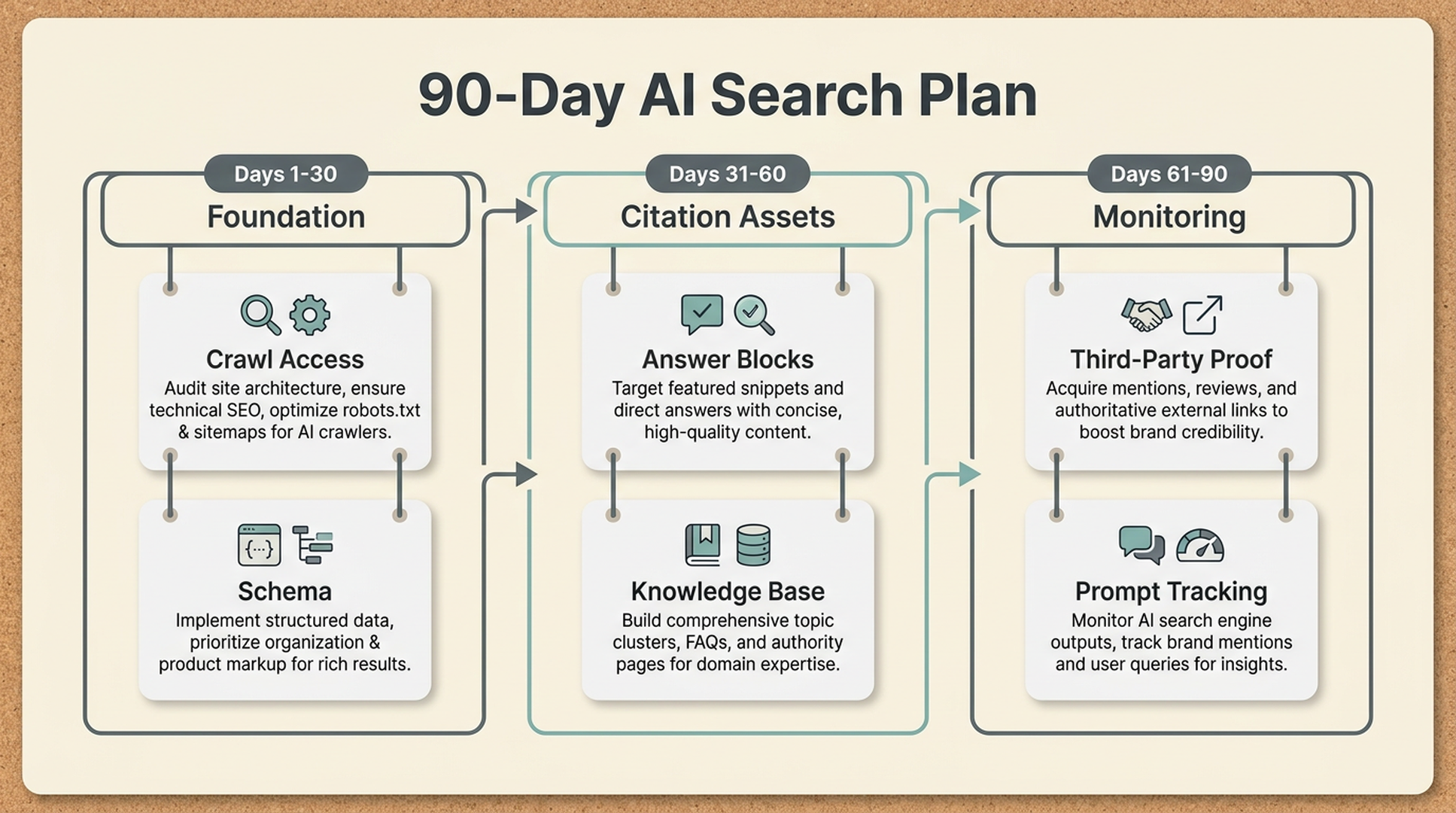
Start with technical access and source quality, then build citation assets and a monitoring loop.
Phase | Focus | Output |
|---|---|---|
Days 1-30 | Foundation | Crawl access, sitemap cleanup, schema checks, priority page audit |
Days 31-60 | Citation assets | Answer-first rewrites, FAQ sections, comparison tables, knowledge base updates |
Days 61-90 | Monitoring | Prompt tracking, AI referral reporting, third-party profile cleanup |
By day 90, you should know three things: which prompts matter, which pages AI tools cite, and where your brand is misunderstood or missing.
How to measure GEO without fooling yourself
GEO measurement is not as clean as SEO reporting. Some AI tools send referral traffic. Some do not. Some cite sources. Some summarize without links. Some answers change between sessions.
Use a combined scorecard:
Signal | What it tells you |
|---|---|
AI referral traffic | Whether AI tools send measurable visits |
Brand mentions in prompts | Whether you appear in answers and shortlists |
Cited URLs | Which pages AI systems trust enough to reference |
Answer accuracy | Whether the AI describes your brand correctly |
Competitor frequency | Which brands are winning the same prompts |
Assisted conversions | Whether AI-referred users become leads or customers |
Auspia's AI Search Visibility Checker can help create a starting view, but manual review still matters. You need to read the answers, not just count mentions.
Common mistakes
The first mistake is treating GEO as a replacement for SEO. If your pages are slow, blocked, duplicated, thin, or disconnected from the rest of the site, GEO work will be fragile.
The second mistake is treating GEO as a content-volume game. Publishing 300 generic AI-written pages may create more cleanup than visibility. Answer engines need useful sources, not more noise.
The third mistake is forgetting multilingual search behavior. If your buyers ask questions in English, Spanish, Japanese, or German, your content should answer in those languages. Machine translation alone is not enough for high-stakes pages. Localize examples, terms, FAQs, and proof.
The fourth mistake is ignoring the source trail. AI answers are shaped by more than your homepage. Keep public profiles, directories, partner pages, docs, and review sites aligned.
Auspia takeaway
SEO is still the foundation. GEO is the new visibility layer on top.
If your team already has strong SEO pages, do not throw them away. Rewrite them so they answer buyer questions directly. Add proof. Add schema. Clean up technical access. Build third-party consistency. Then test the prompts that matter.
The point is not to win every AI answer. The point is to make your brand easier to retrieve, easier to trust, and harder to ignore when buyers ask AI for help.
FAQ
What is GEO?
GEO stands for Generative Engine Optimization. It is the practice of improving content so AI answer engines can find, understand, cite, and mention it in generated responses.
Is GEO replacing SEO?
No. GEO adds a new layer to SEO. SEO helps content get crawled, indexed, ranked, and clicked. GEO helps that content become useful as a source inside AI-generated answers.
What is the biggest difference between SEO and GEO?
SEO optimizes for search result visibility and clicks. GEO optimizes for retrieval, citation, answer quality, and brand mentions inside AI responses.
What content works best for GEO?
Clear, specific, well-structured content works best. Use direct answers, FAQ sections, comparison tables, dated claims, author details, schema, and links to credible sources.
Should B2B companies invest in GEO now?
Yes, especially if buyers compare vendors, ask technical questions, or rely on long research cycles. B2B decisions often involve detailed prompts, which makes them a natural fit for AI-assisted search.
How often should we monitor AI search visibility?
Run a fixed prompt set weekly during the first month of a GEO project, then monthly once the baseline is stable. Track mentions, citations, answer accuracy, and competitors.