Short answer
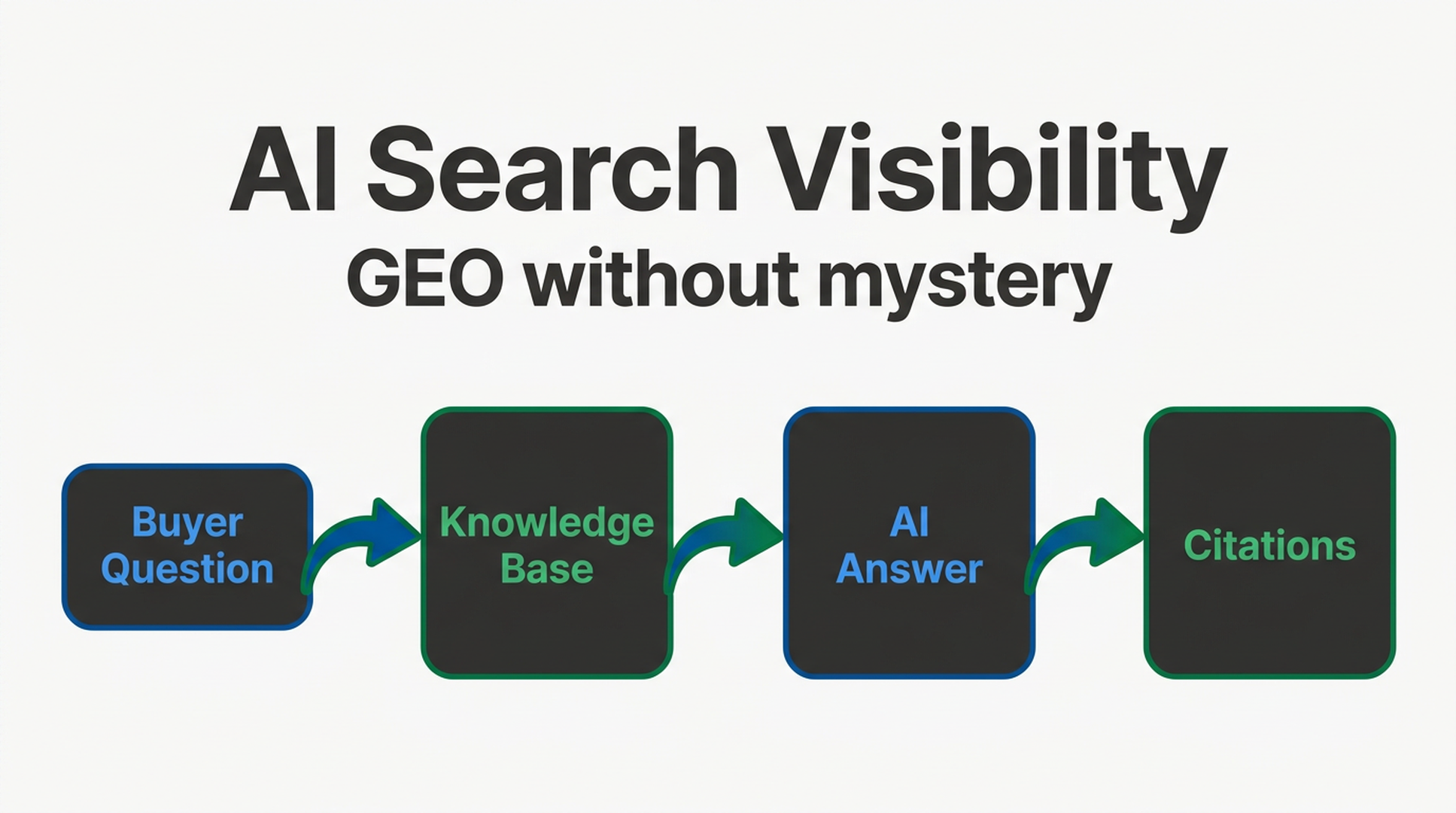
GEO is not a trick for ranking first inside AI. It is the work of making a brand, product, and use case clear enough for AI systems to understand, verify, and recommend when a buyer asks a real question.
The principle is simple. The hard part is operational: turning scattered product pages, sales decks, reviews, documentation, customer language, and proof points into a stable expression system that both people and AI systems can use.
If SEO is about being found for keywords, GEO is about being understood in context.
Why AI search changes the question
A buyer does not always search like this anymore:
"best project management software"
They ask something closer to this:
"I run a 12-person agency, most of the team works remotely, clients need status visibility, and I do not want a tool that takes three months to set up. What should I compare?"
That question contains role, team size, workflow, pain, constraint, and buying intent. A classic search result page can still help, but an AI answer does something different. It interprets the situation, compares options, and often recommends a short list.
This is where many brands fall short. They may have plenty of content, but the content does not answer scenario-level questions. Or the brand is known, but the product is poorly described. Or the product pages are clear, but third-party evidence is thin.
GEO starts with that gap.
It asks: when a buyer describes a situation, can AI systems connect that situation to your brand for the right reason?
SEO and GEO are different jobs
SEO and GEO overlap, but they are not the same job.
SEO usually starts with keywords, pages, rankings, links, and search demand. GEO starts with buyer questions, entity clarity, evidence, retrieval, and answer fit.
Dimension | SEO | GEO |
|---|---|---|
User input | Keywords and search queries | Natural-language problems and scenarios |
Main surface | Search engine results pages | AI answers, summaries, recommendations, and citations |
Brand goal | Earn visibility and clicks | Be understood, cited, and recommended |
Content unit | Optimized web page | Verifiable answer, entity, proof point, and scenario fit |
Measurement | Rankings, impressions, clicks, conversions | Mentions, answer share, citation quality, accuracy, assisted demand |
A useful shortcut: SEO helps a user discover your page. GEO helps an AI system explain when your brand is a good fit.
That matters because AI recommendations are not fixed rankings. The same tool may be a strong recommendation for a startup and a poor recommendation for an enterprise procurement team. The same ecommerce product may fit one use case and fail another. The answer changes with the scenario.
The real task: reduce semantic friction
A lot of brand content asks the reader to do too much work.
A homepage says "the future of intelligent collaboration." A product page says "built for modern teams." A sales deck says one thing, review sites say another, and the help center uses different product names again.
Humans can sometimes decode this. AI systems may not.
GEO reduces semantic friction. It makes the important facts easy to parse:
- What is the brand?
- What category is it in?
- Which customers is it for?
- Which problems does it solve?
- Which scenarios does it fit or not fit?
- What proof supports those claims?
- Which sources can verify the information?
GEO is less glamorous than people expect. Much of the work is cleanup: naming, taxonomy, product descriptions, documentation, reviews, comparison logic, schema, and source consistency.
Boring work. Very useful work.
A six-step GEO operating system
A brand does not need mystical hacks to start. It needs a repeatable system.
1. Understand the product before optimizing anything
Many teams think they have brand assets. What they actually have is a pile of outdated PDFs, inconsistent product names, old screenshots, half-used taglines, and channel-specific claims.
Start by collecting the source material:
- Product pages and pricing pages
- Support docs and implementation guides
- Sales decks and objection notes
- Customer reviews and support tickets
- Case studies and testimonials
- Partner and integration pages
- Public profiles, directories, and marketplace listings
Then reduce it to facts. Who is this for? What problem does it solve? What are the constraints? What proof exists? What should not be claimed?
2. Diagnose AI visibility across brand, product, and scenarios
Do not only ask an AI system "Do you know our brand?" That is too shallow.
Test at three levels:
Level | Example prompt | What it reveals |
|---|---|---|
Brand | "What is [brand] known for?" | Whether the entity is understood |
Product | "Is [product] good for [use case]?" | Whether product-level signals exist |
Scenario | "What should a [buyer type] use for [specific problem]?" | Whether the brand appears in real decision contexts |
Track whether the brand is mentioned, how it is described, which sources are cited, which competitors appear, and what the answer gets wrong.
This is where a tool such as an AI Search Visibility Checker is useful. It gives the team a baseline before everyone starts publishing random content.
3. Build a scenario map instead of chasing generic keywords
GEO is not about owning the broadest term. It is about being the right answer for the right situation.
A good scenario map has four layers:
Layer | Question | Example |
|---|---|---|
Buyer | Who is asking? | Solo founder, ecommerce manager, IT lead, local clinic owner |
Scenario | What is happening? | Launching a site, replacing a tool, comparing vendors, fixing traffic loss |
Intent | What decision are they making? | Buy, compare, troubleshoot, learn, justify budget |
Question | What do they actually ask? | "Which SEO audit tool works for a small SaaS site?" |
This matters because AI answers are context-sensitive. Winning one generic category mention is less useful than appearing in ten high-intent scenario answers that match real buyers.
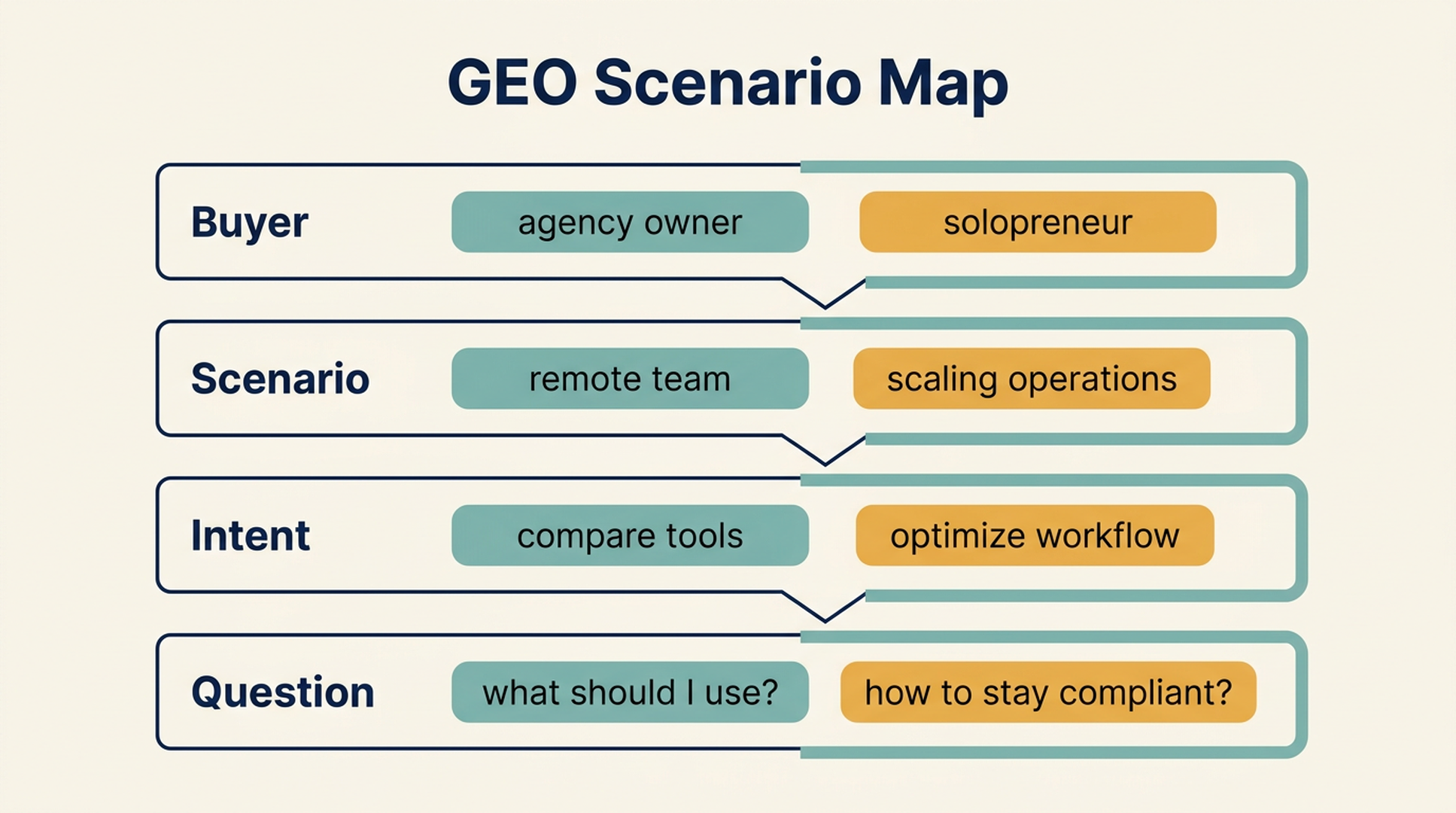
Caption: GEO planning starts with buyer scenarios, not only keyword lists.
4. Turn brand material into a knowledge base
Material is not the same as knowledge.
A screenshot, a product video, a pitch deck, and a customer quote are raw materials. They become a knowledge base only when the team extracts stable information, resolves conflicts, assigns ownership, and keeps it current.
A practical GEO knowledge base should include:
- Official product and category descriptions
- Approved claims and claims that need legal review
- Use cases by buyer type and industry
- Comparison logic against alternatives
- Proof points with source links
- Customer language and common objections
- FAQs with direct answers
- Product limitations and exclusions
The point is not to create a private encyclopedia nobody reads. The point is to make the brand's expression consistent across the website, content, sales, support, PR, and third-party profiles.
Consistency lowers the cost for AI systems to understand the brand. It also lowers the cost for humans.
5. Publish content AI systems can quote without guessing
AI systems can use many content formats, but the easiest content to retrieve and cite tends to share a few traits: clear facts, low ambiguity, direct answers, verifiable claims, and stable wording.
Compare these two claims:
Weak for GEO | Stronger for GEO |
|---|---|
"We redefine customer engagement." | "The platform helps ecommerce teams recover abandoned carts through email, SMS, and onsite messages." |
"Built for scale." | "Supports multi-store teams with role permissions, approval workflows, and centralized reporting." |
"Loved by modern brands." | "Customer reviews most often mention fast setup, template quality, and responsive support." |
The second column is less flashy. It is also easier to understand, verify, and recommend.
Use summaries, tables, lists, FAQs, schema markup, and comparison pages because they help people. If they help people, they usually help AI systems too.
6. Distribute, monitor, and tune continuously
Publishing one article is not a GEO program.
The team needs to monitor whether AI systems pick up the right sources, whether answers improve, whether competitors gain ground, and whether the brand is being placed in the right category.
A simple monitoring loop works:
- Test priority prompts.
- Record mentions, citations, competitors, and inaccuracies.
- Identify missing evidence or confusing language.
- Update owned content and third-party profiles.
- Publish or earn better proof where needed.
- Retest after a set interval.
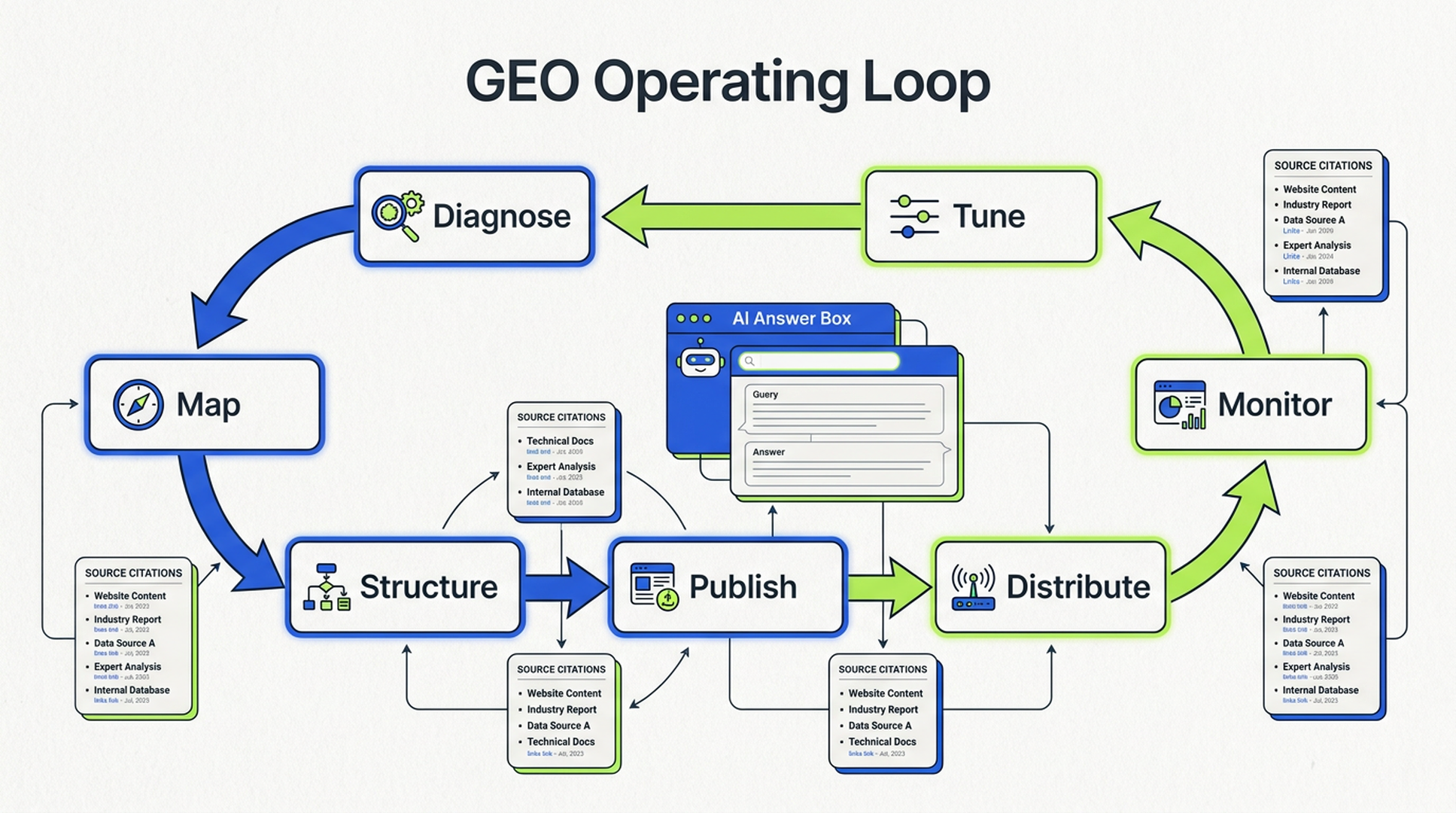
Caption: GEO is a loop. Visibility improves when diagnosis, content structure, distribution, and monitoring work together.
Six mistakes that make GEO fail
Mistake 1: treating GEO as SEO with a new label
Keyword research still matters, but AI answers depend heavily on meaning, context, and evidence. A page can target a keyword and still fail to answer the scenario an AI system is trying to solve.
Mistake 2: confusing more assets with better knowledge
More content can make the problem worse if the facts conflict. Old positioning, outdated product details, duplicate pages, and inconsistent descriptions create noise.
Mistake 3: chasing broad category terms too early
Everyone wants to show up for "best CRM" or "best SEO tool." Those prompts are crowded and often vague. Start with narrower use cases where your product has a real advantage.
Mistake 4: optimizing the brand but ignoring the product
A brand can be well known while a specific product, feature, or service line is invisible. AI recommendations often happen at the product and use-case level, not just the parent brand level.
Mistake 5: trying to optimize every AI platform at once
ChatGPT, Gemini, Perplexity, Claude, Copilot, and AI-enhanced search experiences use different retrieval patterns and user contexts. Start with the platforms your customers actually use, then expand.
Mistake 6: trying to manipulate AI instead of improving evidence
If a tactic depends on fake reviews, synthetic Q&A, misleading comparisons, or mass-produced thin pages, it is not a durable GEO strategy. It is reputational debt.
The safer approach is harder but cleaner: make facts verifiable, keep sources updated, compare alternatives honestly, and find the scenarios where your product genuinely fits.
A practical checklist for the first 30 days
Week | Work | Output |
|---|---|---|
1 | Collect product, sales, support, review, and third-party materials | Source inventory and conflicting claims list |
2 | Run AI visibility tests across brand, product, and scenario prompts | Baseline report with mentions, citations, errors, and competitors |
3 | Build scenario map and knowledge base outline | Buyer-intent-question map and approved fact set |
4 | Rewrite priority pages and publish proof-rich answers | Updated pages, FAQs, comparison tables, and monitoring plan |
Keep the first version small. A clean 30-prompt library and five corrected pages beat a 500-page content sprint with no measurement.
Auspia takeaway
GEO has no secret in the way people hope it does. There is no magic prompt, hidden schema tag, or shortcut that makes a weak brand become the obvious AI recommendation overnight.
The work is more practical: understand the buyer's scenario, make the brand entity clear, build a reliable knowledge base, publish verifiable answers, and monitor whether AI systems describe the brand correctly.
That is good news. It means GEO is not reserved for companies with massive budgets. But it does require discipline. The brands that win in AI search will be the ones that can explain themselves clearly, prove their claims, and keep that expression stable across the web.
Start there. The rest gets easier.
FAQ
What is GEO in simple terms?
GEO, or Generative Engine Optimization, is the practice of helping AI systems understand, verify, cite, and recommend a brand or product in generated answers.
How is GEO different from SEO?
SEO focuses on visibility in search results for keywords. GEO focuses on being understood and recommended in AI-generated answers for natural-language questions and scenarios.
Does GEO require a brand knowledge base?
It does not require a complex system at the start, but it does require consistent facts. A knowledge base helps teams keep product details, claims, use cases, and proof points aligned across channels.
What should a brand measure first?
Start with mention rate, citation sources, answer accuracy, competitor presence, and whether the brand appears in scenario-level prompts that match real buyers.
Is GEO only for large brands?
No. Smaller brands can benefit when they own specific scenarios, have clear proof, and keep their public information consistent. Broad category dominance is hard, but scenario-level visibility is often achievable.