Quick answer
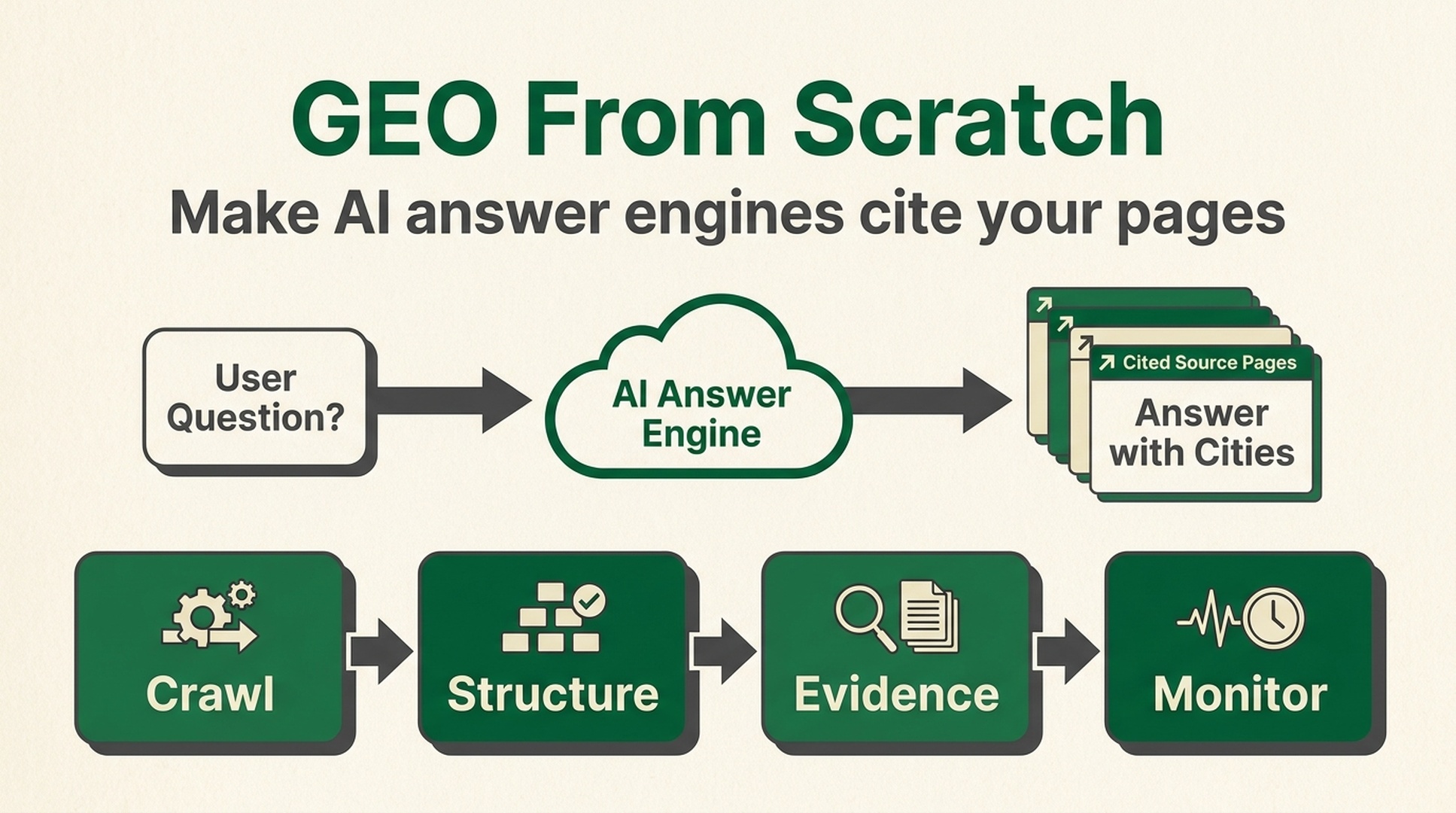
Generative Engine Optimization (GEO) is the practice of making your content more likely to appear as a cited source inside AI-generated answers. SEO still matters, but GEO adds a new layer: pages must be easy to crawl, easy to extract, easy to verify, and useful enough for an answer engine to quote.
If you are starting from zero, do not begin with 50 new articles. Begin with five things:
- Confirm AI and search crawlers can access the important pages.
- Rewrite priority pages so each section opens with a direct answer.
- Add specific evidence: dates, numbers, definitions, authors, and sources.
- Add Article, FAQ, Product, Organization, or HowTo schema where it fits.
- Create an
llms.txtfile that points AI systems to your best pages.
That is the practical version. GEO is not magic. It is mostly better information architecture, cleaner evidence, and less vague writing.
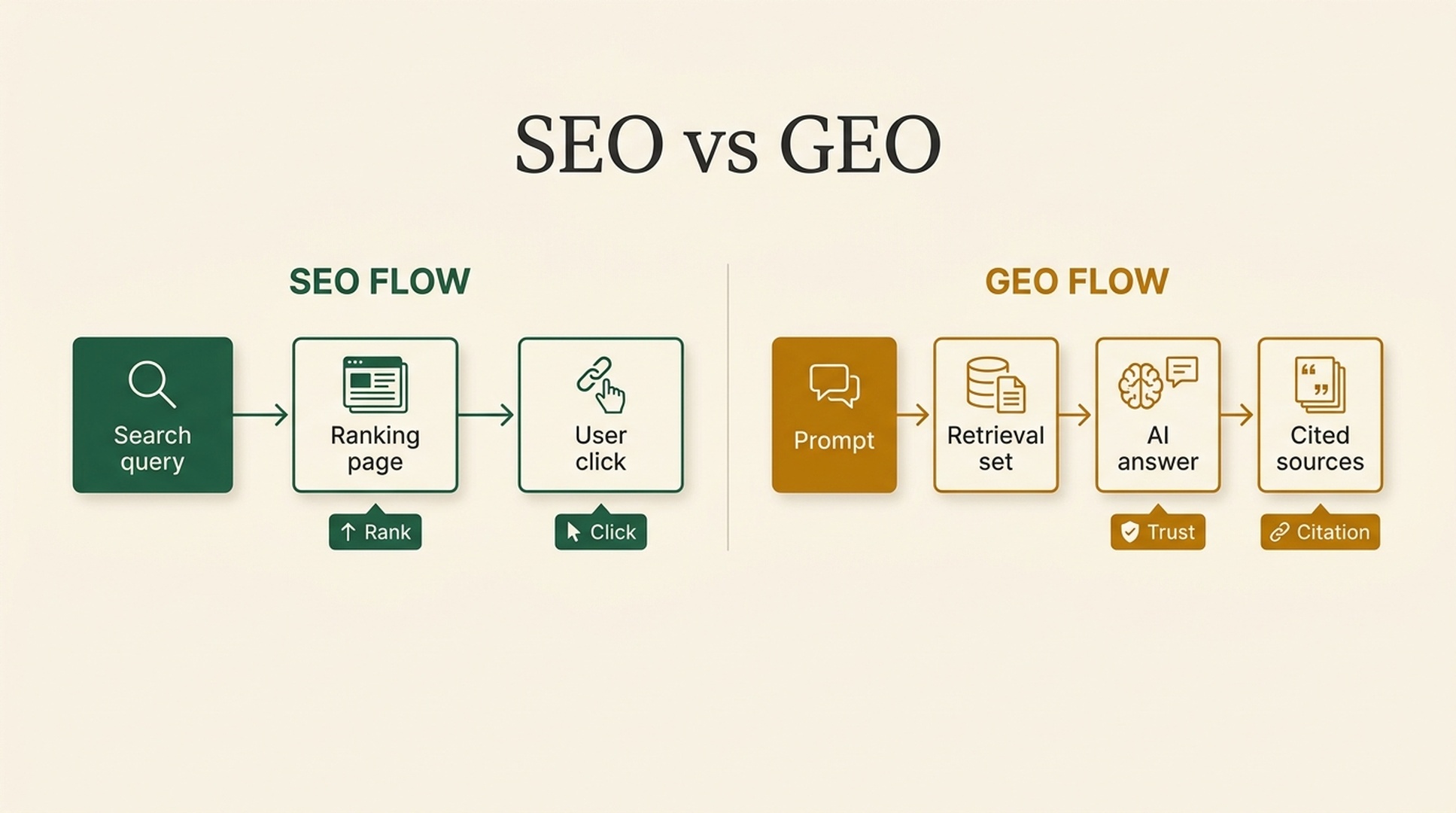
SEO tries to win the ranked result and the click. GEO tries to enter the retrieval set and become a cited source inside the answer.
What GEO means in plain English
GEO means optimizing for AI answer engines such as ChatGPT search, Perplexity, Google AI Overviews, Gemini, Claude with web access, and other retrieval-based assistants.
Traditional search usually works like this: a person searches, scans a results page, clicks a link, and decides whether the page helps. AI search compresses that journey. The user asks a question, the system retrieves sources, writes an answer, and may show citations. If your page is not in the retrieval set, the user may never see you.
The first academic paper to formalize GEO was submitted to arXiv on November 16, 2023, and later accepted to KDD 2024. The paper describes generative engines as systems that synthesize information from multiple sources, then studies how source visibility can be improved in those generated responses. Its reported experiments found visibility improvements of up to 40% in generative engine responses, depending on the strategy and domain.
For a growth team, the takeaway is simple: pages now compete twice. First, they compete to be found. Then they compete to be trusted enough to be quoted.
SEO vs GEO: what changes and what stays
GEO does not replace SEO. It changes the finish line.
Area | SEO goal | GEO goal | What to do |
|---|---|---|---|
Visibility | Rank on a results page | Appear in a synthesized answer | Write sections that can stand alone |
Content format | Comprehensive page | Extractable answers with proof | Put the answer in the first sentence |
Authority | Links, reputation, topical depth | Source trust plus verifiable claims | Add author, date, citations, schema |
Technical access | Crawlable and indexable pages | Crawlable, indexable, and machine-readable pages | Check robots, sitemap, schema, llms.txt |
Measurement | Rankings, clicks, impressions | AI citations, referral traffic, brand mentions | Track AI referrers and run prompt tests |
A page can rank and still fail at GEO if the useful answer is buried under a long intro. A page can also get cited by AI even before it becomes a major SEO winner, especially in narrow B2B topics where the page has a clean explanation and better evidence than the bigger sites.
This is why Auspia treats GEO as a layer on top of SEO, not a separate religion.
How AI answer engines choose sources
Most AI answer products use some version of retrieval-augmented generation. The details differ, but the working model is enough for marketers:
- The user asks a question.
- The system turns that question into a retrieval task.
- It gathers candidate documents from search indexes, partner data, browsing tools, or internal source pools.
- It extracts passages that appear relevant.
- It writes an answer and may attach citations.
That chain creates four places where your content can fail.
Failure point | What it looks like | Fix |
|---|---|---|
Access failure | Crawlers cannot reach the page | Open the right pages in robots.txt and sitemap.xml |
Matching failure | The page does not answer the query clearly | Add answer-first headings and FAQ sections |
Trust failure | Claims are unsupported or too promotional | Add sources, dates, author details, and balanced wording |
Extraction failure | The page is visually rich but text-poor | Add HTML text, schema, transcripts, and clean markdown-like structure |
There is one uncomfortable truth here: AI systems do not reward your best-looking page. They reward the page they can parse and justify.
Step 1: open the doors without giving up control
Start with crawler access. Visit:
https://yourdomain.com/robots.txt
https://yourdomain.com/sitemap.xml
Your robots file should not accidentally block the pages you want cited. Google’s own documentation explains that robots.txt tells crawlers which URLs they can access, mainly for crawl management, and is not the right way to hide sensitive pages from search. That distinction matters for GEO too. If a page is commercially important, blocking it at robots level can remove it from the source pool.
A simple starting point looks like this:
User-agent: *
Allow: /

Sitemap: https://yourdomain.com/sitemap.xml
Then check named AI crawlers according to your policy. Some brands allow search and AI answer crawlers while blocking training crawlers. Others make a stricter legal choice. That is fine. The mistake is not having a policy and discovering later that your best pages were blocked by an old plugin setting.
For WordPress, also check the "discourage search engines" setting and any SEO plugin robots editor. For headless sites, check build-time robots generation. For large sites, review staging, faceted navigation, and internal search URLs so you are not opening crawl traps.
Step 2: write pages that can be quoted
AI answer engines quote passages, not brand strategy decks. A quotable passage has four traits:
- It answers one question directly.
- It can be understood without the paragraph before it.
- It includes the conditions or limits of the claim.
- It avoids sales language.
Weak version:
Our platform transforms the modern content workflow with powerful AI capabilities that help teams unlock new growth opportunities.
GEO-ready version:
A content audit should group pages by search intent, traffic trend, conversion role, and freshness. For B2B sites, review high-intent product, comparison, and solution pages every 30 to 60 days because pricing, competitors, and buyer questions change quickly.
The second version gives the AI something useful to cite. It defines the task, names the dimensions, gives a time window, and explains the reason.
Auspia’s rule: every important section should pass the "copy one paragraph" test. If one paragraph were lifted into an AI answer, would it still make sense? If not, rewrite it.
Step 3: add evidence where the answer needs trust
The original GEO paper found that optimization methods vary by domain. That matches what we see in practice. A travel page, a SaaS comparison page, and a medical page do not need the same proof.
Use this evidence ladder:
Claim type | Weak evidence | Better evidence |
|---|---|---|
Definition | "Experts say" | A named standard, paper, documentation page, or glossary |
Performance claim | "Fast" | Test setup, date, sample size, metric, and limitation |
Product claim | Feature list | Screenshots, docs, changelog, pricing page, and use cases |
Local/service claim | Generic landing page | Address, service area, licenses, reviews, projects, and FAQs |
Research claim | Blog summary | Link to the paper, dataset, authors, and publication date |
Do not fake authority. AI systems are becoming better at ignoring thin claims, and human readers are already good at it. A clear limitation often improves trust: "This benchmark used 120 English queries in the project management category" is stronger than "our tool is best in class."
Step 4: build the technical GEO files
A useful GEO setup has four technical pieces.
robots.txt
This is the access layer. Confirm the important public pages are crawlable. Block low-value or private areas deliberately, not by accident.
sitemap.xml
This is the discovery layer. Include canonical URLs, update dates when your CMS supports them, and keep the sitemap clean. Do not ask crawlers to sort through thousands of junk URLs.
structured data
This is the machine description layer. Use schema that matches the page, not every schema type you can find. Most growth sites should start with:
ArticleorBlogPostingfor editorial pagesFAQPagewhen there is a real FAQ sectionOrganizationfor brand identityProduct,SoftwareApplication, orServicefor commercial pagesBreadcrumbListfor site structure
llms.txt
llms.txt is a proposed markdown file placed at /llms.txt. Jeremy Howard published the proposal on September 3, 2024. The idea is to give LLMs a concise map of the site: what the site is, which pages matter, and where clean markdown resources live.
A practical version can be short:
# Acme Analytics

> Acme Analytics helps B2B SaaS teams measure product-led revenue, activation, and retention.

## Core pages
- [Product overview](https://example.com/product): Main product capabilities, use cases, and supported integrations.
- [Pricing](https://example.com/pricing): Current plans, limits, and billing terms.
- [Security](https://example.com/security): SOC 2 status, data retention, encryption, and access controls.

## Guides
- [Activation metrics guide](https://example.com/guides/activation-metrics): Definitions and formulas for activation, time to value, and cohort analysis.

## Optional
- [Company blog](https://example.com/blog): Additional product updates and commentary.
Keep it honest. llms.txt is a guide, not a ranking hack. It works best when it points to genuinely useful pages.
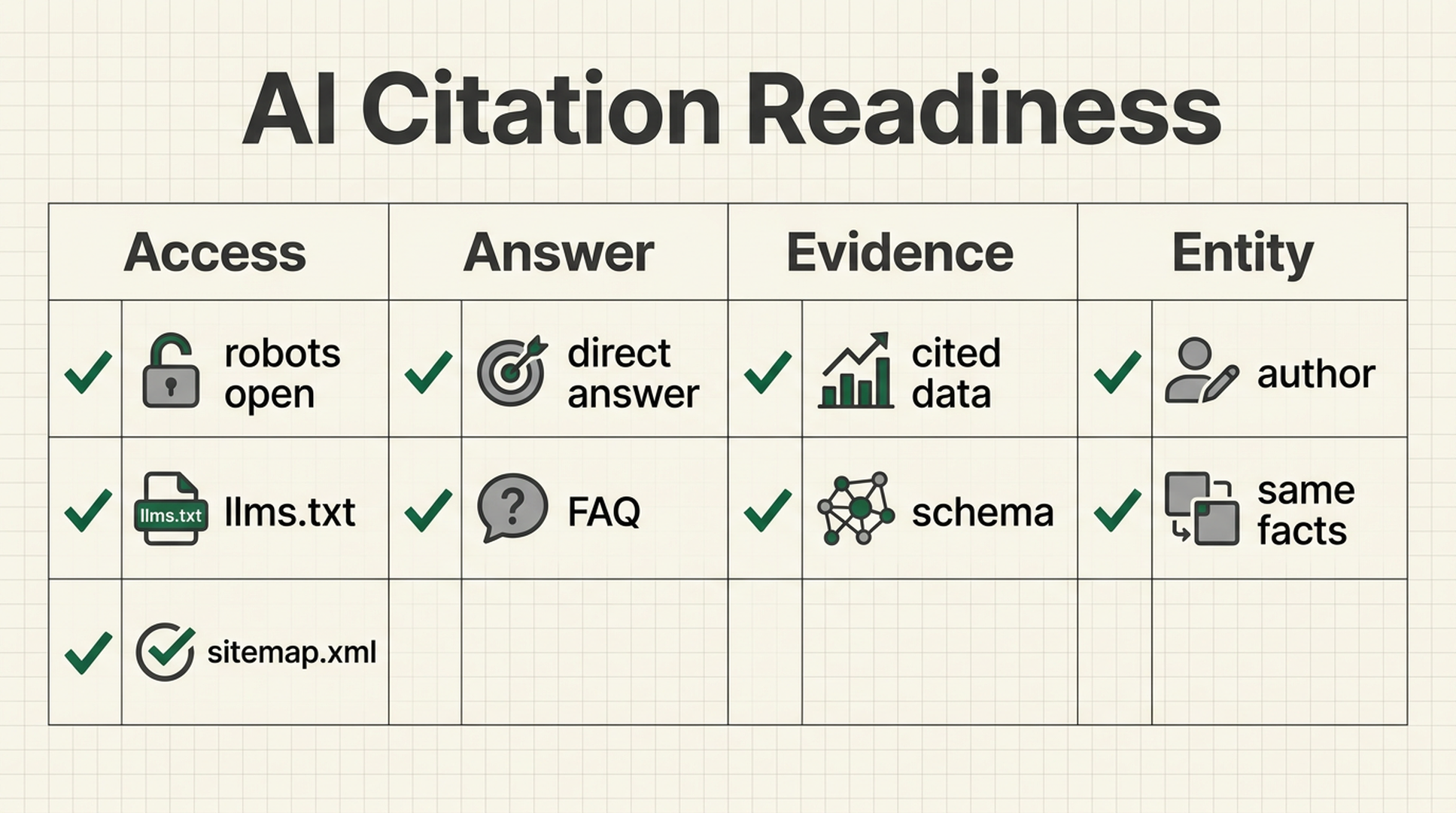
Use this as the first-pass audit: access, answer quality, evidence, and entity consistency.
Step 5: create AI-friendly FAQ blocks
FAQ sections work because they match how people prompt AI systems. They also force writers to stop hiding the answer.
Good FAQ answers are short, specific, and self-contained. Put the answer first, then add the nuance.
Bad FAQ question | Better FAQ question |
|---|---|
"What is the strategic importance of GEO?" | "What is GEO?" |
"How does our solution help modern teams?" | "How do I make a page easier for AI tools to cite?" |
"What are the benefits of advanced optimization?" | "How long does a basic GEO cleanup take?" |
For most pages, five to eight questions are enough. Cover definitions, process, timing, cost, mistakes, and comparison questions. Do not add 20 thin FAQs just to fill space.
Step 6: adapt by platform, but do not chase every rumor
Different answer engines have different source pools. Perplexity often behaves closer to a citation-heavy research assistant. Google AI Overviews sit close to the Google Search ecosystem. ChatGPT search may combine Bing, first-party browsing, partner content, and model behavior depending on the query and product state. Enterprise assistants may rely on private documents more than the public web.
That means one page will not perform the same everywhere.
A useful platform plan looks like this:
Platform type | What usually helps | What to watch |
|---|---|---|
Search-backed AI answers | Strong SEO pages, schema, freshness, crawl access | Pages with weak snippets or buried answers |
Citation-first AI tools | Clear passages, source links, dated claims | Unsupported claims and vague intros |
Community-heavy results | Third-party mentions, reviews, discussions | Brand-only content with no outside evidence |
Enterprise AI retrieval | Clean docs, PDFs, knowledge-base structure | Broken permissions and duplicate files |
Here is the part teams skip: consistency outside your own site. If your pricing, product category, founder name, address, and feature claims differ across directories, review sites, docs, and social profiles, AI systems have to resolve a mess. Keep the core facts identical across your website, knowledge bases, partner pages, and major profiles.
Step 7: measure GEO without pretending it is exact
GEO measurement is still messy. That is not an excuse to avoid it.
Track four signals:
- Referral traffic from domains such as
chatgpt.com,perplexity.ai,claude.ai,gemini.google.com, and AI browser surfaces where they appear in analytics. - Prompt visibility: run a fixed prompt set every week and record whether your brand or URL appears.
- Citation quality: note which page was cited, what claim was used, and whether the citation was accurate.
- Assisted conversions: tag AI referrals and compare lead quality against organic search and paid channels.
Use a simple spreadsheet at first. Columns: date, prompt, engine, location, cited source, answer position, competitor sources, notes. After four weeks, patterns become visible. You will see which topics cite you, which competitors keep appearing, and which pages need a stronger answer block.
If you want a faster first read, use an AI Search Visibility Checker to build a starting prompt set, then manually review the important prompts before making decisions.
A 10-point GEO launch checklist
Use this for the first week.
Priority | Task | Done |
|---|---|---|
1 | Pick 10 priority pages: product, comparison, solution, guide, and FAQ pages | |
2 | Confirm those pages are crawlable and in the sitemap | |
3 | Rewrite the first 100 words of each page so the answer appears immediately | |
4 | Add or update author, date, and organization details | |
5 | Add sources for statistics, definitions, and benchmark claims | |
6 | Add FAQ blocks to pages with clear user questions | |
7 | Validate Article, FAQ, Product, Organization, or Breadcrumb schema | |
8 | Publish | |
9 | Set up GA4 exploration for AI referral domains | |
10 | Run 25 prompts weekly and log citations |
Do the first ten pages before you make this a company-wide program. GEO gets vague when teams start with strategy workshops. It gets useful when they rewrite the pages that buyers and answer engines already care about.
Common mistakes
The biggest mistake is treating GEO as a trick. Adding llms.txt will not rescue thin content. Schema will not make unsupported claims trustworthy. Publishing 100 AI-written glossary pages will probably create more cleanup work than visibility.
The second mistake is copying SEO content patterns too closely. Long intros, keyword repetition, and broad topic coverage may still rank in some cases, but AI answer engines need compact, defensible passages.
The third mistake is ignoring third-party evidence. Your own site can define your product, but outside sources often validate the category. Reviews, analyst pages, partner pages, marketplace listings, documentation, and customer stories all help answer engines understand what you are.
Auspia takeaway
The best first GEO project is not glamorous. Pick ten pages. Make them crawlable. Make the answer obvious. Add proof. Add schema. Publish llms.txt. Track prompts for a month.
That work gives AI systems a cleaner version of your business to read. It also gives human buyers a better page. That is why GEO is worth doing even before attribution is perfect.
FAQ
What is GEO?
GEO stands for Generative Engine Optimization. It is the practice of improving your content so AI answer engines can find, understand, trust, and cite it in generated answers.
Is GEO different from SEO?
Yes, but it depends on SEO foundations. SEO focuses on rankings and clicks. GEO focuses on inclusion and citations inside AI-generated answers. The same page can support both if it is crawlable, authoritative, and written with direct answers.
Do I need llms.txt for GEO?
You do not strictly need it, but it is a useful low-cost addition. A good llms.txt file gives AI systems a concise site map of your most important pages and explains what each page contains.
How long does a basic GEO cleanup take?
A basic cleanup for 10 priority pages usually takes one to two weeks. The fastest wins are robots and sitemap checks, answer-first rewrites, FAQ additions, schema validation, and llms.txt publication.
Can AI tools cite pages that do not rank on Google?
Yes, it can happen, especially in niche topics. But strong SEO signals still help discovery and trust. Treat SEO as the foundation and GEO as the citation layer.
What should I measure first?
Start with prompt visibility, cited URLs, AI referral traffic, and assisted conversions. Do not rely on one metric. AI search attribution is still incomplete, so use several signals together.