Quick Answer
GEO, or Generative Engine Optimization, is the practice of making a brand's public content easier for AI systems to find, understand, verify, and cite inside generated answers.
SEO helps pages rank in search results. GEO helps information become useful source material for AI answers. The overlap is real: technical accessibility, helpful content, authority, and structured information still matter. But the success metric changes. In SEO, the user sees a list of links and chooses where to click. In GEO, an AI system may retrieve many sources, extract facts, compare evidence, and produce a single answer before the user clicks anything.
That means GEO is not just "SEO for ChatGPT." It is a broader visibility discipline for AI search, answer engines, AI Overviews, research agents, and other generative systems.
For growth teams, the practical goal is straightforward: when a buyer asks an AI system a question related to your category, your brand should appear as a relevant, credible, and well-supported source.
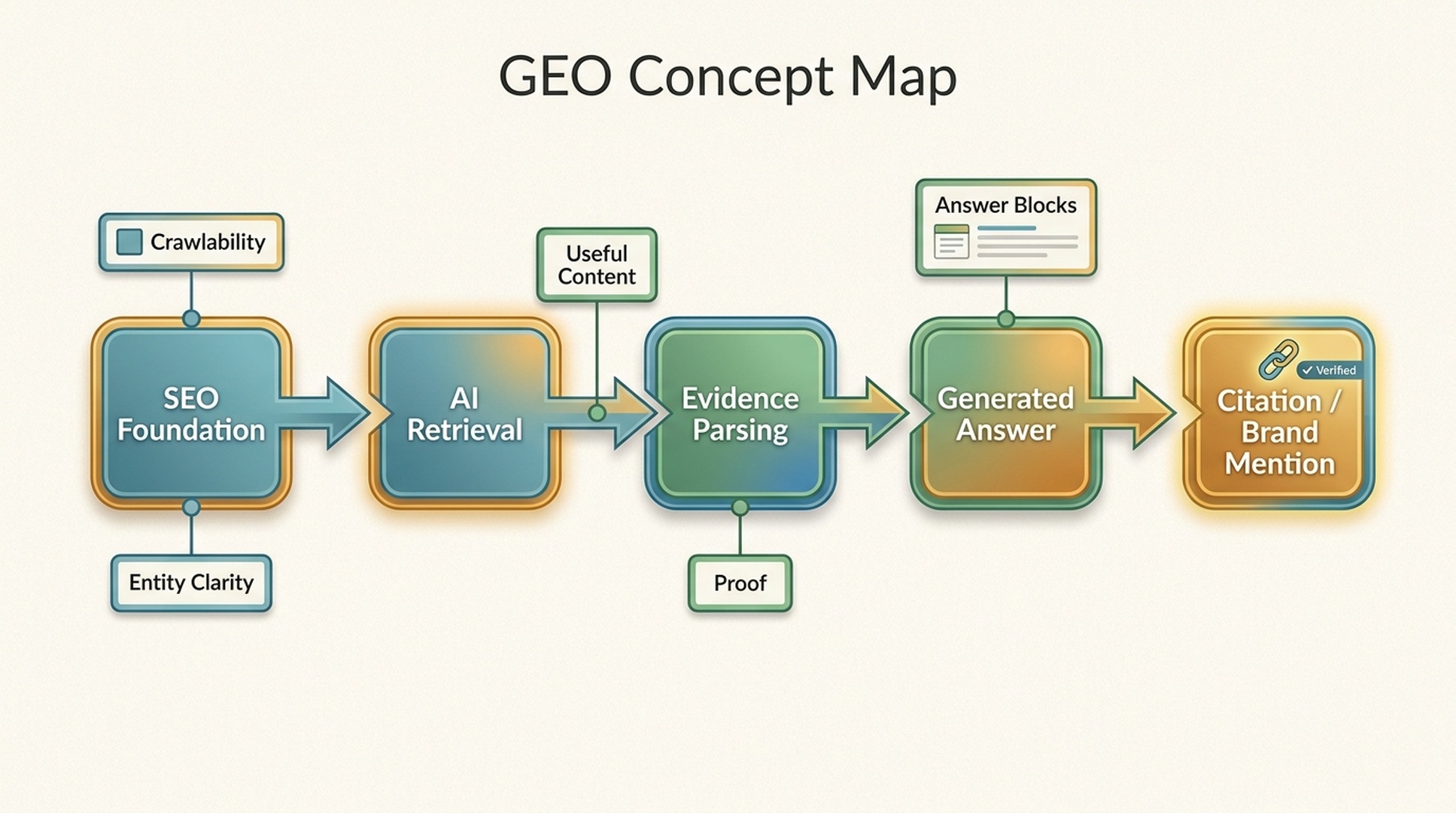
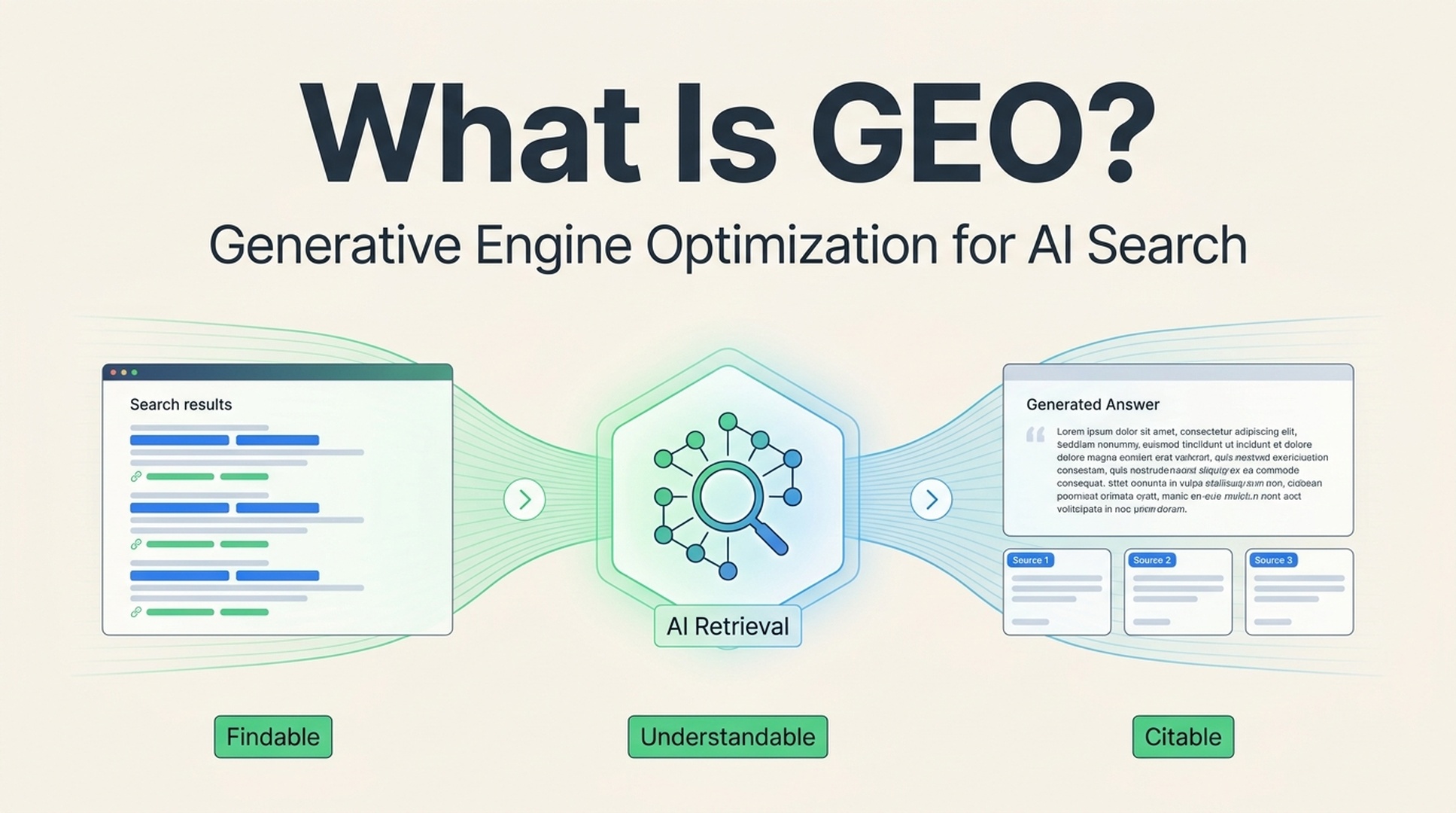
Caption: GEO starts with content quality, but the output is different: the brand becomes source material inside generated answers.
Why GEO Exists Now
For years, most organic growth teams optimized for search engines. Search engines crawled pages, indexed content, ranked URLs, and sent users to websites. A user typed a query such as "best project management software," scanned the results, opened several pages, and made a decision.
AI search changes that journey.
A user can now ask a complex question such as:
We are a 120-person consulting firm using spreadsheets for project tracking. What project management tools should we compare, and which one fits a services team best?
An AI answer engine may interpret the question, search the web, read product pages, summarize review sites, compare tools, and generate a recommendation. The user may still click sources, but the first layer of decision-making happens inside the answer.
This creates a new challenge for brands. Ranking is still useful, but it is not the whole game. Your content also needs to be:
- retrievable for the buyer's real problem, not only for a short keyword
- clear enough for AI systems to extract the right facts
- credible enough to be cited or recommended
- consistent across your website, documentation, profiles, and third-party sources
- specific enough to be useful in a generated answer
That is the reason GEO has become a separate topic. It responds to a new search interface and a new evaluation path.
A Simple Definition of GEO
GEO is the process of improving content, entities, evidence, and technical accessibility so generative AI systems can use your brand as a reliable answer source.
A good GEO program usually works across five layers:
Layer | What it means | Example action |
|---|---|---|
Technical access | AI crawlers and search systems can reach and parse your content | Review robots.txt, page rendering, internal links, schema, and important blocked paths |
Entity clarity | AI can identify who you are and how your brand, products, people, and categories relate | Use consistent naming, About pages, organization schema, product pages, and public profiles |
Content usefulness | Your pages answer real buyer questions with specific facts | Build problem pages, comparison pages, FAQs, and use-case guides |
Evidence quality | Claims are supported by data, examples, sources, and boundaries | Add case studies, dates, metrics, methodology, customer proof, and limitations |
Citation readiness | Content is easy to quote, summarize, and connect to a generated answer | Use clear headings, concise explanations, tables, definitions, and answer-ready blocks |
The most important point: GEO is not about tricking AI. It is about reducing ambiguity and increasing evidence quality so AI systems can safely use your information.
SEO vs GEO: What Changes?
SEO and GEO are connected, but they optimize different moments in the discovery journey.
Dimension | SEO | GEO |
|---|---|---|
Primary interface | Search results page | AI-generated answer |
Main object | Ranking URL | Source, citation, brand mention, recommendation |
User behavior | User reviews links and clicks pages | User reads synthesized answer and may click sources |
Query style | Often short keyword phrases | Often long, conversational, task-based prompts |
Content target | Match search intent and earn rankings | Become retrievable, understandable, and trustworthy answer material |
Measurement | Rankings, impressions, clicks, traffic, conversions | AI visibility, citation frequency, brand inclusion, source quality, assisted conversions |
Risk | Low ranking or low CTR | Being omitted, misdescribed, or replaced by competitors in AI answers |
A strong SEO foundation still helps. If your site cannot be crawled, loads poorly, lacks authority, or publishes shallow content, it will struggle in both SEO and GEO. But GEO adds another layer: the content must survive AI summarization and source comparison.
In other words, SEO asks, "Can this page win a result?" GEO asks, "Can this information be trusted inside an answer?"
How Generative Engines Use Content
Different AI platforms work differently, but many answer systems follow a similar pattern.
1. Interpret the user's intent
The system reads the prompt and identifies the task. A question about "best CRM for a small sales team" may include hidden needs: budget, team size, deployment speed, integrations, reporting, and ease of adoption.
2. Retrieve sources
The system may search web indexes, browse pages, consult internal indexes, or use retrieval tools. This is where technical accessibility and topic relevance matter.
3. Filter and compare evidence
The system looks for useful, reliable, and consistent information. It may prefer pages with clear facts, recognized sources, recent updates, and corroborating evidence.
4. Generate the answer
The system writes a response from the selected material. Sources that are clear and answer-ready are more likely to influence the final wording.
5. Display citations, links, or brand mentions
Some platforms show citations. Others mention brands without visible citations. Some provide source lists. This is why teams should monitor both linked citations and unlinked brand inclusion.
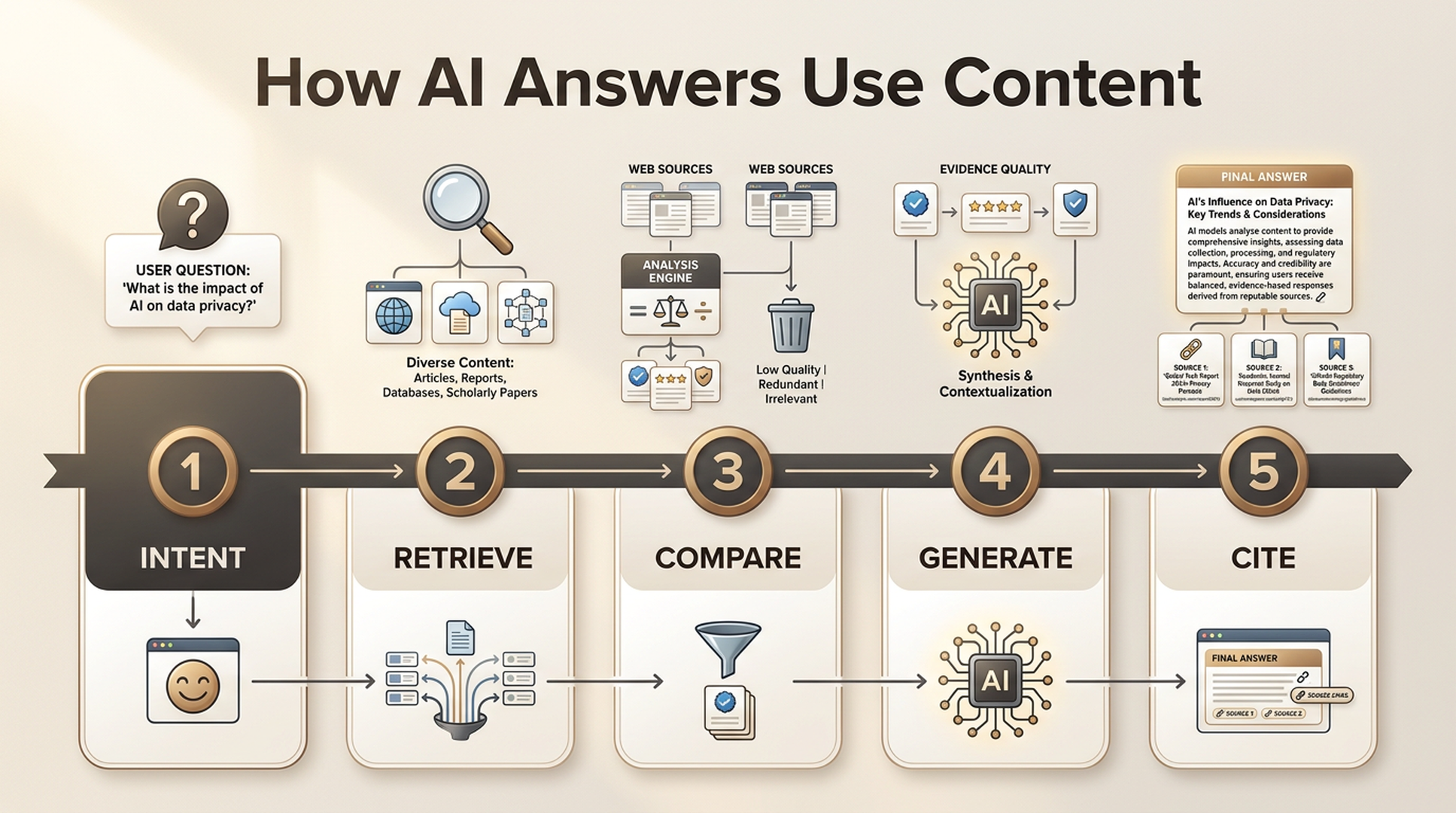
Caption: GEO optimization should match the way AI systems move from a prompt to a supported answer.
The Four Practical Goals of GEO
Auspia recommends treating GEO as four connected goals.
1. Be discoverable for the right questions
Do not only optimize for your product category. Optimize for the problem network around your category.
For example, a payroll platform should not only publish pages about "payroll software." It should answer questions about contractor payments, tax compliance, international hiring, payroll errors, employee onboarding, payroll calendars, and finance workflows.
AI systems often answer broad prompts by breaking them into subtopics. If your content covers the full problem domain, you have more chances to enter the retrieved source pool.
2. Be understandable as an entity
AI systems need to know what the brand is, what it offers, who it serves, and how it differs from alternatives. Confusing entity signals create weak answers.
Common problems include:
- different product names across pages
- vague About pages
- outdated third-party profiles
- inconsistent category labels
- product pages that describe features but not users or use cases
- multiple brands or sub-brands with unclear relationships
Entity clarity is foundational. If AI cannot identify the brand correctly, it cannot recommend the brand confidently.
3. Be useful as answer material
AI systems need facts that can be lifted into an answer. That means pages should contain definitions, decision criteria, examples, tables, boundaries, and evidence.
A weak paragraph says:
Our platform is a powerful solution for modern teams that want to work smarter.
A stronger paragraph says:
Acme Analytics is designed for B2B SaaS teams that need to identify retention risk from product usage, CRM, and support data. It works best when the company already tracks account-level events and has a customer success team responsible for renewals.
The second version is more useful because it contains audience, problem, data sources, fit conditions, and decision context.
4. Be trustworthy enough to cite
AI systems are cautious when public evidence is thin or contradictory. A brand can be visible and still not be cited if the evidence feels weak.
Trust signals include:
- named customers or detailed anonymized case studies
- dated metrics with methodology
- documentation and changelogs
- third-party reviews or marketplace listings
- analyst, media, or partner mentions
- consistent positioning across public sources
- clear limitations and non-fit cases
Trust is where many GEO programs stall. Better writing improves clarity, but proof requires real evidence.
How to Start GEO Optimization
Use this step-by-step workflow before launching a large content program.
Step 1: Audit AI visibility
Ask multiple AI systems problem-shaped questions in your category. Track whether your brand appears, how it is described, which sources are cited, and whether competitors are mentioned more often.
Useful prompts:
What are the best tools for [specific use case] for a [company type]?
Compare [your brand] with alternatives for [specific problem]. Use public sources only.
What public evidence supports [your brand]'s claims about [capability]?
Document the gaps. Do not overreact to one answer. Look for repeated patterns across systems.
Step 2: Fix technical access
Review whether important pages are accessible to search and AI systems. Check robots.txt, noindex tags, canonical tags, broken internal links, JavaScript rendering issues, page speed, and structured data.
If your team wants a quick starting point, use tools such as the Robots.txt AI Crawler Checker or an AI Search Visibility Checker to identify obvious blockers.
Step 3: Clarify entities and categories
Create or update pages that define:
- company name and product names
- target customers
- categories and use cases
- locations, leadership, and contact details where relevant
- integrations and partner relationships
- the difference between your product, services, and sub-brands
Use consistent language across your website, LinkedIn, marketplace profiles, documentation, and review sites.
Step 4: Build answer-ready content
Create content that maps to real user questions, not only keywords. Prioritize:
- use-case pages
- comparison pages
- category education pages
- buyer guides
- implementation guides
- FAQ pages
- case studies with methodology
- glossary pages for important concepts
Each page should answer the question directly near the top, then provide evidence, examples, and constraints.
Step 5: Add proof and boundaries
For every important claim, ask: "What would make this safe for an AI system to cite?"
Improve weak claims like this:
Weak claim | GEO-ready version |
|---|---|
"Trusted by global teams" | "Used by distributed SaaS teams in North America and Europe, based on public case studies from 2024 and 2025." |
"Fast implementation" | "Typical implementation takes 14-30 days for teams using Salesforce and Segment, according to the onboarding checklist published in March 2026." |
"Best for enterprises" | "Best suited for companies with more than 500 employees that require SSO, audit logs, SCIM, and role-based access controls." |
"AI-powered insights" | "Uses account-level product events, support tickets, and CRM fields to identify renewal-risk patterns for customer success teams." |
Boundaries are not a weakness. They help AI systems understand when your brand should and should not be recommended.
Step 6: Monitor and iterate
GEO is not a one-time checklist. Track how AI systems describe your brand over time. Watch for:
- wrong company descriptions
- outdated facts
- missing product categories
- competitor overrepresentation
- citations to weak or old pages
- unhelpful summaries of your value proposition
- answer gaps where your brand should appear but does not
Use those findings to update pages, add proof, improve entity clarity, and build new content around missing questions.
A Simple GEO Checklist
Use this checklist for any important page:
- The page states the answer or core point in the first section.
- The target audience is explicit.
- The problem and use case are specific.
- The page explains who the offer is not for.
- Claims include evidence, dates, scope, or methodology where possible.
- Important terms are defined in plain language.
- The page includes headings that match real questions.
- Tables or lists summarize decision criteria.
- Internal links connect to related guides, tools, and proof pages.
- The page is accessible to crawlers and not blocked by technical settings.
- The same claims are consistent across the website and external profiles.
Common GEO Mistakes
Mistake 1: Publishing more content without a problem domain
More pages do not automatically create AI visibility. If the topics are scattered, AI systems may not associate the brand with a stable area of expertise.
Mistake 2: Confusing AI-friendly with AI-written
GEO content should be easy for AI to parse, but it should not read like generic AI output. Clear evidence, original examples, and real constraints matter more than formulaic prose.
Mistake 3: Optimizing only the homepage
AI systems may cite documentation, blog posts, comparison pages, product pages, review sites, or third-party articles. The full public evidence graph matters.
Mistake 4: Treating citations as the only metric
Some platforms cite sources visibly; others do not. Track citations, brand mentions, answer inclusion, sentiment, and whether the answer describes you correctly.
Mistake 5: Making claims that cannot be verified
Unverifiable claims may sound persuasive to humans but risky to AI systems. Replace vague superiority with specific, bounded evidence.
FAQ
What does GEO stand for?
GEO stands for Generative Engine Optimization. It refers to optimizing content and public evidence so generative AI systems can find, understand, trust, and cite your brand in answers.
Is GEO replacing SEO?
No. GEO builds on many SEO fundamentals, including crawlability, helpful content, authority, and structured information. But GEO adds a new goal: becoming reliable answer material for AI systems.
What is the difference between GEO and AEO?
AEO, or Answer Engine Optimization, focuses on earning answers in search features and answer engines. GEO is closely related but usually emphasizes generative AI systems that synthesize responses from multiple sources.
How can I measure GEO performance?
Measure AI visibility across answer engines: whether your brand appears for target questions, how often it is cited, whether descriptions are accurate, which sources are used, and how you compare with competitors.
Can small brands win in GEO?
Yes, especially in specific problem domains. Small brands can compete by publishing clearer expertise, stronger use-case content, better documentation, and more verifiable proof than larger but vaguer competitors.
Auspia Takeaway
GEO is not a shortcut for ranking everywhere. It is a system for making your brand easier to retrieve, easier to understand, and safer to cite.
The teams that win in AI search will not simply publish the most content. They will build the clearest public evidence: precise definitions, consistent entities, useful answer blocks, real proof, and honest boundaries.
If your team is starting now, do not begin with a massive content calendar. Begin with one question: when a buyer asks AI about the problem you solve, does the answer have enough reliable public evidence to include you?
References
- Pranjal Aggarwal et al., "GEO: Generative Engine Optimization", arXiv, 2023.
- Patrick Lewis et al., "Retrieval-Augmented Generation for Knowledge-Intensive NLP Tasks", arXiv, 2020.
- Google Search Central, "AI features and your website", Google Search documentation.
- OpenAI, "WebGPT: Improving the factual accuracy of language models through web browsing", 2021.