Executive summary
A fair question is starting to show up in AI search conversations: is GEO just a polite name for poisoning AI systems?
No. At least, not when it is done properly.
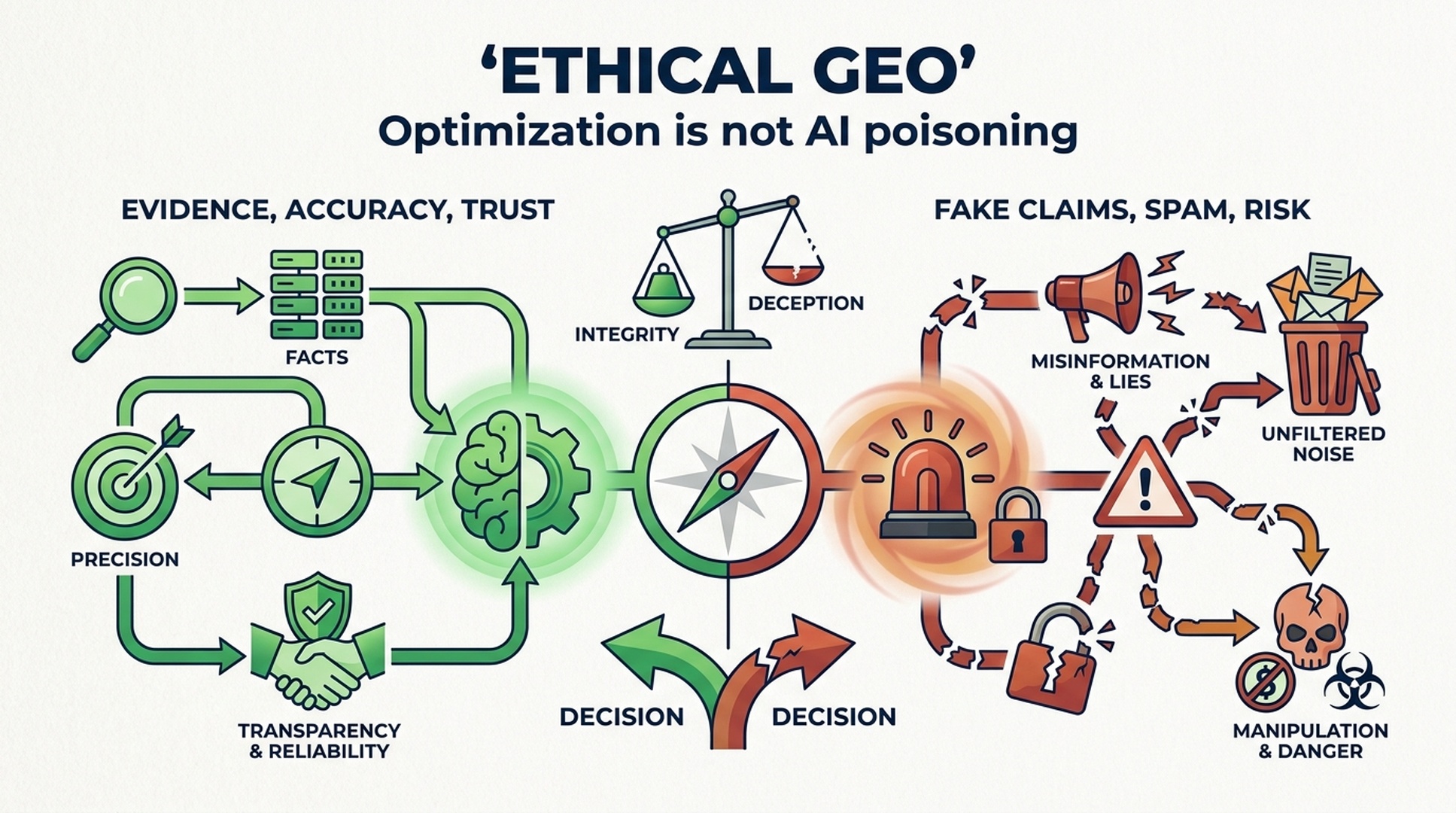
Bad GEO tries to push false or low-quality claims into the information supply chain so an AI system repeats them. Ethical GEO does the opposite. It makes accurate information easier to find, compare, verify, and cite.
That difference matters. AI answer systems are becoming part of how people choose software, agencies, local services, ecommerce products, healthcare information, financial tools, and B2B vendors. If your public information is missing, vague, outdated, or scattered, AI systems may describe you badly or ignore you. Fixing that is not poisoning. It is basic source hygiene.
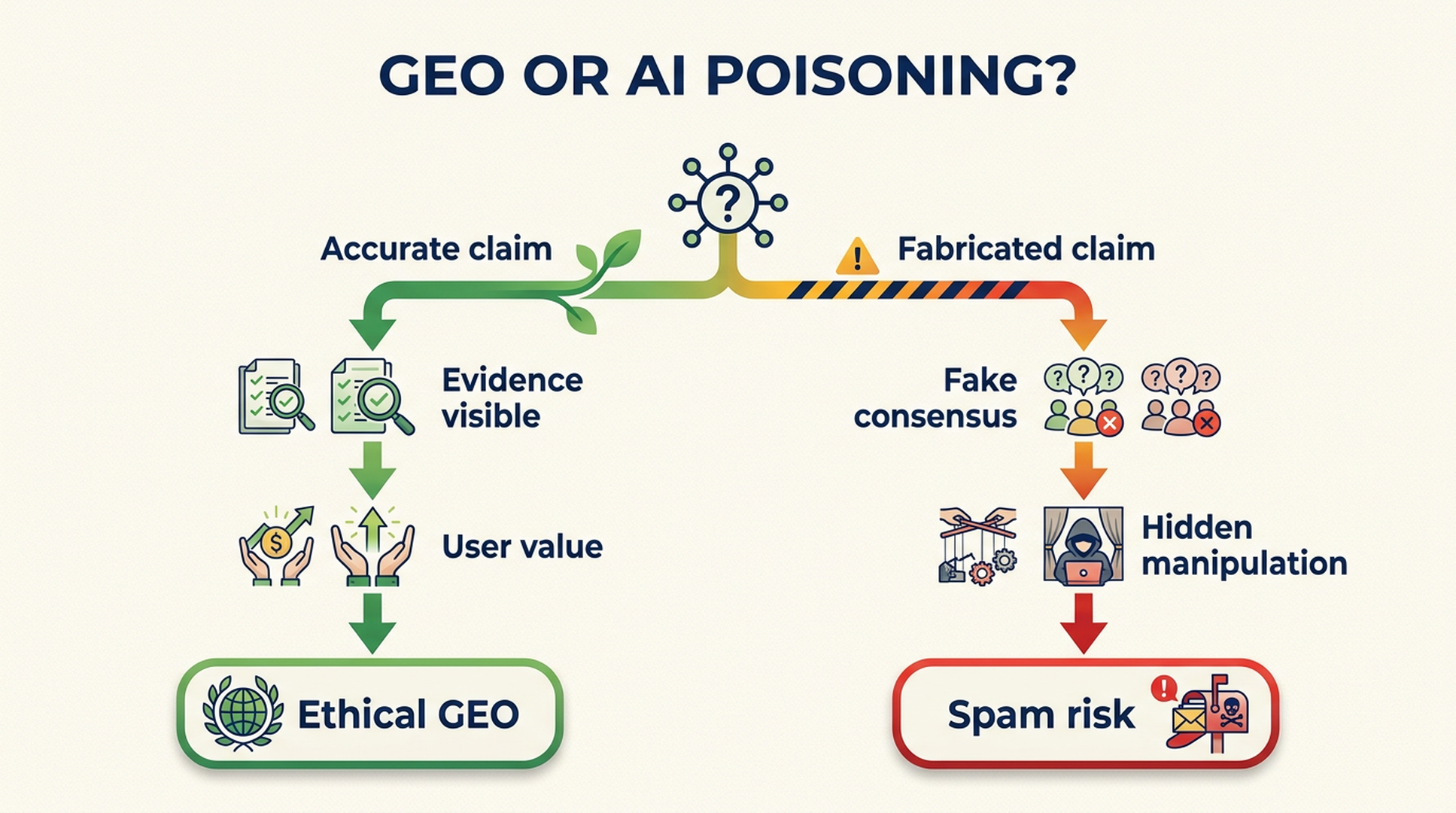
The line is simple: GEO is legitimate when it improves evidence. It becomes spam when it fabricates evidence.
Why people confuse GEO with AI poisoning
The confusion is understandable.
GEO stands for Generative Engine Optimization. In plain English, it means improving how your brand, pages, and proof assets appear in AI-generated answers. That sounds close to manipulation if you only hear the headline.
There is also a real spam problem. Some operators publish fake reviews, invented benchmarks, thin comparison pages, auto-generated press releases, or forum posts designed only to influence AI answers. That work should not be defended. It pollutes the web, misleads buyers, and creates risk for the brands that use it.
But calling all GEO poisoning is like calling all SEO link spam. Link spam exists. SEO still has legitimate work: technical accessibility, useful content, internal links, structured data, and clear answers. GEO has the same split.
The useful version asks:
- Can AI systems understand what we actually do?
- Are our claims backed by proof?
- Are our public sources consistent?
- Are our best explanations crawlable?
- Can users verify what the AI answer says about us?
The spam version asks one question: how do we get mentioned, whether or not the mention is deserved?
That is the fork in the road.
What AI poisoning looks like in practice
AI poisoning is not one tactic. It is a pattern: feeding unreliable information into places that AI systems, search engines, or users may later treat as evidence.
Common versions include:
Spam pattern | What it does | Why it is risky |
|---|---|---|
Fake product claims | Invents features, certifications, customers, or performance metrics | Creates legal, reputation, and buyer-trust risk |
Synthetic reviews | Publishes fake praise across review sites or forums | Can be removed, flagged, or publicly exposed |
Mass-generated articles | Floods low-quality pages around the same entity or query | Weakens source quality and may look manipulative |
Citation laundering | Repeats an unsupported claim across many small sites until it looks common | Makes false information harder to trace |
Misleading comparisons | Creates biased competitor pages with hidden assumptions | Damages trust when buyers notice the framing |
Cloaked or inaccessible pages | Shows different content to crawlers and users | Violates basic quality expectations |
None of this is a durable growth strategy. It may create short-term noise, but it also gives AI systems and human buyers more reasons to distrust the brand.
A simple test helps: would you be comfortable showing the source page to a customer, a journalist, a regulator, and your own sales team? If not, do not use it for GEO.
What ethical GEO looks like
Ethical GEO is source quality work. It makes the web's version of your brand closer to reality.
That includes:
- Clear product descriptions with real use cases and limitations.
- Documentation that answers implementation questions.
- Case studies that separate verified results from illustrative examples.
- Review profiles that use accurate category and company information.
- Comparison pages that explain criteria instead of attacking competitors.
- FAQs that answer the questions buyers actually ask.
- Technical files and internal links that help crawlers reach the right pages.
- Consistent entity information across your website, LinkedIn, app marketplaces, partner pages, and trusted directories.
This work does influence AI answers, but through better evidence. That is the difference.
GEO should make a source more useful even if AI search disappeared tomorrow. If the page helps a human buyer understand the product, check the claim, and make a better decision, it is probably on the right side of the line.
The ethical GEO checklist
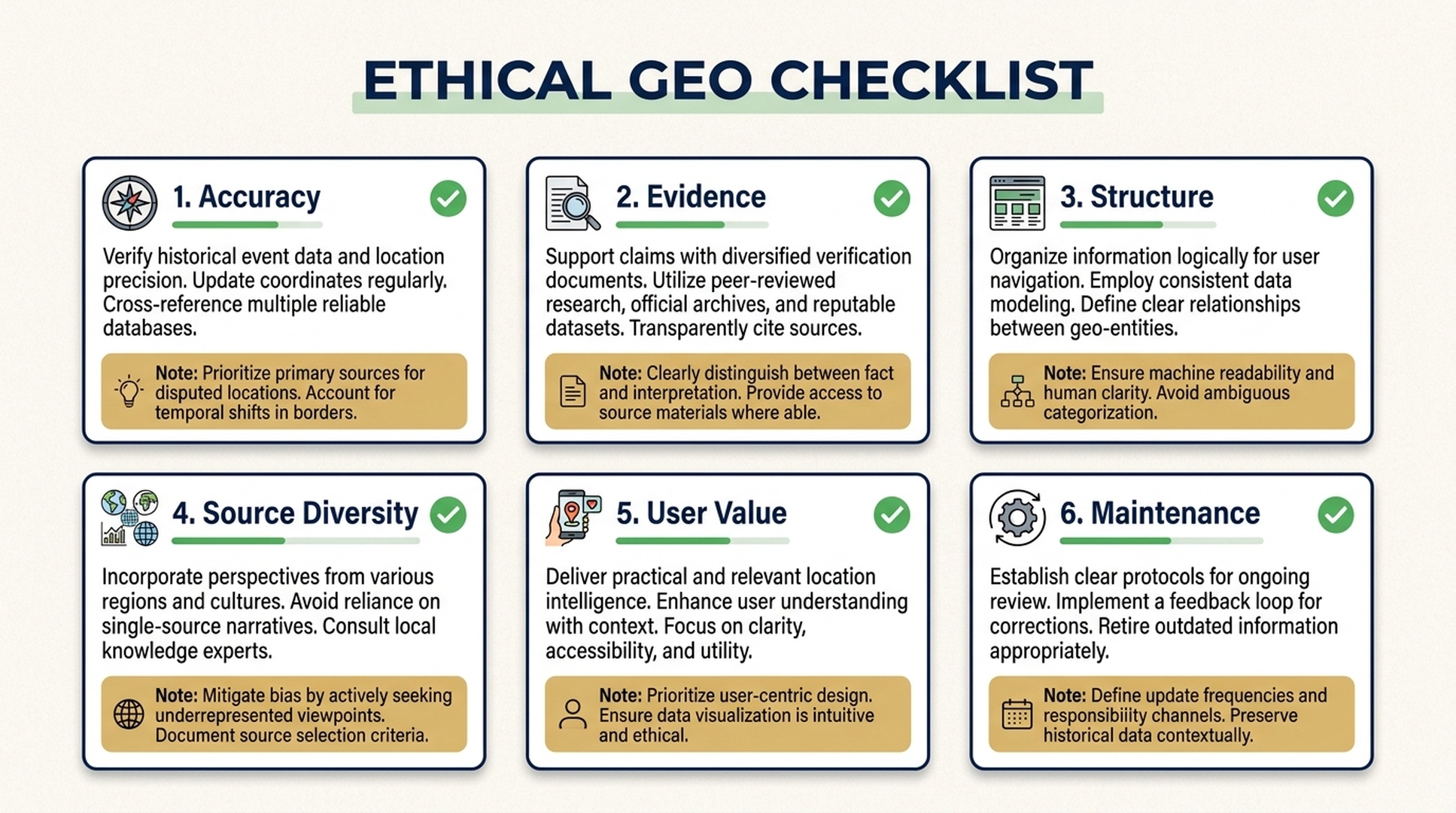
Use this checklist before publishing or updating any page meant to improve AI visibility.
Check | Good GEO | Risky GEO |
|---|---|---|
Accuracy | Claims match the product, docs, and customer reality | Claims are exaggerated or unverifiable |
Evidence | Data, examples, screenshots, sources, or methodology are visible | Proof is vague, invented, or hidden |
Structure | The page has clear answers, lists, tables, and FAQs | The page repeats keywords without helping users |
Source diversity | Third-party mentions are earned, relevant, and consistent | Mentions are manufactured at scale |
User value | A buyer would benefit from reading it | The page exists only to influence AI |
Maintenance | Facts are reviewed and dated when needed | Old claims stay live because they still rank or get cited |
The best GEO pages pass two tests at once. They are easy for AI systems to parse, and they are useful for a skeptical human.
Seven practical GEO moves that are not spam
If you want AI systems to understand and cite your brand without crossing into manipulation, start with these moves.
1. Put the conclusion first
AI systems often need a concise answer. Human readers do too.
Open important pages with a direct explanation of what the product does, who it is for, and when it is not a good fit. Do not make users scroll through a brand story before they get the answer.
Bad opening:
We are redefining the future of intelligent work for ambitious teams.
Better opening:
Auspia helps growth teams audit SEO, GEO, and AI search visibility so they can find missing source pages, crawler access issues, and answer gaps.
Specific beats grand.
2. Use structured sections
AI systems work better with pages that have clean boundaries. Use headings, short definitions, lists, tables, and FAQ blocks. This is not writing for machines. It is just easier to read.
A practical structure:
- Direct answer.
- Who this is for.
- How it works.
- Proof or examples.
- Limitations.
- FAQ.
- Next step.
3. Add proof near the claim
Do not make readers hunt for evidence. Put the proof next to the statement it supports.
If you mention a benchmark, include the source or method. If you mention customer results, include the context and constraint. If you mention integrations, link to the docs or marketplace listing.
Evidence does not need to be dramatic. It needs to be checkable.
4. Build real authority, not fake authority
Authority is not a logo wall with no substance. It comes from useful documentation, expert authorship, customer proof, third-party validation, community answers, and consistent public records.
For technical products, GitHub, docs, changelogs, API references, Stack Overflow, and developer communities may matter. For SaaS, review platforms, app marketplaces, partner pages, analyst mentions, and case studies may matter. For local services, maps, directories, local media, reviews, and service-area pages may matter.
The right source mix depends on the category.
5. Answer the question users actually ask AI
A lot of company pages answer the question the company wishes buyers asked. AI users ask messier questions.
Examples:
- "What is the best tool for a small team that cannot hire an SEO agency?"
- "Which product is easier to implement in two weeks?"
- "What are the risks of using AI-generated content for SEO?"
- "How do I know if an AI search visibility tool is accurate?"
Turn those into headings and answer them directly.
6. Clean up your entity footprint
AI systems can pull from more than your website. If your public profiles contradict each other, the system may choose the wrong description.
Check:
- Company name and product name.
- Category labels.
- Short descriptions.
- Founder, location, and contact details where relevant.
- Pricing and plan names.
- Integration lists.
- Customer segments.
- Old screenshots and outdated feature claims.
Consistency is not glamorous, but it matters.
7. Optimize multimodal assets honestly
Text is not the only input. Images, video transcripts, alt text, captions, tables, and diagrams can help AI systems and users understand the page.
Use descriptive alt text. Add transcripts to important videos. Put real labels on diagrams. Do not hide keyword lists in alt text or captions. The goal is comprehension, not stuffing.
Where the industry is heading
GEO will get harder to fake.
AI search products are improving retrieval, citation checks, entity matching, spam detection, and source evaluation. Users are also getting more skeptical. They ask for citations. They compare answers across tools. They click through when a purchase matters.
Three shifts are worth watching.
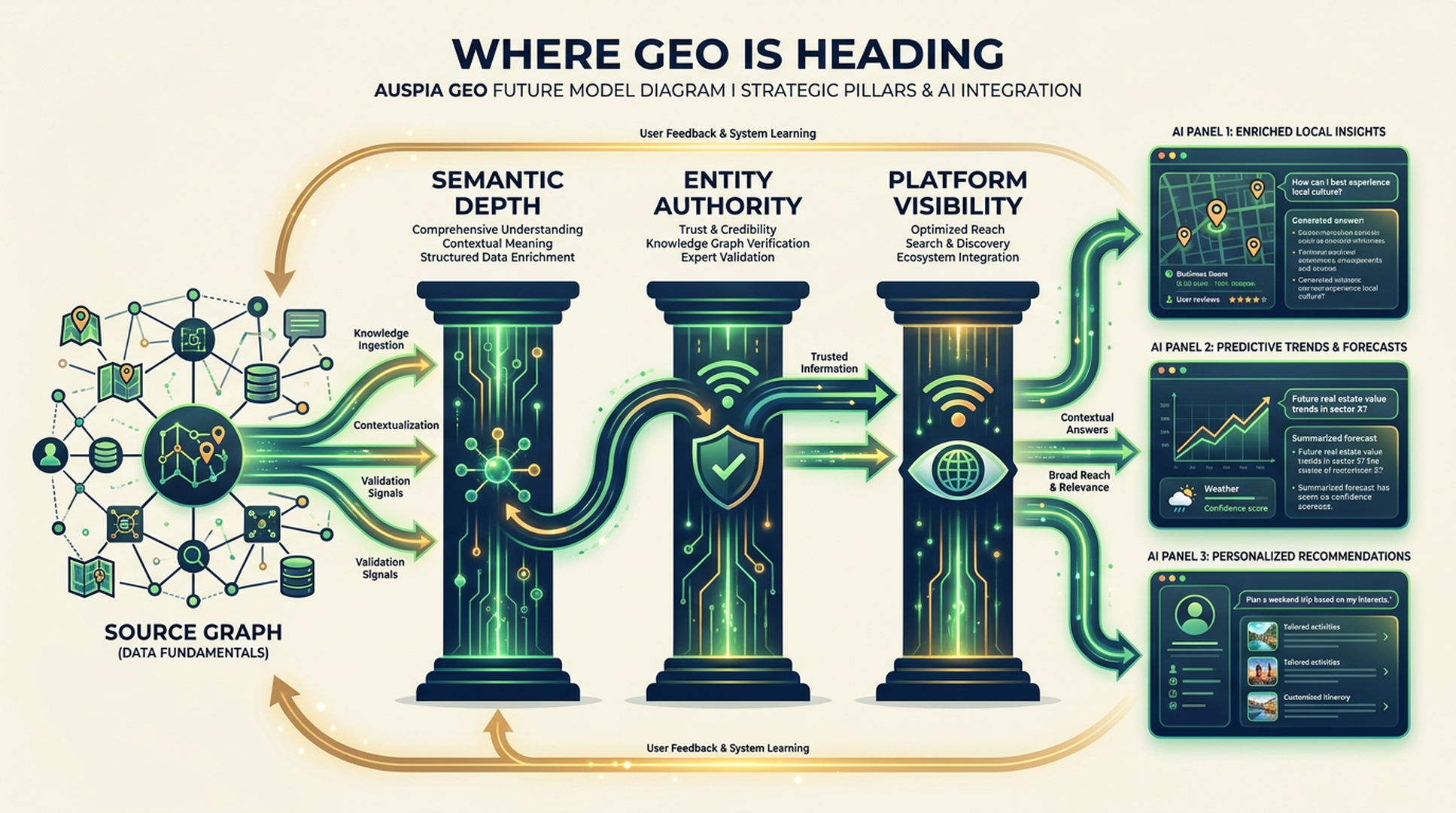
Semantic depth will matter more than keyword density
AI systems are better at understanding whether a page actually answers a topic. A shallow page that repeats the right terms may still fail because it lacks definitions, examples, tradeoffs, and proof.
Entity authority will matter more than isolated pages
One article rarely changes how AI systems understand a brand. A consistent source graph can. That means your website, docs, profiles, reviews, partner pages, and expert content need to tell the same story.
Platform-specific visibility will matter
Different AI search products use different sources and citation patterns. A brand may appear in one answer engine and be absent in another. Teams will need to monitor several platforms instead of assuming one result represents the whole market.
This is why GEO should be treated as an operating system for source quality, not a one-time campaign.
How to evaluate a GEO vendor
If a vendor promises instant AI recommendations, be careful.
Good GEO vendors usually talk about audits, source quality, content structure, evidence, technical access, and measurement. Risky vendors talk mostly about guaranteed mentions, secret tricks, or mass publishing.
Ask these questions before hiring anyone:
- Which sources will you create or update?
- How will you verify claims before publishing?
- Will we approve every public claim?
- How do you avoid fake reviews, fake citations, or fabricated expertise?
- Which AI answer systems will you monitor?
- How will you distinguish a real citation from a one-off mention?
- What happens if an answer is wrong?
- Can the work improve human conversion, not only AI visibility?
A vendor that cannot answer these questions is not doing GEO as source-quality work.
Auspia takeaway
GEO is not poisoning when it makes true information easier to find. It becomes poisoning when it tries to make false information look true.
That distinction should guide the whole program.
If a page helps a buyer make a better decision, improves the accuracy of public information, and gives AI systems a verifiable source, it belongs in a GEO strategy. If it relies on fake proof, fake consensus, or hidden manipulation, it is spam wearing a new label.
Auspia's view is straightforward: build the source base you would want AI systems to use. Then make it crawlable, structured, current, and consistent.
That is slower than spam. It also lasts longer.
FAQ
Is GEO the same as AI poisoning?
No. GEO is a broad practice. Ethical GEO improves the quality, structure, and accessibility of accurate information. AI poisoning tries to push false or misleading information into systems that may later repeat it.
Can GEO be abused?
Yes. Like SEO, PR, reviews, and social media, GEO can be abused through fake claims, synthetic reviews, spam pages, and manufactured citations. That is why teams need editorial controls and evidence standards.
What is the safest first GEO project?
Start with an audit of your owned sources. Check whether your product pages, docs, FAQ pages, review profiles, and public descriptions are accurate, consistent, and crawlable. Fix those before publishing new assets.
How do I know whether a GEO tactic is ethical?
Ask whether the tactic improves a real user's ability to verify the claim. If yes, it is probably legitimate. If the tactic hides, fabricates, or inflates evidence, avoid it.
Should brands avoid GEO because of spam risk?
No. Avoiding GEO does not protect your brand. It leaves AI systems to rely on whatever sources they can find, including outdated or inaccurate ones. The better response is to publish accurate, useful, well-structured sources.