Quick Answer
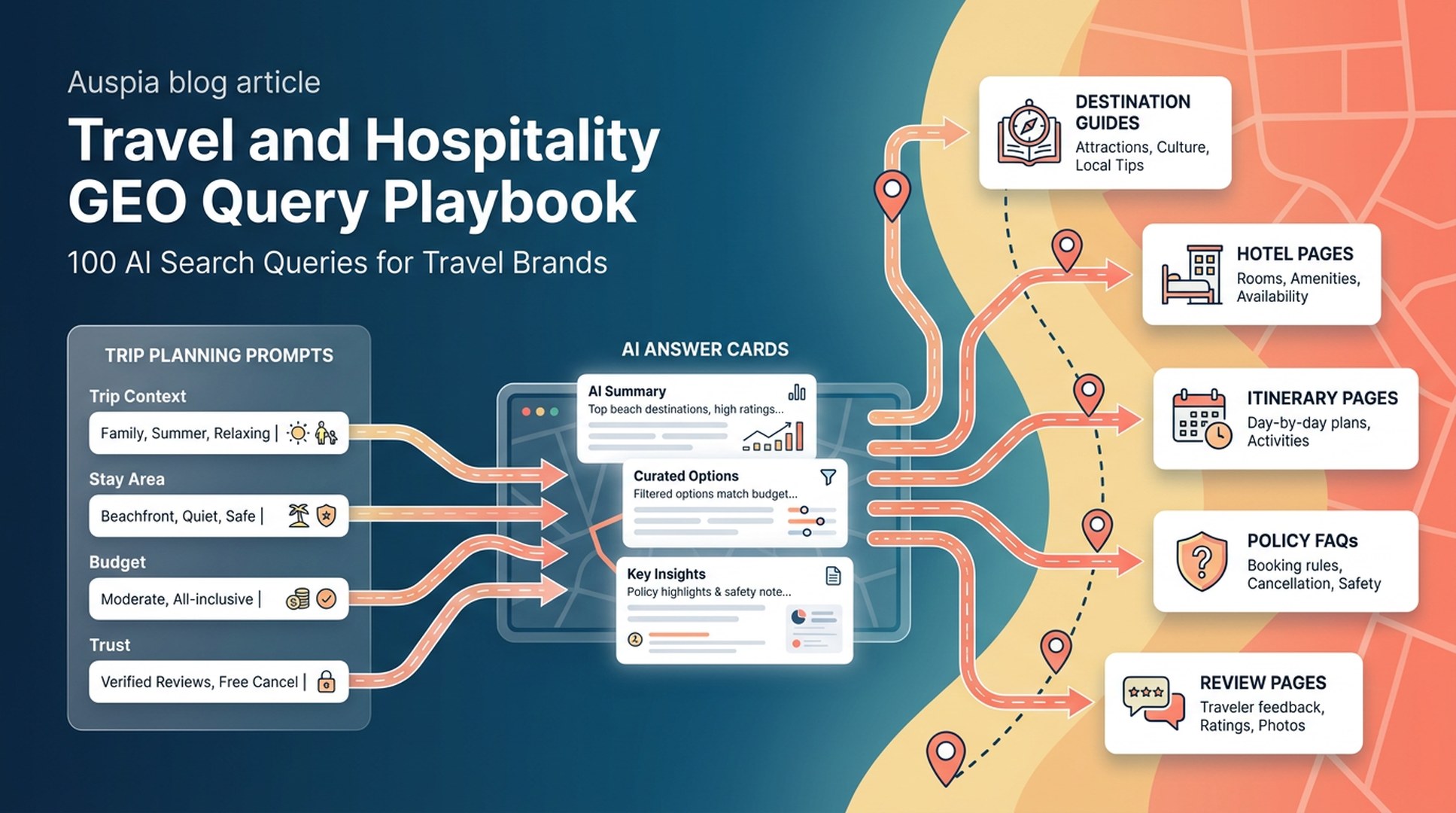
Travel and hospitality GEO is the work of making destination pages, hotel pages, itinerary guides, tour pages, restaurant pages, travel policy pages, and booking flows easier for AI answer systems to understand, compare, and cite when travelers ask planning and booking questions.
Travel users rarely ask only for hotels in Paris, things to do in Tokyo, or family resorts. They ask questions that combine motivation, dates, budget, travel style, safety, accessibility, weather, location, and booking risk:
Where should I stay in Rome for a first trip without renting a car?What is a good 3-day itinerary for Lisbon with kids?Which hotel area is best for a business trip near the convention center?What should I check before booking an all-inclusive resort?Is this destination good during the rainy season?
For travel brands, the strongest GEO assets are destination guides, neighborhood stay guides, hotel pages, room pages, itinerary pages, seasonal pages, amenity pages, tour pages, comparison pages, cancellation policy pages, accessibility pages, and guest review pages.
This playbook gives hotels, resorts, OTAs, tour operators, destination marketers, restaurants, travel agencies, and hospitality groups 100 AI Search queries to track, a trip-intent framework, a query-to-page map, and a 30-day execution plan.
The Trip-Intent Booking Map
Travel GEO is different from many industries because the same destination can mean very different things depending on the trip. A traveler planning a honeymoon, a conference, a family vacation, a solo weekend, or a food trip may need different areas, hotel features, safety context, itinerary pacing, and cancellation flexibility.
That creates a trip-intent booking map:
Layer | What The Traveler Needs | Example Query | Page That Should Support The Answer |
|---|---|---|---|
Trip Purpose | Why they are traveling |
| Destination / stay-area guide |
Traveler Profile | Who is traveling |
| Family / profile guide |
Timing | When they are traveling |
| Seasonal guide |
Location Fit | Where they should stay or visit |
| Neighborhood comparison page |
Experience Fit | What they want to do |
| Itinerary / experience page |
Booking Risk | What could go wrong |
| Policy FAQ |
Trust | Which brand or provider to choose |
| Reviews / provider trust page |
The key is context. AI systems need to know who the trip is for, what the traveler values, what assumptions apply, and which page is the best source for each answer.
A useful first step is to check which prompts already surface your hotel, destination, tours, or travel pages with an AI Search Visibility Checker, then build a prompt library around missing destination contexts, weak amenities, unclear policies, or inaccurate seasonal summaries.
Why Travel GEO Starts With Trip Context, Not Destination Keywords
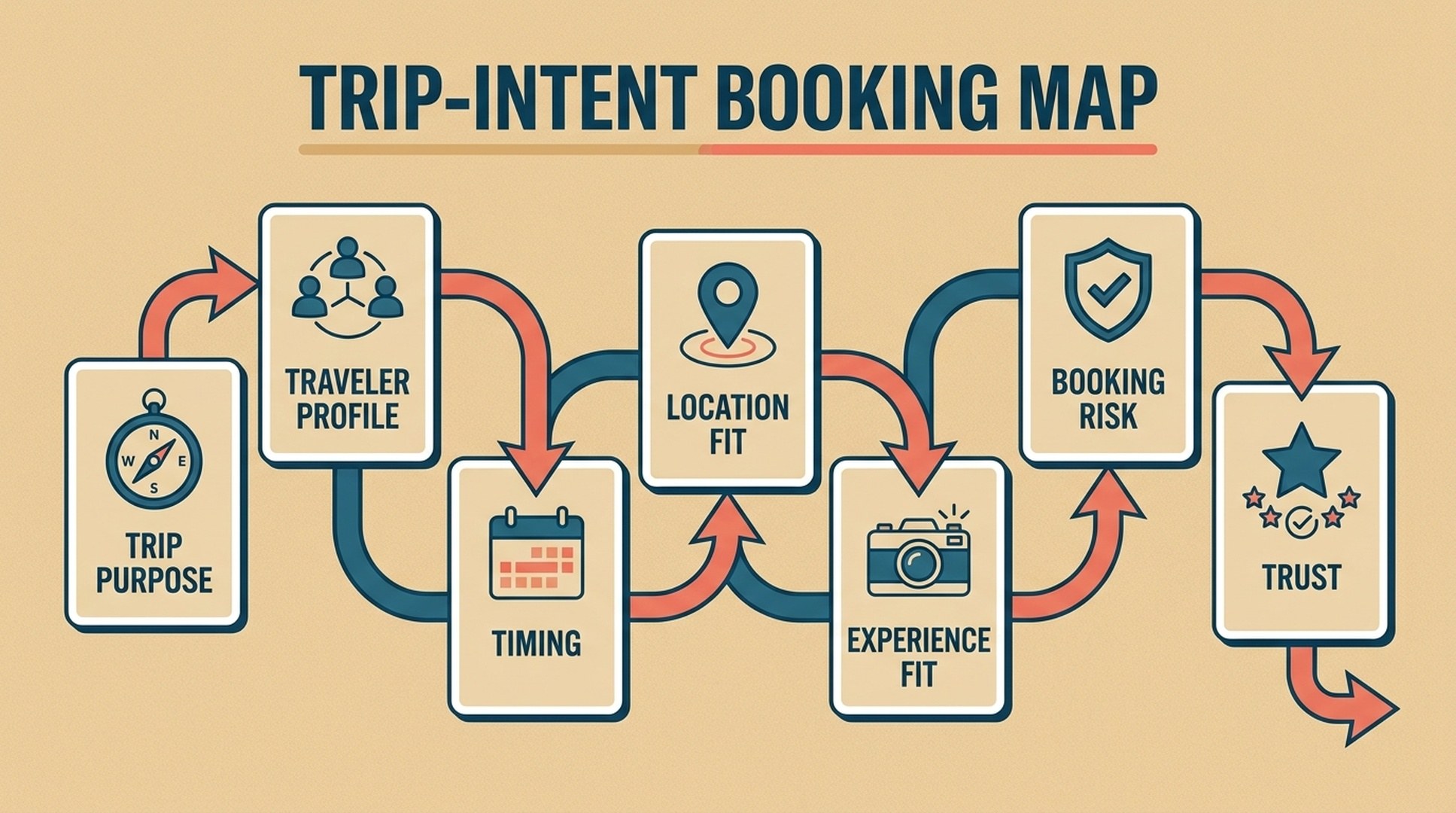
Travel AI Search prompts move through trip purpose, traveler profile, timing, location fit, experience fit, booking risk, and trust.
Traditional travel SEO often starts with destination keywords, hotel location pages, listicles, and attraction guides. Those still matter. GEO adds a planning layer because AI Search users often ask for a synthesized trip recommendation before choosing a website.
The prompt usually contains constraints:
Where should I stay in Tokyo if I want nightlife but not a noisy hotel?What should couples do in Santorini if they do not want crowded beaches?Which resort is better for toddlers vs teenagers?How many nights do I need for a first trip to Iceland?What should business travelers check before booking an airport hotel?
These questions require pages that explain traveler fit, tradeoffs, timing, transportation, amenities, booking policies, and proof. A generic destination page is not enough.
Travel content also needs careful wording. Avoid pretending every traveler should choose the same hotel, area, season, or tour. Avoid unsupported safety claims, guaranteed weather claims, hidden fees, or outdated availability language. Strong travel GEO states the traveler profile, season, location assumptions, and policy limits clearly.
The 10 Query Types Travel and Hospitality Teams Should Map
Classify prompts before creating pages. This prevents teams from publishing repetitive destination listicles without booking value or trust proof.
Query Type | What The User Wants | Best Content Asset |
|---|---|---|
Destination Fit | Decide whether a destination fits a trip purpose | Destination guide |
Stay Area | Choose the best neighborhood, resort zone, or hotel location | Area-to-stay guide, map page |
Hotel / Property Fit | Compare hotel types, room types, amenities, and guest profiles | Hotel page, room guide, amenity page |
Itinerary / Experience | Plan what to do by trip length, interest, or pace | Itinerary page, tour page |
Season / Timing | Understand weather, crowds, events, prices, or timing tradeoffs | Seasonal guide |
Budget / Value | Estimate total trip cost, hotel fees, transport, meals, and activities | Cost guide, fee FAQ |
Transportation / Access | Understand airport transfer, walkability, parking, transit, and mobility | Transportation guide |
Risk / Policy | Understand cancellation, resort fees, safety, visas, accessibility, and restrictions | Policy FAQ, accessibility page |
Trust / Reviews | Choose a hotel, tour operator, travel agency, or restaurant confidently | Review page, provider profile |
Scenario / Traveler Type | Match recommendations to families, couples, solo travelers, business travelers, groups, or accessibility needs | Scenario guide |
Every query cluster should have one owner page. If cancellation terms, resort fees, or airport transfer details are scattered across multiple pages, AI systems may summarize outdated or incomplete information.
How To Prioritize Travel and Hospitality GEO Queries
Use a trip-decision scoring model:
Priority = Booking Intent + Trip Context + Decision Impact + Evidence Strength + AI Answer Probability - Policy Risk - Competition Difficulty
Factor | How To Evaluate It |
|---|---|
Booking Intent | Is the user close to choosing a destination, hotel, tour, room, restaurant, or package? |
Trip Context | Does the query include traveler type, dates, trip length, budget, area, activity, or constraint? |
Decision Impact | Could the answer change where the user stays, books, visits, eats, or spends? |
Evidence Strength | Do you have amenities, maps, room details, policies, reviews, seasonal context, photos, transportation facts, or itinerary expertise? |
AI Answer Probability | Is the query likely to trigger a summarized recommendation, itinerary, comparison, or checklist? |
Policy Risk | Could the answer misstate cancellation terms, fees, accessibility, safety, visa rules, weather, or availability? |
Competition Difficulty | Are OTAs, travel blogs, review sites, tourism boards, airlines, or map platforms dominating? |
Start with queries where the brand can provide specific, verifiable travel context. Avoid broad best destination content unless the page defines the traveler profile, season, criteria, and assumptions.
100 Travel and Hospitality GEO Query Examples
Use these prompts as a starting library. Adapt them by destination, hotel type, travel season, traveler profile, language market, and booking policy.
Destination Fit Queries
- Is Lisbon a good destination for a first trip to Europe?
- Which European city is best for a 3-day food trip?
- Is Bali better for couples or families?
- Is Dubai a good stopover destination for two nights?
- What should first-time visitors know before choosing Rome?
- Is Iceland a good destination for a short trip?
- Which beach destination is best for travelers who do not rent a car?
- Is Singapore a good destination for a family vacation?
- What should solo travelers compare before choosing a city?
- Which destination is better for museums and walkability?
Stay Area Queries
- Where should I stay in Paris for a first visit?
- Best area to stay in Tokyo for food and nightlife
- Best neighborhood in London for families visiting museums
- Should I stay near the beach or old town in Dubrovnik?
- Where should business travelers stay near a convention center?
- Best area to stay in New York without a car
- Which hotel zone is best for a quiet resort trip?
- Where should couples stay in Santorini to avoid crowds?
- Best area to stay in Bangkok for first-time visitors
- What should travelers compare before choosing a hotel location?
Hotel / Property Fit Queries
- Boutique hotel vs chain hotel: which is better for a city break?
- Resort vs city hotel for a family vacation
- All-inclusive resort vs breakfast-only hotel
- Apartment hotel vs traditional hotel for long stays
- Airport hotel vs downtown hotel for a short business trip
- Ocean-view room vs garden-view room: is it worth paying more?
- What hotel amenities matter most for families?
- What should remote workers check before booking a hotel?
- What makes a hotel good for a honeymoon?
- What should travelers check before booking a pet-friendly hotel?
Itinerary / Experience Queries
- What is a good 3-day itinerary for Lisbon?
- What should I do in Rome if I have two full days?
- Best 5-day Japan itinerary for first-time visitors
- What is a good family itinerary for Singapore?
- What should couples do in Paris besides major landmarks?
- What is a relaxed itinerary for Barcelona with older parents?
- Best food-focused itinerary for Mexico City
- What should travelers do near a resort if they do not rent a car?
- What is a good rainy-day itinerary in London?
- How do I plan a trip without overpacking the schedule?
Season / Timing Queries
- Is Kyoto worth visiting in July?
- What is the best month to visit Greece without crowds?
- Is the rainy season a bad time to visit Thailand?
- When should travelers book hotels for peak season?
- What should visitors know about hurricane season in the Caribbean?
- Is winter a good time to visit Iceland?
- What should travelers expect during cherry blossom season in Japan?
- Which destinations are good for shoulder season travel?
- How do local events affect hotel prices?
- What should travelers check before booking during a holiday week?
Budget / Value Queries
- How much should I budget for a 3-day city break?
- What hotel fees should travelers check before booking?
- How do resort fees work?
- What affects the total cost of an all-inclusive vacation?
- Is it cheaper to book hotel and flight together?
- What should families budget beyond flights and hotels?
- How do travelers compare hotel value beyond nightly rate?
- What costs do first-time cruise travelers often miss?
- What should business travelers check before choosing a hotel rate?
- How do cancellation policies affect travel cost?
Transportation / Access Queries
- How do I choose a hotel without renting a car?
- What should travelers check about airport transfers?
- Is it better to stay near transit or attractions?
- What hotel parking fees should road trip travelers check?
- How walkable is a destination for first-time visitors?
- What should travelers with limited mobility ask before booking?
- How do I compare hotels near a train station?
- What should families check about shuttle service?
- What transportation details should a hotel page include?
- How do I plan a destination trip with early morning flights?
Risk / Policy Queries
- What cancellation policy should I check before booking a hotel?
- What should travelers know about non-refundable rates?
- What accessibility questions should I ask before booking a room?
- What safety information should travelers verify before choosing an area?
- What should travelers check before booking through a third-party site?
- What happens if a tour is cancelled because of weather?
- What visa or entry rules should travelers verify before a trip?
- What should guests know about hotel deposits?
- What should travelers check before booking during storm season?
- What should families know about pool and kids-club rules?
Trust / Reviews Queries
- How do I know if a hotel review is reliable?
- How do I choose a trustworthy tour operator?
- What should I look for in recent hotel reviews?
- How do I compare travel agencies?
- What makes a destination guide trustworthy?
- How do I know if a restaurant recommendation is current?
- What should travelers check before booking a private tour?
- How do I compare resort ratings?
- What guest photos matter when choosing a hotel?
- How do I verify a travel company's cancellation support?
Scenario / Traveler Type Queries
- Best hotel area for families visiting London
- Best resort type for toddlers vs teenagers
- Best city break for couples who like food and walking
- Best destination for solo travelers who want easy transit
- Best hotel setup for remote workers on a long stay
- Best itinerary for older parents who need a slower pace
- Best destination for a small company retreat
- Best hotel near a convention center for business travelers
- Best beach trip for travelers who want quiet nights
- Best destination for first-time international travelers
How To Turn Travel Queries Into Citation-Ready Pages
A travel query library should become a booking and destination architecture. The strongest pages are destination guides, area-to-stay pages, hotel pages, room pages, amenity pages, itinerary pages, seasonal guides, transportation guides, review pages, and policy FAQs.
Query Cluster | Owner Page | Page Type | Required Proof |
|---|---|---|---|
Destination prompts | Destination guide | Travel guide | Best fit, trip length, season, local context, update date |
Stay-area prompts | Area-to-stay guide | Map / neighborhood page | Area tradeoffs, transit, attractions, traveler profile |
Hotel-fit prompts | Hotel / room guide | Property page | Amenities, room types, guest profile, photos, policies |
Itinerary prompts | Itinerary page | Experience guide | Time blocks, locations, pacing, booking notes |
Season prompts | Seasonal guide | Timing page | Weather caveats, events, crowds, price context |
Budget prompts | Cost guide | Pricing / fee FAQ | Fees, deposits, taxes, packages, assumptions |
Transportation prompts | Access guide | Logistics page | Airport transfer, parking, transit, walkability, mobility notes |
Risk prompts | Policy FAQ | Policy / safety page | Cancellation, accessibility, deposits, restrictions, official links |
Trust prompts | Reviews / provider page | Trust page | Recent reviews, ratings, operator details, support path |
Scenario prompts | Traveler-type guide | Scenario page | Family, solo, business, couple, group, or accessibility fit |
A citation-ready travel page should answer the traveler's decision question first, then state the traveler profile, season, location, assumptions, booking constraints, and next step.
For technical readiness, travel brands should make sure destination pages, hotel pages, room pages, tour pages, restaurant pages, and policy pages are crawlable, indexable, and internally linked. A quick Website SEO Score Checker can help catch basic crawl, metadata, schema, and content-quality issues before teams rewrite booking-critical pages.
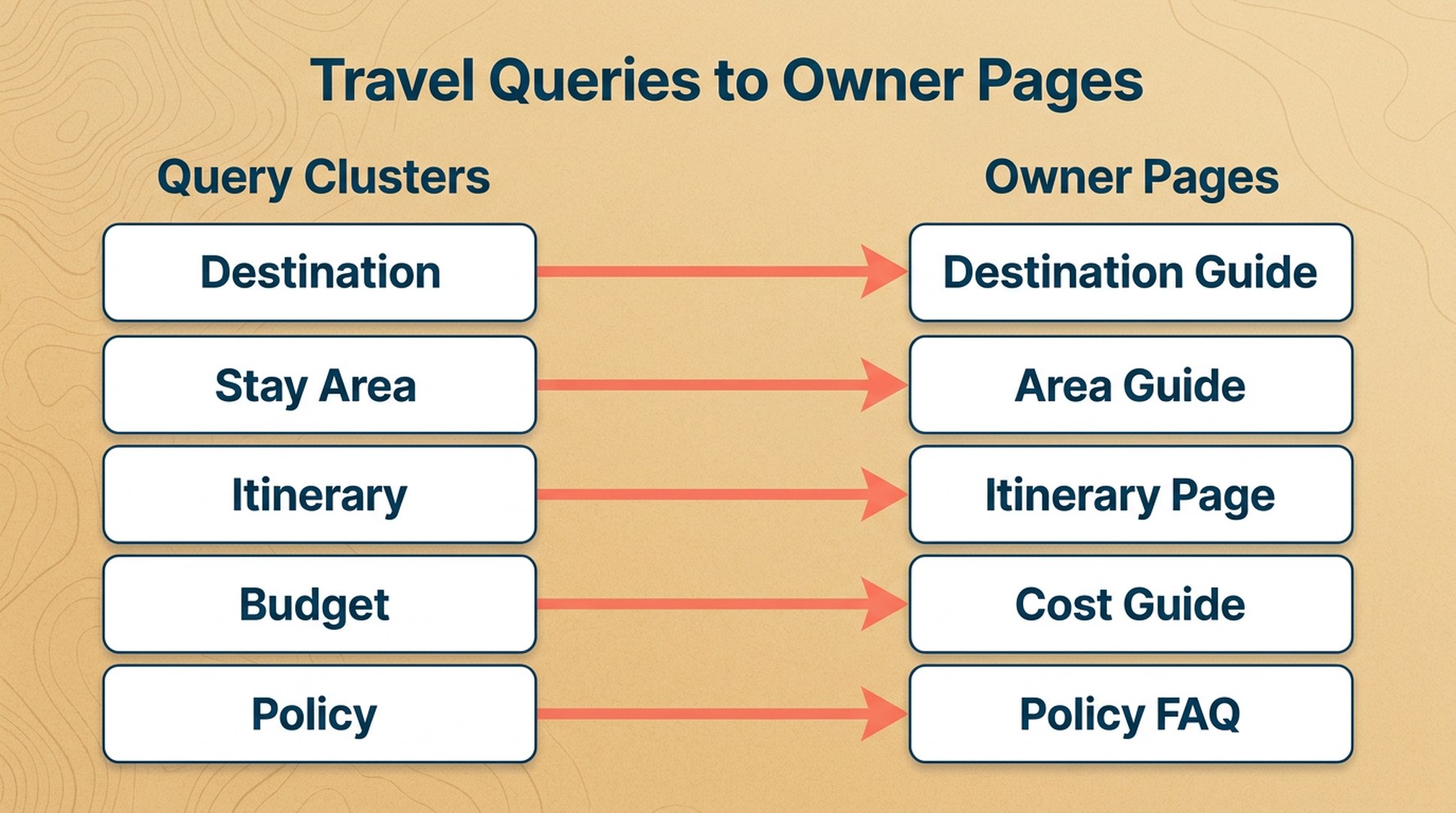
Destination, stay-area, itinerary, budget, and policy queries should map to durable owner pages that support booking decisions.
The First 20 Queries To Prioritize
If a travel or hospitality brand is starting from scratch, these 20 prompts usually create a practical first backlog.
Priority | Query | Why It Matters | Likely Owner Page |
|---|---|---|---|
1 | Where should I stay in Paris for a first visit? | High destination and hotel intent | Stay-area guide |
2 | Best area to stay in Tokyo for food and nightlife | Location fit and booking intent | Area guide |
3 | What should travelers compare before choosing a hotel location? | Broad decision support | Hotel location guide |
4 | Boutique hotel vs chain hotel: which is better for a city break? | Property-fit comparison | Hotel type comparison |
5 | What hotel amenities matter most for families? | Amenity and conversion intent | Family hotel page |
6 | What is a good 3-day itinerary for Lisbon? | AI itinerary likelihood | Itinerary page |
7 | What should travelers do near a resort if they do not rent a car? | Local experience and booking fit | Resort area guide |
8 | Is the rainy season a bad time to visit Thailand? | Seasonal decision | Seasonal guide |
9 | When should travelers book hotels for peak season? | Booking timing | Peak season guide |
10 | What hotel fees should travelers check before booking? | Cost transparency | Hotel fee FAQ |
11 | How do resort fees work? | High-friction fee query | Resort fee explainer |
12 | How do I choose a hotel without renting a car? | Access and location fit | Car-free stay guide |
13 | What should travelers check about airport transfers? | Booking logistics | Transfer guide |
14 | What cancellation policy should I check before booking a hotel? | Policy and risk | Cancellation FAQ |
15 | What accessibility questions should I ask before booking a room? | Accessibility and trust | Accessibility page |
16 | How do I know if a hotel review is reliable? | Trust validation | Review trust guide |
17 | How do I choose a trustworthy tour operator? | Provider selection | Tour operator trust page |
18 | Best resort type for toddlers vs teenagers | Family scenario | Family resort guide |
19 | Best hotel setup for remote workers on a long stay | Long-stay intent | Remote-work hotel page |
20 | Best hotel near a convention center for business travelers | Business booking intent | Business travel hotel page |
These prompts are useful because they can be answered by pages that already influence booking decisions: destination pages, hotel pages, amenities, policies, itinerary guides, transportation pages, and review pages.
30-Day Execution Plan
Timeframe | Action | Output |
|---|---|---|
Days 1-3 | Build the travel AI Search query library and classify by destination, traveler type, trip length, season, and page owner | 100-query prompt library |
Days 4-7 | Score prompts by booking intent, trip context, decision impact, evidence, AI answer probability, policy risk, and competition | First 20 prompt backlog |
Days 8-14 | Map prompts to destination guides, hotel pages, amenity pages, itinerary pages, seasonal pages, transportation pages, and policy FAQs | Query-to-page map |
Days 15-21 | Rewrite priority pages with direct answers, traveler profiles, maps, fees, policies, reviews, seasonal caveats, and next steps | Updated citation-ready pages |
Days 22-30 | Test prompts across AI answer surfaces and record brand mentions, cited URLs, competitor mentions, and inaccurate travel facts | Travel AI visibility tracker |
A boutique hotel can start with five assets: a stay-area guide, a family or couple fit page, a transportation guide, a hotel fee FAQ, and a cancellation/accessibility FAQ. A destination marketing organization should add seasonal guides, itineraries, neighborhood maps, event pages, and visitor-type guides. A tour operator should add operator trust pages, weather policy pages, itinerary pages, and pickup logistics pages.
Common Mistakes
Travel and hospitality GEO fails when teams publish generic inspiration content without booking context or operational accuracy.
Avoid these mistakes:
- Publishing destination pages without traveler fit. Explain who the destination, area, hotel, room, or tour fits best.
- Hiding fees and policy details. Resort fees, deposits, taxes, parking, cancellation terms, and restrictions should be easy to find.
- Ignoring seasonality. Weather, crowds, events, and pricing can change the answer.
- Overpromising safety, weather, or availability. Use careful wording and link to official or current sources when needed.
- Treating reviews as decoration. Recent reviews, guest photos, and service recovery details can support trust.
- Letting OTAs define the answer. Build owned pages that explain location, amenities, policies, and scenarios better than generic listings.
- Measuring only rankings. Track AI mentions, cited URLs, competitor inclusion, and inaccurate summaries of fees, policies, or destination context.
FAQ
What is travel GEO?
Travel GEO is the process of making destination, hotel, tour, itinerary, restaurant, booking, transportation, review, and policy pages easier for AI answer systems to understand, summarize, and cite accurately.
Is travel GEO the same as travel SEO?
No. Travel SEO focuses on rankings, destination traffic, hotel visibility, technical health, and bookings. Travel GEO builds on that foundation but focuses on how AI systems answer trip planning, stay-area, itinerary, hotel-fit, seasonal, budget, policy, and provider-trust questions.
Should travel brands create one page for every AI Search query?
No. The 100-query list should become a page map. Many questions should be answered by stronger destination guides, area pages, hotel pages, itinerary pages, seasonal guides, transportation pages, review pages, and policy FAQs.
Which travel queries should teams prioritize first?
Start with questions about where to stay, hotel fit, trip length, itinerary planning, seasonality, fees, transportation, cancellation, accessibility, reviews, and traveler-specific scenarios. These questions influence booking decisions and can be supported with owned pages.
How can travel brands avoid risky GEO content?
Use clear assumptions, keep policy pages updated, avoid guaranteed weather or safety claims, disclose fees, state cancellation terms clearly, verify accessibility details, and involve operations or legal reviewers when publishing policy-sensitive content.
How should travel teams measure GEO performance?
Track a stable prompt set across AI answer surfaces. Record whether the brand appears, which URLs are cited, which competitors appear, whether details are accurate, and whether AI answers omit important fees, policies, seasonality, accessibility, or booking constraints.
Auspia Takeaway
Travel and hospitality GEO is trip decision support. AI systems need traveler profile, trip purpose, location fit, seasonality, budget, transportation, policy clarity, reviews, and next steps before they can recommend a brand responsibly.
Start with prompts that affect bookings, itinerary choices, area selection, and policy confidence. Map the first 20 queries to pages that already shape conversion. Then rewrite those pages so the answers are direct, contextual, current, and safe to summarize.
Author: Dominic Hale, International SEO Specialist Across 18 Markets at Auspia. Dominic writes about multilingual search behavior, destination content, localization, and global AI visibility systems.