The real GEO entry point is not an AI tool. It is the Reddit comment section.
Most teams start GEO work inside AI platforms — testing prompts, checking citations, tweaking schema. That is useful, but it skips the most important question: what do real users actually ask, in their own words?
The answer is sitting in Reddit comments. Not the posts. The comments.
Reddit has over 24 billion posts and comments. 121 million daily active users. OpenAI confirmed a data partnership with Reddit in May 2024 to feed real-time Reddit content into ChatGPT through the Reddit Data API. Google expanded its own Reddit partnership in February 2024 for product improvement and model training.
When you look at Reddit today, you are looking at the same human conversation database that search engines and LLMs are reading, indexing, and citing.
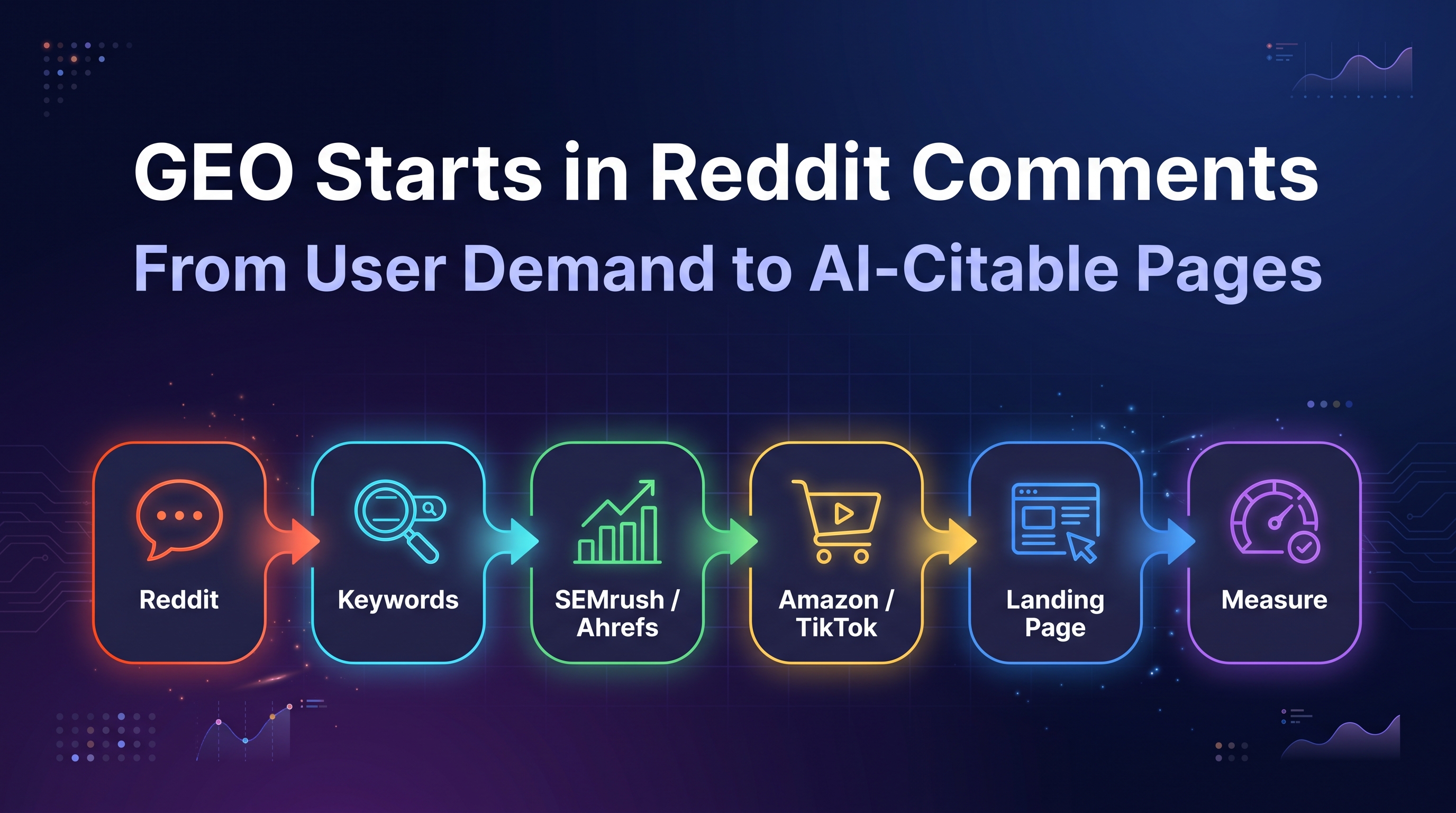
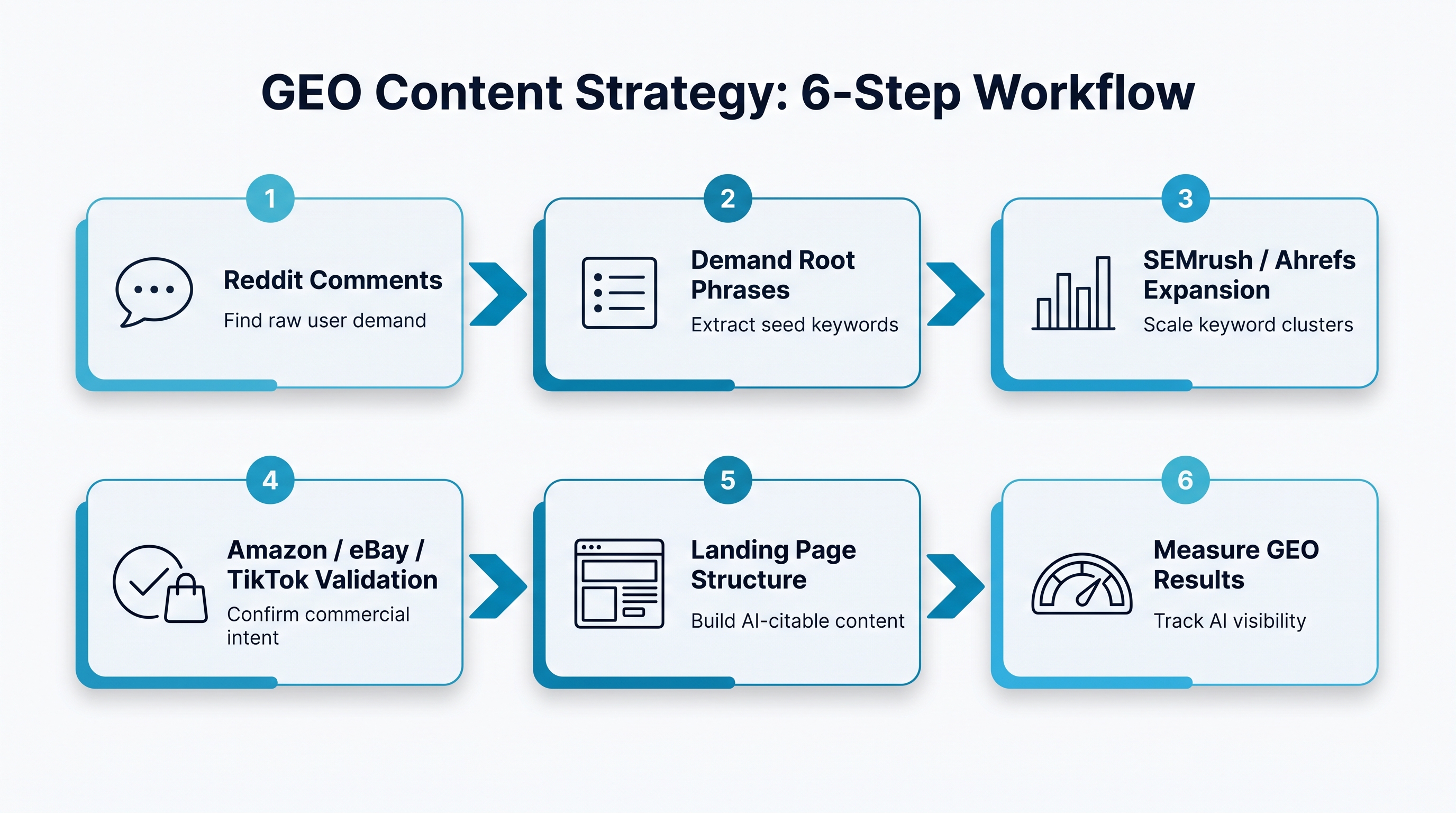
This article walks through a six-step path I use to turn Reddit comments into organic traffic — validated by keyword tools, commercial platforms, and structured into pages that both Google and AI answer engines want to cite.
The path at a glance
Step | What to do | Output |
|---|---|---|
1 | Extract verbatim demand from Reddit comments | Demand root phrases |
2 | Rewrite demand roots into keyword candidates | Initial keyword pool |
3 | Expand in SEMrush or Ahrefs | Long-tail search terms |
4 | Validate on Amazon, eBay, TikTok | Commercial evidence and content evidence |
5 | Build into landing page and 1-2 week content plan | Trackable organic traffic entry points |
6 | Measure GEO results across Search Console, AI engines, and social | Feedback loop for next cycle |
The end result: keywords placed by page module — not stuffed — into landing pages and supporting content that answers real questions in a structure machines can easily cite.
Step 1: Extract verbatim demand from Reddit
Do not start by writing keywords. Start by reading comments.
Skip the high-upvote posts. Focus on repeated sentence patterns in comment threads. Users phrase their problems the same way over and over. Those patterns are closer to actual search queries — and closer to the semantic structures LLMs use when generating answers — than anything a keyword tool will suggest on its own.
Here are the sentence patterns I look for:
Sentence pattern | Underlying demand |
|---|---|
"I tried X but it doesn't work for Y" | Existing solution failure |
"Best X for Y" | Purchase intent in a specific scenario |
"Any alternative to X" | Replacement search |
"How do you deal with Y" | Solution-seeking behavior |
"X vs Y for Z" | Comparison before buying |
These phrases are more useful than any brief you could write yourself. They naturally mirror how people search, and they mirror how LLMs frame Q&A retrieval.
The output from this step is not a topic list. It is a set of demand root phrases — raw user language that maps to real intent.
Step 2: Turn demand roots into keyword candidates
Take the exact phrases from Reddit and reshape them into searchable keyword forms.
Example: Reddit comments repeatedly mention "noise cancelling earbuds that don't fall out when running."
I would not just target that phrase. I would expand it into a cluster:
Keyword | Search intent type |
|---|---|
noise cancelling earbuds for running | Scenario-based demand |
best earbuds that stay in while running | Pre-purchase comparison |
earbuds that don't fall out during exercise | Pain-point demand |
running earbuds vs AirPods Pro | Direct comparison |
wireless earbuds for small ears running | Niche constraint |
This step is still manual. The goal is to have 10-20 keyword candidates before touching any tool.
Step 3: Expand in SEMrush or Ahrefs
Now put those candidates into SEMrush or Ahrefs Keyword Explorer.
I check three metrics for each expanded term:
Metric | What I am looking for |
|---|---|
Search volume | Are people actively searching this? |
KD (Keyword Difficulty) | Can a normal landing page rank? |
CPC | Is there commercial intent behind this query? |
The sweet spot: a keyword that has real volume on Reddit (people are actively complaining about it), measurable search volume in Ahrefs, a CPC above zero (advertisers pay for it), and KD low enough for a focused page to compete.
If a word has Reddit demand + search volume + CPC signal + manageable KD, it goes into the content plan. If it is missing two or more signals, it stays in the backlog.
Step 4: Validate with Amazon, eBay, and TikTok
Reddit tells you why users are frustrated. Keyword tools tell you if anyone is searching. But neither tells you if people are actually spending money.
That is what commercial platforms confirm.
Platform / signal | What it validates |
|---|---|
Amazon sales rank and reviews | Transaction volume for this demand |
Amazon negative reviews | Unresolved problems (content opportunities) |
eBay sold listings | Real purchase behavior at different price points |
TikTok hashtag views | Whether this demand can be explained and spread as content |
TikTok comment sections | Additional phrasing and objections |
When Reddit demand, search metrics, and commercial evidence all point the same direction, you have a validated traffic entry point — not just a keyword.
Step 5: Structure keywords into landing pages
Do not stuff all your keywords into one page. Map them to specific page modules.
Page module | What goes here |
|---|---|
H1 / title | Primary demand keyword |
Hero section | User scenario phrase |
Feature section | Solution-oriented keywords |
FAQ section | Long-tail question keywords |
Comparison section | "alternative to," "vs," "best for" keywords |
Review / evidence section | Real user language extracted from Reddit |
Here is what that looks like for an actual page:
Page position | Example content |
|---|---|
H1 | Noise Cancelling Earbuds That Stay In While Running |
Hero | For runners who want stable ANC without adjusting fit every mile |
Features | secure-fit wings, IPX5 sweat resistance, 8-hour battery, low-latency mode |
FAQ | Do noise cancelling earbuds block traffic noise while running? |
Comparison | AirPods Pro vs Jabra Elite 8 Active for outdoor running |
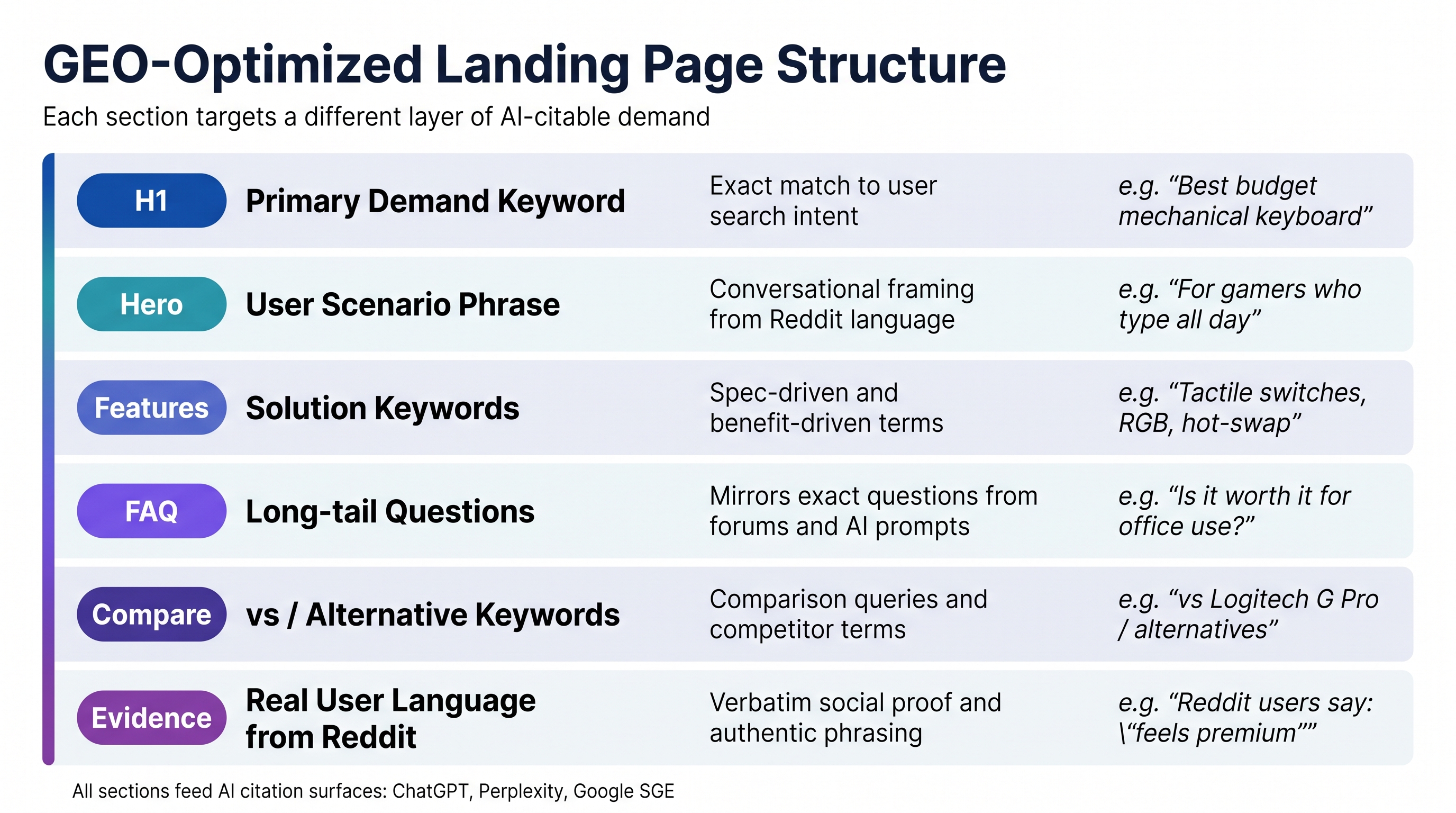
This page is not written to satisfy a search engine. It is answering questions that users have already asked — in a format that both Google and AI answer engines can extract structured responses from.
That is what GEO actually means in practice. Not keyword injection for AI. Real questions, organized so machines can cite them.
Step 5.5: Build a 1-2 week content plan
One landing page is not enough. I build a supporting content cluster around it — typically 10-14 pieces over two weeks.
Day | Content task |
|---|---|
1 | Publish the main landing page |
2 | Write up the most-repeated Reddit pain point |
3 | Analyze real Amazon negative reviews for unresolved problems |
4 | Compare 3-4 top-selling products from Amazon or eBay |
5 | Cover the TikTok use-case that is easiest to explain visually |
6 | Write a "best for" post targeting the primary comparison keyword |
7 | Write an "alternative to" post targeting replacement searches |
8-14 | Expand into FAQ answers, buyer guides, mistake lists, and scenario-specific picks |
Every piece links back to the landing page. Every piece targets one search intent. Every piece preserves at least one real user question from Reddit — reframed as your own analysis and recommendation.
Step 6: Measure GEO results
I do not just watch Google rankings. I check three surfaces:
Where to check | What to look for |
|---|---|
Google Search Console | Are long-tail terms generating impressions? |
ChatGPT, Perplexity, Gemini | When asking the same questions, does your page or brand get mentioned? |
Reddit, TikTok, Amazon reviews | Are new questions emerging that feed your next content cycle? |
A note on what GEO measurement really means: you are not trying to force AI to cite you. You are organizing real user problems, commercial evidence, and page structure into material that is easy for machines to reference. The AI Search Visibility Checker can help you track whether your pages are surfacing in AI-generated answers over time.
What this path actually does
This is not a hack or a shortcut. It is a translation process.
Reddit gives you raw human language. Keyword tools tell you which language has search demand. Commercial platforms confirm money changes hands. Your landing page and content plan translate all of that into pages that both humans and machines can use.
Organic traffic is not something you wait for. It is what happens when you translate real problems — layer by layer — into structured, citable content.
FAQ
Why start with Reddit instead of keyword tools?
Keyword tools show you what people type. Reddit shows you why they type it — the frustration, the comparison logic, the specific failure that triggered the search. Starting with Reddit gives you demand roots that are semantically richer than any seed keyword list.
Does this work for B2B, not just consumer products?
Yes. The validation step changes — instead of Amazon, you check G2 reviews, LinkedIn discussions, and industry forums — but the path is identical. Reddit has active B2B subreddits for SaaS, devtools, marketing, HR tech, and dozens of other verticals.
How long before I see results?
Impressions in Search Console typically start within 2-4 weeks for low-KD long-tail terms. AI citation visibility takes longer and is harder to measure consistently, but pages with clear structure, real FAQ content, and regular updates tend to surface within 4-8 weeks in tools like Perplexity.
Is this the same as keyword research?
No. Keyword research starts with a seed word and expands outward. This path starts with unfiltered user demand and works backward to confirm which demand is worth building a page for. The output is similar — a keyword list — but the input quality is fundamentally different.
Author: Simon Vale, 11-Year Search Intent Researcher at Auspia. Simon writes about buyer queries, SERP patterns, intent mapping, and content alignment strategies for growth teams.