The short version
Amazon search is no longer just a customer typing "portable speaker" and scanning a page of listings. With Alexa for Shopping, Amazon is moving more of the product discovery journey into an AI assistant that can answer questions, compare products, summarize reviews, build carts, track prices, and use context from a shopper's history.
That changes the seller's job.
Traditional Amazon SEO is about helping a shopper find your listing. Amazon GEO, or generative engine optimization, is about helping the AI understand when your product deserves to be recommended.
A seller who only stuffs a title with keywords may still show up in classic search. But when a shopper asks, "What is a good waterproof speaker for a beach weekend under $80?" the assistant needs more than keyword overlap. It needs use cases, comparison points, trust signals, review evidence, price fit, and clear product facts.
Amazon's own announcement says Alexa for Shopping combines product knowledge, web information, shopping history, preferences, conversations, price history, product comparisons, and AI overviews across the Amazon app and website. Sellers should assume their product content is becoming raw material for machine-generated buying advice.
So the practical shift is simple:
Old Amazon SEO | Amazon GEO for Alexa for Shopping |
|---|---|
Rank for a keyword | Become a credible recommendation for an intent |
Repeat product terms | Explain use cases and buyer situations |
Optimize listing fields separately | Make title, bullets, A+ content, Q&A, reviews, and outside mentions tell the same story |
Win the click | Give the AI a reason to shortlist you |
Measure search rank and ad spend only | Watch conversion, recommendation language, review themes, comparison fit, and AI answer presence |
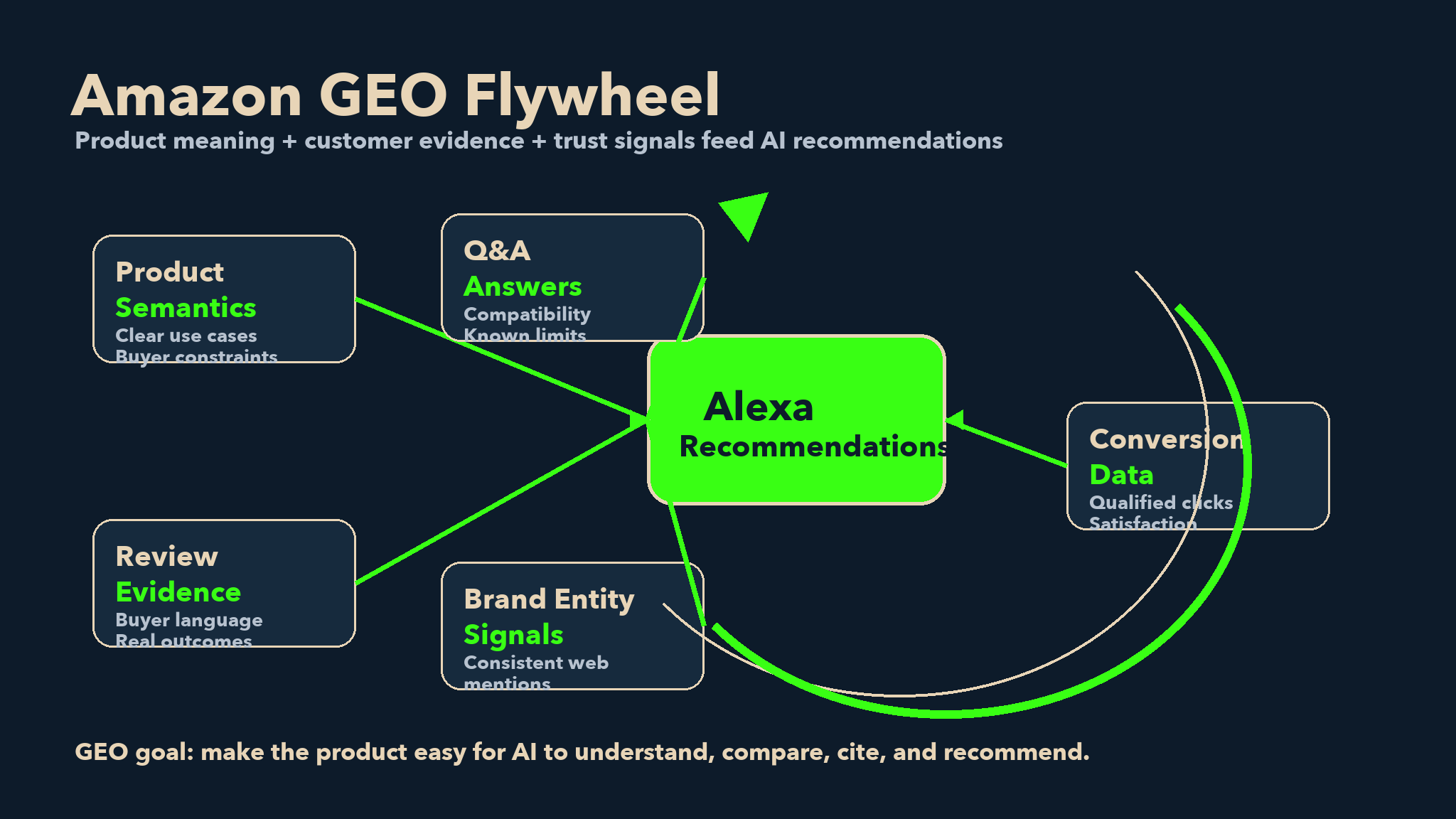
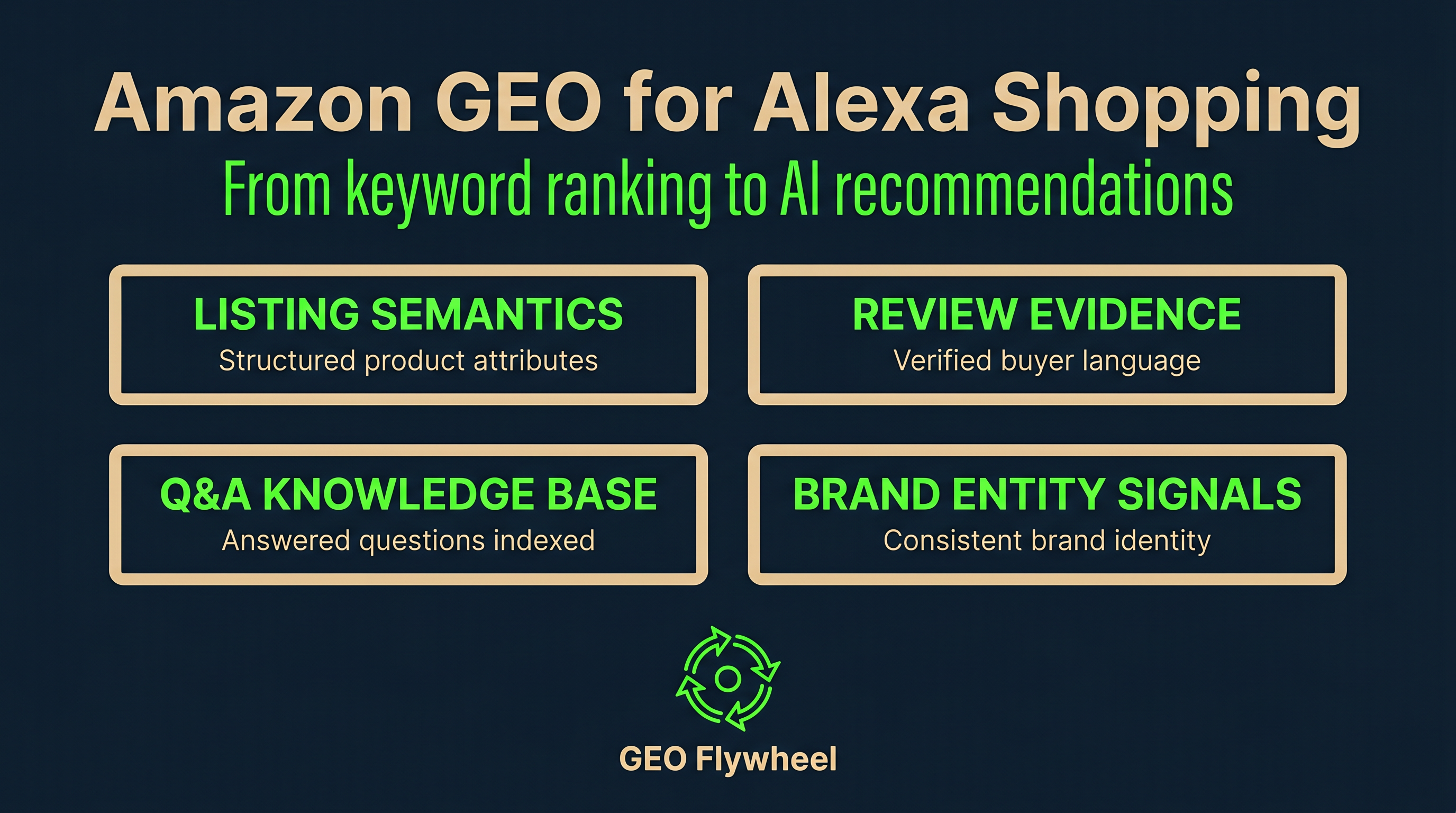
Caption: Amazon GEO is not one listing trick. It is a loop of product meaning, customer evidence, and recommendation-worthy trust signals.
What Alexa for Shopping changes for Amazon sellers
Amazon introduced Alexa for Shopping on May 13, 2026, bringing together Rufus and Alexa+ on the Amazon Shopping app and website. The official launch post describes features that matter directly to sellers: shoppers can ask questions in the main search bar, compare products from search results, see AI overviews on search and product pages, check price history, schedule routine purchases, and get shopping guidance across Amazon and the web.
That does not mean every seller should panic and rewrite everything overnight. But it does mean Amazon discovery is getting another decision layer between the buyer and the listing.
The assistant can now play several roles at once:
- Product researcher: "What should I look for in an espresso machine under $500?"
- Comparison engine: "Compare these two air fryers."
- Review summarizer: "Is this chair good for lower back pain?"
- Cart builder: "Add my usual pet supplies."
- Price watcher: "Buy this if it drops below $40."
- Cross-web shopper: "Find similar products outside Amazon."
For sellers, the uncomfortable part is this: the customer may not read your listing first. Alexa may summarize it, compare it, and decide whether it belongs in the answer.
That is the heart of Amazon GEO.
The underlying logic: LLM plus Amazon data layer
Alexa for Shopping is not a normal search box with a friendlier interface. It is closer to an LLM sitting on top of Amazon's product catalog, customer behavior, reviews, price signals, and web context.
The assistant can draw from many inputs, including:
- product title
- bullet points
- A+ content
- product attributes
- images and captions
- customer reviews
- Q&A
- brand store and brand profile
- price and price history
- availability and delivery promise
- conversion behavior
- returns and satisfaction signals
- Amazon badges and merchandising signals
- shopper preferences and history
- outside web information about brands and products
No seller controls all of those signals. That is the point. GEO is not a hack. It is a discipline for making the product easier for an AI system to understand, trust, compare, and explain.
A good Amazon GEO asset answers four questions clearly:
- What is this product, in plain language?
- Who is it best for?
- In which situations is it a better choice than alternatives?
- What evidence supports that recommendation?
If your listing cannot answer those questions, Alexa has to guess. And when AI systems have to guess, they usually choose the product with clearer evidence.
1. Rewrite listings for meaning, not just keywords
A lot of Amazon listings still read like they were built for a search crawler from 2016:
Bluetooth Speaker Portable Speaker Wireless Mini Speaker Loud Bass Waterproof Speaker
That may still capture terms. It does not explain the product well.
For Alexa-style shopping queries, the better version is specific about use case, buyer situation, and constraint:
Portable Waterproof Bluetooth Speaker for Beach Trips, Camping, and Small Outdoor Parties, 24-Hour Battery Life
The second version gives the assistant more to work with. It can map the product to questions like:
- "What speaker should I bring camping?"
- "I need a waterproof speaker for the beach."
- "Which portable speaker lasts all weekend?"
- "What is a good outdoor party speaker?"
The keyword is still there. The difference is that it now sits inside a useful semantic frame.
For each top ASIN, rewrite the title and first content block around five fields:
Field | Bad version | GEO-ready version |
|---|---|---|
Product type | "speaker" | "portable waterproof Bluetooth speaker" |
Main use case | "outdoor" | "camping, beach trips, pool days, small backyard parties" |
Buyer | "for everyone" | "for travelers, families, students, and casual hosts" |
Constraint | "long battery" | "24-hour battery for weekend use without daily charging" |
Differentiator | "premium sound" | "clear vocals at low volume and strong bass outdoors" |
Do not remove your core search terms. Put them in a sentence a human would actually understand.
2. Turn bullet points into AI-quotable answers
The five bullet points are no longer just a place for specs. They are likely source material for product summaries, comparisons, and AI-generated buying advice.
A weak bullet says:
- 5000mAh battery
- IPX7 waterproof
- Lightweight design
A stronger GEO bullet answers the buyer's question:
- Runs up to 24 hours, so it can cover a full beach day or weekend camping trip without a midday recharge.
- IPX7 waterproof design handles pool splashes, rain, and short accidental drops in water.
- Weighs under 1.2 lb, making it practical for backpacks, carry-ons, and picnic bags.
The better version still contains the facts. But it adds context. That makes it easier for an AI assistant to extract, compare, and explain.
A useful bullet structure is:
Buyer question | Bullet structure |
|---|---|
"Will it work for my situation?" | Feature + situation + limit |
"Why is this better?" | Differentiator + compared alternative |
"Can I trust it?" | Evidence + constraint + honest caveat |
"Is it compatible?" | Compatibility statement + exact models or standards |
"What problem does it solve?" | Problem + outcome + measurable detail |
For example, do not write "Ergonomic chair with lumbar support." Write: "Adjustable lumbar support helps people who sit 6-8 hours a day keep lower-back support aligned as posture changes."
That is the kind of sentence an assistant can turn into a recommendation reason.
3. Treat reviews as semantic evidence
Reviews are going to matter more, not less. Not because sellers can control them, but because they contain the buyer language that listings often miss.
If a shopper asks, "Which neck massager is best for my mom?" Alexa will not only look for "neck massager" in the title. It may care whether real buyers describe the product as:
- bought for my mom
- easy for older parents to use
- gentle enough for beginners
- lightweight to hold
- helpful after long workdays
- simple controls
- clear instructions
A review that says "good" is not useless, but it is thin. A review that explains the buyer, use case, comparison, and result is much more valuable for AI synthesis.
Sellers should not manipulate reviews. That is risky and against marketplace rules. But they can design legitimate post-purchase prompts that invite useful, specific feedback.
Ask customers about real usage:
- What did you buy this for?
- Who used it?
- What problem were you trying to solve?
- Was setup easy or difficult?
- What did you compare it with?
- What surprised you after using it?
This can be done through compliant follow-up emails, product inserts, customer support scripts, Vine participation where appropriate, and better onboarding content. The goal is not fake positivity. The goal is richer language.
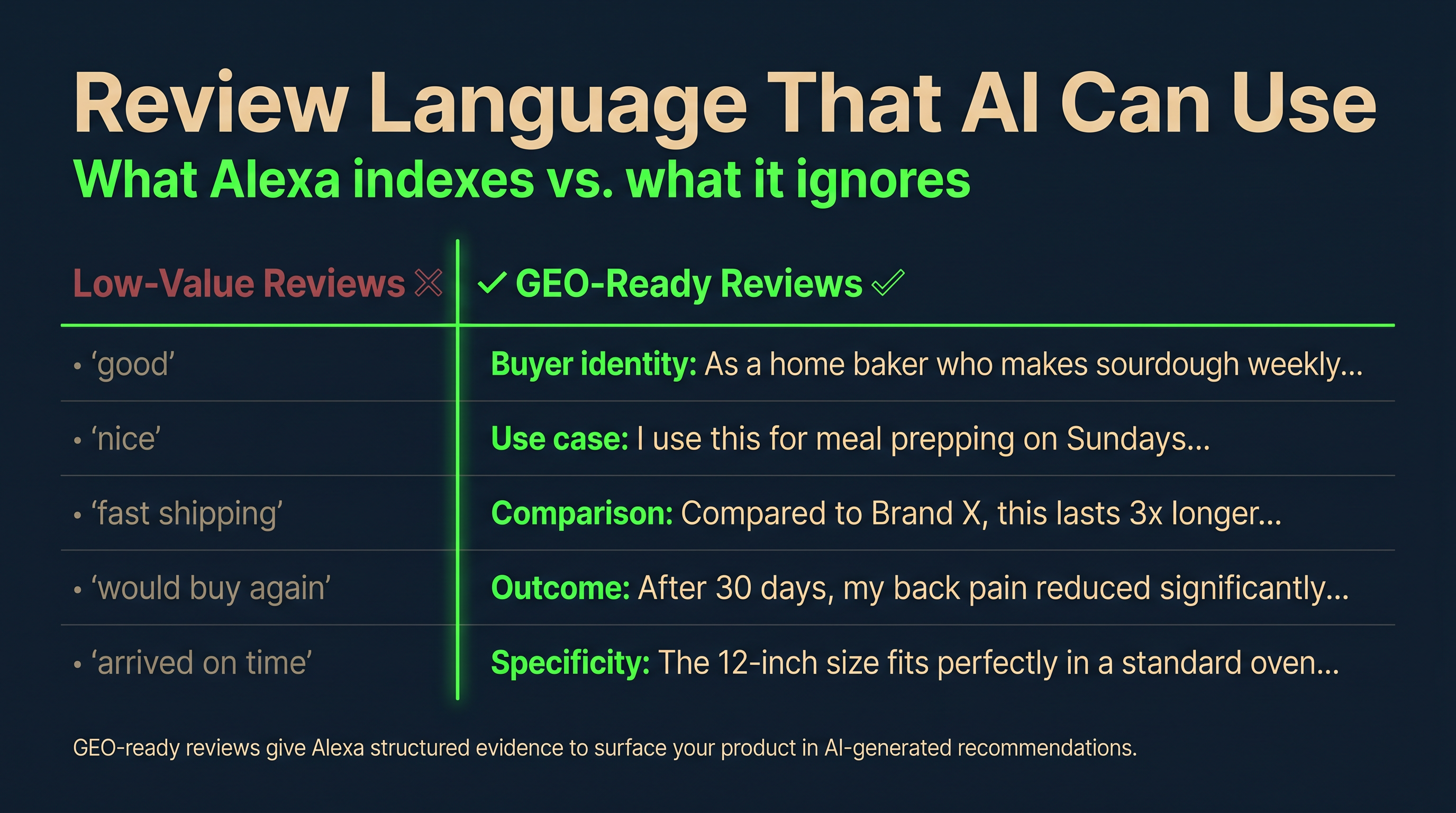
Caption: Review quality is not only star rating. For GEO, the words inside the review help the assistant understand who the product is for.
4. Build the Q&A section like a product knowledge base
The Q&A area is often messy, outdated, or empty. That is a problem if AI assistants use it to answer specific shopper questions.
Think of Q&A as a mini knowledge base for Alexa.
A seller should proactively cover questions in these buckets:
Q&A bucket | Examples |
|---|---|
Compatibility | "Does this work with iPhone 16?" "Does it fit a 2024 Tesla Model Y?" |
Usage | "Can I use it outdoors?" "How long does setup take?" |
Audience | "Is it suitable for seniors?" "Is it safe for kids?" |
Troubleshooting | "What should I do if it will not pair?" |
Comparisons | "How is this different from the standard model?" |
Limits | "Can it handle heavy rain?" "What is the maximum weight?" |
The best Q&A answers are direct. They do not sound like ad copy.
Bad answer:
Yes, this amazing product is perfect for everyone and delivers premium quality.
Better answer:
Yes. It works with iPhone 12 and newer models that support Bluetooth 5.0. For older iPhones, pairing still works, but the low-latency mode may not be available.
That second answer gives Alexa something safe to repeat.
5. Make your brand an entity, not just a seller name
The source article makes a point sellers should take seriously: Amazon GEO is not only on-Amazon optimization.
Amazon's announcement says Alexa for Shopping can use information from across the web. That means external brand signals may matter more as AI shopping assistants become comfortable pulling context from outside a marketplace.
For sellers, brand entity work includes:
- a clear brand website with product categories, use cases, and support pages
- consistent brand descriptions across Amazon, Google, YouTube, TikTok, Reddit, and review sites
- third-party reviews that use recognizable category language
- comparison pages or buying guides on owned media
- structured product information where appropriate
- clear About, warranty, support, and safety pages
- mentions in relevant category lists, not random PR placements
A kitchen brand wants to be associated with phrases like "compact espresso machine for small apartments" or "budget burr grinder for beginners," not just its brand name. A chair brand wants credible mentions around "ergonomic chair for lower back support," not just "office chair."
This is where AI search visibility overlaps with Amazon selling. If ChatGPT, Perplexity, Google AI Overviews, Reddit threads, and review sites all describe your product category differently, AI systems receive a messy picture. If the language is consistent, the brand becomes easier to retrieve and recommend.
6. Give the AI a reason to compare you favorably
AI shopping assistants love comparisons because shoppers love comparisons. "Compare these two air fryers" is exactly the kind of request Alexa for Shopping is designed to handle.
That means your listing should not only say what the product is. It should say when it is the better choice.
Useful differentiators include:
- quieter than typical models in the category
- lighter for travel
- beginner-friendly setup
- better for small apartments
- safer for kids or pets, if supported by facts
- easier to clean
- faster charging
- wider compatibility
- dermatologist tested or recommended, if documented
- lower total cost of ownership
Be careful with vague claims like "best quality" or "premium performance." They are hard for AI systems to defend.
Better:
Best for small kitchens: the 9-inch width fits under most apartment cabinets and still holds four slices of bread.
Better:
Better for beginners: the one-button preset mode avoids manual temperature settings and includes a printed quick-start guide.
Those sentences contain recommendation logic. They help Alexa explain why one option fits a shopper better than another.
7. Expect GEO to affect ad efficiency
Amazon Ads will not be separate from this shift forever. Even if classic Sponsored Products still look familiar, AI-assisted discovery can change which products get considered, which answers mention sponsored options, and which listings convert after a recommendation.
A likely flywheel looks like this:
- Alexa recommends a product because its content fits the shopper's intent.
- The recommendation drives a better-qualified visit.
- Better-qualified visits improve conversion behavior.
- Stronger conversion and satisfaction signals make the product safer to recommend again.
- Ads attached to that product become more efficient because the listing does a better job answering the intent.
The reverse is also possible. A listing with vague content, weak reviews, poor Q&A, and no clear differentiator may pay for clicks but fail to earn AI recommendation confidence.
For the next 60-90 days, sellers should watch more than rank and ACoS. Track:
- conversion rate changes on top ASINs
- review language themes
- Q&A coverage gaps
- search-term reports with conversational phrasing
- share of branded versus non-branded discovery
- price-alert and deal-driven conversion patterns, where available
- AI answer visibility in Amazon and external AI search tools
If your reporting still treats all queries as keyword strings, you will miss the shift toward shopping questions.
A practical Amazon GEO checklist for sellers
Start with your top 10 revenue ASINs. Do not try to fix the whole catalog first.
Use this checklist:
Area | Action |
|---|---|
Title | Add product type, primary use case, audience, and key constraint without making it unreadable. |
Bullets | Rewrite each bullet as an answer to a buyer question, not a pile of specs. |
A+ content | Add use-case blocks, comparison tables, buying guidance, and plain-language explanations. |
Reviews | Encourage compliant, specific feedback about use case, buyer, outcome, setup, and comparison. |
Q&A | Seed the most important compatibility, usage, audience, troubleshooting, and limit questions. |
Images | Add captions or infographic-style panels that explain use cases and differentiators. |
Brand entity | Align Amazon, website, social, support, Reddit, YouTube, and third-party review language. |
Comparison | State when your product is the better choice and when it is not. |
Measurement | Review conversational queries, conversion quality, AI answer presence, and review themes monthly. |
If you want a fast audit, run your product page through Auspia's GEO tools and ask a simple question: could an AI assistant explain who this product is best for without inventing anything?
FAQ
What is Amazon GEO?
Amazon GEO is the practice of optimizing product content and brand signals so generative AI shopping assistants, such as Alexa for Shopping, can understand, compare, and recommend a product for the right buyer intent.
Is Amazon GEO replacing Amazon SEO?
No. Keyword relevance still matters. GEO adds another layer: semantic clarity, review evidence, Q&A coverage, brand trust, and comparison-ready product information.
What should sellers update first for Alexa for Shopping?
Start with the title, first two bullets, A+ content, review prompts, and Q&A section for your highest-revenue ASINs. These fields give the assistant the clearest product facts and use-case language.
Do reviews affect GEO?
Yes, reviews can help AI systems understand real buyer use cases, outcomes, objections, and comparisons. Sellers should not manipulate reviews, but they should ask compliant questions that encourage useful, specific feedback.
Does off-Amazon content matter for Amazon GEO?
It can. Amazon says Alexa for Shopping uses information from across the web, so consistent brand and product language on your website, social channels, review sites, and community discussions can support better entity understanding.
How do I measure Amazon GEO performance?
Track conversational search terms, conversion rate, Q&A coverage, review themes, AI-generated product summaries, external AI visibility, and whether your product appears in recommendation-style answers for important buyer prompts.
Author: Maya Ellison, 12-Year GEO Strategy Researcher at Auspia. Maya writes about AI search visibility, brand entity clarity, and practical GEO operating systems for growth teams.