The Email That Made a Founder Freeze
A screenshot landed in a founder's inbox. A customer was asking: "Is your company some kind of scam?"
Not a bad review. Not a competitor's smear campaign. Not an angry Reddit thread.
It was Google's AI Overviews — calmly linking two legitimate German publishing companies to phrases like "fraud schemes," "subscription traps," and "suspicious business practices."
The worst part? The sources AI cited didn't contain any of those accusations at all.
It didn't dig up something negative. It invented one on the spot.
This Isn't a Glitch — It's a Brand Rename by Machine
In May 2026, the Munich Regional Court I issued a temporary injunction against Google (Case 26 O 869/26). The plaintiffs were two publishing companies based in Munich — one operating over 10 publishing brands, the other producing technology and history titles under the GeraMond imprint.
Here's what happened: users searched for the company names alongside the German word "Betrugsmasche" (roughly "fraud scheme"). Google AI Overviews generated a response that tied these publishers to fraud, subscription traps, and suspicious conduct — some of which belonged to entirely different companies.
The court stepped in because the associations didn't exist even in AI's own cited sources.
That's the terrifying part. AI isn't always repeating rumors. Sometimes it manufactures them.
In the old search world, brands worried about page-one negativity, bad Yelp reviews, or a viral complaint on X. At least you could trace the source — issue a takedown, publish a clarification, file a lawsuit. Dirty work, but there was a playbook.
Generative search is different. It creates content in the moment of answering. Today's version may differ from tomorrow's. The user reads it and moves on. You never know how many strangers already heard your brand described as a fraud.
It's like a rumor machine wearing a suit — and it says "please" and "thank you."
Most GEO Strategies Are Solving the Wrong Problem
When most teams talk about GEO (Generative Engine Optimization), the conversation starts with: "How do we get ChatGPT to recommend us?" "How do we get mentioned in Perplexity?" "How do we show up in Gemini's answers?"
Those are valid questions. Traffic matters.
But the Munich case flips the table.
In generative search, not being mentioned means no traffic. Being mentioned incorrectly can mean brand destruction.
This matters most for small and mid-size businesses — a medical device company, a dental clinic, a study-abroad agency, a franchise brand. Before buying, customers search. They used to see a list of links. Now they increasingly read an AI summary first. One sentence like "this brand has ongoing complaints" and they never click through to your site.
It's not a conversion rate drop. It's the trust entrance collapsing.
Here's the mechanism: AI is very good at assembling fragments into plausible-sounding paragraphs. It doesn't necessarily understand your company. It notices that certain words appear near each other across the web — your company name, "complaint," "refund," "subscription," "trap" — and the connections get baked into an answer.
Stale data makes it worse. Product specs from three years ago. Discontinued service terms. An old address that never got updated. A resolved support ticket still sitting on a forum. A human might know these are outdated. A model picks them up and treats them as current.
AI Hallucinations Aren't Magic — They're Information Gaps
When people hear "AI hallucination," they picture a model going rogue.
It's less dramatic than that — and more dangerous.
A large language model is essentially an extremely fluent autocomplete. It optimizes for responses that sound right. When it encounters missing data, conflicting data, or outdated data, it doesn't pause to say "I don't know." It fills in the blanks.
And it fills them convincingly.
For businesses, the problem breaks down into three holes:
Gap | What happens | Example |
|---|---|---|
Too little public information | Model can't find reliable answers, so it stitches together fragments | A B2B SaaS with no clear pricing page gets quoted as "expensive and opaque" |
Inconsistent messaging across sources | Official site, press releases, wiki, and job pages all say different things | Launch date on Crunchbase disagrees with the blog, so AI hedges with "reportedly founded in..." |
Outdated content never cleaned up | Model treats the past as the present | A 2023 pricing change still shows old numbers on a directory site, and that's what gets cited |
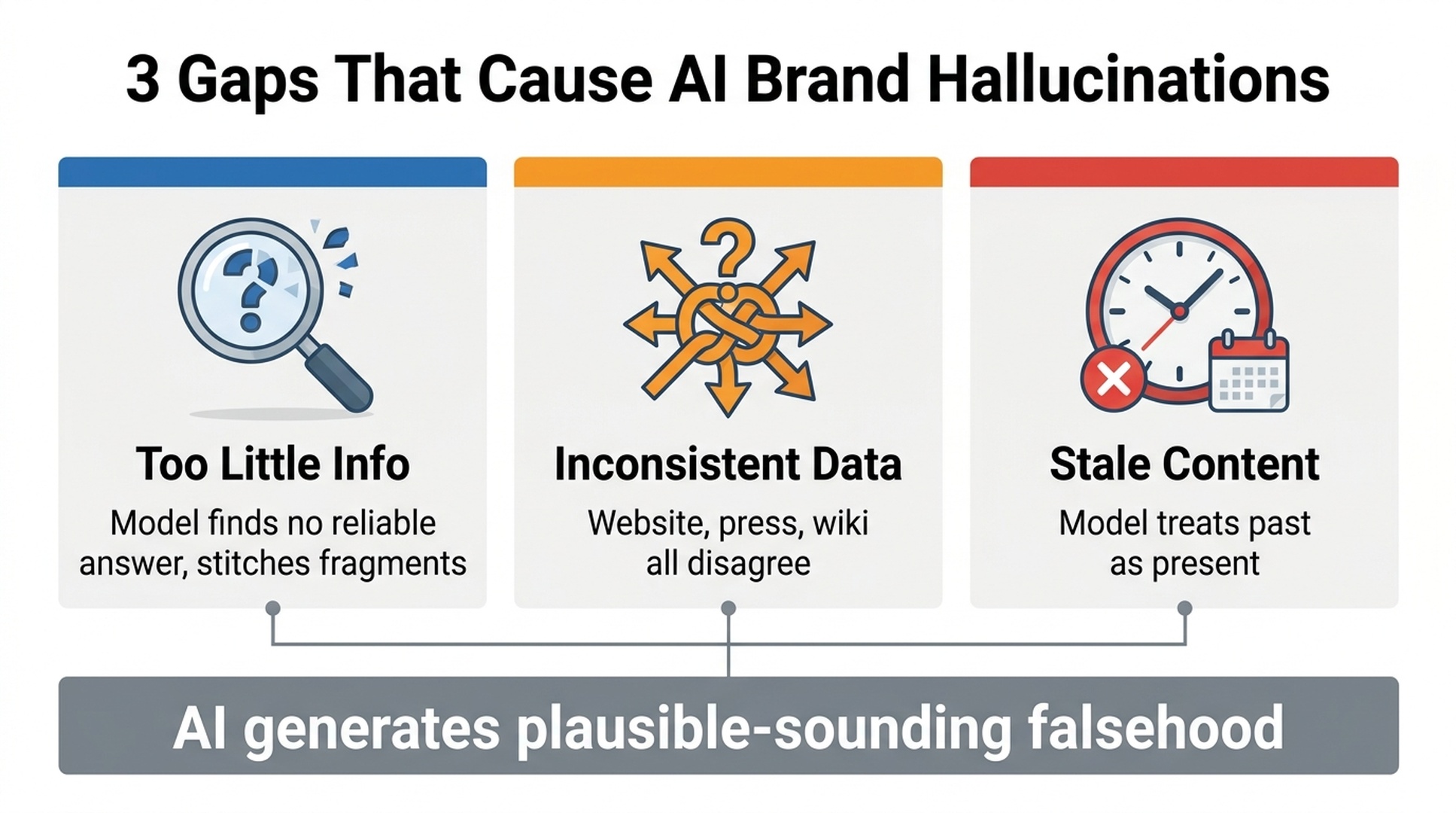
None of these are sophisticated failures. But the damage is very real — especially in regulated industries like healthcare, finance, automotive, education, and franchising. One wrong AI sentence can trigger compliance reviews, complaint spikes, and PR fires simultaneously.
Users don't cross-reference. They assume AI has already done that for them.
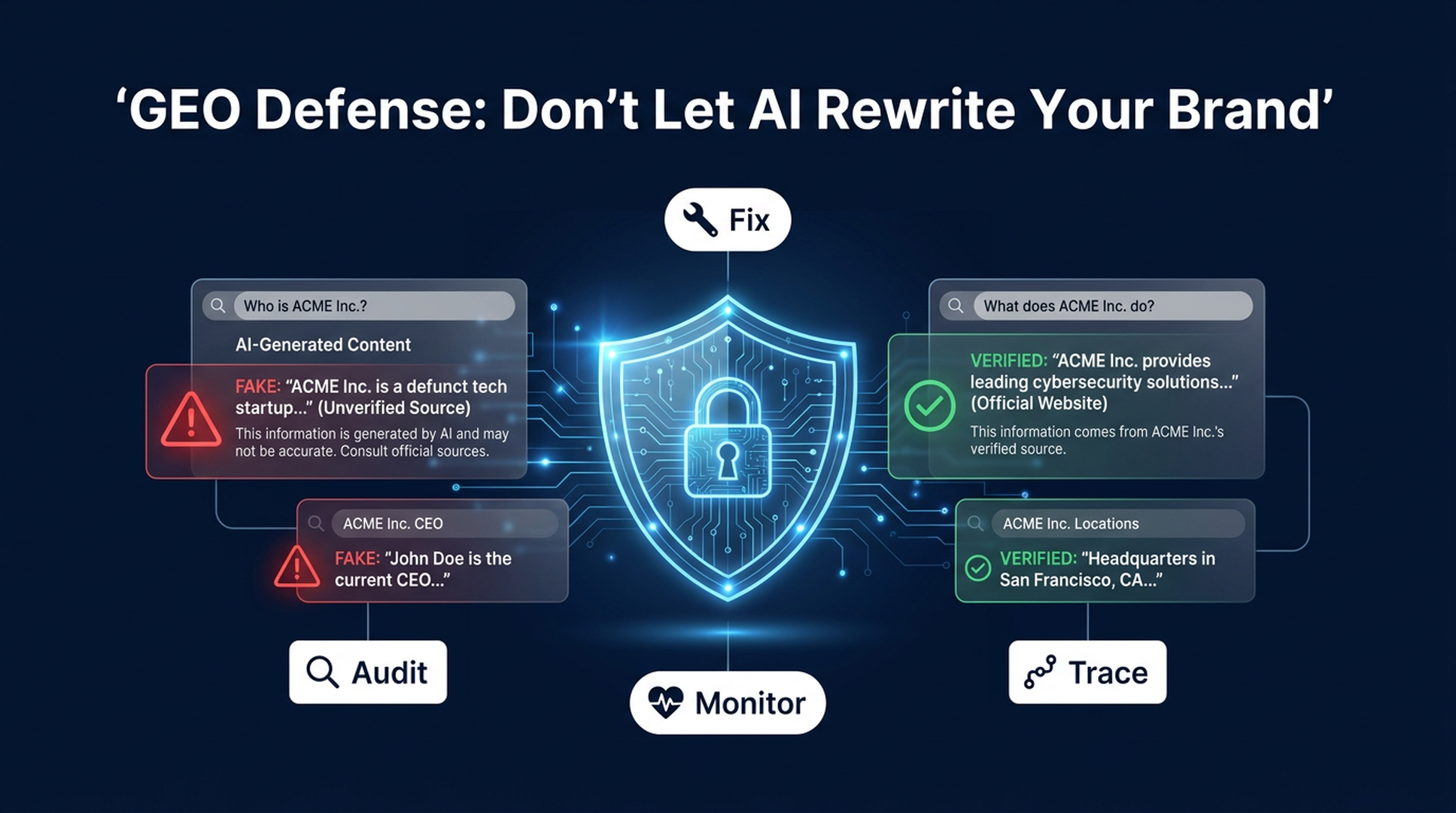
The Real First Move in GEO: Audit What AI Already Says About You
Before writing 100 blog posts to feed the models, do the unglamorous work first.
Open ChatGPT, Gemini, Perplexity, Claude, and every AI search tool your customers use. Ask about your brand. Ask about your founder by name. Ask about your products. Ask "is it reliable?" "any complaints?" "how does it compare to [competitor]?" "what about refunds?"
Don't ask once. Vary the phrasing, the scenario, the language.
You'll find uncomfortable things. One platform has your founding year wrong. Another attributes a competitor's feature to you. A third is still quoting your 2023 pricing. And it all sounds so confident — confident enough that you'd applaud the delivery of pure nonsense.
Then trace each error backward.
Where did it come from? Is the company "About" page vague? Did a press release use different numbers than the website? Is there a stale Glassdoor listing, an outdated industry directory entry, or an auto-aggregated profile that pulled dirty data?
Fix the source. Then reinforce with clean, consistent, time-stamped information across every surface you control:
- Website: Clear company description, product details, and last-updated dates
- Press and media: Verifiable facts, not vague claims
- Profiles: Crunchbase, LinkedIn, Google Business, industry directories — align everything
- Content freshness: Mark dates on important pages so models know what's current
And stop obsessing over volume. One hundred thin blog posts won't help. Ten authoritative, consistent, verifiable sources that reinforce each other will. Models are getting pickier — Claude, Gemini, and ChatGPT are all moving toward "cite sources, reduce fabrication." Give them clean, stable, traceable material, and they have a reason to get you right.
The Defense-First GEO Checklist
Step | Action | Priority |
|---|---|---|
1 | Query your brand across all major AI platforms with varied prompts | Critical |
2 | Document every factual error, outdated claim, and misattribution | Critical |
3 | Trace each error to its source (website, directory, press, forum) | High |
4 | Fix source data — update pages, align messaging, add timestamps | High |
5 | Consolidate public profiles (Crunchbase, LinkedIn, Google Business, wiki) | High |
6 | Publish clear, fact-rich "About" and product pages with dates | Medium |
7 | Build 10+ authoritative, interlinked reference pages (not 100 thin posts) | Medium |
8 | Set up quarterly re-audits — AI responses change with model updates | Ongoing |
Don't Wait for the Lawsuit
The Munich injunction is a wake-up call for every brand operating in AI search.
A court can correct one specific error. But it can't control every generation across Google, Gemini, ChatGPT, Perplexity, and every AI search tool that launches next quarter. The old assumption — "as long as my website is fine, I'm fine" — no longer holds.
GEO is splitting into two kinds of operators:
One group is still chasing exposure, asking how to get AI to say more about them.
The other group is watching what AI already says — and making sure it isn't wrong.
The first group is fighting for the microphone.
The second group is checking whether the microphone is electrified.
In the AI era, your brand assets don't live only in your trademark filing. They live in what models say when someone types your name.
Get that right first. Then worry about getting recommended.
Somewhere right now, a potential customer just typed your company name into an AI search box. The cursor blinked twice.
Then AI started answering.
FAQ
What is GEO (Generative Engine Optimization)? GEO is the practice of making your brand's information easier for AI search systems to retrieve, verify, and cite correctly. Unlike traditional SEO, which targets keyword rankings, GEO focuses on accuracy, consistency, and source authority across the surfaces that AI models draw from.
Why should brands care about AI-generated misinformation? AI search tools like Google AI Overviews, ChatGPT, and Perplexity generate answers in real time. When they get your brand wrong — wrong founding date, wrong product claims, wrong associations — users trust the output without checking sources. A single incorrect sentence can damage credibility before you even know it happened.
What's the first step in a GEO defense strategy? Audit what AI platforms currently say about your brand. Query your company name, founder name, and products across ChatGPT, Gemini, Perplexity, and Claude using varied prompts. Document every error, then trace each one back to its source — an outdated page, a stale directory listing, inconsistent messaging.
How is GEO different from SEO? SEO optimizes for search engine rankings through keywords, backlinks, and technical signals. GEO optimizes for AI citation accuracy through data consistency, source authority, factual clarity, and structured information that models can verify.
How often should I audit AI responses about my brand? At least quarterly. AI models update their training data and retrieval systems frequently, so responses about your brand can change without warning. Set a calendar reminder and rotate through different prompt styles each time.