Direct answer
GEO (Generative Engine Optimization) is the process of making your brand and content more visible, understandable, and citable in AI-generated answers. It's not a replacement for SEO—it's an extension. SEO handles crawling, indexing, and page visibility. GEO handles whether AI treats you as a trusted information source.
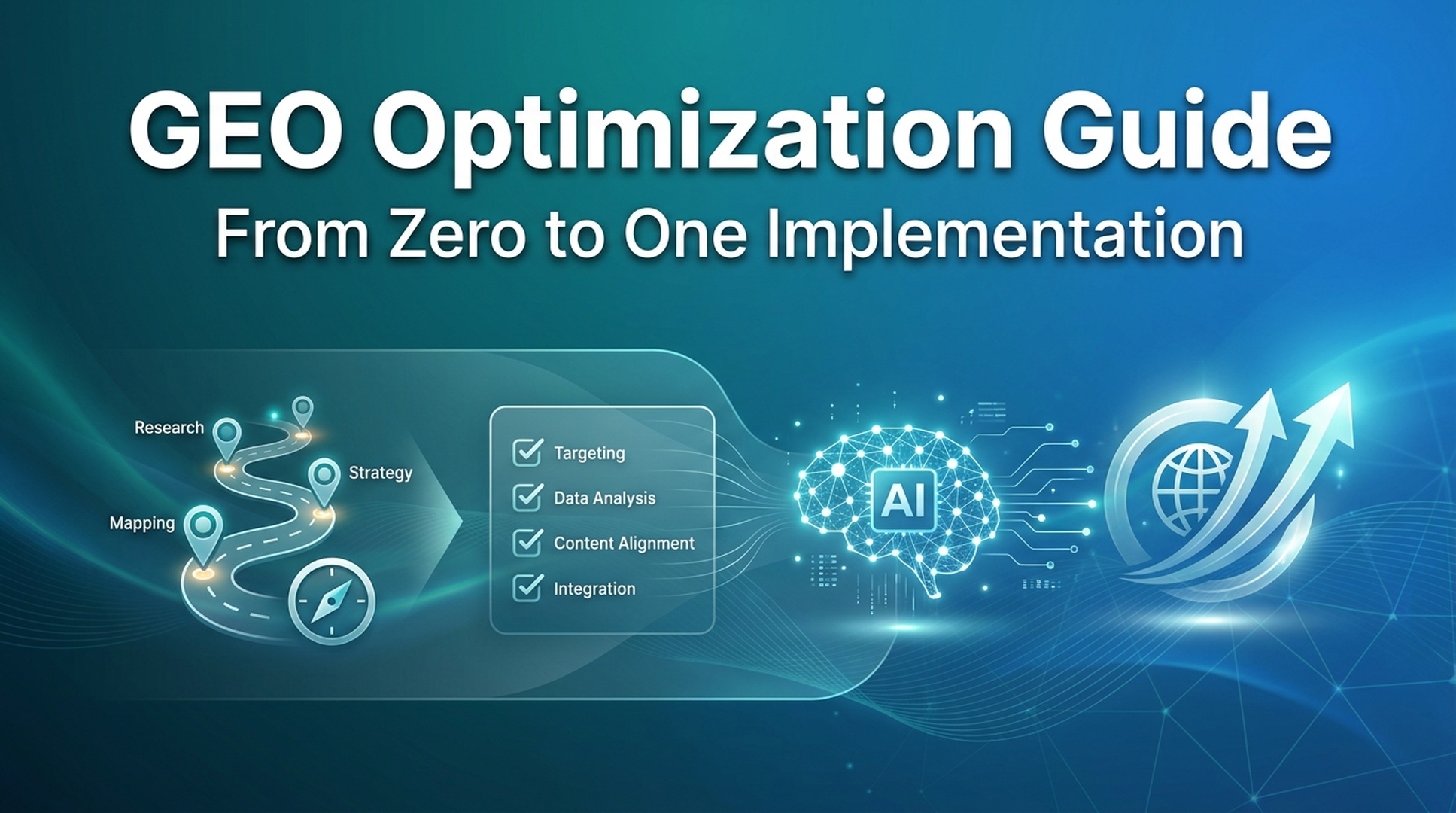
To implement GEO effectively, start with 4 prerequisites: clarify your goals, map user questions, audit existing content, and assess whether your business is a good fit. Then follow 6 implementation steps: conduct prompt research, analyze your current AI presence, optimize on-site expression, build content structure, add off-site trust signals, and continuously monitor and iterate.
This guide explains what GEO is, which businesses should prioritize it, how to implement it from scratch, and the most common mistakes beginners make.
Before you start: 4 prerequisites
1. Clarify your goals before discussing tactics
What do you actually want from GEO?
Common goals fall into three categories:
- Brand visibility: You want your brand mentioned more frequently in AI results.
- Decision-stage entry: You want to appear in comparison, recommendation, and selection questions.
- Business conversion: You want AI search to become a channel for inquiries, bookings, trials, or lead generation.
Different goals require different page priorities. If brand visibility is primary, focus on your homepage, About page, definition pages, and brand-related FAQs. If high-quality inquiries matter more, prioritize service pages, comparison pages, case studies, and decision-stage content.
2. Start with questions, not keywords
When planning this type of content, don't think "Which keyword should I target?" first. Think "How would users ask this in a real scenario?" Whether through search or AI Q&A, users increasingly ask complete questions rather than typing isolated keywords.
Before planning content, clarify the questions first, then decide how to structure pages and what to write.
3. Audit your existing content assets
Don't rush to create new content before understanding what you already have. Pull up all these pages and review them:
- Homepage
- Service pages
- Product pages
- About page
- FAQ page
- Case study pages
- Blog posts
- Author/team pages
The key question isn't "Do these pages exist?" but "Do these pages clearly explain who you are?"
If your homepage doesn't clarify who you are, service pages don't explain what you offer, About page doesn't differentiate you from competitors, and FAQs don't cover what customers actually ask, then adding more articles won't produce stable results.
4. Assess whether your business should prioritize GEO
Not every industry needs to overhaul GEO immediately, but these business types typically benefit most from early investment:
- B2B companies
- SaaS products
- Professional service firms
- Cross-border and international brands
- High-ticket, high-consideration businesses requiring explanation and comparison
The reason is simple: users in these categories tend to ask AI questions like:
- Which company is more suitable?
- Is this solution worth pursuing?
- What's the difference between A and B?
- How should I choose?
- Is there a better provider for my situation?
If your business naturally depends on explanation, comparison, trust, and judgment, GEO becomes increasingly important—not optional.
Conversely, if you sell low-consideration, low-explanation, impulse-purchase products, GEO's priority typically won't exceed basic SEO, paid advertising, and conversion page optimization in the short term.
How to implement GEO: 6 steps
Step 1: Conduct prompt research to understand how users actually ask
Prompt research means systematically collecting, categorizing, and prioritizing the questions users might input into ChatGPT, Gemini, Google AI, and other AI systems.
For example, someone researching project management tools wouldn't just search "project management tool." They'd ask:
- Do I really need a project management tool?
- What's the best project management tool for remote teams?
- What's the difference between Asana, Monday, and ClickUp?
- Is it worth paying for a premium plan for a 10-person team?
- How should I choose for the first time?
These are real questions, and they mirror how users now interact with AI.
Categorize questions into 4 types:
- Definition questions: What is this, is it necessary. Example: "What exactly is project management software" "Is it worth buying"
- Comparison questions: What's the difference between A and B. Example: "What's the difference between Asana and Monday"
- Selection questions: Which is more suitable, should I choose. Example: "Which tool works best for remote teams" "Is the premium plan worth it for small teams"
- How-to questions: How to do something specific. Example: "How should I choose for the first time" "How do I set up workflows after purchase"
Once questions are categorized, it's easier to decide content priorities: which to write first, which belong in FAQs, which work better as comparison pages or how-to guides.
This phase should produce at least two deliverables:
- A question inventory: List real questions as comprehensively as possible.
- A question priority matrix: Determine which questions deserve immediate attention.
Priority doesn't need to be complex initially. Consider 4 factors:
- How frequently does this question appear?
- How close is it to a decision point?
- Can existing pages address it?
- Will the content remain relevant long-term?
Skip this step, and you'll end up writing content that doesn't answer what users actually ask.
Step 2: Analyze your current AI search presence
Many teams skip this step and start writing blindly. But GEO isn't about闭门造车 (building behind closed doors)—you need to see clearly: How does AI currently perceive you?
Analyze at least 4 dimensions:
- Is your brand mentioned? Test different AI scenarios with brand terms, product terms, and service terms. Do systems mention you?
- How does AI describe you? Being mentioned doesn't mean being understood. Many brands' problems aren't "completely absent" but "mentioned yet described vaguely or placed in wrong categories."
- In which questions do competitors appear? Some questions where you're absent but competitors consistently appear—this is more actionable than simply knowing "I'm not mentioned."
- Which questions are closest to business outcomes? Not all mentions matter equally. Focus on questions related to inquiries, comparisons, selections, and solution judgments.
After this analysis, you'll typically see 3 scenarios, each requiring different next steps:
- Completely absent from AI视野: Priority isn't expanding content but establishing basic AI认知: who you are, what you do, who you serve.
- Present but misunderstood: Priority isn't publishing more articles but fixing on-site expression to avoid conflicting messages about brand, services, target audience, and differentiation.
- Present for basic questions but absent from decision-stage questions: Basic认知 exists. Next step is filling gaps in comparison, selection, and conversion-related questions.
Step 3: On-site GEO—make AI understand you
If AI hasn't noticed you yet, or mentions you but understanding is consistently off, don't rush to expand content. First, clarify the most critical on-site information.
The problem usually isn't "insufficient content" but "incomplete basic认知": who you are, what you offer, who you serve, how you differ from others—these aren't expressed consistently and clearly.
On-site GEO optimization should achieve clarity across 3 dimensions:
1. Brand clarity
Homepage, About page, service pages, case studies, and author pages should maintain consistency in brand name, service names, value propositions, and target audience. Don't have your homepage claim "AI search growth," service pages say "GEO optimization," and blog posts write "generative engine marketing"—each page sounding like a different business.
AI doesn't fear too much information; it fears conflicting information. If core concepts aren't consistent, the system can't form stable understanding.
2. Relationship clarity
Who you are, what you sell, who you serve, how you differ, why you're worth recommending—these 5 points can't be scattered across a dozen pages for the system to guess. Proactively write out these relationships and ensure core pages support each other.
Homepage establishes basic认知. Service or product pages explain specifics. Case studies provide proof. About and author pages build credibility. Pages shouldn't each tell separate stories but collectively explain the same narrative.
3. Expression clarity
On-site content should "answer first, then expand." Definitions should give a standard answer first, then background. Steps should list sequence first, then principles. Comparisons should clarify differences first, then reasons. Express core information in explicit text, not just images, videos, or vague copy.
Many sites' problems aren't insufficient content but buried answers, scattered messaging, and inconsistent terminology. Users can't grasp key points; AI can't stably extract and cite.
Step 4: If AI already knows you, add decision-stage content
If AI knows who you are and what you do but still doesn't appear in selection and conversion questions, you don't lack basic introductions—you lack content that helps users make judgments.
What truly influences decisions isn't "what you are" but questions like: How do you differ from alternatives, which is more suitable for me, should I choose you, when is it appropriate, when isn't it. With only introductions and no judgments, AI can't stably mention you in high-value questions.
For B2B, SaaS, and professional services, the same principle applies. Don't add generic introductions first—add comparison, selection, judgment, boundary, and trade-off questions.
Don't write immediately. Return to Step 1's question inventory and extract questions closest to comparison, selection, and conversion. Focus on two types: questions users repeatedly ask, and questions frequently pursued before inquiry, trial, or purchase.
Then determine what each question lacks:
- No one answers it at all
- Already written, but only conclusions without evidence
- Answer mentioned, but applicable conditions and boundaries unclear
More effective approach: one core judgment question per page. Each page gives a direct answer first, then explains who it's suitable for, judgment criteria, differences, and when it's not appropriate.
The focus isn't making content bigger but advancing from "introducing who you are" to "explaining why you're suitable to be chosen and under what conditions."
Step 5: Off-site GEO optimization—add external trust signals
Many teams stop at on-site work, but if you're in a competitive industry, this step is usually unavoidable.
Off-site GEO's focus isn't "publishing more content" but ensuring AI repeatedly encounters you in more credible contexts.
Whether AI stably cites a brand depends not just on how well the official site is written but on whether sufficient external corroboration exists.
From an execution standpoint, off-site GEO requires at least 3 initial actions:
1. Find the most relevant third-party contexts
Don't broadly distribute press releases. Seek places users actually see, trust, and that models are more likely to identify and retrieve.
For international markets, Reddit is典型. Many users check Reddit for real usage experiences, alternative discussions, pitfall warnings, and横向 comparisons before deciding. For SaaS, G2, Capterra, industry blogs, review sites, and vertical communities matter. For consumer products, forums, YouTube reviews, Q&A communities, and review media often outperform generic press releases.
2. Align external expression
After identifying contexts, don't immediately scale volume. First, align external expression with official site messaging. If your site says you're A, external articles say B, and community posts write you as C—this damages consistency. Off-site isn't about quantity; it's about consistency.
3. Build mutual corroboration between official site and external content
Official site is the primary statement; third parties are supporting evidence. If your site claims you're suitable for a certain customer type and excel at solving specific problems, third-party contexts should show similar discussions, reviews, case studies, or comparisons. If your site emphasizes a differentiator, external content should show others choosing you for that reason. Only when "how you describe yourself" and "how external sources mention you" align can AI more easily judge you as credible, stable, and worth citing.
For most teams, off-site GEO doesn't need massive initial deployment, but recognize early: off-site's essence is building trust, not volume.
Step 6: Continuous monitoring and iteration—make GEO a closed loop
GEO fails most often because teams treat it as a one-time content project. It's more like continuous calibration operations. Split monitoring into 3 layers:
Layer 1: Track mentions. Does the brand appear? In which questions?
Layer 2: Track descriptions. How does AI define you, compare you, describe your advantages and boundaries?
Layer 3: Track outcomes. Are there higher-quality clicks, longer dwell times, visits closer to inquiry and conversion?
Monitoring isn't for reports—it's for inferring next actions.
- If mentions increased but descriptions are inaccurate, on-site expression needs refinement.
- If descriptions are more accurate but decision-stage questions still absent, off-site trust may be insufficient.
- If mentions increased but no clicks or conversions, questions were misselected or content pages aren't converting.
Truly effective GEO isn't one-time publishing but iteratively connecting "questions, expression, trust, results" round by round.
Which on-site pages should you optimize first?
If you're ready to start now, prioritize checking these 5 page types:
- Homepage
- Service pages
- About page
- FAQ page
- Core blog posts
Check 5 items per page:
- Does this page clearly answer "Who are you?"
- Does it explicitly state "What do you offer?"
- Does it specify "Who is it for?"
- Does it clarify "How do you differ from others?"
- Does it provide evidence for "Why are you worth recommending?"
Then unify expression:
- Lead each section with the answer
- Use subheadings to break down logic
- Use steps, lists, comparisons, and FAQs frequently
- Standardize definitions—don't use three terms for one concept
- Add boundaries at the end—don't overclaim
This isn't about "pleasing AI" but making pages easier to understand accurately and read clearly.
When should you start off-site GEO?
Typically, when these 3 signals appear, it's time to prioritize off-site work:
- Industry competition intensifies. You notice competitors appearing more frequently in AI.
- Official site content alone can't establish trust. Especially for high-ticket, high-consideration businesses—users and models won't rely solely on your self-description.
- On-site foundations are mostly complete. Continuing to work only within the official site yields diminishing returns.
Common off-site GEO directions to start:
- Industry media
- Vertical communities
- Forums
- Q&A platforms
- Brand-related content ecosystems
Focus remains on two things:
- Are there credible contexts?
- Is external content consistent with official site messaging?
Once these two align, off-site value truly emerges.
7 common mistakes beginners make with GEO
- Writing articles immediately without question inventory or current-state analysis. The more you write, the further off-track you go.
- Focusing only on keywords, not real questions. Content ends up mechanical, generic, and weak on conversion.
- Only doing on-site work without building external trust. Once competition rises, official site alone rarely builds stable advantage.
- Inconsistent brand, service, and product messaging. This is the most common and隐蔽 problem.
- Treating GEO as SEO with a different name. The two are highly related but not identical.
- Over-relying on special technical tags. Many teams hear "GEO" and start searching for "AI-specific techniques." But in most cases, what needs fixing first is basic visibility, page structure, and expression clarity.
- No monitoring, stopping after implementation. Without monitoring, GEO easily becomes "did many actions but don't know which worked."
30-day GEO launch plan for beginners
If you want to run a minimum viable version, follow this pace:
Week 1: Question research and current-state analysis
List 20-30 real questions, categorized into definition, comparison, selection, and how-to. Simultaneously observe whether AI mentions you, how it mentions you, and who else it mentions.
Week 2: Revise core on-site pages
Prioritize homepage, service pages, About page, and FAQ page. Clarify brand, services, target audience, differentiation, and recommendation rationale.
Week 3: Add 3 high-priority content pieces
Recommend starting with:
- 1 definition page
- 1 comparison page
- 1 how-to guide page
Don't publish 3 random blog posts just to hit a number.
Week 4: First-round monitoring and adjustment
Check whether AI starts mentioning you, whether mentions are more accurate, which pages are more easily cited. Then decide whether the next round should focus on on-site or off-site work.
The advantage is you won't pursue comprehensiveness initially but complete the first closed loop.
FAQ
Must GEO be done alongside SEO?
In most cases, yes. GEO doesn't exist independently from SEO. Crawling, indexing, internal linking, text visibility, and page structure—these foundational capabilities still come from SEO basics.
Does GEO require heavy technical overhaul?
Depends on site status, but don't overstate it. For most teams, true priority isn't stacking technical terms but first ensuring basic crawlability, page expression, and content structure.
Should you start with official site or external content first?
Most teams should start with the official site. If the site itself isn't clear, external expansion just amplifies confusion.
Which pages should be prioritized for optimization?
Priority order is typically:
- Homepage
- Service pages
- FAQ page
- Definition pages
- Comparison pages
- How-to guide pages
How long until you see initial signals?
No universal answer. A more stable view: track mentions and descriptions first, then citation and click quality, finally business outcomes. GEO isn't instant feedback—observe in phases.
Can small teams run a minimum version first?
Absolutely. Once you complete the small loop of "question research—on-site understanding—content gaps filled—first monitoring round," you can decide whether to add off-site work.
The Auspia perspective
GEO isn't about doing more faster—it's about getting the sequence right: first understand how users ask, then see how AI currently perceives you; first clarify on-site messaging, then add decision-stage content and off-site trust. What remains isn't a few articles but a continuously accumulating growth asset.
At Auspia, we help brands run the full loop of "being seen, being understood, being recommended." If you want to systematically implement GEO but aren't sure whether to start with on-site fixes, content gaps, or off-site trust, start by assessing your current state. Understanding where you stand before deciding what to do typically outperforms blind initial investment.