Direct answer
If you are choosing a GEO audit tool in 2026, the best option is the one that can answer three questions at the same time: can AI systems access your site, can they understand and cite your content, and can you turn the audit into a fix list you will actually use?
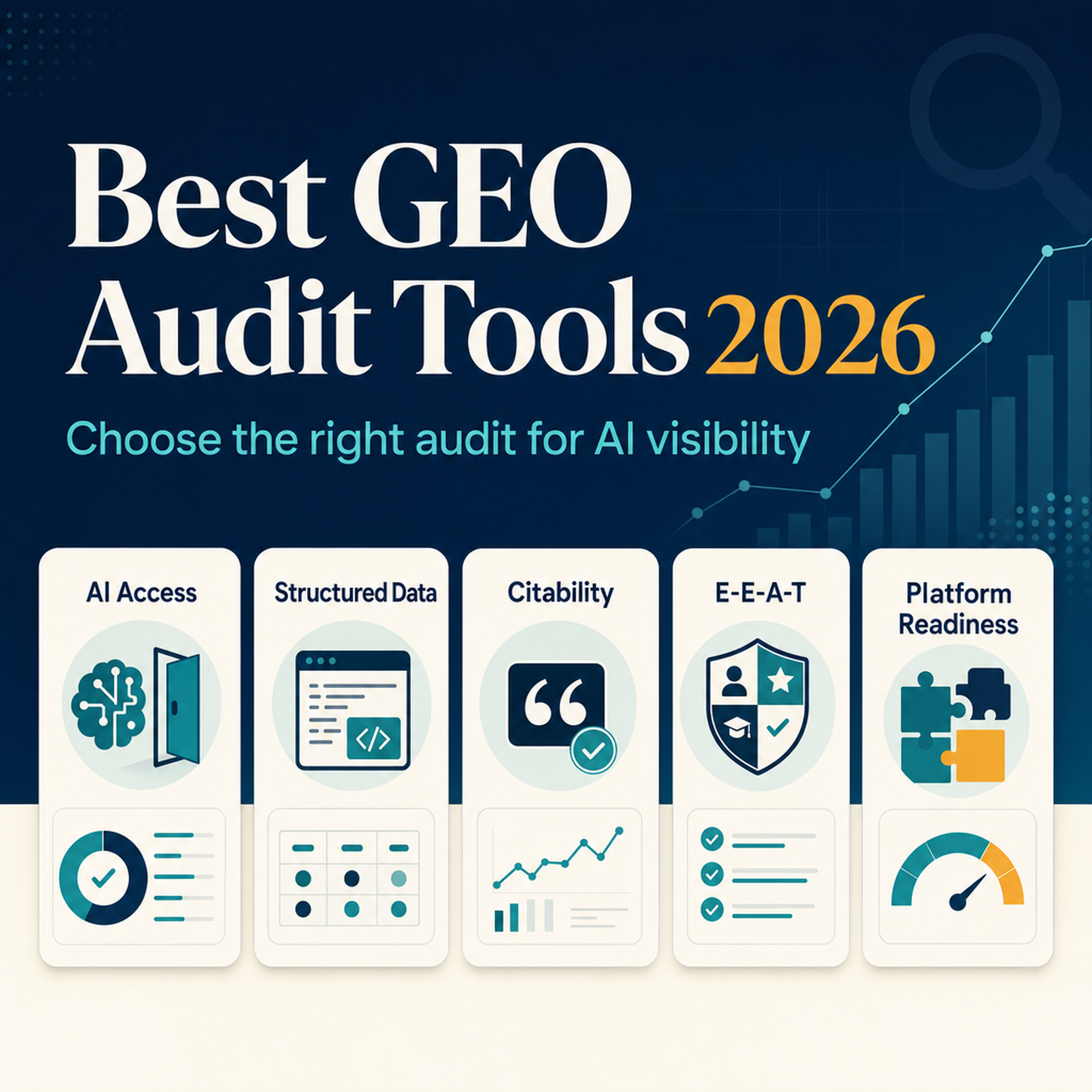
For most teams, a GEO audit tool should not stop at generic SEO checks. It should show whether your pages are readable by AI crawlers, whether your content is structured enough to be quoted, whether your entity and trust signals are clear, and whether your site is ready for AI surfaces such as ChatGPT, Perplexity, Gemini, Google AI Overviews, and Copilot.

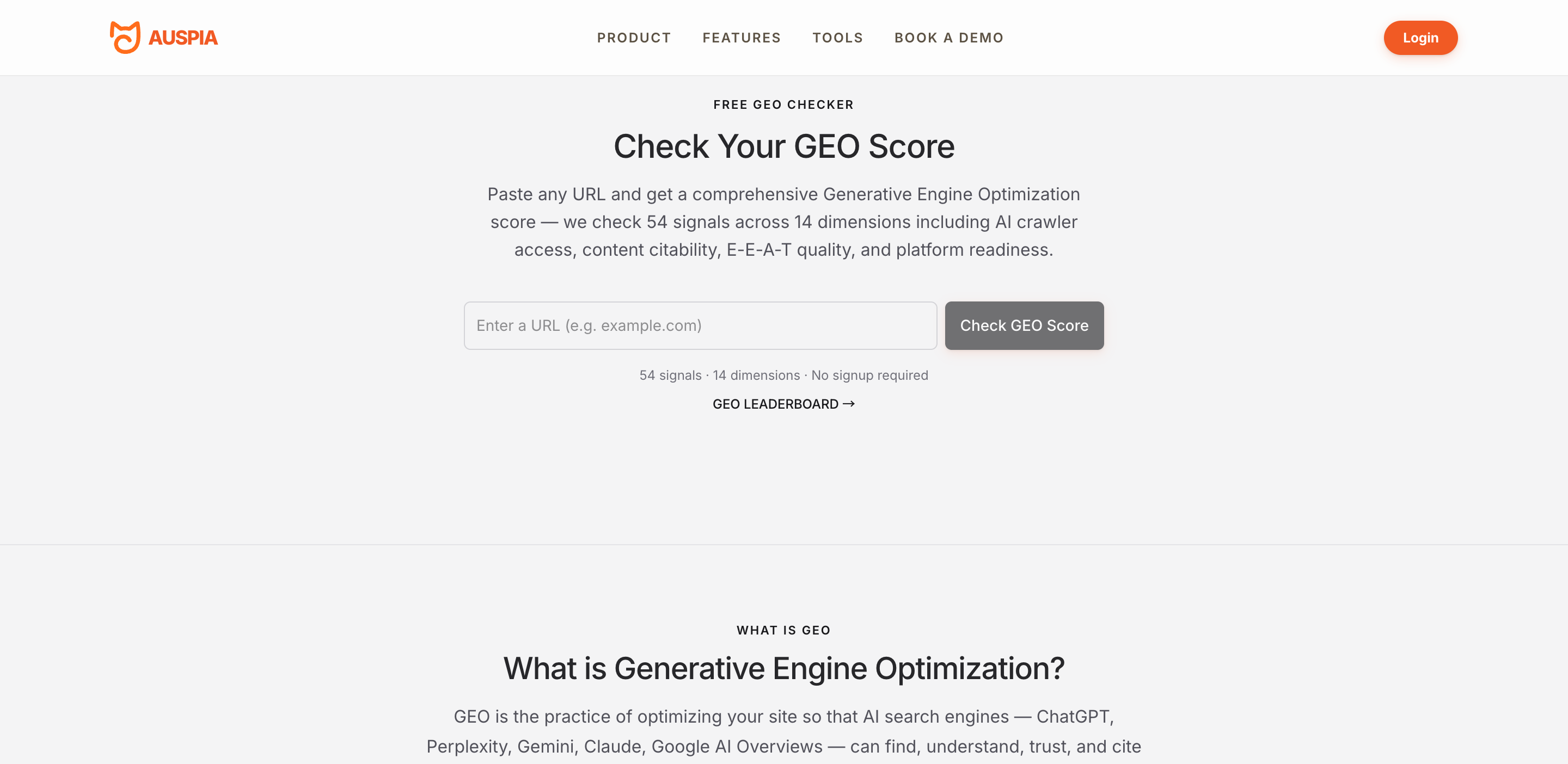
That is why Auspia's GEO Score Checker is a strong 2026 benchmark. It audits 54 signals across 14 dimensions, including AI crawler access, content citability, E-E-A-T quality, structured data, and platform readiness. It is designed to tell you not just what is wrong, but what to fix next.
What a GEO audit tool should actually do
A GEO audit tool is not just a prettier version of a site crawler. It should evaluate whether your content ecosystem is ready for AI answer systems to find, trust, and cite.
In practice, that means checking things like:
- AI crawler access and blocking rules;
- llms.txt and robot instructions;
- server-side rendering and crawlability;
- structured data such as Organization, Article, and FAQPage schema;
- entity clarity, bylines, and author authority;
- paragraph structure and answer extractability;
- citation density and evidence quality;
- platform-specific readiness for AI Overviews, Perplexity, ChatGPT, Gemini, and Copilot.
A basic SEO audit may tell you that a page loads slowly or lacks a title tag. A GEO audit should also tell you whether an AI system could confidently reuse your page as part of an answer.
What to look for in the best GEO audit tools
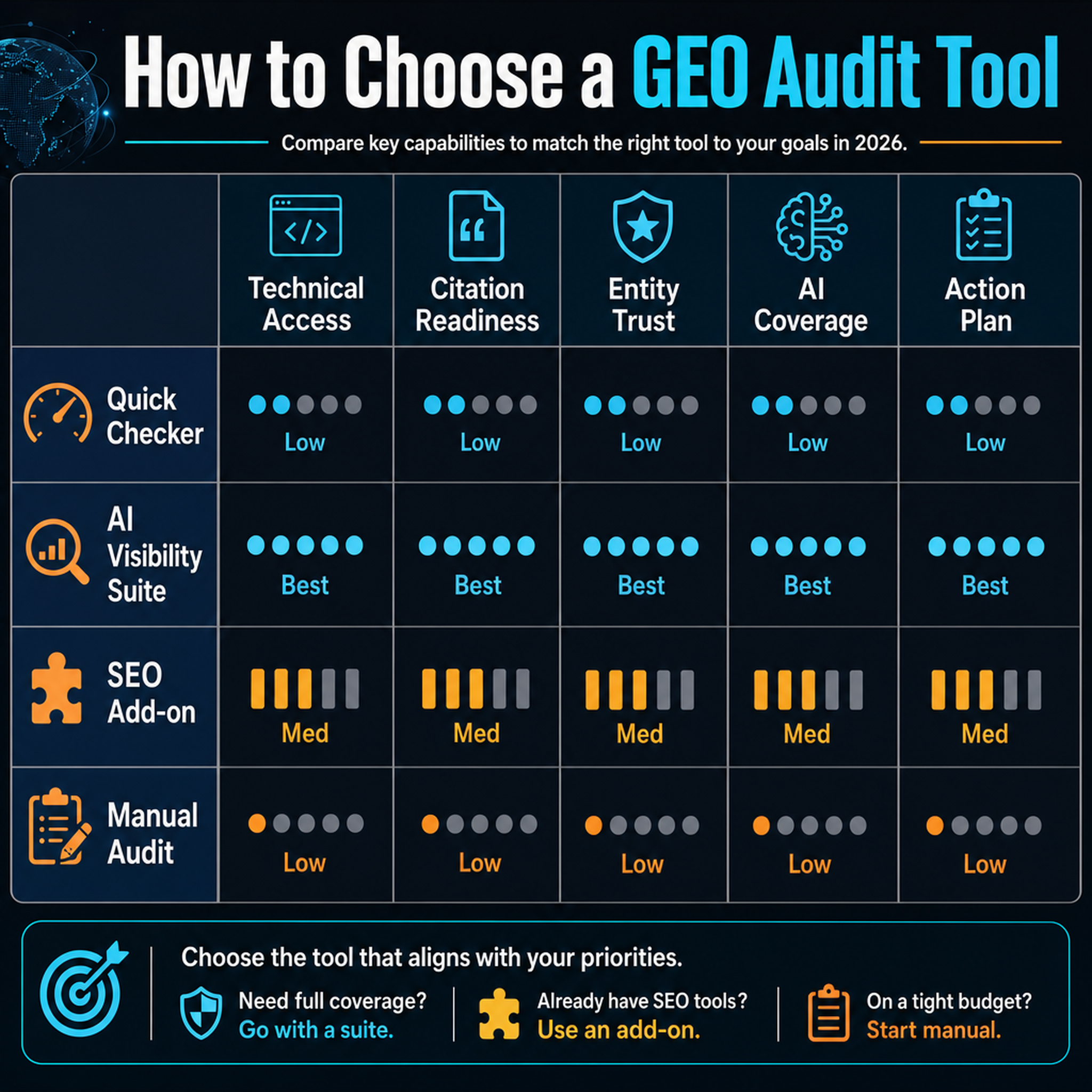
Evaluation area | What good looks like | Why it matters |
|---|---|---|
Technical access | Crawlers can reach the content, and the site renders in a way AI systems can parse | If AI cannot access the page, nothing else matters |
Citation readiness | Pages contain direct answers, clear facts, and stable wording | AI systems need quote-worthy information |
Entity trust | Brand, author, and organization signals are consistent across the site | AI systems rely on identity clarity and authority |
AI platform coverage | The tool tests the surfaces your audience actually uses | Different platforms have different source preferences |
Action plan | The report shows prioritized fixes, not just a score | Teams need a roadmap, not a vanity metric |
If a tool gives you a single score without explaining why, it is not enough for GEO work.
Why Auspia's GEO Score Checker stands out
Auspia's GEO Score Checker is useful because it combines mechanical auditing with AI-aware analysis.
It checks 54 signals across 14 dimensions and breaks the result into areas that matter for AI visibility, not just traditional search performance. The product description on the page makes the positioning clear: you paste a URL and get a comprehensive GEO score without signup.
The tool's strengths are especially relevant for 2026 because AI visibility is now split across multiple surfaces. A site may look fine in classic SEO tools but still fail in AI answer systems because:
- the page is not quote-friendly;
- the author and brand entity are weak;
- the site blocks important crawlers;
- the content lacks evidence structure;
- the page does not map well to question-answer use cases;
- the site is not ready for platform-specific AI retrieval patterns.
The GEO Score Checker is built to surface those gaps and turn them into a practical remediation plan.
Why product screenshot evidence matters
For articles about audit tools, a real product screenshot does more than decorate the page. It proves the tool exists, shows the interface, and helps readers understand what they will actually see after scanning their own site.
In this article, the screenshot supports three things:
- It shows the free GEO checker as a real product, not just a concept.
- It makes the audit scope concrete: 54 signals, 14 dimensions, no signup required.
- It gives readers a visual clue about how the output is framed before they click through.
That is also why the screenshot should be used thoughtfully. Capture the actual product surface, not a mocked-up marketing card. If the tool has a score, modules, or a result summary, show that interface directly so the article can answer the obvious reader question: "What does the audit look like?"
How to choose the right GEO audit tool in 2026
The decision does not need to be complicated. Use this sequence.
Step 1: Check coverage
Ask whether the tool checks crawlability, structured data, entity clarity, content citability, and AI platform readiness.
Step 2: Check output quality
A good audit should show the problem, the severity, and the next fix. If it only gives a score, it is too shallow.
Step 3: Check evidence depth
The best tools are transparent about what they measure. Look for dimensions, signals, and plain-language explanations.
Step 4: Check workflow fit
The report should be something your team can hand to engineering, content, and SEO without translating it into a second document.
Step 5: Check whether it fits GEO and SEO together
A GEO tool should not replace your SEO stack. It should extend it. The best setup is usually a classic SEO toolset plus a GEO-specific audit layer.
Recommended audit workflow for growth teams
Here is a simple operating loop you can use after the scan.
Stage | Action | Owner |
|---|---|---|
Scan | Run the GEO audit on your homepage, category pages, and best-converting content pages | SEO or growth lead |
Triage | Group issues into access, structure, trust, and content problems | Content strategist + technical SEO |
Fix | Rewrite answer blocks, improve schema, add citations, and clean crawl rules | Content, SEO, engineering |
Validate | Re-scan the same pages after changes | Growth team |
Monitor | Track whether AI answers now cite or summarize the improved pages | SEO + AI visibility owner |
That workflow is more useful than a one-time score because it turns GEO from a report into a repeatable process.
Which teams need a GEO audit tool most
- SaaS teams that want AI answer visibility for product-led content and comparison pages.
- Ecommerce teams that need product facts, use-case content, and trust signals to appear in AI shopping answers.
- Publishers and media brands that want their content cited instead of summarized incorrectly.
- Local service businesses that need better entity clarity, location signals, and service descriptions.
- Agencies and consultants that need a repeatable GEO audit method for client work.
Auspia takeaway
If you are evaluating the best GEO audit tool for 2026, do not choose the one that sounds the most futuristic. Choose the one that helps you improve answer visibility in a way your team can actually act on.
Auspia's GEO Score Checker is a good example of that standard because it combines:
- broad signal coverage;
- AI-specific analysis;
- a free first scan;
- and a result that leads naturally to a fix list.
That makes it useful both as a product and as a model for how GEO auditing should work in general.
If you want a simple starting point, run your own site through the checker and compare the output across your homepage, a key category page, and one high-value article. The differences will usually tell you where AI visibility is being lost.
FAQ
What is a GEO audit tool?
A GEO audit tool checks whether a website is ready to be found, understood, cited, and recommended by AI answer systems.
How is a GEO audit different from an SEO audit?
SEO audits focus on crawlability, indexation, rankings, and click performance. GEO audits add AI-specific concerns such as citation readiness, entity clarity, content extractability, and platform readiness for AI answer systems.
Is Auspia's GEO Score Checker free?
The product page says you can paste a URL and get a GEO score with no signup required.
What should I audit first?
Start with your homepage, your most important money pages, and one page you want AI systems to cite most often.
Can one tool cover both SEO and GEO?
Some overlap exists, but GEO often needs a dedicated audit layer because AI systems evaluate content and trust signals differently from classic search engines.