

Quick Answer
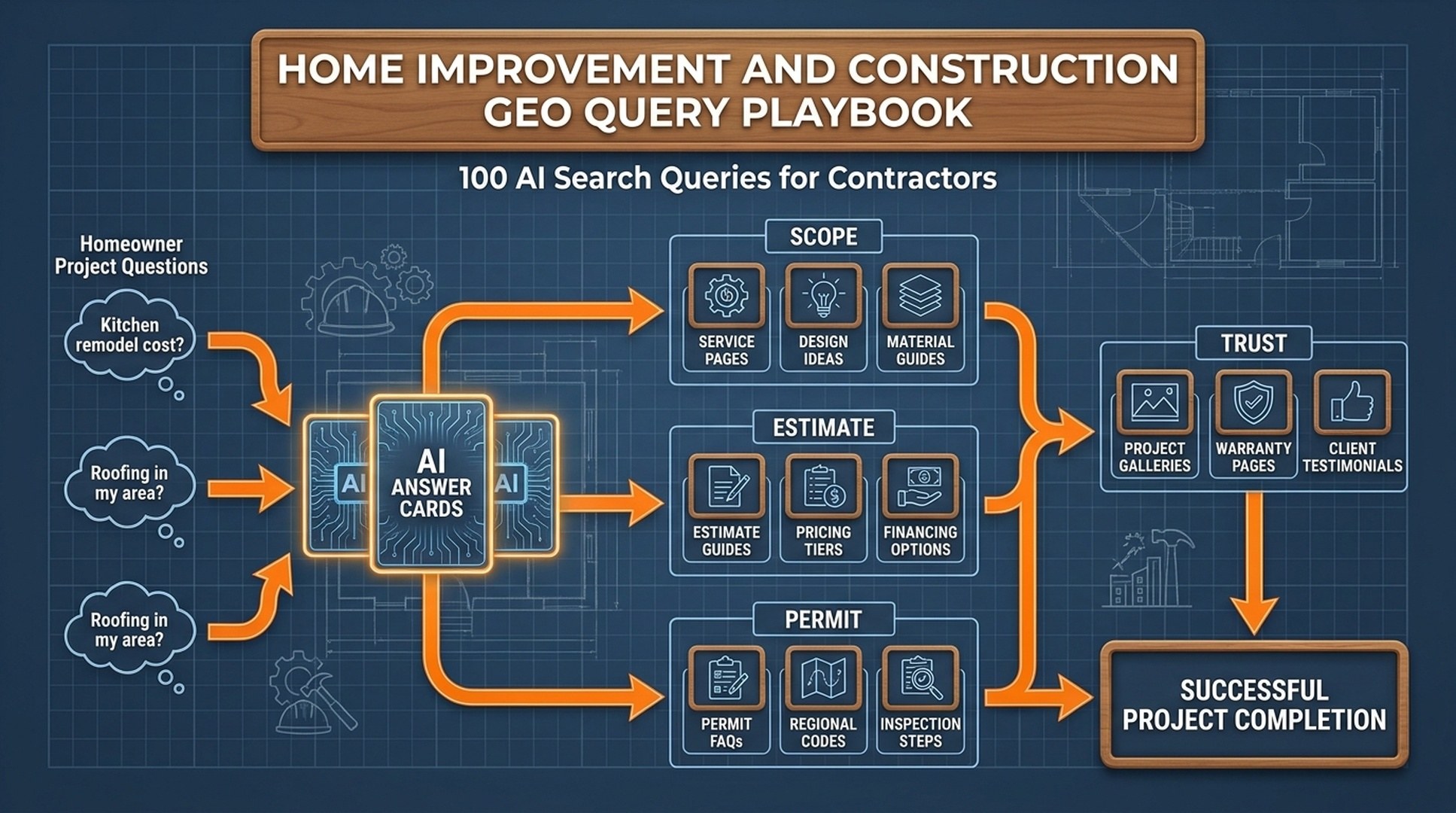
Home improvement and construction GEO is the work of making contractor pages, service pages, project guides, estimate pages, permit FAQs, before-and-after galleries, warranty pages, and local service-area pages easier for AI answer systems to understand, compare, and cite when homeowners ask project decision questions.
Homeowners rarely ask only for roofing contractor, kitchen remodel, or bathroom renovation near me. They ask questions that combine project scope, budget, property condition, timeline, permits, contractor trust, materials, disruption, warranty, and risk:
How do I choose a contractor for a kitchen remodel?What questions should I ask before replacing a roof?How much should I budget for a bathroom renovation?Do I need a permit for a basement remodel?How do I know if a contractor estimate is fair?
For home improvement and construction brands, the strongest GEO assets are service pages, project cost guides, estimate explainers, permit pages, material comparison pages, local service-area pages, project timeline pages, warranty pages, financing pages, contractor trust pages, and photo-rich case studies.
This playbook gives remodelers, roofers, HVAC companies, plumbers, electricians, landscapers, builders, specialty contractors, restoration companies, and home service marketplaces 100 AI Search queries to track, a project-risk framework, a query-to-page map, and a 30-day execution plan.
Important note: this article is about SEO/GEO content strategy, not legal, building-code, engineering, safety, tax, insurance, or contractor advice. Contractors should involve licensed professionals, code specialists, estimators, insurance reviewers, or local operations leaders before publishing claims about permits, structural work, safety, financing, or warranties.
The Home Project Risk Ladder
Home improvement GEO is different from many industries because a homeowner is not buying a simple product. They are inviting a provider into their property, paying for uncertain field conditions, living through disruption, and depending on quality workmanship.
That creates a home project risk ladder:
Layer | What The Homeowner Needs | Example Query | Page That Should Support The Answer |
|---|---|---|---|
Problem Diagnosis | What is wrong or what should I improve? |
| Diagnosis guide |
Scope Fit | What project type fits my home and goal? |
| Service / scope page |
Cost Range | What might it cost and why? |
| Cost guide |
Permit / Code | What rules or approvals matter? |
| Permit FAQ |
Contractor Trust | Who can I safely hire? |
| Contractor trust page |
Project Process | What will happen during the work? |
| Process page |
Warranty / Aftercare | What happens after completion? |
| Warranty / aftercare page |
A useful first step is to test which prompts already surface your services, service-area pages, galleries, reviews, and project guides with an AI Search Visibility Checker, then build a prompt library around missing projects, weak trust signals, unclear estimates, or inaccurate permit answers.
Why Home Improvement GEO Starts With Project Risk, Not Service Keywords
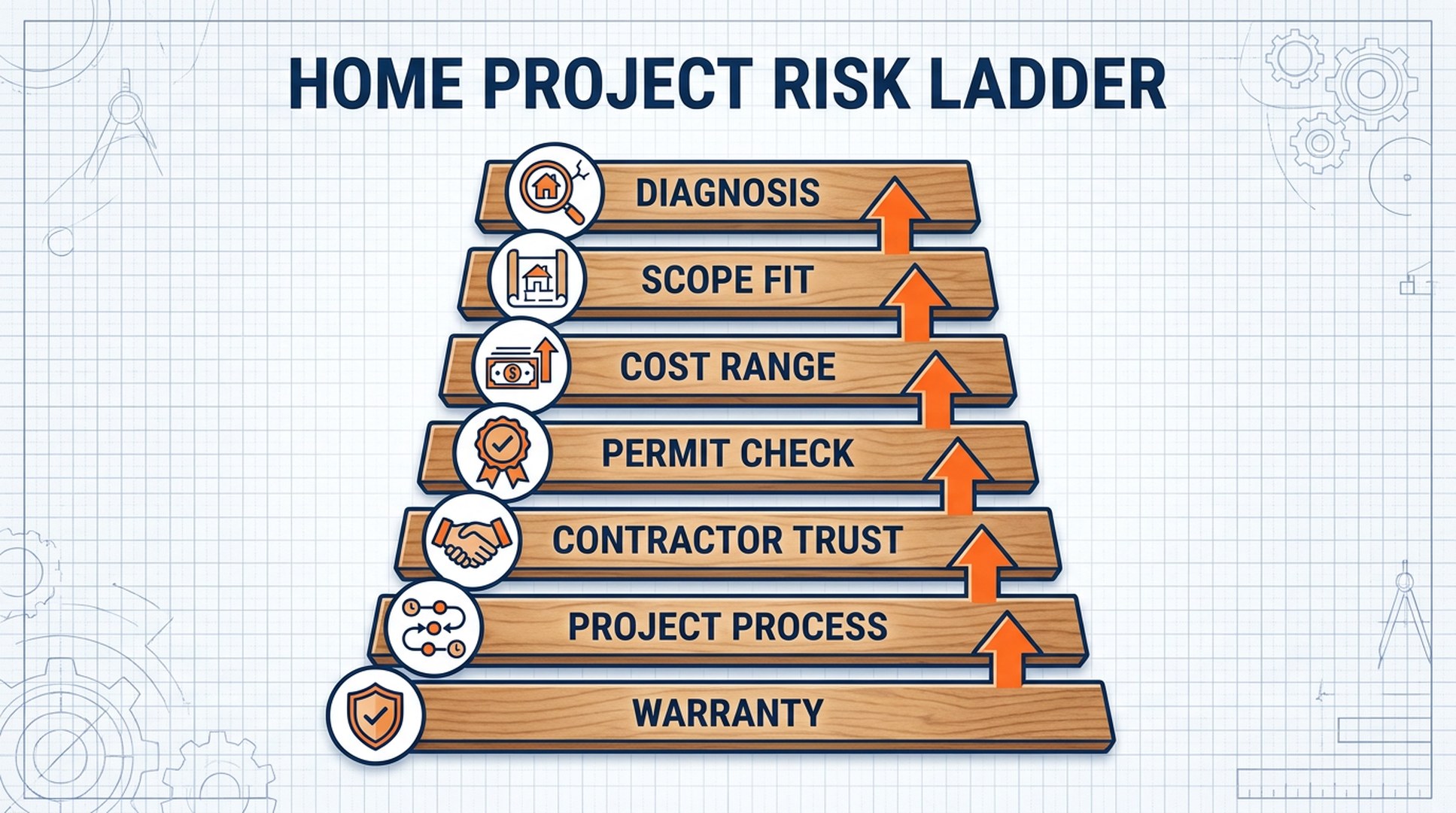
Home improvement AI Search prompts move through diagnosis, scope fit, cost range, permit check, contractor trust, project process, and warranty.
Traditional contractor SEO often starts with service keywords such as roof repair, kitchen remodel, HVAC installation, plumber near me, or deck builder. GEO starts with the homeowner's anxiety.
The prompt usually contains risk:
How do I compare two contractor estimates?What should be included in a roof replacement quote?What can go wrong during a bathroom remodel?Should I repair or replace my HVAC system?What should I check before hiring a basement contractor?
These questions require pages that explain scope, inspection factors, cost drivers, project steps, materials, permits, warranties, and proof. A thin service page with a phone number is not enough.
Home improvement content also needs careful wording. Avoid guaranteed prices, universal timelines, building-code certainty, insurance promises, or claims that every home needs the same solution. Strong contractor GEO states the property conditions, local assumptions, inspection requirements, scope limits, and update date.
The 10 Query Types Home Improvement Teams Should Map
Classify prompts before creating pages. This prevents teams from publishing repetitive service pages without enough decision support.
Query Type | What The User Wants | Best Content Asset |
|---|---|---|
Diagnosis / Problem | Understand symptoms, damage, repair urgency, or project need | Diagnosis guide, FAQ |
Scope / Service Fit | Decide whether repair, replace, remodel, build, or maintain is the right path | Service page, scope guide |
Cost / Estimate | Understand price ranges, cost drivers, estimate structure, allowances, and change orders | Cost guide, estimate FAQ |
Material / Option Comparison | Compare materials, fixtures, systems, finishes, layouts, or methods | Comparison page |
Contractor Selection | Choose a contractor, builder, remodeler, installer, or service provider | Selection checklist, trust page |
Permit / Code / Insurance | Understand permits, inspections, code, HOA, insurance, and safety requirements | Permit FAQ, policy guide |
Process / Timeline | Understand consultation, inspection, design, ordering, installation, cleanup, and handoff | Process page |
Risk / Red Flags | Avoid bad contractors, hidden damage, poor workmanship, unsafe work, or contract issues | Risk checklist |
Warranty / Maintenance | Understand warranty, maintenance, service intervals, aftercare, and support | Warranty page, maintenance guide |
Local / Project Scenario | Match project advice to climate, home age, neighborhood, property type, or homeowner goal | Local guide, scenario page |
Every cluster should have one owner page. If warranties, permits, and cost drivers are scattered across blogs, PDFs, and sales scripts, AI systems may summarize incomplete or outdated information.
How To Prioritize Home Improvement GEO Queries
Use a project-risk scoring model:
Priority = Project Intent + Local Service Fit + Risk Sensitivity + Evidence Strength + AI Answer Probability - Claim Risk - Competition Difficulty
Factor | How To Evaluate It |
|---|---|
Project Intent | Is the user close to requesting an estimate, inspection, design consultation, repair, or emergency service? |
Local Service Fit | Can the company actually serve the project type, property type, location, and urgency? |
Risk Sensitivity | Does the query involve high cost, safety, permits, structural work, water damage, electrical work, or warranty concerns? |
Evidence Strength | Do you have project photos, reviews, licenses, process details, estimate examples, warranties, or local experience? |
AI Answer Probability | Is the query likely to trigger a checklist, comparison, cost explanation, or contractor recommendation? |
Claim Risk | Could the answer overpromise price, timeline, permit rules, insurance coverage, or code compliance? |
Competition Difficulty | Are directories, marketplaces, review sites, national chains, or local competitors dominating? |
Start with queries where the company has real proof and the homeowner has a decision. Avoid broad best contractor pages unless the page explains criteria, service area, licensing context, scope, and verification steps.
100 Home Improvement and Construction GEO Query Examples
Use these prompts as a starting library. Adapt them by service category, climate, local code, project size, property type, and contractor licensing requirements.
Diagnosis / Problem Queries
- How do I know if my roof needs replacement?
- How do I know if a water stain is a roof leak or plumbing leak?
- What are signs my HVAC system needs replacement?
- How do I know if my electrical panel is outdated?
- What causes basement moisture after heavy rain?
- How do I know if windows need replacement?
- What are signs of poor attic insulation?
- How do I know if my deck is unsafe?
- What are signs a bathroom needs mold remediation?
- How do I know if foundation cracks are serious?
Scope / Service Fit Queries
- Should I repair or replace my roof?
- Should I refinish or replace kitchen cabinets?
- Bathroom remodel vs bathroom refresh: what is the difference?
- Should I repair or replace my HVAC system?
- Should I replace windows before siding?
- Should I finish my basement or build an addition?
- Should I replace a deck or repair it?
- Should I choose design-build or hire separate contractors?
- What projects should homeowners do before selling a house?
- What home upgrades are worth considering for energy efficiency?
Cost / Estimate Queries
- How much should I budget for a bathroom renovation?
- What affects kitchen remodel cost?
- What should be included in a roof replacement estimate?
- How do contractors price a deck project?
- What affects HVAC replacement cost?
- How do change orders work in construction?
- How do allowances work in remodeling estimates?
- What should homeowners compare between contractor quotes?
- Why do remodeling estimates vary so much?
- What costs do homeowners often miss during renovations?
Material / Option Comparison Queries
- Asphalt shingles vs metal roofing: what should homeowners compare?
- Quartz vs granite countertops for a kitchen remodel
- Vinyl windows vs fiberglass windows
- Tankless water heater vs traditional water heater
- Heat pump vs gas furnace
- Composite deck vs wood deck
- Tile shower vs acrylic shower system
- Hardwood vs luxury vinyl plank flooring
- Spray foam vs blown-in insulation
- Paver patio vs concrete patio
Contractor Selection Queries
- How do I choose a trustworthy contractor?
- What questions should I ask before hiring a remodeler?
- How do I compare two contractor estimates?
- What should I look for in a roofing contractor?
- What should I ask before hiring an HVAC company?
- How do I choose a design-build firm?
- What reviews matter when choosing a contractor?
- How do I verify a contractor's license and insurance?
- What should I ask before hiring a basement contractor?
- How do I choose a contractor for an older home?
Permit / Code / Insurance Queries
- Do I need a permit for a basement remodel?
- Do I need a permit to replace windows?
- What projects usually require electrical permits?
- What should homeowners know about building inspections?
- How do HOA rules affect exterior renovations?
- What should I ask about insurance before hiring a contractor?
- What should homeowners know about code upgrades during renovation?
- Does insurance cover roof replacement after storm damage?
- What should I document before starting an insurance restoration project?
- Who is responsible for pulling permits for a remodel?
Process / Timeline Queries
- How long does a kitchen remodel usually take?
- What happens during a roofing inspection?
- What happens after requesting a remodeling estimate?
- What should homeowners expect during HVAC installation?
- How does the design-build process work?
- What happens during a bathroom remodel?
- How long does window replacement take?
- What should happen before demolition starts?
- How do contractors protect the home during construction?
- What should be included in a project closeout walkthrough?
Risk / Red Flags Queries
- What are red flags in a contractor estimate?
- What should homeowners check before signing a remodeling contract?
- How do I avoid contractor scams?
- What can go wrong during a bathroom remodel?
- What should I check before paying a deposit to a contractor?
- What are signs of poor workmanship?
- What hidden problems can appear during a kitchen remodel?
- What should I ask about subcontractors?
- How do I avoid scope creep in a renovation?
- What should homeowners know before choosing the lowest bid?
Warranty / Maintenance Queries
- What warranty should a roofing contractor provide?
- What does a workmanship warranty usually cover?
- What maintenance should homeowners do after a remodel?
- How often should HVAC systems be serviced?
- What should homeowners know about manufacturer warranties?
- What is not covered by a typical contractor warranty?
- How do roof material warranties differ from workmanship warranties?
- What maintenance does a composite deck need?
- What should homeowners ask about post-project support?
- How should homeowners track renovation documents and warranties?
Local / Project Scenario Queries
- Best roofing material for homes in hot climates
- Best window type for cold climates
- Best basement waterproofing option for older homes
- Best kitchen remodel scope before selling a house
- Best deck material for rainy climates
- Best HVAC option for homes without ductwork
- Best bathroom remodel plan for a small space
- Best contractor type for storm damage repair
- Best home upgrades for aging in place
- Best renovation approach for a historic home
How To Turn Home Improvement Queries Into Citation-Ready Pages
A home improvement query library should become a project confidence architecture. The strongest pages are service pages, diagnosis guides, cost guides, material comparisons, estimate explainers, permit FAQs, process pages, trust pages, project galleries, warranty pages, and maintenance guides.
Query Cluster | Owner Page | Page Type | Required Proof |
|---|---|---|---|
Diagnosis prompts | Problem guide | Diagnosis FAQ | Symptoms, urgency, inspection caveats, next step |
Scope prompts | Service page | Scope guide | Repair vs replace criteria, fit, limits, photos |
Cost prompts | Cost / estimate page | Pricing guide | Cost drivers, allowances, change orders, assumptions |
Material prompts | Material comparison page | Comparison guide | Pros, cons, climate fit, maintenance, lifespan caveats |
Contractor prompts | Contractor trust page | Selection guide | Licenses, insurance, reviews, process, verification steps |
Permit prompts | Permit FAQ | Policy / code page | Local caveats, who pulls permits, inspection steps |
Process prompts | Project process page | Timeline guide | Steps, timeline ranges, homeowner responsibilities |
Risk prompts | Red flags checklist | Risk page | Contract terms, deposits, red flags, documentation |
Warranty prompts | Warranty / aftercare page | Ownership page | Coverage, exclusions, maintenance, support path |
Local prompts | Local scenario guide | Service-area page | Climate, home type, local examples, update date |
A citation-ready contractor page should answer the homeowner's decision question first, then support the answer with scope, inspection caveats, cost drivers, local context, proof, warranty information, and next steps.
For technical readiness, contractors should make sure service pages, service-area pages, galleries, reviews, estimate pages, and warranty pages are crawlable, indexable, and internally linked. A quick Website SEO Score Checker can help catch basic crawl, metadata, schema, and page-quality issues before teams rewrite revenue-critical pages.
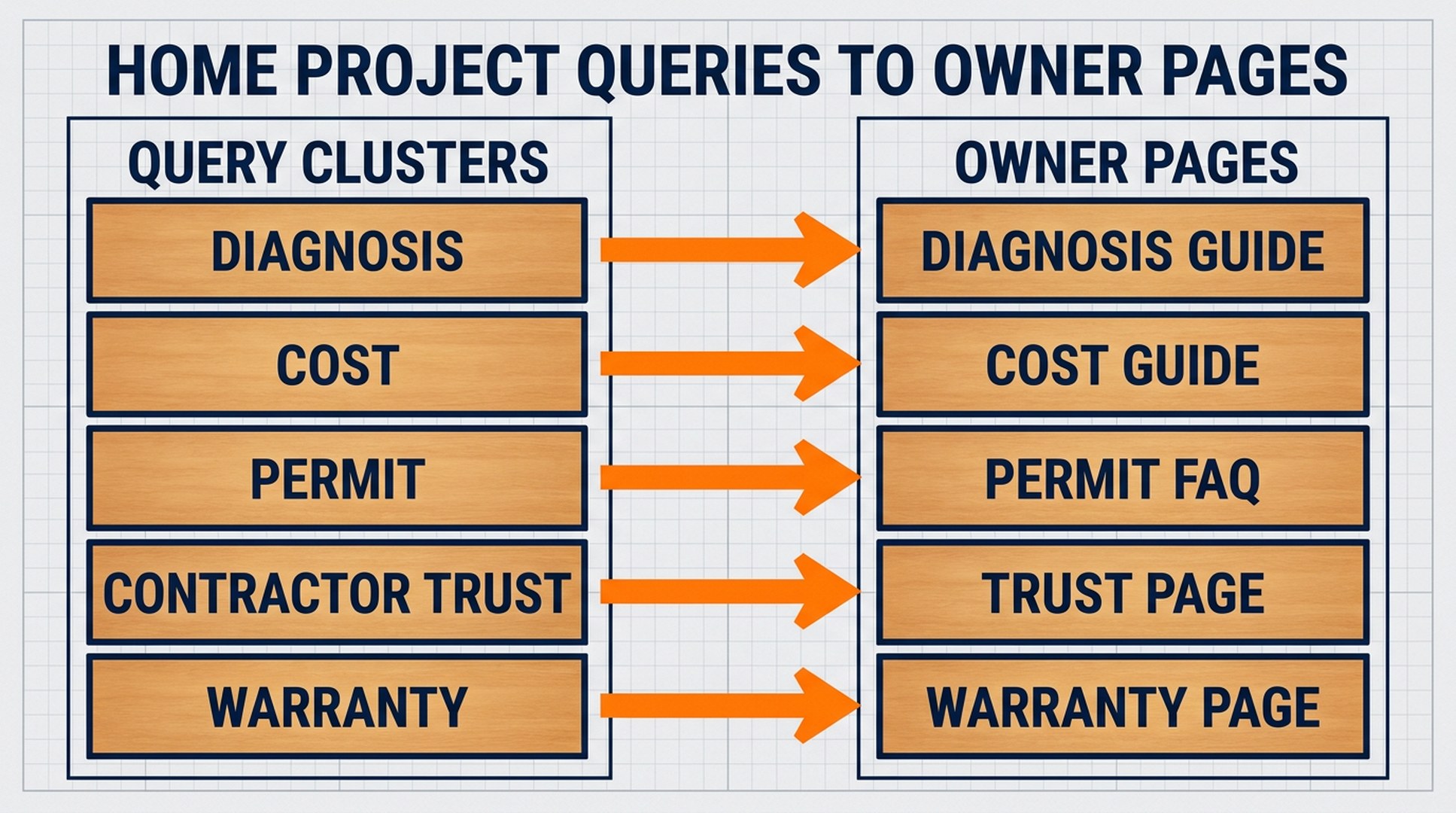
Diagnosis, cost, permit, contractor-trust, and warranty queries should map to durable owner pages that reduce homeowner risk.
The First 20 Queries To Prioritize
If a contractor or home improvement brand is starting from scratch, these 20 prompts usually create a practical first backlog.
Priority | Query | Why It Matters | Likely Owner Page |
|---|---|---|---|
1 | How do I know if my roof needs replacement? | High problem intent | Roof diagnosis guide |
2 | Should I repair or replace my HVAC system? | High project decision value | HVAC repair vs replace page |
3 | How much should I budget for a bathroom renovation? | Estimate and consultation intent | Bathroom cost guide |
4 | What affects kitchen remodel cost? | High-value project query | Kitchen remodel cost page |
5 | What should be included in a roof replacement estimate? | Quote comparison intent | Roofing estimate guide |
6 | Asphalt shingles vs metal roofing | Material comparison | Roofing material comparison |
7 | Heat pump vs gas furnace | High purchase tradeoff | HVAC comparison page |
8 | How do I choose a trustworthy contractor? | Provider selection | Contractor trust page |
9 | How do I compare two contractor estimates? | High conversion support | Estimate comparison guide |
10 | How do I verify a contractor's license and insurance? | Trust and risk query | License/insurance FAQ |
11 | Do I need a permit for a basement remodel? | Permit-sensitive query | Basement permit FAQ |
12 | Who is responsible for pulling permits for a remodel? | Risk and process clarity | Permit responsibility page |
13 | How long does a kitchen remodel usually take? | Timeline planning | Kitchen process page |
14 | What happens after requesting a remodeling estimate? | Conversion readiness | Estimate process page |
15 | What are red flags in a contractor estimate? | Risk-sensitive buyer query | Estimate red flags checklist |
16 | What should homeowners check before signing a remodeling contract? | Contract risk | Contract checklist |
17 | What warranty should a roofing contractor provide? | Trust and aftercare | Roofing warranty page |
18 | What does a workmanship warranty usually cover? | Warranty clarity | Workmanship warranty FAQ |
19 | Best bathroom remodel plan for a small space | Scenario and project fit | Small bathroom guide |
20 | Best home upgrades for aging in place | Scenario lead value | Aging-in-place guide |
These prompts are useful because they can be answered by pages that already influence estimate requests, inspections, consultations, financing conversations, and contractor selection.
30-Day Execution Plan
Timeframe | Action | Output |
|---|---|---|
Days 1-3 | Build the home improvement AI Search query library and classify by service, project stage, property type, and page owner | 100-query prompt library |
Days 4-7 | Score prompts by project intent, local service fit, risk sensitivity, evidence, AI answer probability, claim risk, and competition | First 20 prompt backlog |
Days 8-14 | Map prompts to service pages, cost guides, permit FAQs, process pages, trust pages, galleries, and warranty pages | Query-to-page map |
Days 15-21 | Rewrite priority pages with direct answers, local context, inspection caveats, cost drivers, proof, warranties, and next steps | Updated citation-ready pages |
Days 22-30 | Test prompts across AI answer surfaces and record brand mentions, cited URLs, competitor mentions, and inaccurate project facts | Home improvement AI visibility tracker |
A small contractor can start with five assets: one diagnosis guide, one service page, one cost guide, one contractor trust page, and one warranty FAQ. A larger home services brand should add service-area pages, material comparisons, permit pages, project galleries, financing pages, and maintenance guides.
Common Mistakes
Home improvement GEO fails when contractors publish service pages that do not reduce homeowner risk.
Avoid these mistakes:
- Publishing thin service pages. Explain symptoms, scope, materials, process, timeline, and proof.
- Hiding estimate logic. If exact prices vary, explain cost drivers, allowances, inspection needs, and change orders.
- Making permit claims too broadly. Local code varies. State location context and recommend verification.
- Overpromising timelines or prices. Existing conditions, materials, weather, and inspections can change the project.
- Treating galleries as decoration. Add project scope, location context, materials, constraints, and lessons learned.
- Ignoring warranties and aftercare. Homeowners want to know what happens after the crew leaves.
- Measuring only rankings. Track AI mentions, cited pages, competitor inclusion, and inaccurate summaries of cost, permits, scope, or warranties.
FAQ
What is home improvement GEO?
Home improvement GEO is the process of making contractor, service, project, estimate, permit, gallery, warranty, and local service-area pages easier for AI answer systems to understand, summarize, and cite accurately.
Is home improvement GEO the same as contractor SEO?
No. Contractor SEO focuses on rankings, local pages, technical visibility, reviews, and estimate traffic. Home improvement GEO builds on that foundation but focuses on how AI systems answer project-fit, cost, contractor-selection, permit, process, risk, and warranty questions.
Should contractors create one page for every AI Search query?
No. The 100-query list should become a page map. Many questions should be answered by stronger service pages, cost guides, permit FAQs, process pages, trust pages, galleries, risk checklists, and warranty pages.
Which home improvement queries should teams prioritize first?
Start with questions about problem diagnosis, repair vs replace, cost, estimate comparison, materials, contractor trust, permits, project timelines, red flags, warranties, and high-value local scenarios. These queries influence estimate requests and contractor selection.
How can contractors avoid risky GEO content?
Use clear assumptions, avoid guaranteed prices or timelines, state local permit caveats, explain inspection requirements, avoid legal or engineering advice, and involve licensed or qualified experts when publishing safety, structural, electrical, code, or insurance content.
How should home improvement teams measure GEO performance?
Track a stable prompt set across AI answer surfaces. Record whether the brand appears, which URLs are cited, which competitors appear, whether project facts are accurate, and whether AI answers omit important cost, permit, warranty, or scope details.
Auspia Takeaway
Home improvement and construction GEO is project confidence support. AI systems need diagnosis clarity, scope logic, cost drivers, permit caveats, contractor trust, process details, warranty terms, and local context before they can recommend or cite a contractor responsibly.
Start with prompts that affect inspections, estimates, remodel consultations, emergency calls, and contractor selection. Map the first 20 queries to pages that already shape homeowner conversations. Then rewrite those pages so the answers are direct, practical, local, and safe to summarize.
Author: Miles Donovan, Local AI Search Analyst Across 500+ Service Queries at Auspia. Miles writes about local visibility, service-area pages, location intent, and AI recommendations for location-driven businesses.