GEO Concepts Decoded: Which Actually Move the Needle — and Which Are Just Hype
Slug: geo-concepts-decoded Locale: en Category: GEO Tags: Playbook, Basics, Experience Excerpt: Everyone in GEO is talking about RAG, vector databases, and knowledge graphs — but most of these terms have zero impact on whether AI recommends your brand. Here are the 30 concepts that matter, what they actually mean for optimization, and the ones you can safely ignore. SEO Title: GEO Concepts Decoded: What Actually Works vs. What's Just Hype Meta Description: Not every GEO concept deserves your time. We break down 30 terms into three tiers — must-know, useful context, and pure buzzword — so you can focus on what actually drives AI recommendations.
Executive Summary
If you work in SEO or digital marketing, you've probably sat through a meeting where someone dropped "RAG," "vector database," or "knowledge graph" into a GEO strategy discussion — and nobody asked what any of it actually means for results.
Here's the truth: at least half the concepts circulating in the GEO industry are packaging, not practice. The concepts that determine whether AI recommends your brand have almost nothing to do with machine learning architecture.
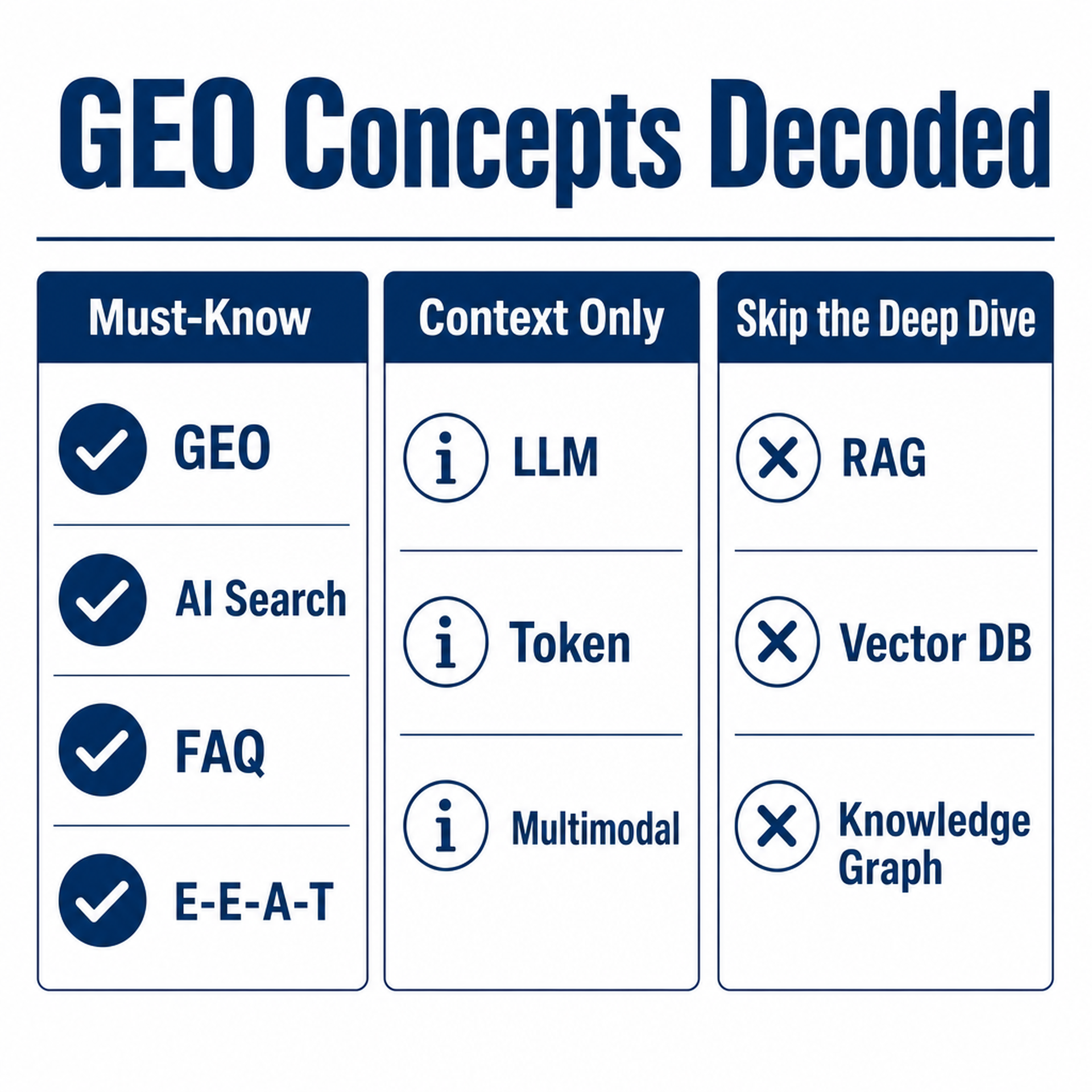
This article breaks down 30 GEO concepts into five tiers: what you must understand, what's useful context, what's pure buzzword, what drives your content strategy, and what builds the trust signals AI actually uses. By the end, you'll know exactly where to spend your time — and where to stop pretending it matters.
Two Entry-Level Mistakes That Derail Everyone Before They Start
Before we get into the concepts, let's kill two misconceptions that waste more time than anything else in this space.
Mistake 1: GEO Has Nothing to Do with Geography
GEO stands for Generative Engine Optimization. It's the practice of optimizing your brand's information so that AI-powered search platforms — ChatGPT, Perplexity, Gemini, Copilot — cite and recommend your brand when answering user questions.
It has zero relationship to local SEO, geo-targeting, or location-based ranking. If you're approaching GEO with a local SEO playbook, you're optimizing for the wrong engine entirely.
Mistake 2: GEO Is Not SEO with a Rebrand
The overlap between traditional SEO and GEO optimization is roughly 20%. SEO optimizes for ranking algorithms that return lists of links. GEO optimizes for generative models that synthesize answers from their training data and retrieved sources.
One competes for position on a results page. The other competes for inclusion inside a generated answer. The strategies, metrics, and execution methods are fundamentally different. Treating GEO as "SEO 2.0" is the fastest way to build the wrong strategy.
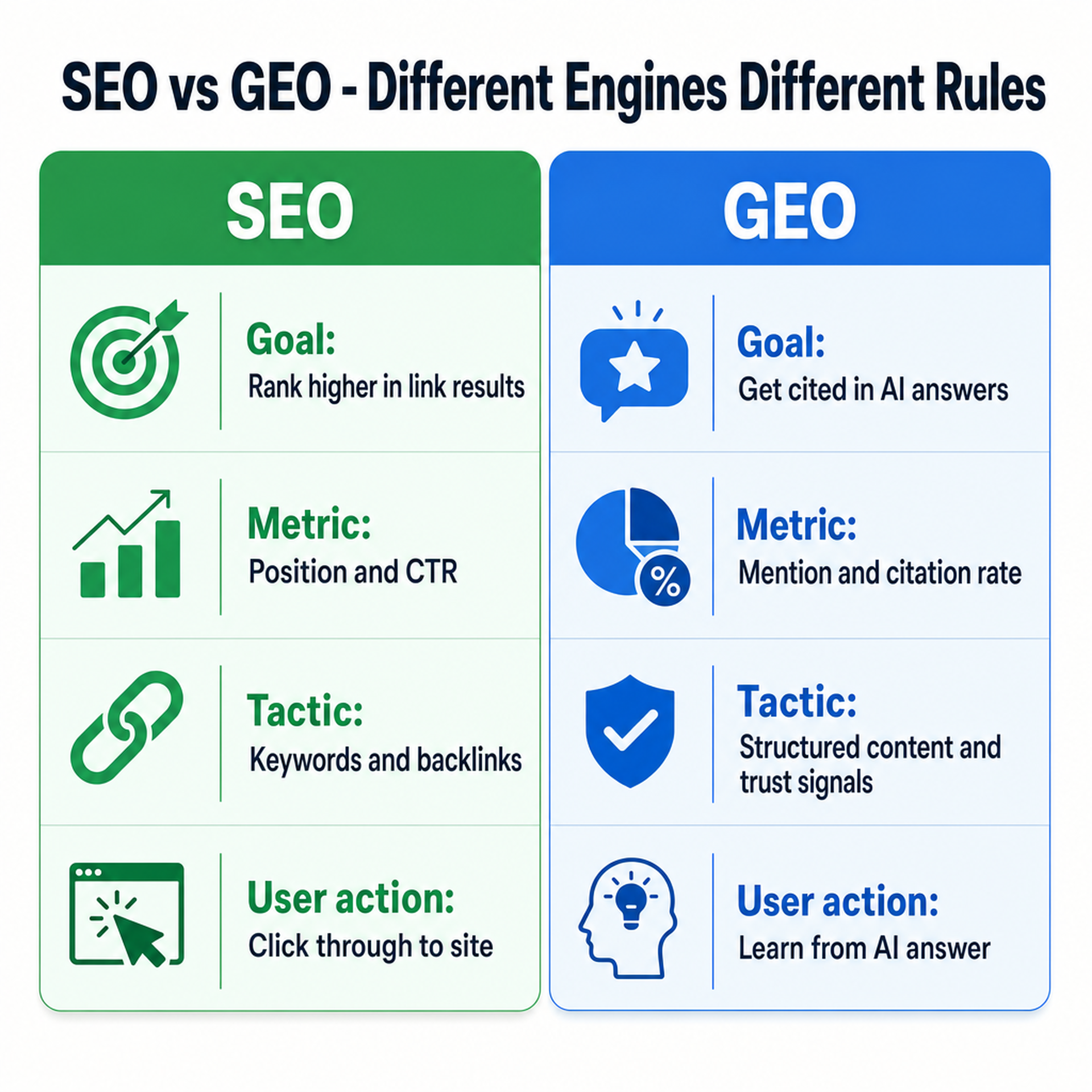
Figure: SEO and GEO serve different engines, different user behaviors, and different success metrics.
Tier 1: Five Foundation Concepts You Actually Need
These five are the bedrock. You don't need to study them deeply, but you must understand them correctly — because getting any of these wrong means building on a cracked foundation.
1. GEO (Generative Engine Optimization)
What it is: The practice of structuring your brand's information, content, and cross-platform presence so that AI models cite, reference, and recommend your brand in their answers.
Why it matters: Every GEO action you take should aim at one outcome — increasing the probability that AI recommends you. If your tactic doesn't connect to that goal, it's not GEO. It's busywork.
Deep dive worth it? Yes. This is the core. Understand it thoroughly.
2. LLM (Large Language Model)
What it is: The technology behind ChatGPT, Perplexity, Gemini, and similar AI assistants. These models learn from massive datasets to understand questions, retrieve relevant information, and generate answers.
Why it matters: You don't need to understand model architecture. You do need to internalize one fact: AI answers come from the data the model has seen. If your brand information isn't in that data, you don't exist to the model.
Deep dive worth it? No. Know what it is. Skip the technical deep end.
3. AIGC (AI-Generated Content)
What it is: Any content produced by AI — answers, summaries, articles, responses. The direct answer a user sees in an AI search is AIGC.
Why it matters: AI won't recommend your brand out of thin air. You need to put usable information into the ecosystem. No input, no output.
Deep dive worth it? No. Understand the cause-and-effect.
4. Token
What it is: The unit AI models use to process text. A sentence gets broken into dozens of tokens for analysis.
Why it matters: Concise, information-dense content costs less to process and is easier for models to extract. Rambling introductions and filler paragraphs get skipped. Front-load your key information.
Deep dive worth it? No. Write tight. Move on.
5. Multimodal Models
What it is: AI models that can process text, images, audio, and video simultaneously.
Why it matters: GEO isn't just text anymore. Clear product photos, data-rich charts, and authentic video content all increase your chances of being cited. Diversify your content formats.
Deep dive worth it? No. Know it's the direction. Start producing visual content.
Tier 2: Five Concepts That Explain Where AI Traffic Comes From
Understanding these five tells you how users actually encounter your brand in AI-powered search — and why the rules have changed.
6. AI Search
What it is: A search experience where a generative model produces a synthesized answer instead of returning a list of links for you to click through.
Why it matters: Users no longer need to visit your website to learn about your brand. They get the information directly from the AI's answer. The traffic metric is shifting from clicks to mentions.
Deep dive worth it? Yes. This is the entire reason GEO exists.
7. AIO (AI Overview / AI Answer)
What it is: The AI-generated summary that appears at the top of search results — whether in ChatGPT Search, Perplexity, Google SGE, or Bing Copilot.
Why it matters: Getting your brand into the AIO is one of GEO's primary objectives. Industry testing shows brands featured in AI overviews receive roughly 2.7x more user attention than the #1 traditional organic result.
Deep dive worth it? Yes. This is a core GEO KPI.
8. AEO (Answer Engine Optimization)
What it is: Optimizing content specifically to serve as source material for AI answers. FAQ pages are the most common AEO format.
Why it matters: AEO is a subset of GEO, not a replacement. Use answer-focused content optimization as part of a broader GEO strategy — but don't treat it as the whole game.
Deep dive worth it? Yes, for content optimization specifically.
9. SEO in the AI Era
What it is: The combined approach of maintaining traditional SEO for link-based search while building GEO capabilities for AI-powered search.
Why it matters: "SEO is dead" is a lazy narrative. Traditional search isn't going away — it's evolving. The winning strategy is dual-track: SEO protects your existing traffic, GEO captures the new AI-driven demand.
Deep dive worth it? No. Understand the layout logic. Execute both.
10. The AI Recommendation Path
What it is: The user journey from first brand exposure in an AI answer to conversion: user asks a question → AI recommends your brand → user verifies → visits your site or initiates contact.
Why it matters: Your brand information in AI systems must be accurate, differentiated, and backed by trust signals. Vague or contradictory information kills the conversion path before it starts.
Deep dive worth it? No. Understand the funnel. Optimize each step.
Tier 3: Five Overhyped Technical Concepts — Skip the Deep Dive
Important note: Every concept in this section can be understood at a surface level. Ninety-nine percent of GEO practitioners will never touch the underlying technology. Anyone building a sales pitch around your ignorance of these terms is selling you something.
11. RAG (Retrieval-Augmented Generation)
What it is: The technical architecture where an AI model first retrieves relevant information from external sources, then generates an answer based on that retrieved data.
The bottom line: AI answers come from real information sources, not hallucination. The easier your content is to retrieve and the higher its credibility, the more likely it gets used as source material.
Deep dive worth it? No. That's the entire insight. Move on.
I've seen practitioners who can explain RAG architecture in detail but can't tell you what happens when you search their industry's core keywords in ChatGPT or Perplexity. Theory without application is just conversation theater.
12. Vector Database
What it is: A database that stores and retrieves information based on semantic similarity rather than exact keyword matching.
The bottom line: AI understands meaning, not just keywords. You don't need to repeat the same phrase obsessively — semantically relevant content gets matched even with different wording.
Deep dive worth it? No. Write naturally. Cover the topic thoroughly.
13. Semantic Network
What it is: The web of conceptual relationships that AI models build from the data they're trained on.
The bottom line: Build content clusters around your core topic roots. Help the AI connect your brand to the key concepts in your industry.
Deep dive worth it? No. Understand the logic. Execute content clusters.
14. Entity Recognition
What it is: The AI's ability to identify specific company names, brand names, product names, and other named entities in text.
The bottom line: Your brand name and core product names must be consistent across all content. Don't alternate between abbreviations, nicknames, and full names. Standardize.
Deep dive worth it? No. Use your brand name consistently. That's it.
15. Brand Knowledge Graph
What it is: The complete network of information about your brand across the internet — how all your data points connect in the AI's understanding.
The bottom line: The more complete and consistent your brand information is across platforms, the clearer the AI's picture of your brand, and the more confidently it will recommend you.
Deep dive worth it? No. Understand the value. Audit your brand information for consistency.
Tier 4: Seven Content Concepts That Directly Drive Optimization
This is the core of GEO execution. Each of these seven maps directly to a content action you can take today.
16. Structured Content
What it is: Content with clear headings, subheadings, bullet points, and logical hierarchy.
Why it matters: AI models extract information most efficiently from well-structured content. A wall of text without breaks is hard to parse. Content with clear sections is easy to cite.
How to execute:
- Use hierarchical headings (H2, H3, H4) for core topics
- Present key information in bullet points or numbered lists
- Never bury critical information inside long, unstructured paragraphs
17. FAQ Structure
What it is: Question-and-answer content format.
Why it matters: AI models have been trained on massive amounts of Q&A data. They recognize FAQ format instinctively and cite it frequently.
How to execute:
- Create standalone FAQ pages for each core industry question
- Phrase questions the way real users ask them (conversational, not keyword-stuffed)
- Answer directly, accurately, and without hedging
18. Topic Root Coverage
What it is: Systematic content built around a core topic — covering definitions, buying guides, comparisons, use cases, and common mistakes.
Why it matters: AI matches on semantics, not exact keywords. When you cover a topic root comprehensively, users get matched to your content regardless of how they phrase their question.
How to execute:
- Identify 3-5 core topic roots in your industry
- Build a complete content suite around each one: definition pages, comparison guides, how-tos, and recommendation content
19. Content Authority
What it is: The demonstrated expertise and depth of your content in a specific domain.
Why it matters: AI models prioritize authoritative sources. Two articles explaining the same concept — one with data, case studies, and specific methods, the other with generic claims — the authoritative one gets cited. Period.
How to execute:
- Back every claim with specific data or real examples
- Replace vague adjectives ("very professional," "highly reliable") with concrete evidence
20. Knowledge Density
What it is: The ratio of valuable, actionable information to total word count.
Why it matters: AI doesn't reward word count. It rewards signal-to-noise ratio. An 800-word article packed with insights will out-cite a 3,000-word article padded with filler.
How to execute:
- Start with the answer. Explain after.
- Every paragraph must carry distinct information value
- Cut introductions that don't add information
21. E-E-A-T
What it is: Experience, Expertise, Authoritativeness, Trustworthiness — the framework AI uses to evaluate content and brand credibility.
Why it matters: This is the core credibility framework for both traditional search and AI search. Content that demonstrates all four dimensions gets significantly higher trust scores from AI models.
How to execute:
- Use first-hand experience and original insights, not regurgitated content
- Cite sources for all data claims
- Keep all claims factual and verifiable — no exaggeration
22. Information Consistency
What it is: Uniformity of your brand information (name, offerings, key data points, differentiators) across every platform and publication.
Why it matters: Contradictory information across platforms destroys AI trust. If your website says "8 years in business" and your Wikipedia page says "5 years," the AI can't verify the truth — so it skips you entirely.
How to execute:
- Create a single source of truth for your brand information
- Audit every platform where your brand appears and standardize discrepancies
- Treat consistency as an ongoing process, not a one-time fix
Tier 5: Five Trust Infrastructure Concepts That Determine Whether AI Dares to Recommend You
Getting retrieved is not the same as getting cited. These five concepts determine which side of that line your brand falls on.
23. Information Source
What it is: Where AI models find your brand information.
The critical distinction: Being indexed by an AI system is not the same as being cited by it. Many agencies treat mass-publishing low-quality press releases as a GEO strategy. AI models don't cite those sources. They're invisible.
The bottom line: One authoritative, in-depth piece of content on a credible platform outperforms 100 low-quality press releases across obscure sites.
24. Authoritative Sources
What it is: Information sources that AI models treat as high-credibility — mainstream media, leading industry publications, established platforms.
The bottom line: The same content published on an authoritative source carries significantly more weight than identical content on your own website. Where you publish matters as much as what you publish.
25. Media Endorsement
What it is: Third-party media coverage of your brand — news articles, industry features, expert interviews.
The bottom line: Media coverage is one of the strongest third-party trust signals available. Within the same industry, brands with legitimate media coverage are cited by AI models at substantially higher rates than brands with only self-published content.
26. Third-Party Citation
What it is: Any mention of your brand by sources other than yourself — other websites, industry accounts, platforms, and publications.
The bottom line: Self-promotion doesn't build AI trust. Third-party validation does. The more independent sources reference your brand, the stronger the signal that your brand has genuine industry recognition.
27. Brand Credibility Score
What it is: The AI model's composite assessment of how reliable your brand is as a recommendation. This is the ultimate GEO objective.
The bottom line: Everything in this article — structured content, consistent information, authoritative sources, third-party citations — feeds into this single metric. Optimize for it directly.
Tier 6: Three Measurement Metrics (and Why Most Tools Are Wrong)
28. Mention Rate
What it is: The frequency with which AI models mention your brand when answering industry-related questions.
The problem: Every GEO monitoring tool on the market has significant error rates — some exceeding 70%. Automated tools miss context, misattribute mentions, and fail to account for query variation.
The reliable approach: Manually test 10-20 core industry questions across major AI platforms (ChatGPT, Perplexity, Gemini, Copilot) and count mentions yourself. It takes an afternoon. It's more accurate than any tool.
29. Citation Rate
What it is: The proportion of AI answers that directly reference your content, data, or viewpoints — not just your brand name, but your actual information.
Why it matters: Citation rate is more valuable than mention rate. A mention gets your name in front of a user. A citation positions your specific information as the answer.
30. AI Visibility
What it is: A composite measure of mention rate, citation rate, recommendation frequency, and overall brand presence in AI-powered search results.
The bottom line: Don't chase precise numbers. Track directional trends. Is your AI visibility going up or down over time? That's the only metric that matters.
The Honest Truth Nobody in This Industry Wants to Say
Most GEO work is backwards. Practitioners spend their time studying RAG architecture, vector embeddings, and semantic networks — then can't tell you what ChatGPT actually returns when you search their own industry's core questions.
They pitch clients with concept after concept, then execute by publishing generic press releases and tweaking website keywords. That's not GEO. That's using new vocabulary to justify old habits.
After eight years in search optimization — from traditional SEO through the transition to GEO — here's what I can tell you with full confidence: GEO is not won by people who know the most technical terms. It's won by people who do the foundational work consistently.
Three things determine GEO outcomes. Nothing else comes close:
- Is your content structured, information-dense, and optimized for AI extraction?
- Are your cross-platform information sources credible, consistent, and backed by third-party validation?
- Are you publishing, iterating, and building AI trust in your brand over time — not in bursts, but steadily?
There is no technical barrier to any of these. They require discipline, not expertise. The projects that fail aren't failing because the practitioner doesn't understand vector databases. They're failing because nobody is willing to do the unglamorous, unscalable, unsexy work of building a coherent, credible, consistent information presence.
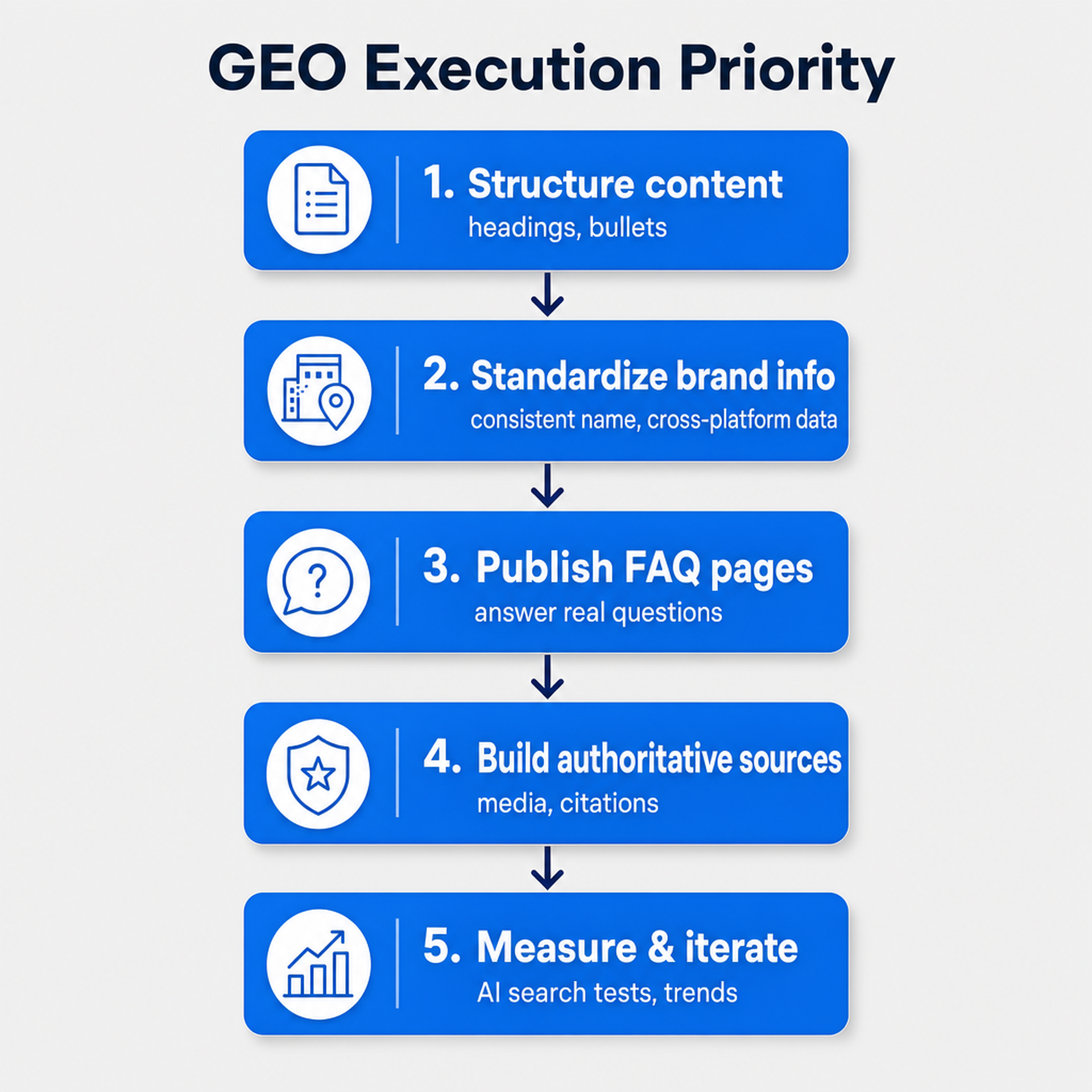
Figure: The five-step GEO execution priority — from content structure through continuous measurement.
If You're New to GEO: Start Here
Don't start by studying RAG. Don't memorize terminology. Do this instead:
- Spend one day testing every major AI platform — ChatGPT, Perplexity, Gemini, Copilot. Search 10 core questions from your industry.
- Document what each platform returns. Which brands get mentioned? Which get cited? What sources do the answers pull from?
- Compare that to your brand's presence. Where are you missing? What information is inconsistent? What trust signals are absent?
- Start with the easiest fixes first: structure your existing content, standardize your brand information across platforms, publish FAQ pages for your top industry questions.
One afternoon of this will teach you more than 100 hours of concept study.
GEO isn't about knowing the most terms. It's about executing the fundamentals well enough, consistently enough, and credibly enough that AI models have no reason not to recommend you.
That's the entire game. Everything else is noise.
FAQ
Q: Do I need to understand RAG or vector databases to do GEO? A: No. Understanding that AI retrieves real information before generating answers is sufficient. The technical implementation is irrelevant to 99% of GEO practitioners.
Q: Is GEO the same as local SEO or geo-targeting? A: No. GEO stands for Generative Engine Optimization. It has nothing to do with geographic location. It's about optimizing for AI-powered search platforms that generate answers, not location-based ranking.
Q: How do I measure GEO performance without expensive tools? A: Manually search 10-20 industry questions across ChatGPT, Perplexity, Gemini, and Copilot. Count how often your brand is mentioned and cited. Repeat monthly. Track the trend.
Q: Should I stop doing SEO and focus only on GEO? A: No. The best approach is dual-track. Traditional SEO protects your existing search traffic. GEO captures the growing AI-powered search demand. They serve different user behaviors and should be pursued in parallel.
Q: How long does it take to see GEO results? A: GEO is not a quick-win strategy. It requires consistent content publishing, information standardization, and trust-building across platforms. Most brands see measurable improvement in 3-6 months of sustained effort.
Publishing Package
Field | Value |
|---|---|
Title | GEO Concepts Decoded: What Actually Works vs. What's Just Hype |
Slug | geo-concepts-decoded |
Locale | en |
Category | GEO |
Tags | Playbook, Basics, Experience |
Excerpt | Everyone in GEO is talking about RAG, vector databases, and knowledge graphs — but most of these terms have zero impact on whether AI recommends your brand. Here are the 30 concepts that matter, what they actually mean for optimization, and the ones you can safely ignore. |
SEO Title | GEO Concepts Decoded: What Actually Works vs. What's Just Hype |
Meta Description | Not every GEO concept deserves your time. We break down 30 terms into three tiers — must-know, useful context, and pure buzzword — so you can focus on what actually drives AI recommendations. |
Translation Of | (new post — no translation-of) |
Same Slug As Source | yes |