Direct answer
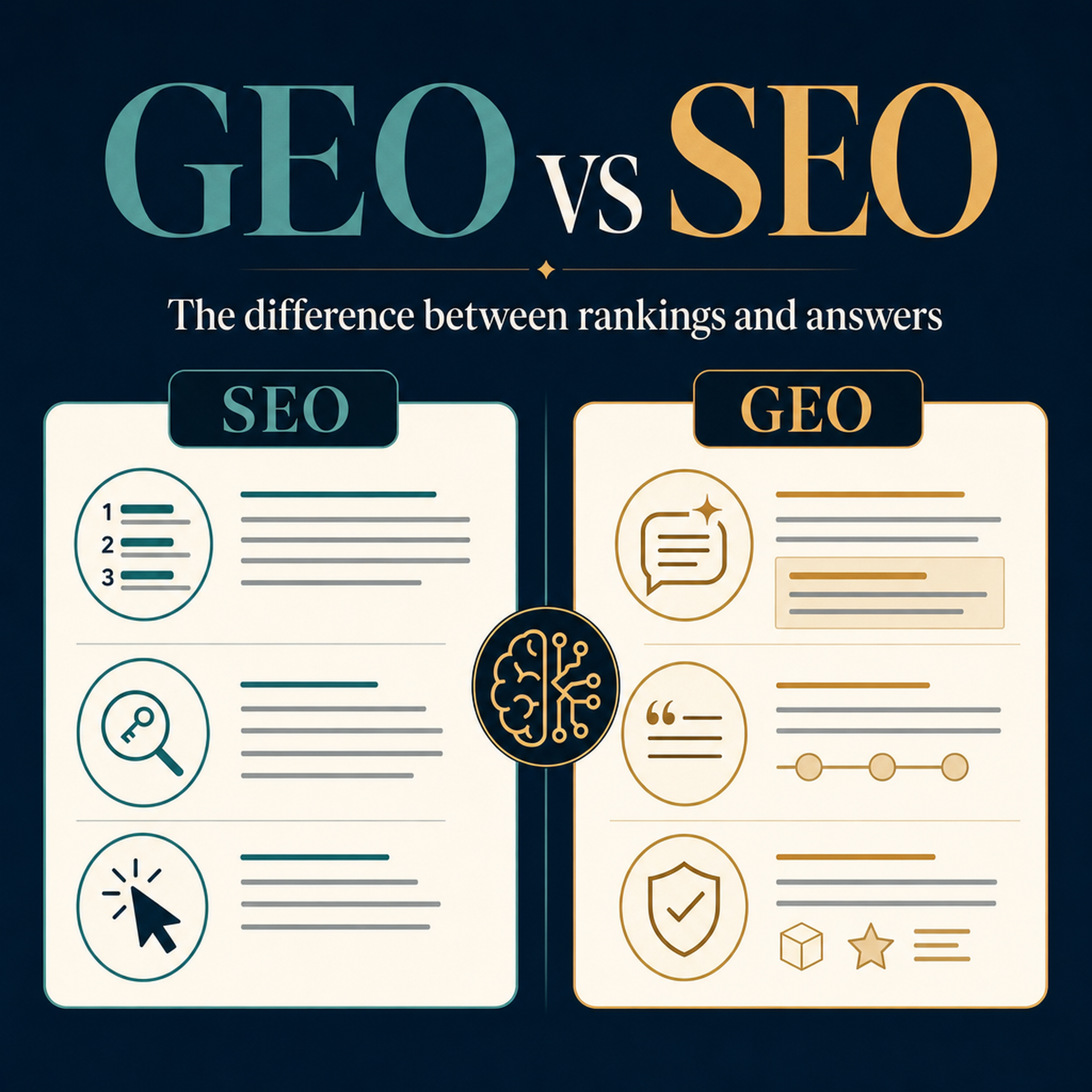
GEO and SEO are related, but they do not optimize for the same surface. SEO helps pages rank in search results so people can click through. GEO, or Generative Engine Optimization, helps brands, pages, and products become understandable, citable, and recommendable inside AI-generated answers.
The practical difference is this: SEO asks, "Can this page rank for the query?" GEO asks, "Can an AI system confidently use this source to answer the question?"
That shift matters because buyers now discover information through both classic search and AI answer interfaces: Google AI Overviews, ChatGPT, Perplexity, Gemini, Copilot, Claude, retailer assistants, and vertical AI tools. Teams that only optimize for rankings may still miss the moment when AI systems summarize the market and decide which sources deserve a mention.

Simple explanation
SEO, or Search Engine Optimization, is the discipline of improving a website so search engines can crawl it, understand it, rank it, and send traffic to it. SEO work usually includes technical health, keyword research, content quality, internal links, backlinks, structured data, page experience, and rank tracking.
GEO, or Generative Engine Optimization, is the discipline of improving a brand's information ecosystem so generative AI systems can understand it, trust it, cite it, and include it in answers. GEO work usually includes entity clarity, answer-ready pages, source consistency, product and service facts, third-party evidence, comparison content, FAQs, citation monitoring, and AI-answer testing.
SEO is still foundational. GEO does not replace it. In most cases, a strong GEO program needs strong SEO because AI systems often depend on crawlable pages, reputable sources, structured data, and established web authority. But GEO adds a new requirement: your content must be useful not only as a destination page, but also as a source that an AI answer can reuse.
GEO vs SEO at a glance
The fastest way to understand the difference is to compare the surface, the output, and the success signal.
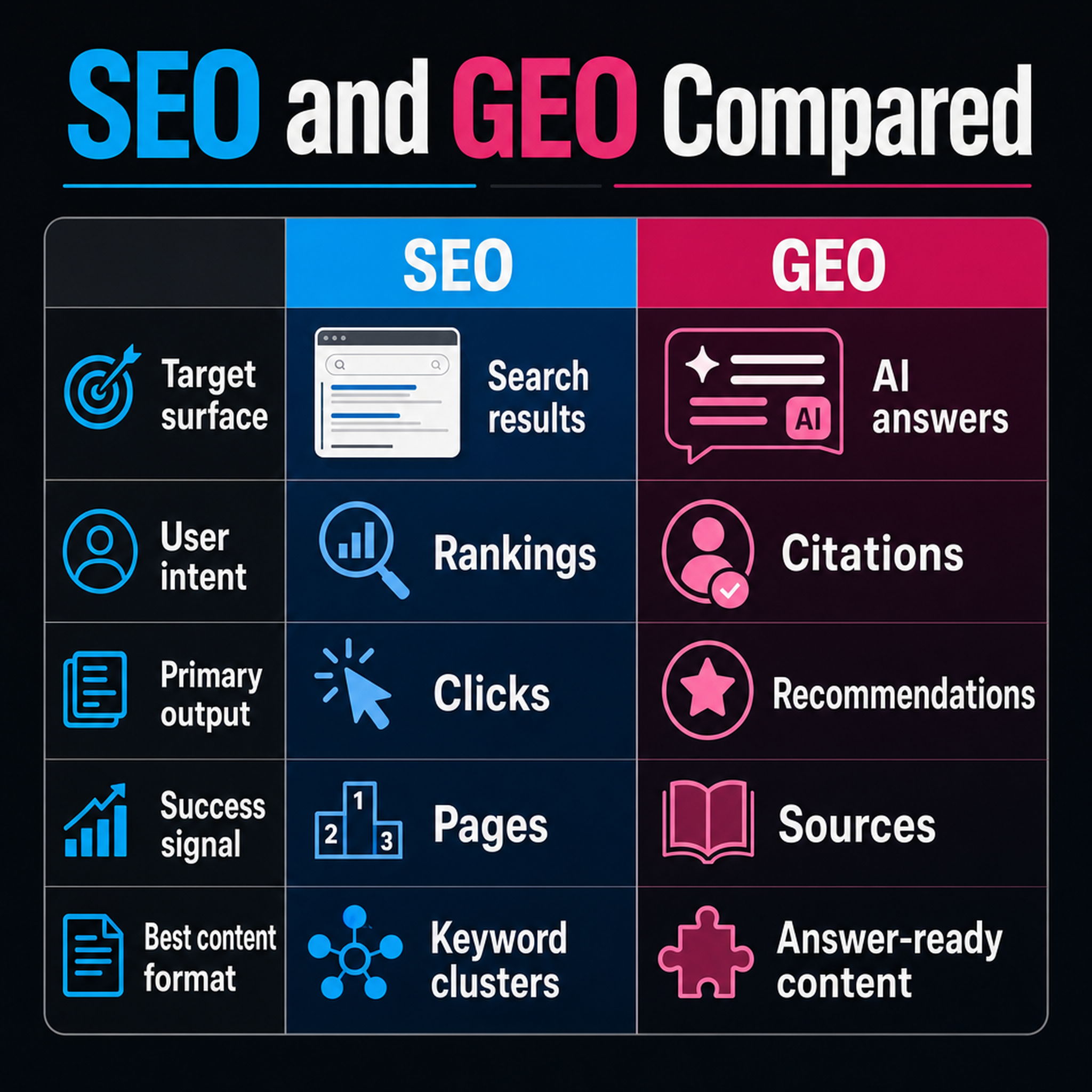
Dimension | SEO | GEO |
|---|---|---|
Target surface | Search engine results pages | AI-generated answers, summaries, recommendations, and citations |
Main objective | Rank pages and earn clicks | Be understood, cited, summarized, or recommended by AI systems |
User behavior | Search, scan results, click pages | Ask a question, receive a synthesized answer, follow cited sources if needed |
Core asset | Optimized web pages | Trusted, structured, answer-ready information across sources |
Success signal | Rankings, impressions, clicks, organic sessions, conversions | AI answer inclusion, citation share, source accuracy, recommendation frequency, answer sentiment |
Content pattern | Keyword-targeted pages, topical clusters, guides, landing pages | Direct answers, clear entities, comparison tables, evidence blocks, FAQs, product facts, third-party proof |
Measurement habit | Rank tracking and analytics | Prompt tracking, citation monitoring, answer accuracy checks, source-gap analysis |
The overlap is large, but the final mile is different. SEO wants the user to choose your result. GEO wants the AI system to choose your information as part of the answer.
Why this difference matters for growth teams
In a classic SEO journey, a user searches "best CRM for small business," scans a results page, opens several links, and compares vendors manually. The winning page earns a click because it has a strong title, ranking position, search snippet, authority, and content fit.
In an AI search journey, the same user may ask, "What is the best CRM for a ten-person agency that needs email automation and simple reporting?" The AI answer may summarize a shortlist, explain trade-offs, cite a few sources, and reduce the number of pages the user needs to open.
That does not mean traffic disappears. It means traffic becomes more selective. The people who click from AI answers may arrive with stronger intent because the answer has already shaped their decision. But if your brand is absent from the answer, you may lose influence before the click even exists.
This is why GEO matters for SEO teams, product marketers, ecommerce teams, SaaS companies, agencies, and local businesses. The competitive question is no longer only "Who ranks?" It is also "Who becomes part of the answer?"
How SEO content becomes GEO-ready
Many teams do not need to throw away their SEO strategy. They need to make their strongest pages more answer-ready.
A GEO-ready page usually has five traits:
- Clear entity identity: the page makes it obvious who the brand, product, author, location, category, and audience are.
- Direct answer blocks: the page answers the main question near the top in language that can be quoted or summarized.
- Structured comparisons: the page explains differences, trade-offs, alternatives, and decision criteria in tables or lists.
- Evidence and source clarity: the page shows where claims come from, what data supports them, and which claims are limitations rather than guarantees.
- Consistent facts across the web: brand sites, product pages, listings, reviews, social profiles, and third-party mentions do not contradict each other.
For example, a normal SEO article titled "Best Project Management Software for Agencies" may include a long intro, keyword variations, feature blurbs, and affiliate-style summaries. A GEO-ready version would add a direct answer, a comparison table, use-case fit, pricing caveats, integration notes, customer size assumptions, and a clear explanation of why each tool belongs in the shortlist.
Common mistake: treating GEO as just another keyword strategy
GEO is not simply "SEO for ChatGPT." That framing leads teams to repeat old habits in a new channel.
A keyword-first page may ask, "What phrase should we target?" A GEO-ready page asks more operational questions:
- What exact question is the user asking?
- What entities does the AI need to understand?
- What facts must be extractable?
- What sources would make this answer trustworthy?
- What comparisons or constraints change the recommendation?
- What would cause an AI system to exclude us?
For GEO, vague marketing language is a liability. Phrases like "industry-leading," "all-in-one," "next-generation," and "trusted by teams worldwide" are weak unless they are connected to concrete evidence. AI systems need facts they can compare: features, constraints, use cases, customer types, integrations, locations, pricing boundaries, proof points, and independent validation.
How teams should work SEO and GEO together
The best approach is not SEO versus GEO. It is SEO plus GEO.
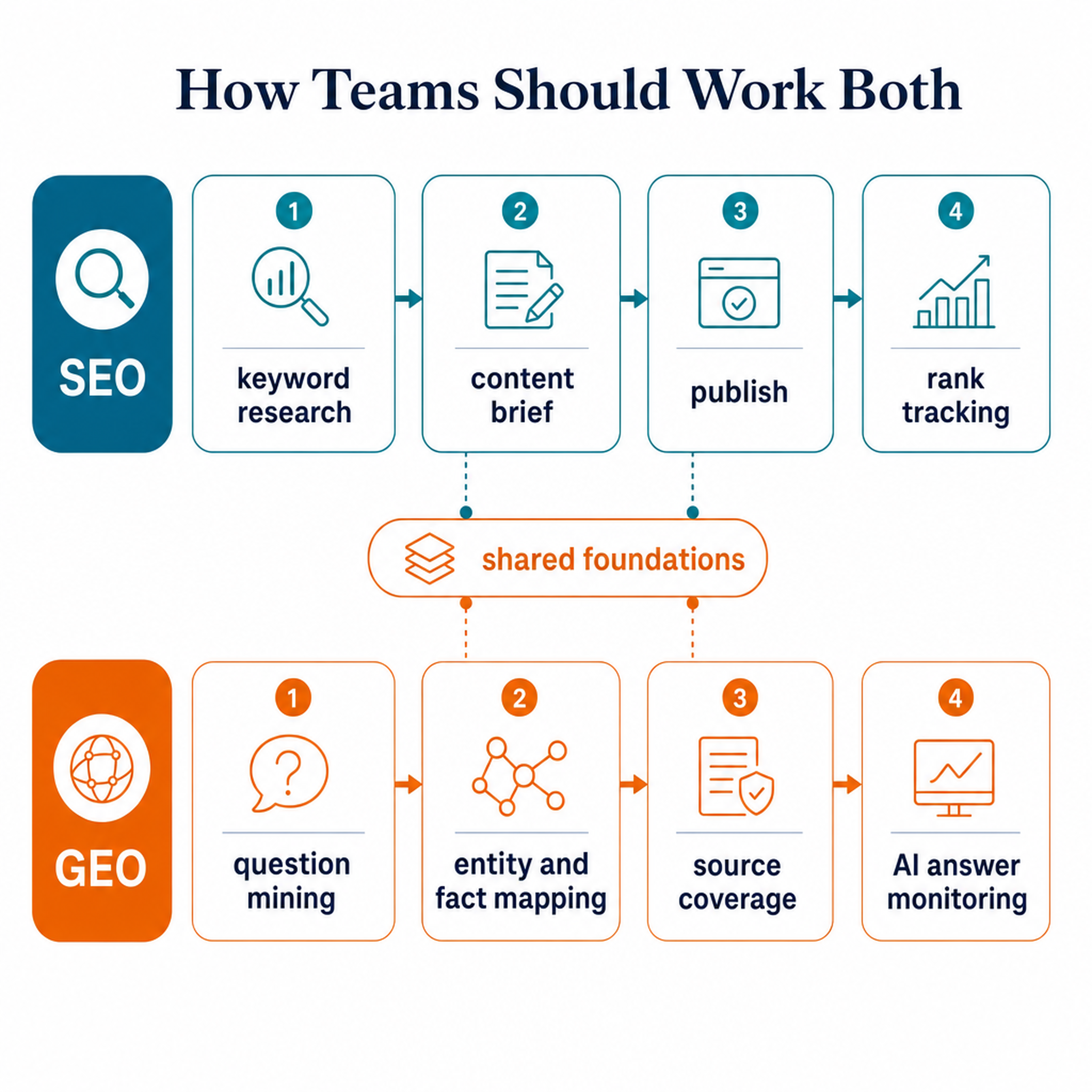
Workstream | What to do | Output |
|---|---|---|
SEO foundation | Fix crawlability, indexation, internal links, performance, schema, and content depth | Search engines can discover and evaluate your pages |
Topic strategy | Build clusters around high-intent problems, not isolated posts | Humans and AI systems see topical authority |
GEO formatting | Add direct answers, tables, decision criteria, entity definitions, FAQs, and evidence blocks | AI systems can extract answer-ready information |
Source ecosystem | Align brand pages, profiles, directories, reviews, documentation, media mentions, and community references | AI systems see consistent evidence across sources |
Monitoring | Track rankings, clicks, AI answer inclusion, citations, and answer accuracy | Teams know whether they are visible in both search and AI answers |
A practical workflow looks like this:
- Start with high-intent queries where ranking or AI visibility would affect revenue.
- Turn each keyword into real user questions and decision scenarios.
- Audit the current search results and AI answers for those questions.
- Identify missing facts, missing comparisons, weak entities, and inconsistent claims.
- Rewrite or create pages that answer the question directly and show evidence.
- Build or improve external proof sources where appropriate.
- Monitor both SERP rankings and AI answer inclusion monthly.
What should be measured differently
SEO teams already measure rankings, impressions, clicks, click-through rate, organic traffic, conversions, backlinks, and technical health. Those still matter.
GEO adds a different measurement layer:
GEO metric | What it tells you |
|---|---|
Answer inclusion | Whether your brand, page, product, or source appears in AI answers for target prompts |
Citation share | How often AI systems cite your pages versus competitors or third-party sources |
Answer accuracy | Whether the AI describes your offering correctly |
Recommendation reason | Why the AI recommends or excludes you |
Source mix | Which sources AI systems use when forming answers in your category |
Competitor pattern | Which competitors appear repeatedly and what evidence supports them |
Gap list | Which missing pages, facts, or external sources block visibility |
Auspia's recommendation is to track prompts the way SEO teams track keywords. Build a small prompt set for each major topic, product category, or buying journey. Test it across the AI systems your customers actually use. Record whether your brand appears, how it is described, what is cited, and what needs to be fixed.
Examples by business type
For a B2B SaaS company, SEO might target "best customer support software" with a comparison guide. GEO would make the guide answer-ready by adding use-case segments, integration criteria, customer size assumptions, pricing boundaries, implementation trade-offs, and clear reasons why each product fits a scenario.
For an ecommerce brand, SEO might optimize category pages and product pages for "best running shoes for flat feet." GEO would add structured fit guidance, use-case proof, review themes, return policy clarity, material specs, expert references, and comparison blocks that help AI systems explain why a shoe is or is not suitable.
For a local service business, SEO might optimize location pages and Google Business Profile signals. GEO would also make service areas, licenses, specializations, pricing expectations, emergency availability, reviews, and third-party directory consistency easy for AI systems to understand.
For a media or education site, SEO might build evergreen explainers. GEO would strengthen definitions, direct answers, citations, original data, diagrams, author expertise, and concise summaries that AI systems can reference without misunderstanding the topic.
Common mistakes to avoid
- Replacing SEO with GEO too early: AI visibility often depends on crawlable, authoritative, well-structured web content.
- Publishing answer pages without evidence: direct answers help, but unsupported claims rarely build trust.
- Ignoring third-party sources: AI systems may prefer independent reviews, documentation, directories, and community references over brand-owned copy.
- Measuring only traffic: AI answers can influence consideration before a site visit happens.
- Using generic brand language: vague claims are hard for AI to cite or compare.
- Not checking answer accuracy: visibility is not enough if AI describes your product incorrectly.
Auspia takeaway
SEO earns the click. GEO earns the mention, citation, or recommendation that may happen before the click.
The right growth strategy treats them as one system. SEO creates discoverable, authoritative pages. GEO turns those pages and related sources into structured, trustworthy information that AI systems can reuse.
If you are starting today, do not begin with a large rebrand of your content program. Begin with a practical audit:
- Choose 20 high-intent questions that matter to revenue.
- Check how Google, Perplexity, ChatGPT, Gemini, and other relevant AI systems answer them.
- Record whether your brand appears and whether the description is accurate.
- Improve the pages and sources that should support those answers.
- Repeat the test monthly.
The brands that win the next stage of organic growth will not only rank well. They will be easy for AI systems to understand, trust, cite, and recommend.
FAQ
What is the main difference between GEO and SEO?
SEO optimizes pages to rank in search results and earn clicks. GEO optimizes information so AI systems can understand, cite, summarize, and recommend a brand, product, or page inside generated answers.
Does GEO replace SEO?
No. GEO builds on SEO. Crawlable pages, strong content, schema, internal links, topical authority, and trustworthy sources all help AI systems understand and reuse information.
Which should a company do first?
Most companies should fix SEO foundations first, then make priority pages GEO-ready. If a page cannot be crawled, understood, or trusted by search engines, it is unlikely to become a strong AI answer source.
How do you measure GEO performance?
Track answer inclusion, citation share, answer accuracy, recommendation reasons, source mix, and competitor patterns across a defined set of prompts.
What content formats help both SEO and GEO?
Direct answer sections, comparison tables, FAQs, definitions, product facts, use-case pages, evidence summaries, original data, and clear author or brand entity information help both search rankings and AI answer extraction.