


Executive summary
GEO in 2026 is less about tricking AI search systems and more about making your pages safe to cite. The pages that win AI visibility usually have four traits: specific claims, verifiable evidence, clean answer structure, and proof that the brand is discussed outside its own website.
The source article that prompted this piece had the right instinct: GEO rewards content that feels quotable. But for an English-speaking Auspia audience, the practical question is sharper: if ChatGPT, Gemini, Perplexity, or Google AI Overviews had to answer a buyer's question today, would your page give them enough evidence to mention you by name?
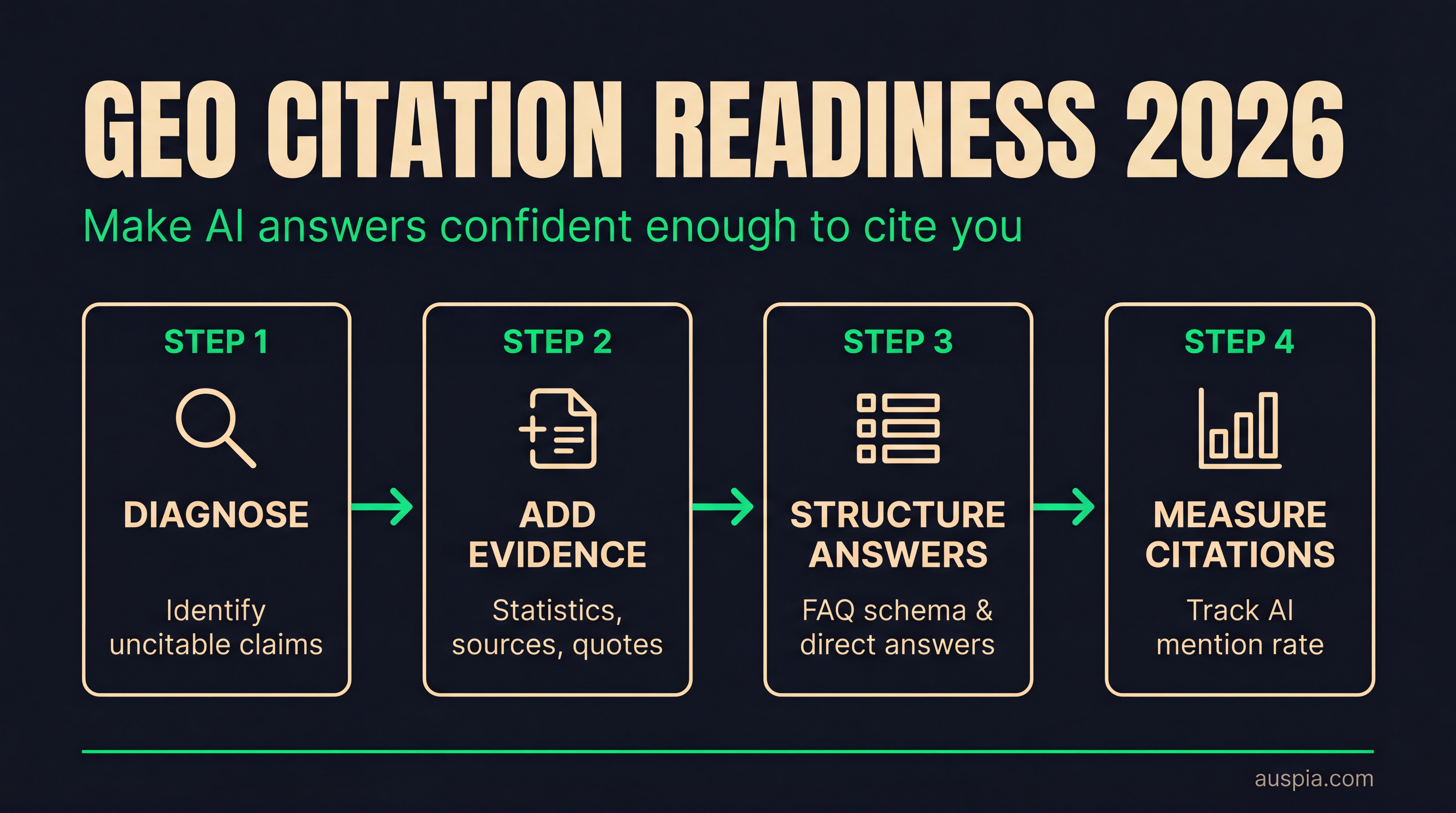
A simple 2026 GEO loop looks like this:
- Audit pages for claims AI systems would hesitate to repeat.
- Replace vague selling language with numbers, sources, examples, and constraints.
- Rebuild important sections as self-contained answers.
- Track citations, brand mentions, and competitor inclusion across recurring prompts.
This is where Auspia's AI Search Visibility Checker becomes useful: it turns GEO from a writing opinion into a repeatable visibility check.
GEO is not replacing SEO. It adds a citation layer
Classic SEO asks: can a page rank, earn clicks, and satisfy search intent? GEO asks a different question: can an answer engine confidently use this page as source material?
Those two questions overlap, but they are not identical. A page can rank because it has authority, backlinks, and good keyword coverage. That same page may still be too vague for an AI answer system to cite. A smaller page may have fewer links, but if it contains original data, a clear explanation, and a directly answerable structure, it can become useful retrieval material.
The better framing for 2026 is this:
Dimension | SEO | GEO |
|---|---|---|
Main goal | Earn rankings and clicks | Earn citations, mentions, and answer inclusion |
Strong signal | Relevance, authority, crawlability, intent match | Evidence density, source clarity, answer structure, entity consistency |
Content risk | Thin pages, duplicate topics, weak search intent | Vague claims, unsupported statistics, brand-only assertions |
Measurement | Impressions, rankings, CTR, sessions | Citation rate, share of answer, brand mentions, prompt-level visibility |
Best asset | A page that solves a search query | A page that an AI system can quote without embarrassment |
That last line matters. AI systems are conservative when they synthesize answers. They prefer facts that are easy to extract, claims that have context, and sources that appear credible across more than one surface.
The 2026 citation-readiness test
Before rewriting a page, run this quick test. Pick one important service page, product page, guide, or comparison article. Then ask whether each paragraph passes the citation test.
Question | Pass | Fail |
|---|---|---|
Does the paragraph answer one clear question? | It can stand alone if copied into an AI answer. | It depends on vague setup from earlier sections. |
Does it include a specific fact, number, source, method, example, or constraint? | The claim has evidence attached. | The claim says the brand is "leading," "trusted," or "high quality" without proof. |
Is the brand/entity clearly named? | Product, company, category, and use case are explicit. | Pronouns and generic category terms dominate. |
Would a buyer trust the sentence if it appeared in an AI answer? | It sounds measured and verifiable. | It sounds like ad copy. |
Can the section be mapped to a real prompt? | It answers how, what, why, best, compare, cost, risk, or alternative questions. | It exists because the page needed more text. |
The fastest win is usually not a new article. It is a rewrite of pages that already have impressions, backlinks, or buyer relevance but read like brochures.
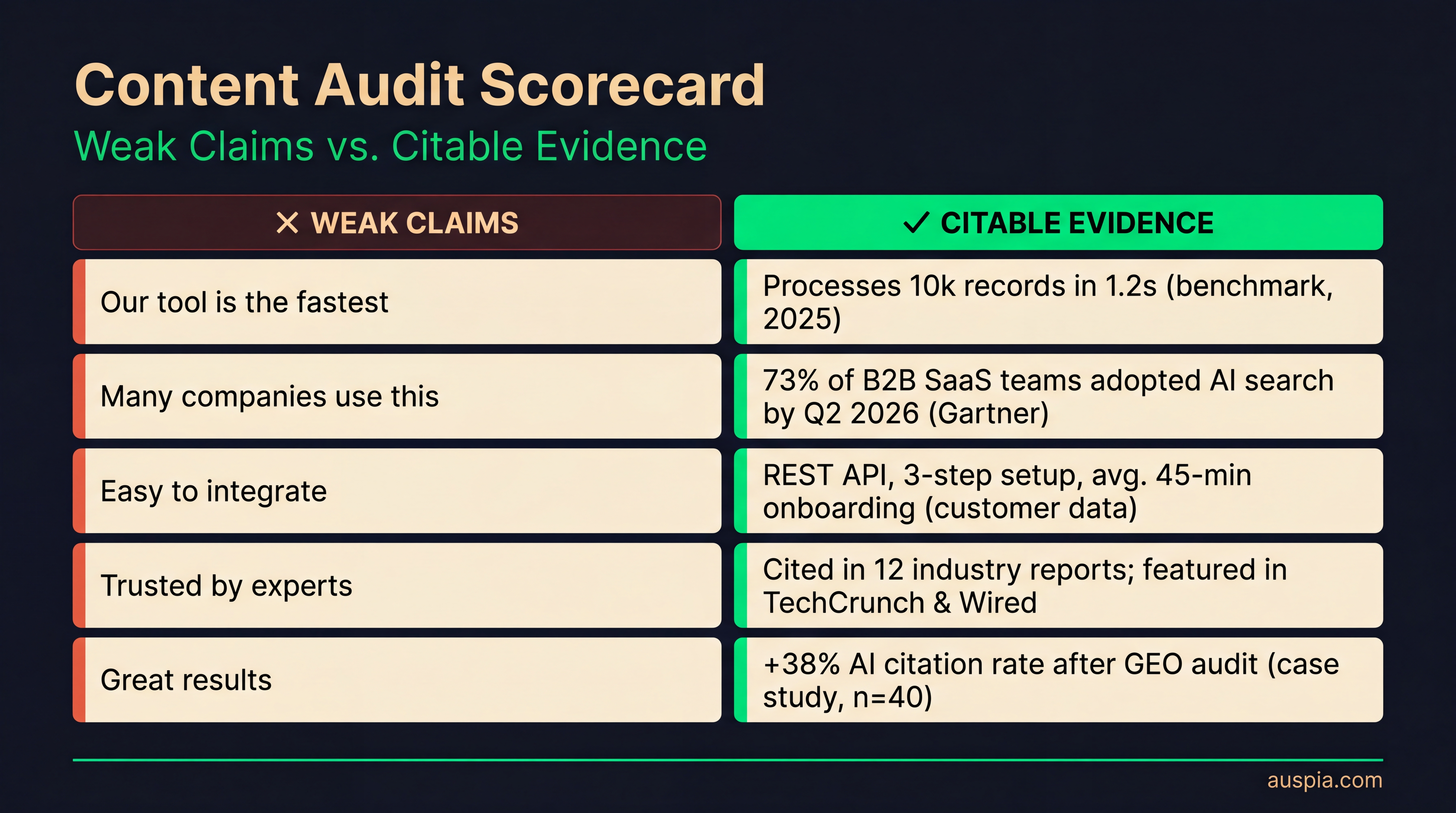
Caption: A practical GEO audit starts by turning weak brand claims into evidence an answer engine can safely cite.
Four moves that make a page easier for AI to cite
1. Replace soft claims with hard edges
Soft claims are everywhere:
- "Our platform improves productivity."
- "We provide reliable delivery."
- "Our team has deep expertise."
- "The product is easy to use."
None of those lines are useless for a human reader, but they do not give an AI answer system much to work with. The fix is not to stuff in random statistics. The fix is to add hard edges.
Better versions look like this:
Weak claim | Citable version |
|---|---|
"Our platform improves productivity." | "In a 42-person pilot, the team reduced manual reporting time from 6.5 hours to 2.1 hours per week after moving recurring dashboards into the platform." |
"We provide reliable delivery." | "For standard U.S. orders in Q1 2026, 96.8% shipped within two business days; custom orders had a median lead time of 11 days." |
"The tool is easy to use." | "New users can complete the first audit without connecting Google Search Console; advanced checks are available after setup." |
"We are trusted by growing teams." | "The product is used by B2B SaaS, ecommerce, and agency teams that need repeatable SEO/GEO checks before publishing." |
Notice the pattern. The stronger sentence names the scope, time period, metric, user type, or limitation. It gives the model something precise enough to reuse.
2. Put evidence next to the claim
Many pages bury sources at the bottom. That helps humans verify the article, but retrieval systems often work at the passage level. If the source is five sections away from the claim, the citation value drops.
For GEO writing, place evidence close to the sentence it supports. A good passage often has this shape:
- Claim: what is true.
- Evidence: where the claim comes from.
- Constraint: when it applies.
- Implication: what the reader should do.
Example:
"FAQ-style sections can help answer extraction when the questions match real buyer prompts. They are most useful on pages where users ask specific comparison, implementation, pricing, or risk questions. Do not add FAQ blocks just to create schema; unsupported answers can make a page look thinner, not stronger."
That paragraph is boring in the right way. It gives a usable answer and a boundary.
3. Write sections as answers, not decorations
A lot of SEO pages still use headings like "Our advantages" or "Why choose us." Those headings may be familiar, but they rarely match how people ask AI systems for help.
Rewrite key sections as question-led or answer-led blocks:
Old section | Better GEO section |
|---|---|
Our advantages | What makes this tool useful for AI search visibility checks? |
Solutions | How should a B2B team measure GEO performance in 2026? |
Features | Which page signals help ChatGPT, Gemini, and Perplexity understand a brand? |
Why choose us | When should a team use Auspia instead of a manual spreadsheet audit? |
The goal is not to make every page look like an FAQ. The goal is to make important passages self-contained. If one paragraph is retrieved without the rest of the page, it should still make sense.
4. Track prompts like you track keywords
SEO teams already monitor keyword rankings. GEO teams need a similar habit for prompts.
Create a small prompt library for each product or service category. Include buyer questions, comparison prompts, problem prompts, and vendor-selection prompts. Then check whether your brand appears, which competitors appear, and which sources are cited.
A simple prompt set might include:
Prompt type | Example |
|---|---|
Category discovery | "What are the best tools for checking AI search visibility?" |
Problem diagnosis | "Why is my SaaS brand not appearing in ChatGPT recommendations?" |
Comparison | "Compare GEO audit tools for a small B2B marketing team." |
Implementation | "How do I make a website easier for AI answer engines to cite?" |
Risk | "What GEO tactics should companies avoid in 2026?" |
Check the same prompts monthly. The trend matters more than one screenshot.
Reddit and community proof: useful, but easy to abuse
The source article puts heavy emphasis on Reddit. That instinct is understandable. Community discussions, reviews, comparison threads, and practitioner comments often surface in AI-assisted research because they contain real language and concrete objections.
But there is a bad version of this advice: creating fake account networks, manufactured comments, and thin "discussion" posts. That may create noise for a while, but it is fragile. It also teaches the wrong habit.
A better 2026 approach is community evidence, not community spam.
Use external discussions to capture real questions:
- What do buyers compare you against?
- Which objections appear repeatedly?
- What phrases do users use when they describe the pain?
- Which examples, screenshots, or mini case notes do people trust?
- Where does your website fail to answer what the community already asks?
If your team participates, be useful and transparent. Answer specific questions. Share constraints. Link only when it genuinely helps. The goal is to create a public trail of expertise, not a footprint that looks like reputation manipulation.
The 2026 GEO workflow for growth teams
A practical GEO program does not need to start with 50 new posts. Start with 10 pages that already matter to revenue.
- Pick pages with commercial intent: product pages, service pages, comparison pages, use-case pages, and high-performing guides.
- Run a citation-readiness audit: mark vague claims, unsupported numbers, missing definitions, and unclear entity references.
- Add evidence: proprietary data, customer-safe examples, public sources, benchmark ranges, product screenshots, methodology notes, or expert quotes.
- Reformat answer blocks: concise summaries, comparison tables, FAQs, checklists, and schema where it fits the page.
- Build off-site proof: reviews, community answers, partner pages, case studies, documentation, and credible third-party mentions.
- Measure prompt visibility: track recurring prompts across ChatGPT, Gemini, Perplexity, Google AI Overviews, and other surfaces relevant to your market.
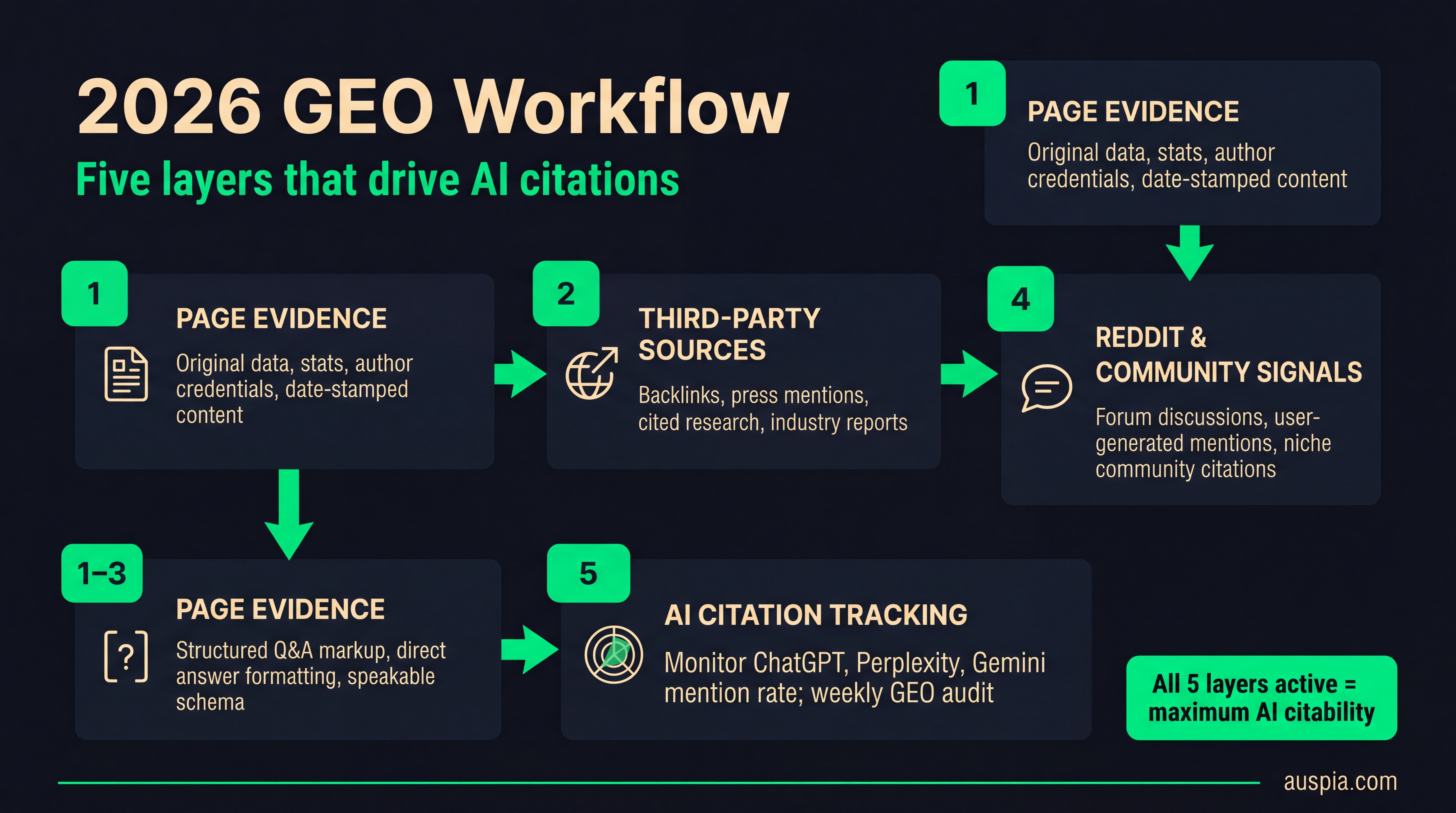
Caption: GEO becomes manageable when teams treat it as a workflow: page evidence, outside proof, structured answers, and prompt-level measurement.
What most teams get wrong
The common mistake is treating GEO as a formatting trick. Teams add FAQs, a few statistics, and an AI-generated summary, then expect instant citations.
That rarely works.
The deeper issue is usually evidence quality. AI systems do not need another page saying a product is "powerful." They need passages that resolve uncertainty. What does the product do? For whom? Under what conditions? Compared with what? What proof supports the claim? What are the limits?
Another mistake is measuring GEO too casually. A single AI answer is not a benchmark. Answers vary by model, location, time, user wording, browsing availability, and source freshness. Treat each check as a sample. Track patterns.
A quick GEO checklist for 2026
Use this before publishing any important page:
Check | What to fix |
|---|---|
One-sentence answer | Add a direct summary near the top of the page. |
Entity clarity | Name the brand, product, category, market, and target user. |
Evidence density | Replace empty adjectives with numbers, examples, sources, or constraints. |
Passage independence | Make key paragraphs understandable without the full page context. |
Comparison readiness | Explain when the solution is a fit and when it is not. |
Schema fit | Add FAQPage, Article, Product, Organization, or SoftwareApplication schema only when the content supports it. |
External proof | Build credible mentions, reviews, documentation, and community answers. |
Prompt tracking | Monitor recurring prompts, citations, competitors, and answer sentiment. |
If you want a starting point, run a site check with Auspia's GEO tools, then choose one page to rewrite. Do not begin with a 90-day content calendar. Begin with one page that should already be cited but is too vague to trust.
FAQ
What is GEO citation readiness?
GEO citation readiness is the degree to which a page gives AI answer systems enough clear, verifiable, and well-structured information to mention or cite it in an answer. It depends on evidence quality, answer structure, entity clarity, and off-site proof.
Is GEO the same as SEO?
No. SEO focuses on search rankings, clicks, and organic sessions. GEO focuses on whether AI answer systems include, mention, or cite a brand in generated responses. Strong SEO foundations still help, but they are not enough by themselves.
What should I audit first for GEO in 2026?
Start with pages that already influence revenue: product pages, service pages, comparison pages, use-case pages, and guides with commercial intent. These pages usually have the highest upside if AI systems begin citing them.
Do FAQ blocks help with AI visibility?
They can help when the questions match real user prompts and the answers are specific. FAQ blocks are weak when they repeat generic marketing claims or exist only to add schema. The answer quality matters more than the markup.
How often should teams measure AI citation visibility?
Monthly is a good starting cadence for most teams. Use a fixed prompt library, record which brands appear, note cited sources, and track changes over time. Daily checks can create noise unless you are monitoring a launch or fast-moving news topic.
Author: Adrian Cole, Analyst of 1,000+ AI Search Results at Auspia. Adrian writes about how brands appear in ChatGPT, Perplexity, Gemini, Google AI Overviews, and other answer surfaces.


