Executive Summary
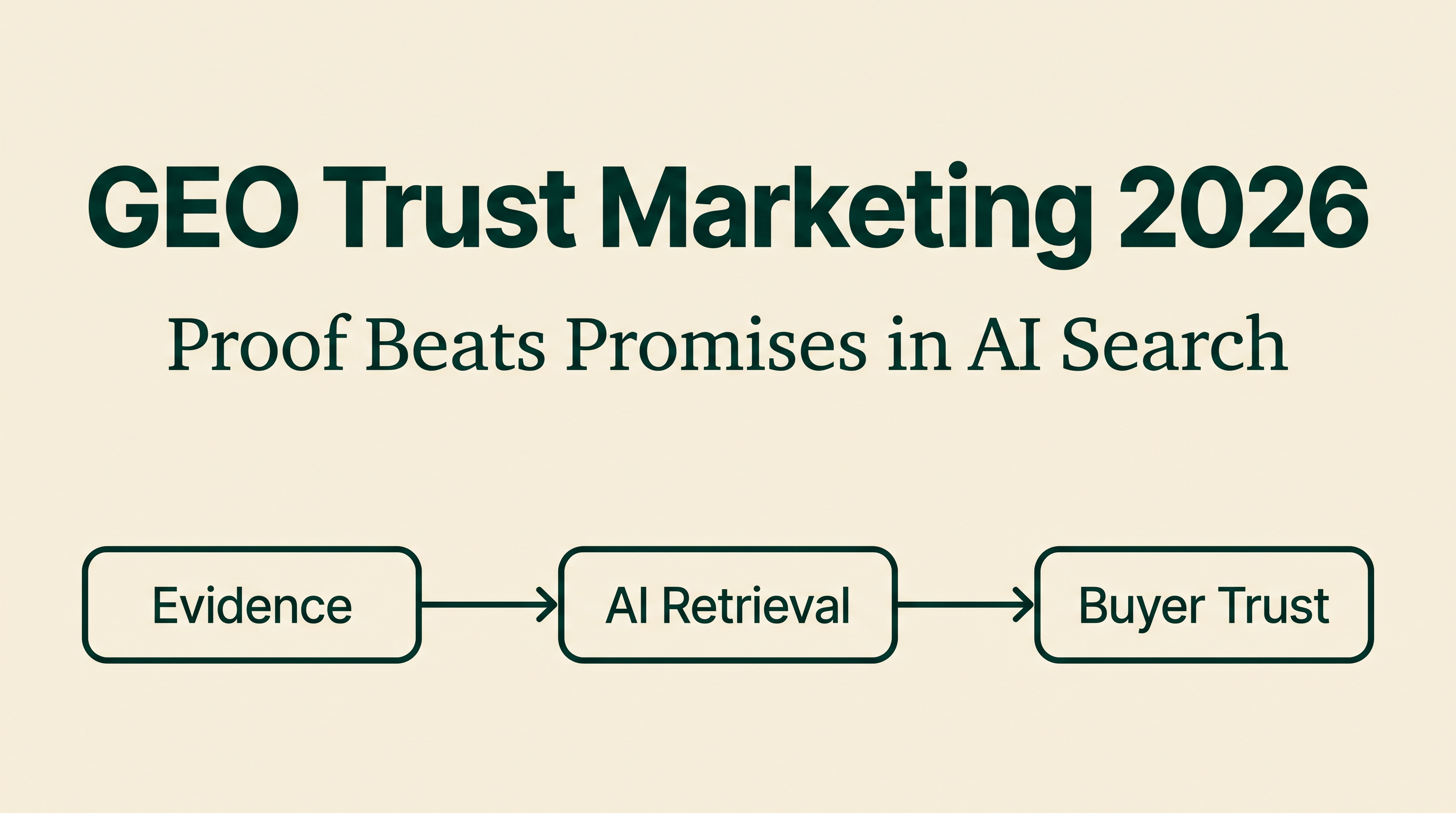
In 2026, the brands that win in AI search will not be the loudest advertisers. They will be the easiest to verify.
That is the useful lesson for trust marketing now: when buyers are surrounded by polished claims, trust comes from visible cost and specific proof. A fruit seller who cuts open the watermelon gives shoppers more confidence than a seller who only says it is sweet. The same pattern now applies to B2B software, ecommerce, local services, education, healthcare-adjacent services, consulting, and manufacturing.
For growth teams, GEO is no longer just a traffic tactic. It is a trust publishing system. It turns your process, sourcing, standards, limitations, evidence, and customer-facing explanations into content that AI answer engines can retrieve, summarize, and cite.
The short version: stop asking AI systems and buyers to believe your adjectives. Give them structured proof.
Why Trust Is The Bottleneck In 2026
Most markets are crowded now. Buyers see more ads, more comparison pages, more influencer recommendations, and more AI-written product copy than they can reasonably evaluate.
That creates a simple problem: claims are cheap.
A brand can say it is premium, reliable, expert-led, transparent, compliant, ethical, fast, or high quality. Competitors can say the same thing five minutes later. The buyer is left asking a more practical question: what can I check?
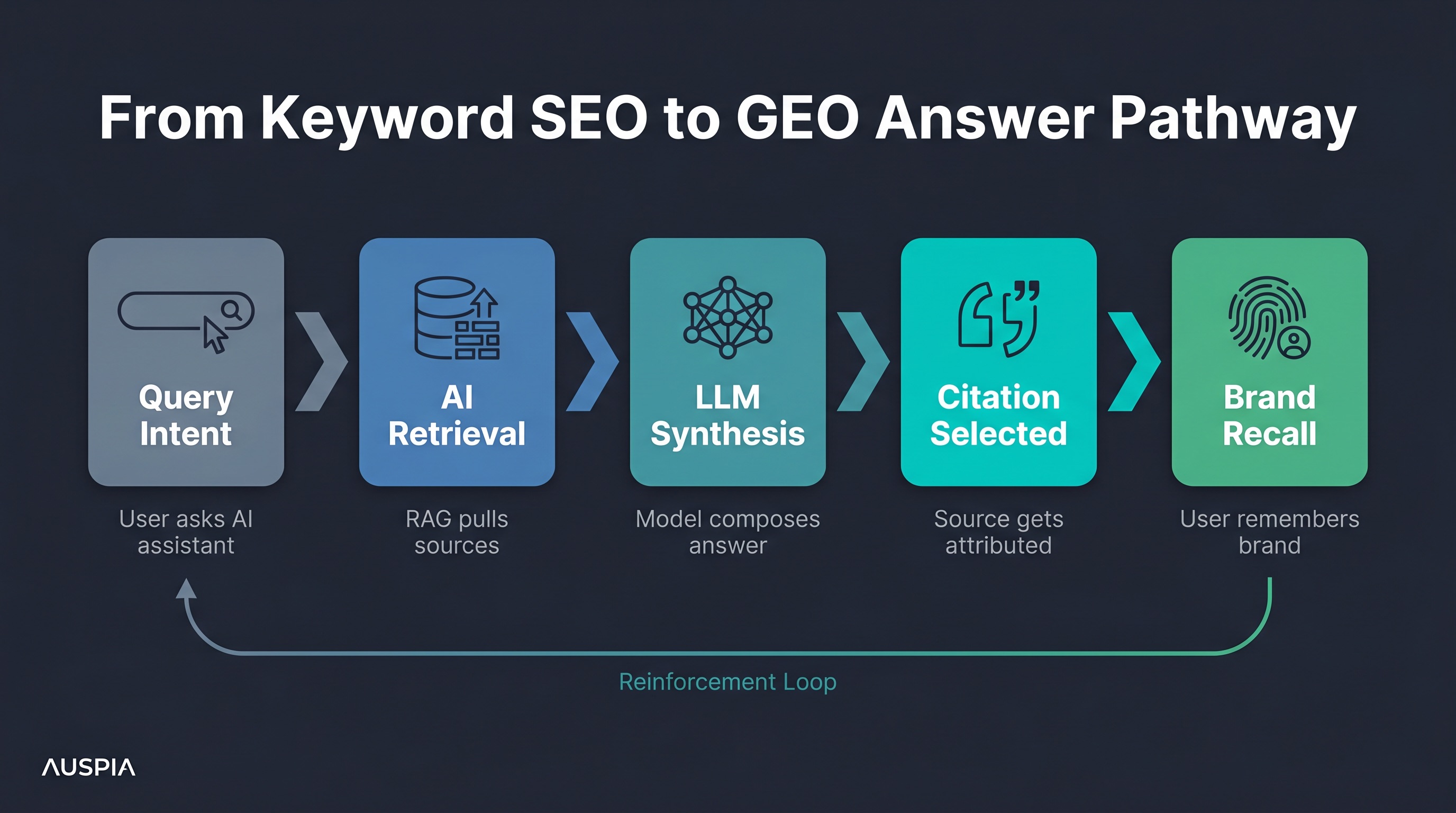
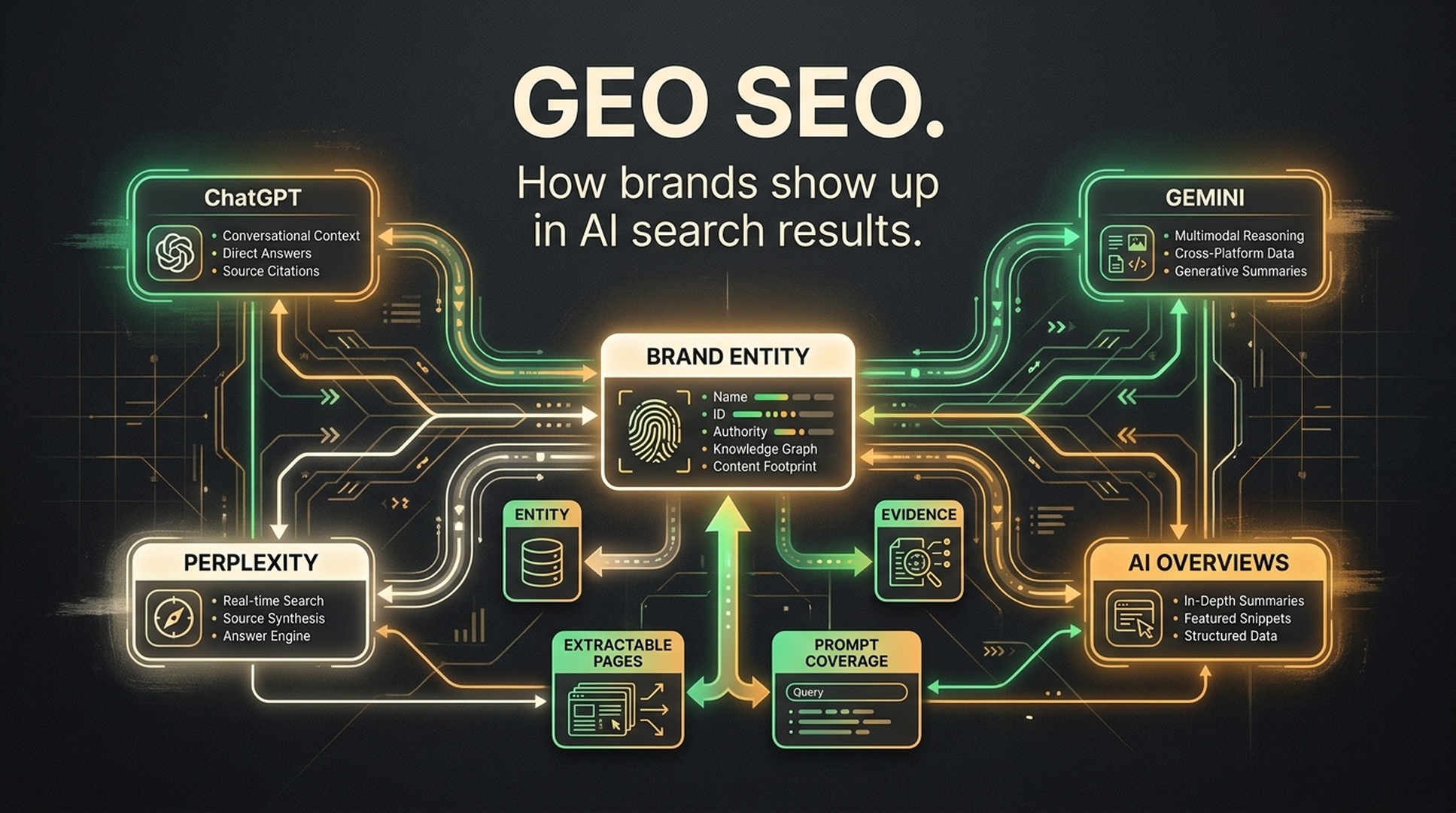
That question matters even more in AI search. When someone asks ChatGPT, Perplexity, Gemini, Google AI Overviews, or another answer surface for a recommendation, the system has to assemble an answer from available evidence. It is less interested in your slogan than in pages, facts, references, schema, reviews, product documentation, comparison context, and consistent third-party signals.
A brand with a thin website and heavy ad spend may still get attention. But attention is not the same as being trusted, cited, or recommended.
The Watermelon Test For Modern Brands
Imagine two sellers at a market.
One has a sign that says: "Guaranteed sweet." The other cuts a watermelon open, shows the color, lets buyers see the texture, and accepts the small loss of exposing one fruit.
The second seller has done something important. They paid a visible cost to reduce buyer uncertainty.
That is a better model for 2026 marketing than another round of abstract brand language. Buyers want to see what the brand risks, reveals, refuses, and proves.
For an ecommerce brand, that might mean ingredient sourcing, material tests, manufacturing tolerances, return data, and product comparison details.
For a SaaS company, it might mean security docs, implementation steps, integration limits, uptime history, migration guides, support expectations, and public changelogs.
For a consulting or education business, it might mean methodology notes, sample deliverables, scope boundaries, instructor or practitioner background, refund rules, and realistic outcome ranges.
The point is not to expose everything. The point is to expose enough real operating detail that a buyer, reviewer, journalist, or AI answer engine can tell the difference between a claim and a standard.
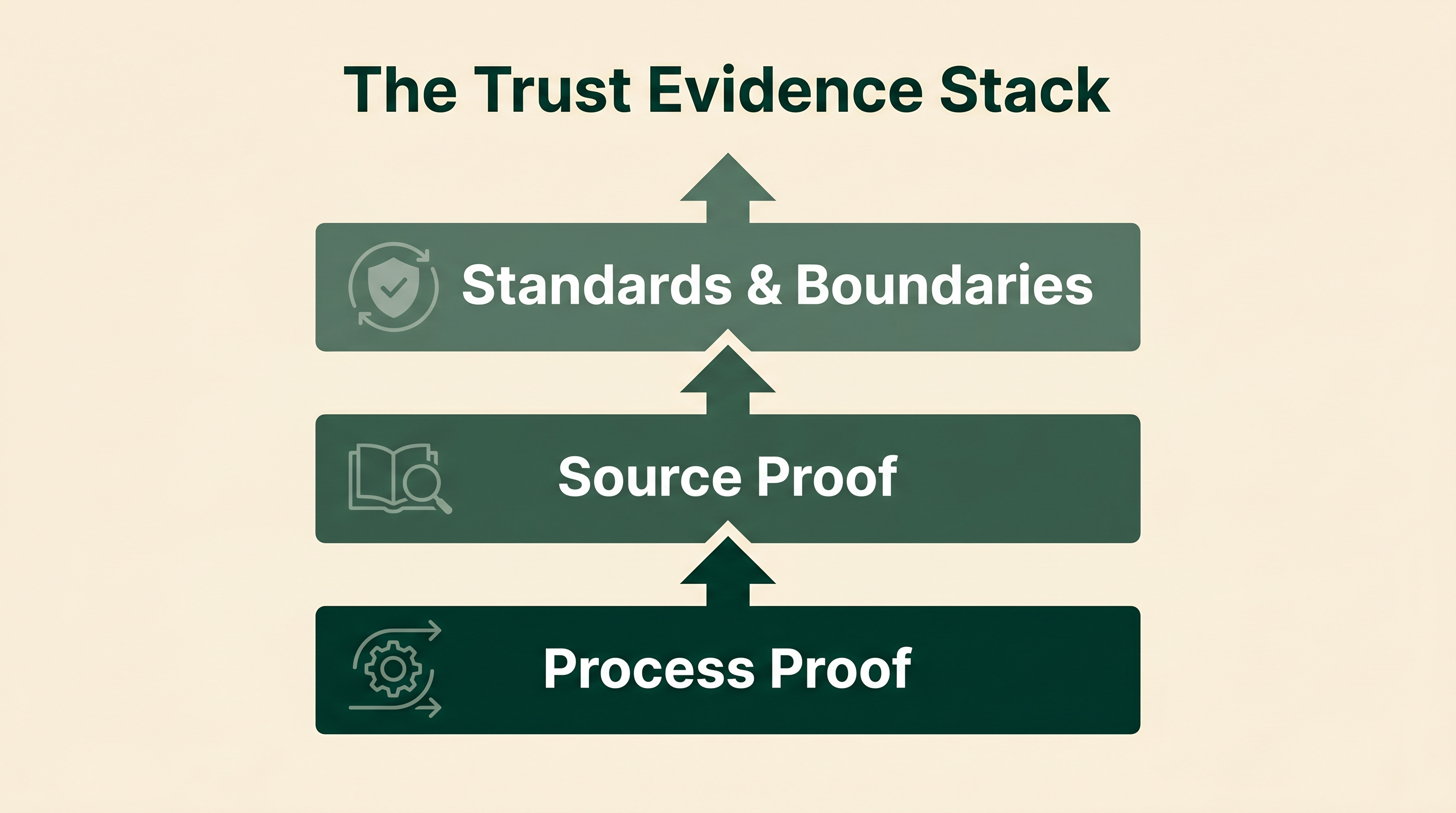
Caption: A practical GEO trust stack starts with process proof, adds source proof, and becomes stronger when a brand states its standards and boundaries.
Traditional Advertising vs GEO Trust Marketing
Traditional advertising usually pushes a promise into the market. GEO trust marketing publishes the proof behind the promise so humans and AI systems can retrieve it later.
| Area | Traditional advertising | GEO trust marketing |
|---|---|---|
| Core asset | Campaign message | Verifiable evidence library |
| Buyer reaction | "They paid to say this" | "I can inspect this" |
| AI search value | Often low if claims are vague | Higher when facts are structured and consistent |
| Lifespan | Ends when spend slows | Compounds as pages, citations, and mentions accumulate |
| Best use | Awareness and recall | Evaluation, comparison, recommendation, and trust |
This does not mean advertising is dead. It means advertising works better when it points to evidence instead of carrying the whole trust burden by itself.
A paid campaign can bring the buyer in. GEO-ready proof helps the buyer, and the AI tools they use, decide whether the brand deserves the shortlist.
The Three Proof Layers Every Brand Should Publish
The source article described a useful three-layer trust method: restore the process, restore the materials, and restore the boundaries. For a global Auspia audience, I would frame it as a GEO evidence stack.
1. Process Proof: Show How The Work Actually Happens
Buyers are nervous when the process is invisible.
A page that says "expert implementation" does not answer much. A page that explains onboarding steps, review gates, data requirements, handoff points, quality checks, and realistic timelines gives the buyer something to evaluate.
Good process proof can include:
- Step-by-step production or delivery workflows
- Quality control checkpoints
- Implementation timelines and dependencies
- Before-and-after examples with context
- Troubleshooting paths and support rules
- Behind-the-scenes documentation, when appropriate
For GEO, this content should be written in answer-friendly sections. Use clear headings such as "How our onboarding works," "What happens before launch," "How quality is checked," and "What can delay the project." AI systems are more likely to extract useful answers when the page gives them clean facts instead of one long brand story.
2. Source Proof: Make Inputs And Evidence Traceable
"High quality" is an opinion. "Made from 316L stainless steel, tested under X condition, with documentation updated on June 12, 2026" is closer to evidence.
Source proof depends on the industry, but the logic is consistent. Explain what your product or service relies on, where those inputs come from, and why you choose them.
Examples:
- Ecommerce: materials, ingredients, certifications, lab results, supplier standards
- SaaS: data sources, model behavior notes, integration documentation, security controls
- Agencies: research sources, audit methods, editorial review standards, reporting templates
- Local services: staff training, equipment, safety procedures, service guarantees
- Manufacturing: tolerances, inspection methods, batch checks, rejected-material policies
This is also where many brands accidentally lose AI visibility. They hide their best proof in PDFs, sales decks, gated documents, or scattered support replies. If buyers ask AI tools about your category, those tools need crawlable, consistent, easy-to-summarize evidence.
3. Boundary Proof: Say What You Do Not Do
This layer is underrated.
Buyers do not only care what a brand promises. They care which shortcuts it refuses.
A clear boundary page can be more persuasive than another benefits page. It tells buyers what standards protect them when things get difficult.
Useful boundary proof can include:
- What your product is not designed for
- Claims you will not make
- Low-quality inputs you reject
- Industries, use cases, or tactics you avoid
- Data, privacy, compliance, or review lines you will not cross
- Refund, replacement, or service recovery rules
For GEO, boundaries are valuable because AI answer engines often compare options. A brand that states its constraints clearly is easier to represent accurately. A brand that hides the fine print may be summarized poorly, or ignored.
How To Turn Proof Into GEO Assets
The practical work is not complicated, but it does require discipline. Most teams already have proof. It is just trapped in Slack threads, sales calls, SOPs, customer support macros, implementation docs, QA spreadsheets, and founder memory.
Start by turning that proof into an accessible content system.
Step 1: Audit The Questions Buyers Already Ask
Collect questions from sales calls, demos, customer support, Reddit threads, reviews, comparison pages, and AI search prompts.
Look for questions that signal uncertainty:
- "Is this product actually safe?"
- "How does this service work?"
- "What happens if the first result is not good?"
- "Why is this more expensive than alternatives?"
- "What proof exists that this company knows the category?"
- "What are the limitations?"
These are GEO opportunities because they map directly to AI answer behavior. People do not only search keywords. They ask for judgment.
Step 2: Build Pages Around Proof, Not Slogans
Create or refresh pages that answer one trust question at a time.
Useful formats include:
- Process explainer pages
- Standards and methodology pages
- Sourcing or data-origin pages
- Comparison and alternatives pages
- Limitations pages
- FAQ hubs
- Case evidence pages
- Technical documentation and implementation guides
If you want a quick diagnostic, run important URLs through an AI Search Visibility Checker and compare what AI systems can currently say about your brand with what you wish they would say.
Step 3: Structure The Content So Machines Can Reuse It
Readable content is not enough. GEO content should be easy to parse.
Use:
- Descriptive H2 and H3 headings
- Short answer blocks near the top of sections
- Tables for comparisons and requirements
- FAQ blocks for high-intent questions
- Schema where appropriate
- Consistent entity names, product names, and category language
- Updated dates when the page contains time-sensitive standards
- Internal links to related proof pages
Avoid burying important claims in decorative copy. If a fact matters, make it easy to quote.
Step 4: Add External Evidence Where It Exists
Owned content is necessary, but it is not the whole system.
AI answer engines also look at third-party mentions, reviews, community discussions, partner pages, analyst coverage, marketplace listings, documentation references, GitHub activity, app store reviews, and other public signals.
You cannot manufacture all of that overnight. You can, however, make it easier for real evidence to appear by giving customers, partners, reviewers, and communities precise facts to reference.
A 2026 GEO Trust Readiness Checklist
Use this quick check before publishing another brand claim.
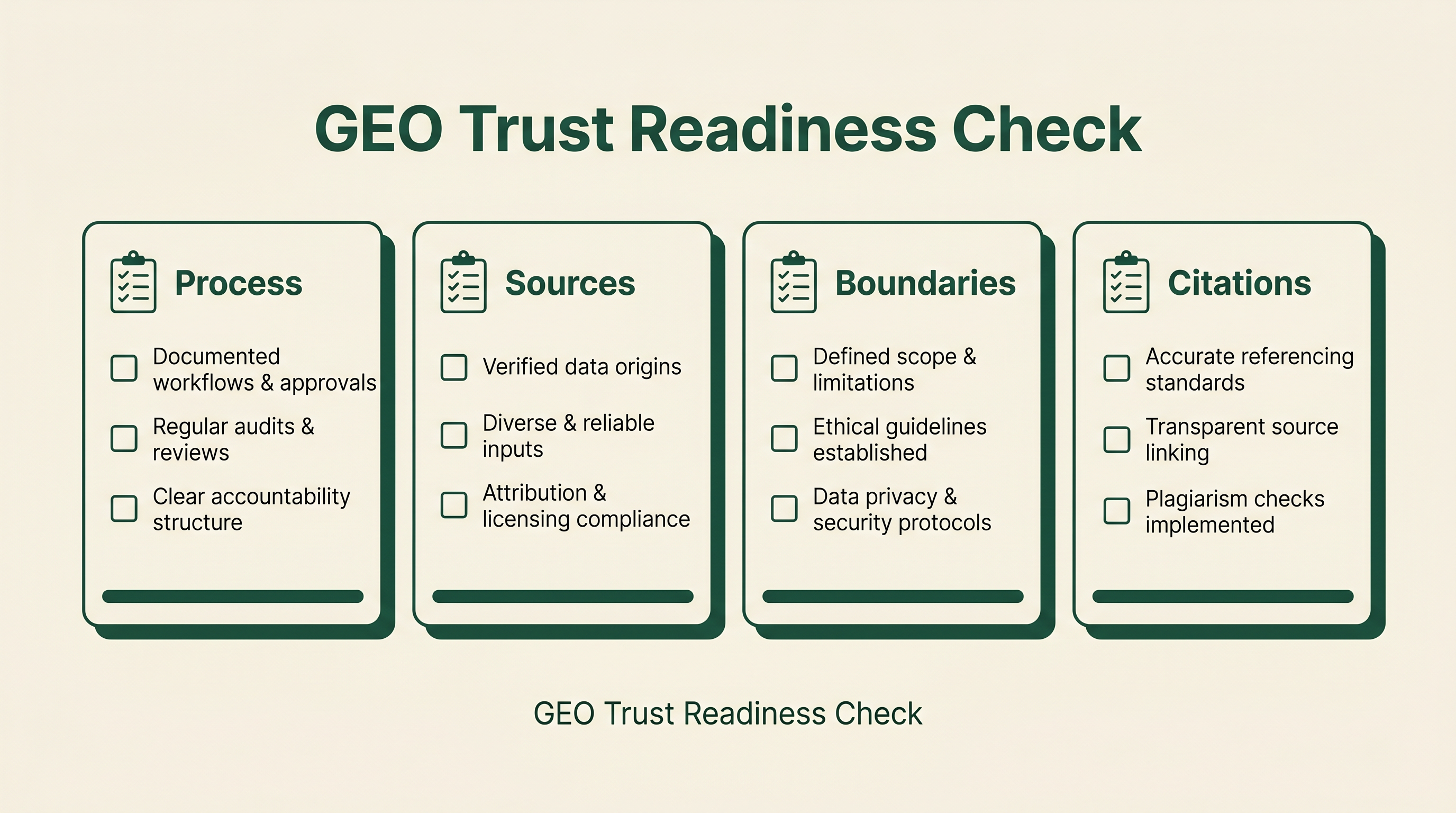
Caption: A simple GEO readiness check asks whether AI systems can find process details, source evidence, boundary statements, and citation-worthy pages.
| Question | Good sign | Fix if missing |
|---|---|---|
| Can AI explain how your product or service works? | You have a clear process page | Publish a workflow page with steps, owners, and checkpoints |
| Can AI verify your inputs or standards? | You show sources, materials, data, or review rules | Create a sourcing, methodology, or standards page |
| Can AI state your limitations accurately? | You publish use cases and non-use cases | Add a limitations and boundaries section |
| Can AI cite more than your homepage? | You have specific proof pages and external mentions | Build topic pages and earn references from credible third-party contexts |
| Can buyers compare you fairly? | You explain tradeoffs and ideal-fit criteria | Add comparison tables and decision guidance |
| Is the content fresh enough for 2026 decisions? | Important pages show recent updates | Refresh outdated claims, screenshots, policies, and examples |
What Most Teams Get Wrong
The common mistake is treating GEO as a layer of AI-friendly keywords placed on top of old marketing pages.
That is too shallow.
If the underlying content has no evidence, there is nothing meaningful for an answer engine to retrieve. A vague page can be optimized, but it will still be vague. The better move is to improve the evidence first, then structure it for retrieval.
Another mistake is overclaiming. AI search visibility is not guaranteed. No tool can promise that every answer engine will cite a page. What teams can control is whether their public content gives those systems a fair chance to understand the brand.
The third mistake is hiding the best proof. Sales decks, private Notion docs, customer-only PDFs, and long videos may help a few prospects, but they do little for public AI search if the content is not crawlable or summarized on a page.
Auspia Take: Trust Is Becoming A Search Asset
Auspia's view is simple: the next phase of GEO is less about chasing individual AI prompts and more about building a proof base that survives across prompts.
Prompt tracking still matters. Share-of-answer still matters. Citation reports still matter. But the foundation is the evidence layer underneath them.
If a brand wants to be recommended in AI search in 2026, it needs more than a homepage, a few blogs, and a positioning statement. It needs pages that answer how it works, why it can be trusted, where its claims come from, and what it refuses to do.
That is not just content strategy. It is trust infrastructure.
FAQ
What is GEO trust marketing?
GEO trust marketing is the practice of publishing structured, verifiable brand evidence so generative search and answer engines can understand, summarize, and cite a company accurately. It focuses on proof such as process, sourcing, standards, limitations, examples, and third-party signals.
Is this different from traditional SEO?
Yes, although the two overlap. SEO often focuses on ranking pages in search results. GEO focuses on helping AI answer systems retrieve and use the right facts about a brand. Strong technical SEO, crawlability, internal linking, and clear content structure still support GEO.
What kind of proof should a brand publish first?
Start with the proof buyers already ask for during evaluation. For most brands, that means process details, product or service standards, sourcing or methodology notes, limitations, pricing logic, implementation expectations, and credible examples.
Can GEO replace advertising?
No. Advertising can create awareness faster than organic proof pages. The better approach is to connect the two: use ads to create demand, then use GEO-ready evidence to help buyers and AI systems verify the brand.
How often should GEO trust content be updated?
Update it whenever the underlying proof changes. For 2026 pages, review high-impact trust assets at least quarterly: methodology pages, comparison pages, product documentation, policy pages, customer evidence, and AI-search visibility checks.
Author: Isabel Grant, Researcher of 2,000+ AI Citation Patterns at Auspia. Isabel writes about citation earning, source quality, retrieval behavior, and how brands become easier for AI systems to trust.