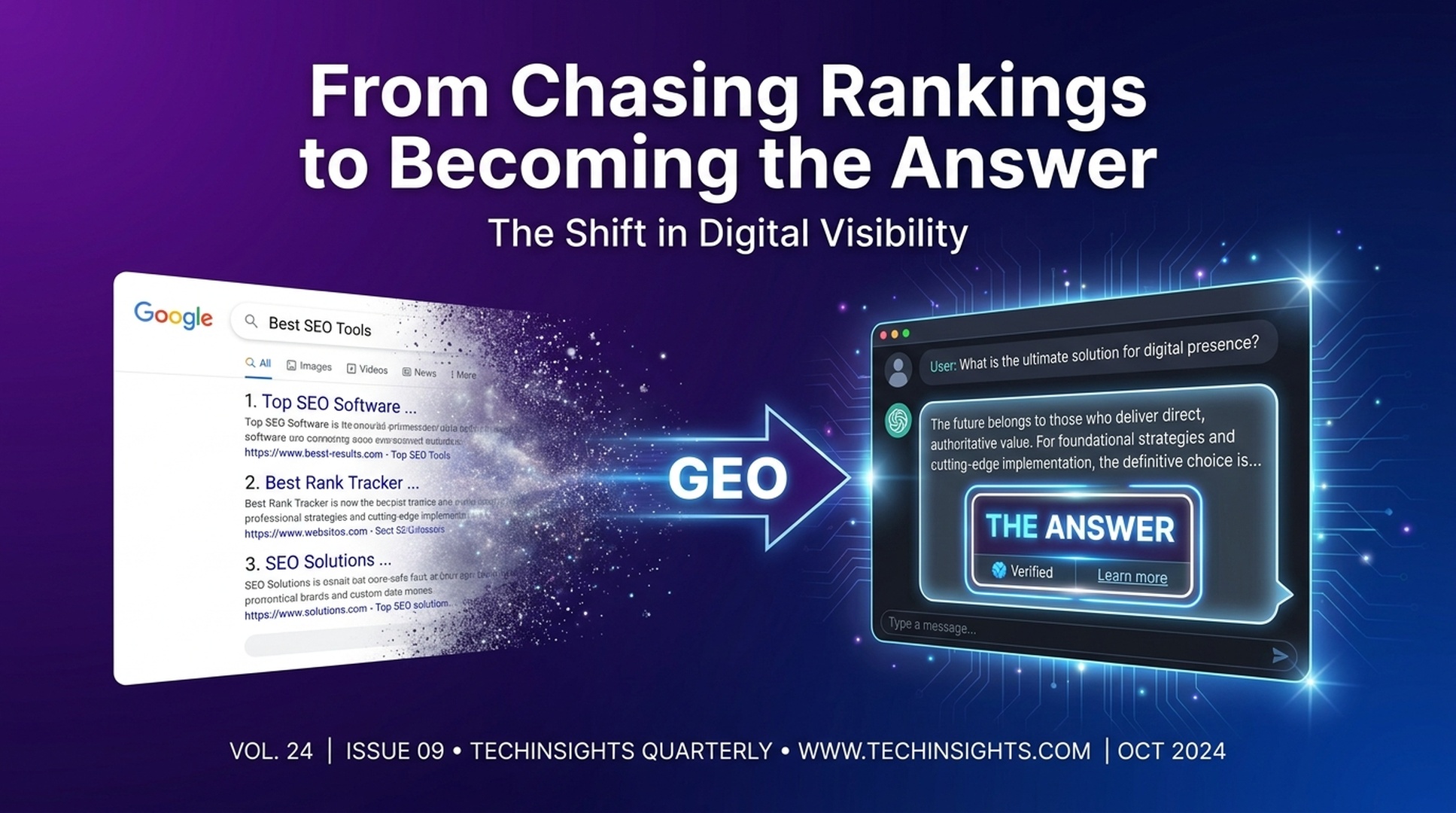
From "Chasing Rankings" to "Becoming the Answer": How GEO Rewrites the Operating Logic of Digital Marketing
The fundamental goal of marketing has always been simple: be seen. But how you get seen is undergoing a once-in-a-generation transformation.
For two decades, digital marketing ran on one engine: SEO. Get your page to rank on Google's first page, and the clicks would follow. The entire industry — content strategy, link building, technical optimization, keyword research — was built around one metric: ranking position.
That logic is breaking down. Not slowly. Fast.
In 2026, AI-native search accounts for over 42% of global search activity. ChatGPT has 800 million weekly active users. 68% of Google searches now produce zero clicks. Users aren't visiting websites anymore — they're reading AI-generated answers and acting on them directly.
A new discipline has emerged to address this shift: GEO (Generative Engine Optimization). And it's not just a new tool in the marketing stack. It's a fundamental rewrite of how digital marketing works.
The Paradigm Shift: From Exposure to Embedding
Traditional SEO's operating logic is straightforward:
Create content → Optimize for keywords → Rank higher → Get clicks → Convert traffic
The entire value chain revolves around "exposure." You're competing for attention in a list of links, hoping users choose you.
GEO rewrites this logic completely:
Create structured, authoritative content → Optimize for AI comprehension → Get cited in AI answers → Become part of the answer → Convert trust
The difference isn't incremental. It's categorical.
In the SEO paradigm, your content sits next to the answer. Users have to click through to find it. In the GEO paradigm, your content is the answer — or at least a source the AI uses to construct one.
The marketing endgame shifts from "getting exposure" to "becoming the answer itself."
Why This Shift Is Happening Now
Three forces are converging to make GEO not optional but existential:
1. Traffic Is Migrating to AI Interfaces
Users are moving from search boxes to chat windows. When someone asks Perplexity "what's the best project management tool for remote teams," they don't want a list of links. They want a recommendation — with reasoning.
This means the "click" is disappearing. And with it, the entire SEO traffic model.
2. AI Answers Compress the Decision Funnel
Traditional search required multiple steps: search → scan results → click → read → compare → decide. AI collapses this into a single interaction. The user asks, AI synthesizes, the user acts.
For brands, this means you either appear in that synthesis or you don't exist in the user's decision space at all.
3. The Market Is Pricing This In
The numbers are stark:
- The global SEO market was valued at approximately $48 billion in 2025
- China's GEO market grew over 200% year-over-year in Q2 2025
- Over 68% of mid-to-large enterprises have allocated GEO budgets
- Traditional SEO budgets are declining 23% year-over-year
- The global GEO market is projected to exceed $100 billion by 2030
Capital is flowing from SEO to GEO. The question isn't whether this shift will happen — it's whether your brand will be positioned on the right side of it.
How GEO Actually Rewrites Marketing Logic
From "Impression Economy" to "Citation Economy"
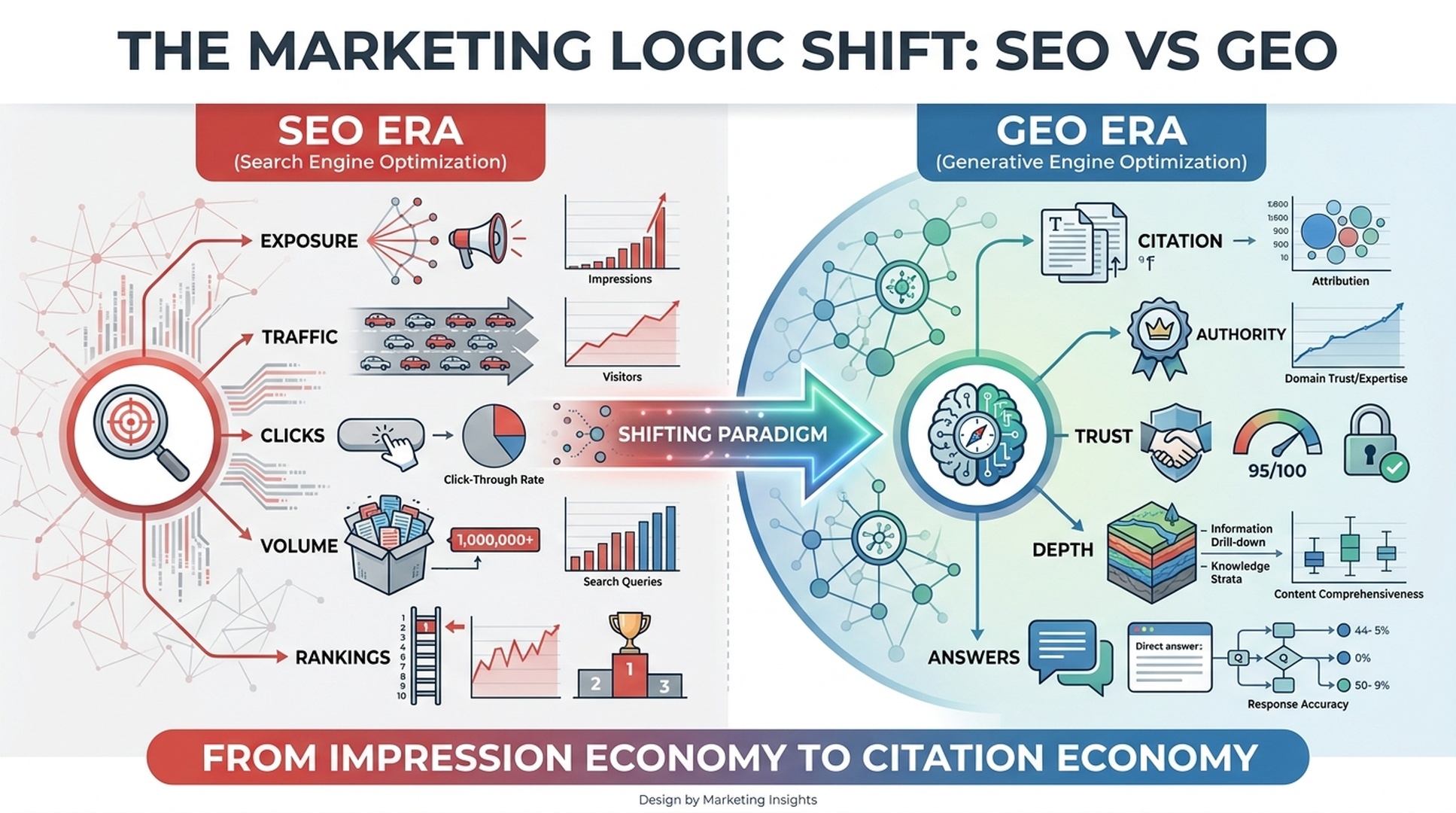
Traditional marketing metrics revolve around impressions and clicks: how many people saw your ad, how many clicked your link, how many converted.
GEO introduces a new currency: citations. How often does AI reference your brand when answering relevant questions? How frequently does your name appear in AI-generated recommendations?
This is a fundamentally different metric. Impressions measure passive exposure. Citations measure active endorsement — AI is effectively vouching for you.
From "Traffic Monetization" to "Cognition Monetization"
SEO's business model is: get traffic → monetize attention → generate revenue.
GEO's model is different: become the trusted answer → shape user perception → generate preference and conversion.
The value chain shifts from "how many people visit your site" to "how many people form a positive impression of your brand through AI answers." This is cognition monetization — converting brand authority into business outcomes without requiring a click.
From "Content Volume" to "Content Authority"
SEO rewarded volume. More pages, more keywords, more backlinks — the more, the better. GEO inverts this.
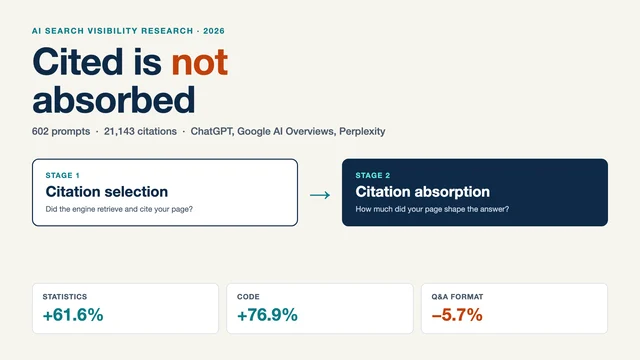
AI doesn't count your pages. It evaluates your authority. Research from Princeton and Georgia Tech found that content using a "Question-Answer-Evidence" structure gets cited 4.7x more often than traditional blog posts. Structured data markup increases sustained citation rates by 3.2x.
Ten authoritative, well-structured, data-rich pieces outperform a hundred thin articles every time.
The New Marketing Stack: What GEO Changes
Content Strategy
Old model: Write for keywords. Target search volume. Optimize for crawlability.
New model: Write for AI comprehension. Target question spaces. Optimize for citability.
Every piece of content should answer: "If AI were building an answer to a user's question, why would it choose this paragraph?"
Brand Building
Old model: Build brand through ads, PR, social media presence, and content marketing.
New model: All of the above, plus ensuring AI systems can accurately retrieve, understand, and cite your brand information.
Your brand's "semantic identity" — how AI represents you when summarizing your company — is now a core brand asset.
Competitive Analysis
Old model: Track competitor rankings for target keywords.
New model: Track competitor citation rates across AI platforms. Who gets mentioned? In what context? With what frequency?
Bing Webmaster Tools now offers GEO reporting with citation share data — a preview of what measurement will look like across the industry.
Budget Allocation
Old model: Majority to SEO, with paid search and content marketing as supplements.
New model: Shifting toward GEO optimization, semantic asset creation, and AI platform monitoring — while maintaining SEO as a foundation.
The GEO Value Chain: Who Wins
The GEO industry is still early, but the value chain is already forming:
Upstream: Data and content platforms — Sites like Reddit, Quora, and industry forums serve as training and retrieval sources for AI models. Their content carries outsized influence in AI answers.
Midstream: AI engine infrastructure — OpenAI, Google, Anthropic, ByteDance, and others build the models that generate answers. Their retrieval and ranking algorithms determine who gets cited.
Downstream: GEO tools and services — Companies building SaaS platforms, monitoring tools, and optimization services that help brands improve their AI visibility. This layer is growing fastest.
One particularly promising application area is "AI + e-commerce." Companies operating close to product channels, with deep consumer insight, are positioned to benefit first from GEO's commercial applications.
Two Directions GEO Is Heading
1. Multi-Modal Content Optimization
Current GEO focuses on text. But AI systems are becoming multi-modal — processing video, audio, and images alongside text. The next frontier is optimizing all content types for AI retrieval and citation.
Brands that build multi-modal semantic assets now will have a significant advantage as AI search evolves beyond text.
2. Dynamic Personalized Recommendations
AI answers aren't static. They adapt based on user context, query history, and intent signals. GEO will evolve from "optimize for general citation" to "optimize for citation in specific user contexts."
This means brands will need to think about who is asking, not just what they're asking — and tailor their semantic assets accordingly.
What This Means for Marketing Leaders
The shift from SEO to GEO isn't just a tactical change. It's a strategic one that affects how you think about brand visibility, content investment, and competitive positioning.
Three things to do now:
First, audit your AI visibility. Open ChatGPT, Perplexity, and Gemini. Search for your brand and your core category terms. If you're not in the answers, you have a problem — and a starting point.
Second, restructure your content for citability. Apply the Question-Answer-Evidence framework. Add structured data. Build semantic depth in your core topic areas. Make every paragraph a standalone, citable unit.
Third, start measuring what matters. Track AI citation rates, not just search rankings. Monitor your semantic share across platforms. Build the measurement framework that will define marketing performance in the AI era.
The brands that understand this shift early won't just adapt — they'll define the competitive landscape for the next decade.
The question is no longer "how do we rank higher?"
It's "how do we become the answer?"
FAQ
What does "from chasing rankings to becoming the answer" mean? It describes the fundamental shift from SEO (optimizing for search engine result positions) to GEO (optimizing for AI citation in generated answers). Instead of competing for a spot in a list of links, brands compete to be the source AI uses when constructing its response.
How does GEO change marketing's core logic? Marketing's goal shifts from "getting exposure" (impressions and clicks) to "becoming the answer" (citations and brand embedding in AI responses). This changes content strategy, brand building, competitive analysis, and budget allocation.
What is "cognition monetization"? Unlike traditional "traffic monetization" (getting visitors to your site and converting them), cognition monetization converts brand authority into business outcomes by shaping how AI represents your brand in answers — without requiring users to click through to your site.
How big is the GEO market? China's GEO market grew over 200% year-over-year in Q2 2025. The global GEO market is projected to exceed $100 billion by 2030. Traditional SEO budgets are declining 23% annually as capital shifts toward GEO.
What content structure works best for GEO? The "Question-Answer-Evidence" structure increases AI citation probability by 4.7x compared to traditional blog posts. Combined with structured data markup, sustained citation rates improve 3.2x across multi-turn conversations.
Where is GEO heading next? Two key directions: multi-modal content optimization (video, audio, images for AI retrieval) and dynamic personalized recommendations (optimizing for citation in specific user contexts rather than general queries).