In 2026, If Your Brand Isn't Doing GEO, You're Facing a "Semantic Invisibility" Crisis
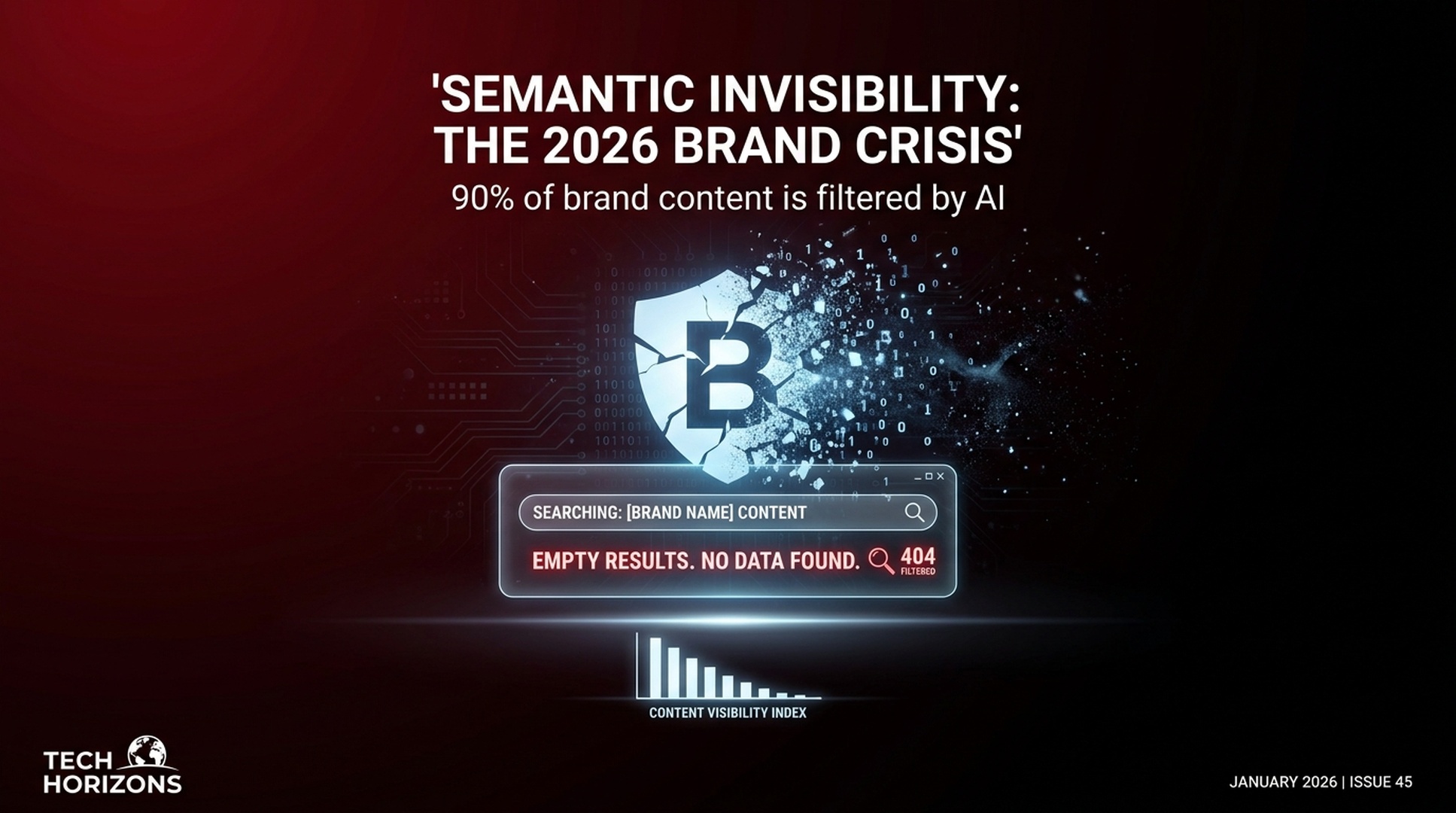
Here's a number that should keep brand owners up at night: in 2026, AI-native search accounts for 42.8% of all search activity globally. Yet the average probability of brand information being accurately cited by AI is less than 12.5%.
That means nearly 90% of brand content gets filtered out or ignored in AI answer chains.
Your website might be perfectly optimized for Google. Your SEO rankings might be solid. But if your brand can't be precisely retrieved and cited during the AI's Retrieval-Augmented Generation (RAG) process, you're effectively invisible in the digital world.
This is the "semantic invisibility" crisis — and it's already here.
The Paradigm Shift: From SEO to GEO
In 2026, the global information distribution logic has fundamentally shifted from "keyword retrieval" to "generative intent recognition." According to the 2026 Global Generative AI Market Insight Report, over 72% of users now prefer generative AI platforms like ChatGPT, Perplexity, and Gemini as their primary decision-making tool — ahead of traditional search engines.
The numbers tell the story:
- 68% of enterprise searches now produce zero clicks
- Traditional SEO budgets are declining 23% year-over-year
- Over 68% of mid-to-large enterprises have already allocated GEO budgets
- AI-driven platform penetration is projected to jump from 35% to 65% by 2030
This isn't a gradual transition. It's a structural break.
How RAG Works: The Three Stages Where Your Brand Lives or Dies
To understand GEO, you need to understand RAG (Retrieval-Augmented Generation) — the underlying technology that determines whether AI cites you or ignores you.
When a user asks AI a question, your brand information goes through three processing stages:
Stage 1: Vector Retrieval
AI converts the user's question into a high-dimensional vector and searches for semantically similar content in vector databases. At this stage, keyword stuffing is completely useless — AI is looking for "semantic neighbors," not keyword matches.
Stage 2: Knowledge Re-ranking
Retrieved information gets scored by a re-ranking model based on relevance, authority, and freshness. Only the highest-scoring fragments move forward. Most brand content dies here.
Stage 3: Generative Summary
The language model takes the selected high-quality fragments and generates a natural, coherent answer. Your brand either appears in this answer or doesn't exist at all.
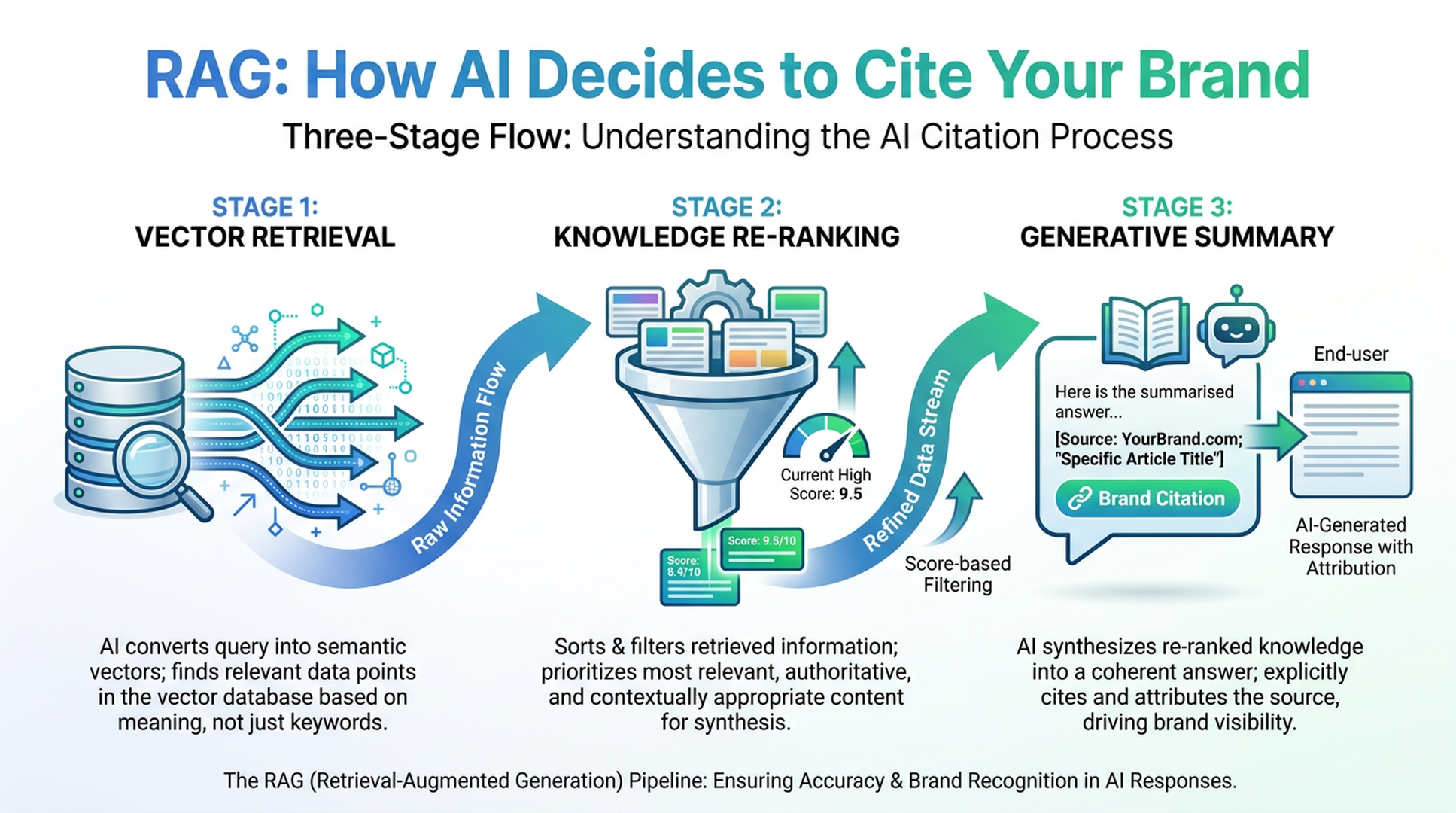
The implication is clear: enterprises must shift from pursuing "page indexing" to achieving "semantic positioning." GEO's core goal is making your brand's terminology, solutions, and advantages the semantic coordinates that AI cannot bypass when answering questions in your domain.
The New Measurement Framework: Three Dimensions That Replace Rankings
Traditional SEO rankings are obsolete for measuring AI visibility. The new GEO evaluation framework has three dimensions:
Dimension 1: Semantic Share
How frequently and densely does your brand appear as a core reference when AI answers questions in your domain? This isn't about ranking position — it's about citation density.
Dimension 2: Decision Impact Factor
To what extent does your brand information influence the user's final decision? Being mentioned is one thing. Being the reason someone chooses you is another.
Dimension 3: Brand Recognition Retention
Across multiple conversation turns and different contexts, how well does AI maintain consistent, accurate brand information? This measures whether your brand stays top-of-mind in ongoing AI interactions.
What Actually Works: The Evidence
Brand-Owned Content Dominates
BrightEdge analyzed 6.8 million AI citation data points and found that brand-owned content (websites, blogs, white papers) accounts for 67% of all AI citation sources — far exceeding social media (18%) and user-generated content (15%).
This means building your own "credible source signal system" is the foundation of GEO. You can't outsource your authority.
The "Question-Answer-Evidence" Structure
Research from Princeton University and Georgia Tech found that content using a "Question-Answer-Evidence" structure gets cited by AI 4.7x more often than traditional blog posts. Adding structured data markup (Schema.org) increases sustained citation rates across multi-turn conversations by 3.2x.
Real-World Results
A B2B hardware company created 30+ in-depth technical blogs, multi-language FAQs, and structured Schema markup. Within 6 months:
- AI search visibility jumped from 15% to 85%
- Brand search volume increased 300%
- ROI reached 6.2:1
An international beauty brand implemented a comprehensive semantic asset strategy. Results:
- AI platform mention rate rose from 12% to 48%
- TOP3 positioning rate in Western markets improved from 22% to 89%
- Offline conversion grew 2.3x
Three Traps to Avoid
Trap 1: Mass-Producing Low-Quality Content
The mistake: Generating large volumes of semantically repetitive, fact-light articles to flood AI retrieval databases.
The consequence: You trigger AI downranking mechanisms. Your domain may even end up on negative lists for model training.
The fix: Focus on semantic anchoring — build high-quality knowledge graphs with industry depth, data reports, and original insights. Long-term retention rates are 5.5x higher than "publishing thousands of articles daily."
Trap 2: Ignoring Cross-Language Semantic Gaps
The mistake: Machine-translating content and publishing it directly without adapting cultural context and professional terminology.
The consequence: AI can't correctly understand brand meaning in other languages, leading to retrieval failures or context confusion.
The fix: Build multilingual semantic alignment systems and industry terminology mapping libraries. One foreign trade company improved contract retrieval accuracy from 60% to 98% using this approach.
Trap 3: Confusing Old SEO Tactics with GEO
The mistake: Service providers promising "guaranteed #1 ranking" or using outdated link-building and keyword-stuffing methods.
How to tell the difference: Real GEO providers show you "semantic node maps" or "citation chain analysis" — revealing your brand's position in AI reasoning logic, not just indexing and rankings.
Your 3-Step GEO Roadmap
Step 1: Audit Your Current AI Visibility
Open ChatGPT, Perplexity, Gemini, and Claude. Search for your brand name, core products, and key industry questions. Document where you appear, where you're missing, and where you're misrepresented.
This is your baseline. Without it, you're optimizing blind.
Step 2: Build Semantic Assets
Create content that AI can't ignore:
- Use the Question-Answer-Evidence structure
- Add structured data markup (FAQ schema, Article schema)
- Include specific data, research citations, and verifiable claims
- Ensure each paragraph can stand alone as a complete information unit
- Update content regularly to maintain freshness
Focus on depth over volume. Ten authoritative, well-structured pieces outperform a hundred thin articles.
Step 3: Expand Your Semantic Footprint
Don't limit GEO to your website. AI retrieves from multiple sources:
- Industry publications and media coverage
- Professional communities and forums
- White papers and research reports
- Social platforms and expert profiles
Build consistent brand signals across all these surfaces. When AI encounters your brand from multiple independent sources, it reinforces authority and increases citation probability.
The Bottom Line
The brands that will thrive in 2026 and beyond aren't necessarily the ones with the biggest SEO budgets. They're the ones that understand a fundamental shift: visibility in AI search requires a completely different approach than visibility in traditional search.
Semantic invisibility isn't a future risk. It's a present reality for most brands.
The question isn't whether you should start doing GEO. It's whether you can afford to wait another quarter while your competitors establish their semantic positions.
Your customers are already asking AI about your industry. The only question is whether AI has anything to say about you.
FAQ
What is "semantic invisibility" in AI search? Semantic invisibility occurs when your brand fails to be retrieved and cited by AI systems during their answer generation process. Even if your website ranks well in traditional search, AI may not reference your content when answering user questions — making you effectively invisible to the growing population of AI search users.
Why is traditional SEO not enough for AI search? Traditional SEO optimizes for keyword matching and page rankings. AI search uses RAG (Retrieval-Augmented Generation) which retrieves content based on semantic similarity, authority, and freshness — not keyword density. You need GEO to optimize for how AI understands and cites information.
How do I measure GEO success? The new framework has three dimensions: semantic share (how often you're cited), decision impact factor (how much you influence choices), and brand recognition retention (consistency across multiple AI conversations). Tools like Bing Webmaster Tools now offer GEO reporting with citation share data.
What content structure works best for GEO? Research shows the "Question-Answer-Evidence" structure increases AI citation probability by 4.7x compared to traditional blog posts. Add structured data markup for a 3.2x boost in sustained citations across multi-turn conversations.
How long does it take to see GEO results? Unlike traditional SEO which takes weeks to months, GEO can show results faster. One case study showed visibility improvements within 6 months. However, building the semantic asset foundation takes time — focus on quality and consistency over speed.
Can I do GEO alongside SEO? Yes, and you should. GEO builds on SEO foundations. Brand-owned content accounts for 67% of AI citations, so your website and content remain critical. GEO adds layers like semantic structure, entity clarity, and cross-platform authority signals that complement traditional SEO.