The Buyer Answer First
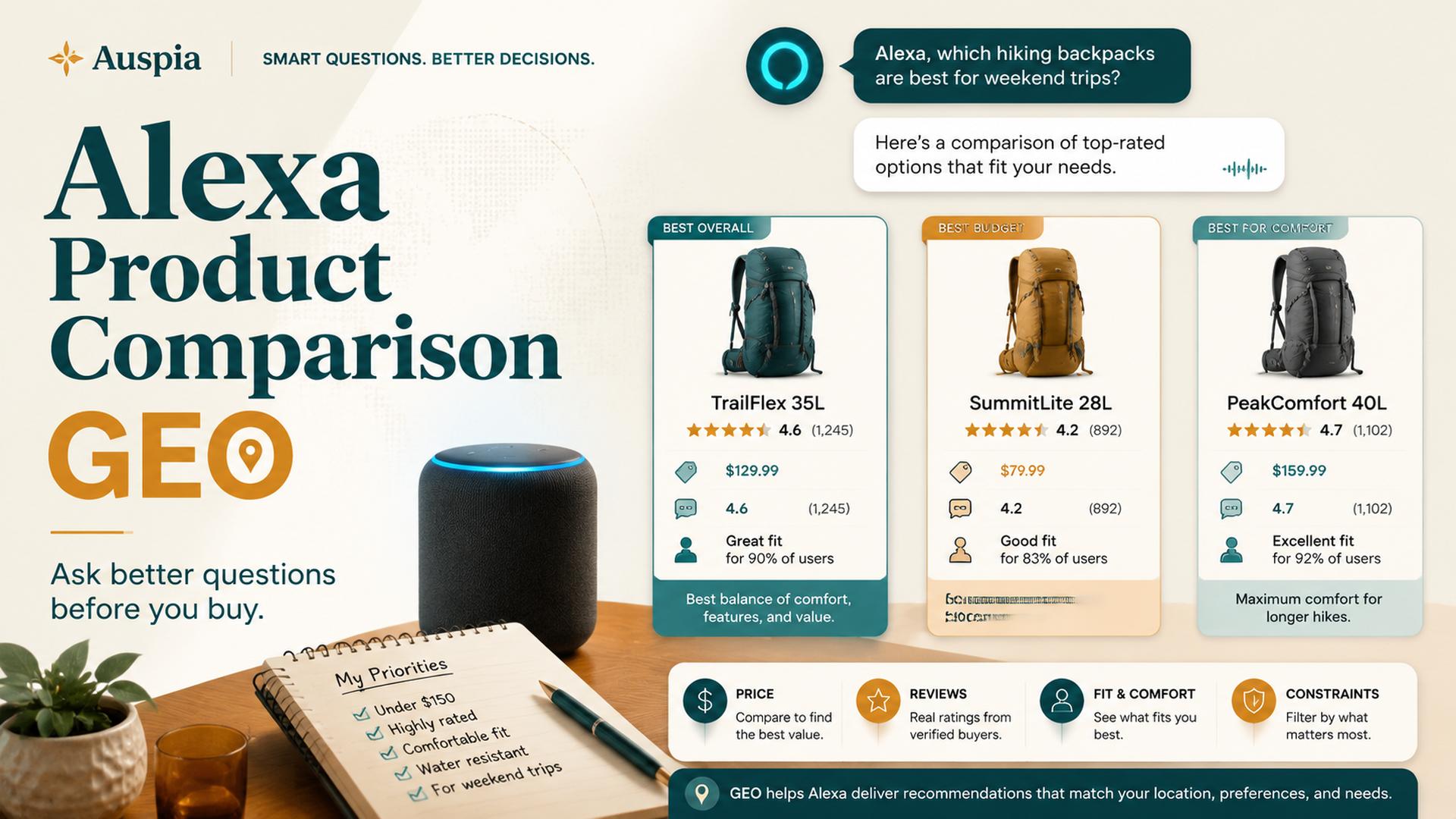
Alexa Product Comparison GEO is about asking product questions that are specific enough for a voice assistant, AI shopping assistant, or Amazon search flow to return useful comparisons. For buyers, the goal is not to get the fastest answer. The goal is to avoid vague recommendations that ignore your real constraints.
If you are comparing products with Alexa or any AI-assisted shopping surface, ask about use case, constraints, evidence, tradeoffs, and final checks. A better question is not “What is the best air purifier?” A better question is “Which air purifier is better for a small bedroom, low noise at night, and replacement filters under $40?”
DataForSEO research for this topic showed amazon product comparison as a small but commercial-intent keyword. The volume is not the point. The intent is. People comparing products are close to a decision, and the questions they ask shape what assistants can safely summarize.
Why Product Comparison By Voice Can Go Wrong
Voice shopping feels simple because the question is short. Product comparison is not simple. A good comparison needs context.
When a buyer asks a vague question, the assistant may lean on broad popularity, past purchase behavior, availability, ratings, or incomplete product facts. That can be helpful for low-risk items, but it can be weak for products where fit matters.
Common failure modes include:
- The recommendation ignores size, compatibility, or household constraints.
- A cheaper product has the wrong pack count or model.
- A highly rated product has review complaints that matter to your use case.
- A voice answer hides tradeoffs that would be obvious on a comparison page.
- The assistant compares categories instead of exact products.
- The buyer treats a summarized answer as a final decision.
The fix is to ask comparison questions like a careful shopper, not like a search box.
The Five-Part Comparison Question
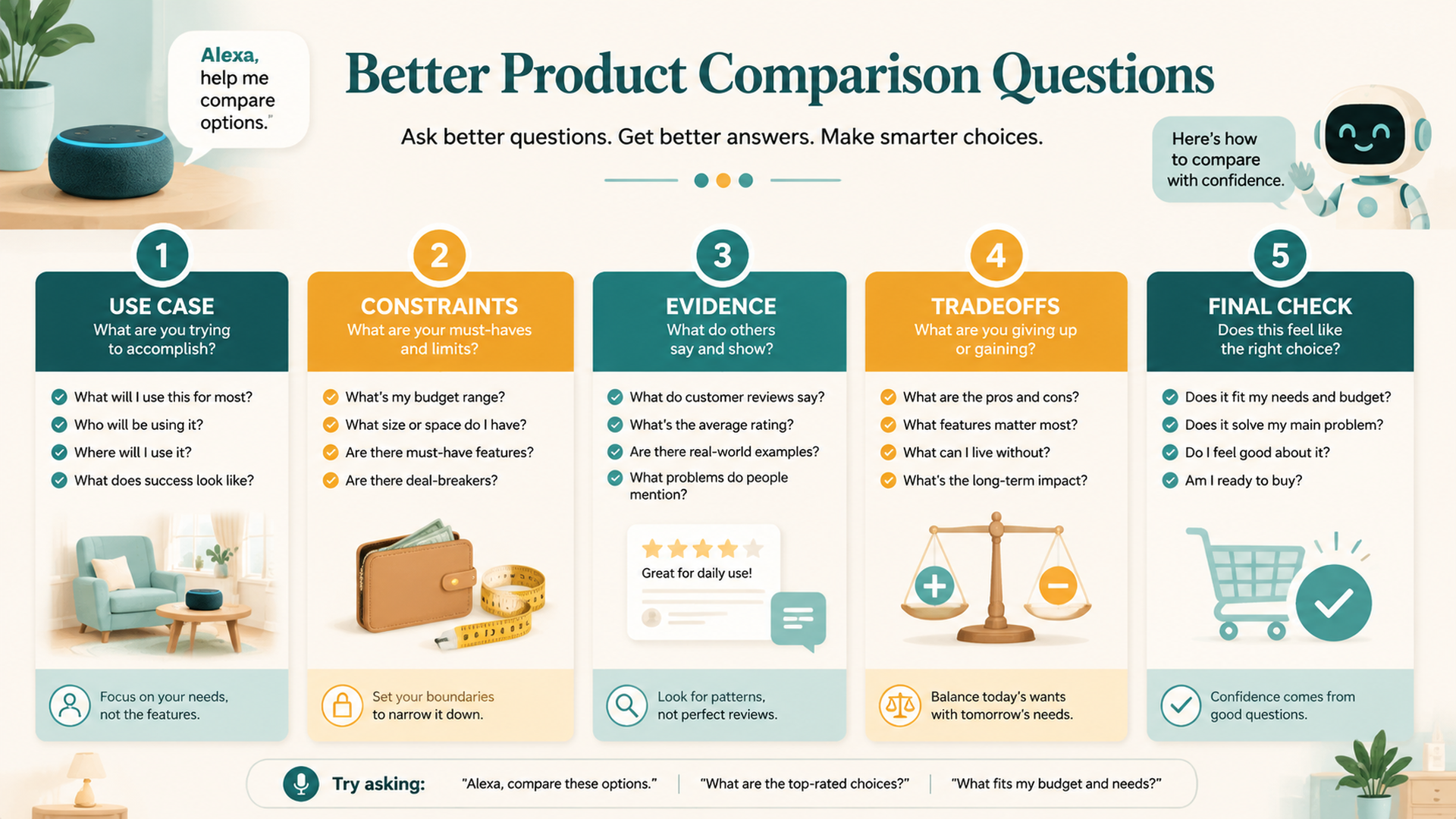
Use this structure when asking Alexa or any AI shopping assistant for help:
Question part | What to include | Example |
|---|---|---|
Product category | What kind of item you need | “smart plug,” “air purifier,” “coffee grinder” |
Use case | Where and how you will use it | “small bedroom,” “daily espresso,” “shared apartment” |
Constraint | What must be true | “works with Alexa,” “under $50,” “quiet at night” |
Evidence | What proof matters | “reviews mention easy setup,” “low return complaints” |
Decision check | What you want compared | “compare price, filter cost, noise, and reviews” |
A complete prompt might be:
“Alexa, help me compare two smart plugs for a small apartment. I care about Alexa compatibility, no hub, easy setup, and reliable reviews. What should I check before buying?”
Even if Alexa cannot answer every detail perfectly, the question pushes the shopping flow toward the right evidence.
Better Questions By Product Type
Different products need different comparison questions. Do not use the same prompt for dog food, smart bulbs, supplements, and electronics.
Product type | Better comparison question |
|---|---|
Smart home device | “Which option works with Alexa without a hub, supports 2.4 GHz Wi-Fi, and has fewer setup complaints?” |
Consumable | “Which product has the better unit price, pack count, recent reviews, and reorder fit?” |
Appliance part | “Which replacement filter matches my model number and has reliable fit reviews?” |
Pet food | “Which formula matches small adult dogs, salmon flavor, and repeat purchase reviews?” |
Beauty product | “Which option is fragrance-free, travel-size, and has reviews from sensitive-skin buyers?” |
Electronics | “Which model is newer, compatible with my device, and has fewer battery complaints?” |
This is buyer-side GEO in practice: better input creates better assistant output.
Ask, Then Verify
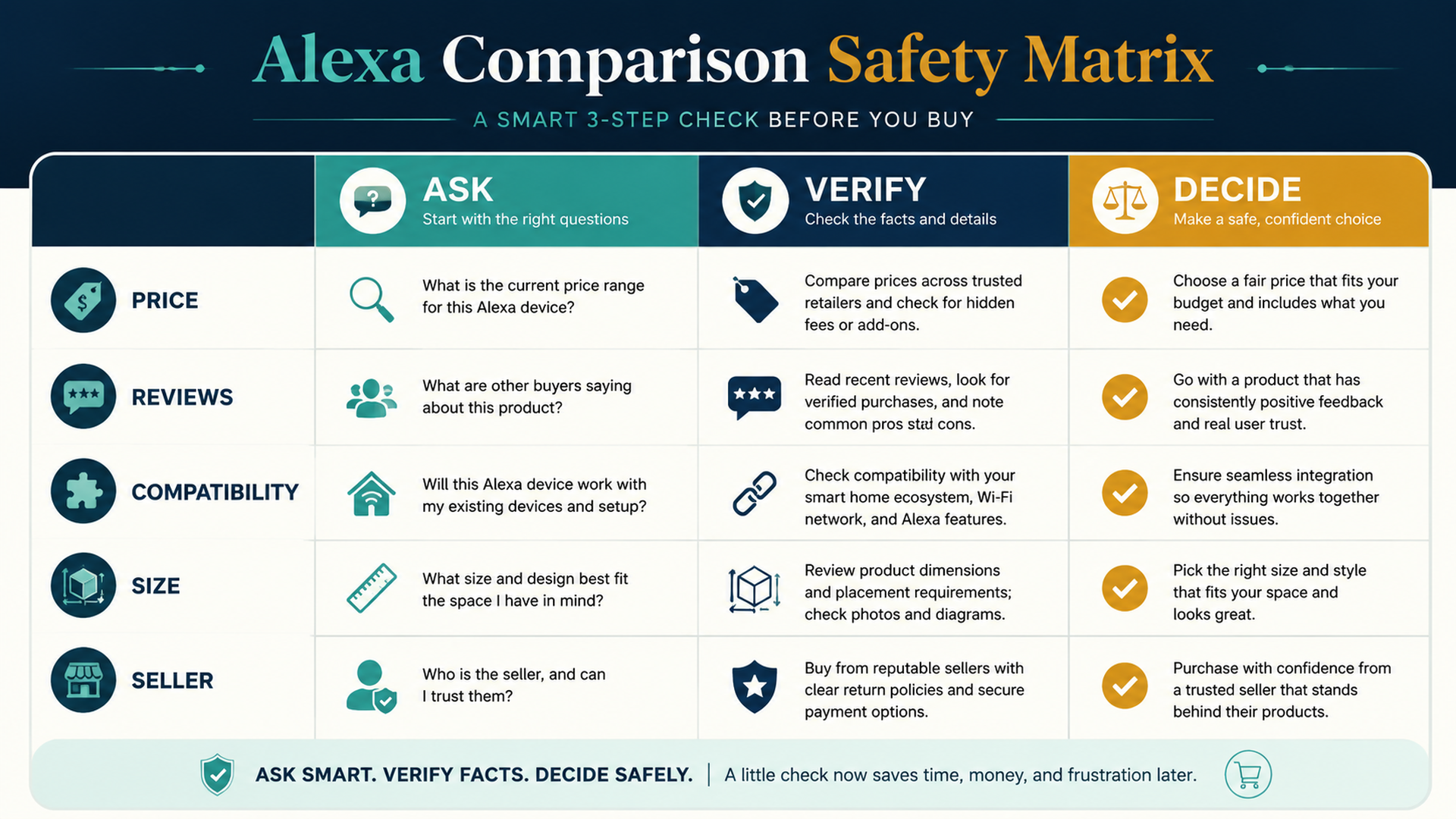
A product comparison answer should create a shortlist, not replace verification. After the assistant gives a recommendation or comparison, verify the details manually.
Assistant answer says | Buyer should verify |
|---|---|
“Best value” | Unit price, pack count, coupon, subscription status |
“Works with Alexa” | Hub requirement, Wi-Fi band, app setup, supported commands |
“Highly rated” | Recent reviews, review themes, complaint patterns |
“Popular choice” | Whether popularity matches your use case |
“Fast delivery” | Delivery date, seller, return policy |
“Good for beginners” | Setup steps, support content, missing accessories |
The more expensive or personal the product, the more important verification becomes.
How To Compare Reviews Without Reading Everything
Reviews are useful, but a star rating is not enough. Ask for patterns.
Look for:
- Positive reviews that match your exact use case.
- Negative reviews that mention deal-breaking issues.
- Recent reviews, not only all-time average.
- Repeated complaints about setup, sizing, packaging, durability, or support.
- Review photos or details that confirm real usage.
- Differences between “good product” and “good for me.”
A useful question is:
“What do reviews say about setup difficulty, noise, and long-term reliability?”
That is better than asking whether the product is “good.”
Price Is Not Just Price
When comparing Amazon products, price can be misleading. Buyers should check the full price context.
Price factor | Why it matters |
|---|---|
Unit price | Pack counts can make the cheaper listing worse |
Coupon | Temporary discount may change the decision |
Subscribe & Save | Recurring purchase may not be intended |
Replacement cost | Filters, bags, blades, batteries, or refills add cost |
Shipping date | A cheaper item may arrive too late |
Seller | The same product can appear under different seller conditions |
Ask comparison questions that include cost over time, not just today’s visible price.
A Safer Comparison Workflow
Use this workflow for any product that costs enough to matter:
- Ask Alexa or Amazon for a shortlist, not a final answer.
- Add your constraints: price, size, compatibility, use case, delivery, review concern.
- Compare two or three products, not ten.
- Verify details in the product page or cart.
- Read recent critical reviews for deal-breakers.
- Check seller, return policy, delivery date, and subscription status.
- Decide only after the product matches your constraints.
The best comparison workflow is not the fastest. It is the one that prevents the wrong product from feeling convenient.
What Sellers Can Learn From Buyer Questions
This article is written for buyers, but sellers should pay attention. Every comparison question is a content clue.
If buyers ask about compatibility, setup, pack count, filter cost, sensitive skin, room size, replacement parts, or noise level, those details should be easy to find in listings, A+ Content, product Q&A, and support pages.
For sellers, GEO means making those facts clear enough for both buyers and AI systems to compare accurately.
FAQ
Can Alexa compare products for me?
Alexa and Amazon shopping surfaces can help with product discovery and comparison, but buyers should verify details such as price, seller, pack count, compatibility, reviews, and delivery before purchasing.
What is a good Alexa product comparison question?
A good question includes category, use case, constraints, evidence, and the decision criteria you care about. For example: “Compare two Alexa-compatible smart plugs under $25 that do not need a hub and have easy setup reviews.”
Should I trust a voice recommendation?
Use it as a starting point, not a final decision. Voice answers are convenient but may omit details that matter for your household, device, size, budget, or safety needs.
How do I avoid buying the wrong product after a comparison?
Check the exact product title, variant, model, seller, quantity, delivery date, recent reviews, and return policy before confirming the order.
How does product comparison relate to GEO?
GEO is about making information understandable for AI and answer systems. Buyers benefit by asking clearer questions; sellers benefit by publishing clearer product facts.
Auspia Takeaway
Product comparison by voice works best when the buyer supplies the missing context. Do not ask for the “best” product as if one answer fits everyone. Ask for the best fit under your constraints.
A good Alexa shopping question includes what you need, where you will use it, what could go wrong, and what proof matters. That is how voice shopping becomes useful without becoming careless.
Author: Nora Whitfield, AEO Specialist for 800+ Answer Patterns at Auspia. Nora writes about answer engine optimization, FAQ design, and clear question-and-answer content for AI-assisted search experiences.