Reorder Is Where Product Discovery Becomes Product Memory
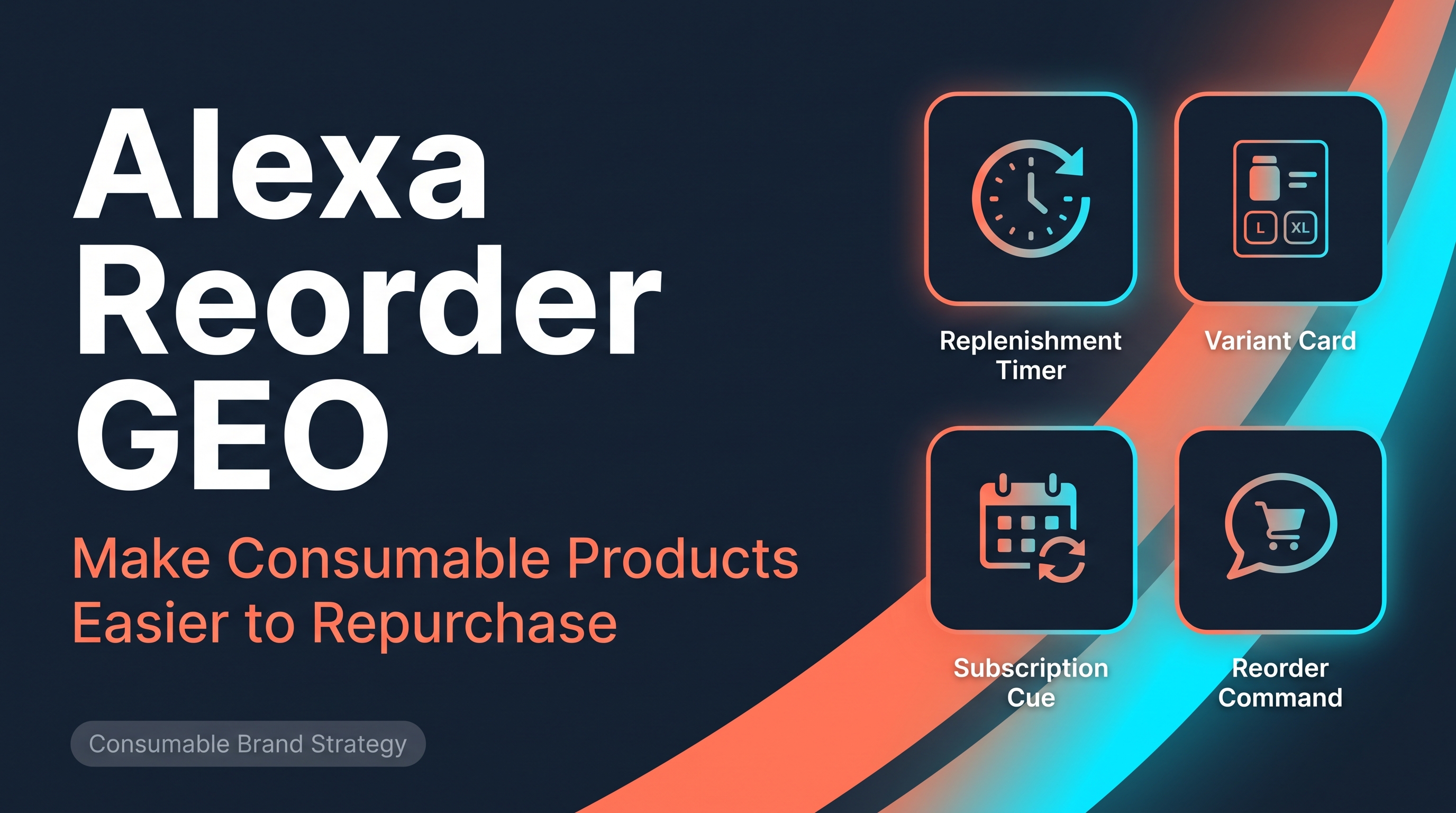
Alexa Reorder GEO is the practice of making consumable products easier to buy again through clear naming, variant structure, pack-size visibility, replenishment timing, and repeat-purchase evidence. It is most useful for products that customers run out of: coffee pods, vitamins, pet food, filters, batteries, detergent, shampoo, wipes, snacks, supplements, and other household staples.
The seller mistake is to treat reorder as a checkout feature. Reorder starts much earlier. It starts when the buyer remembers the product, recognizes the right variant, understands how long the pack lasted, and trusts that buying the same item again will not create a mismatch.
DataForSEO research for this Alexa series showed alexa reorder at about 50 monthly searches, alexa voice shopping at about 110, voice commerce at about 110, and alexa shopping list at about 1,600. Those are not huge product-keyword volumes, but they expose an important behavior: shoppers use voice and lists around routine purchase tasks. For consumable brands, the payoff is not only first discovery. It is reducing friction on the second, third, and tenth purchase.
The Reorder Problem Is Usually A Friction Problem
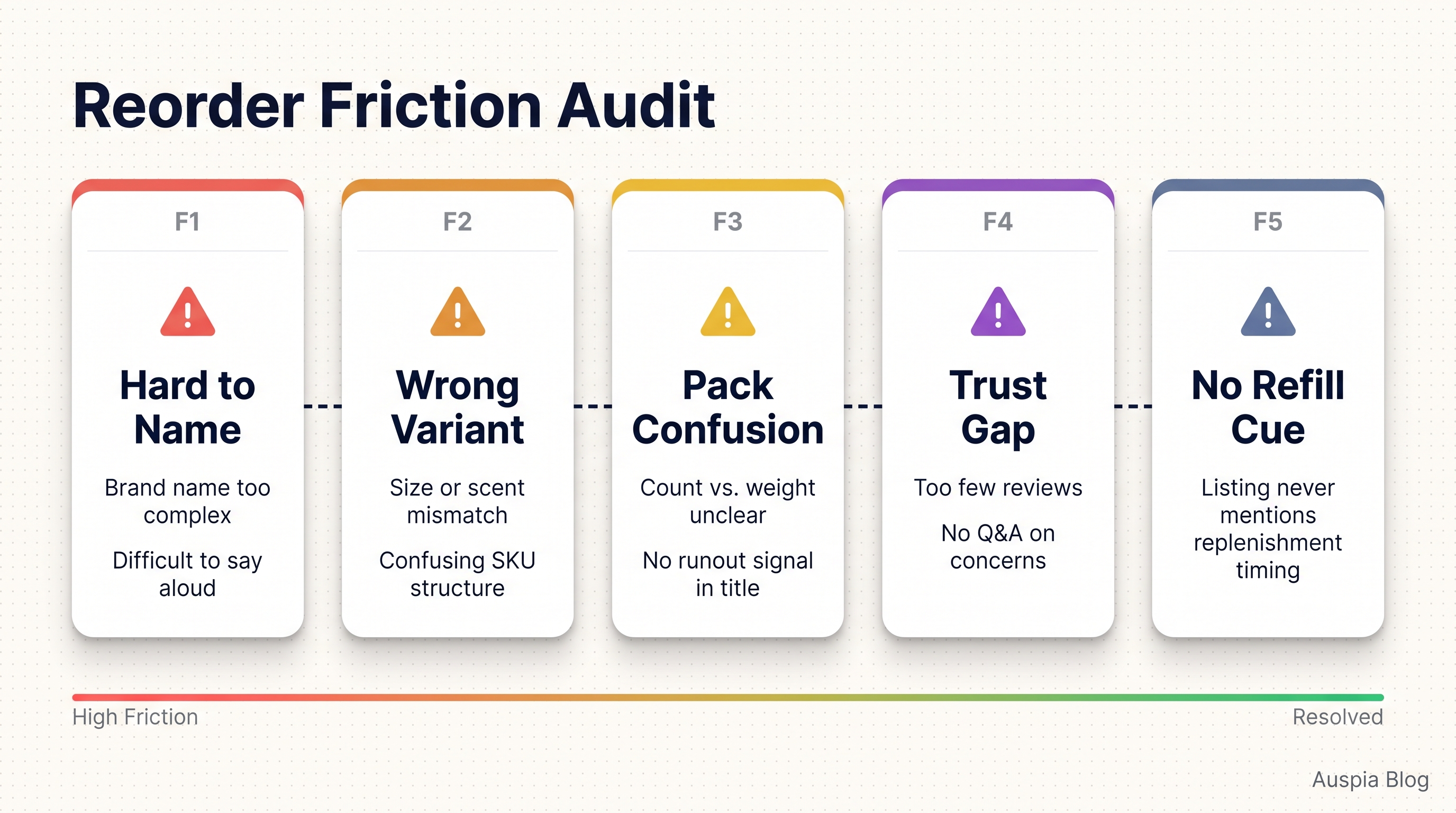
A buyer may like your product and still fail to reorder it if the product is hard to name, the variant is confusing, or the pack-size signal is weak. That friction matters more in voice and assistant-style shopping because the buyer cannot always visually compare every option before confirming.
Friction point | What happens | Seller fix |
|---|---|---|
Hard to name | Buyer cannot say or remember the product clearly | Use simple product naming and consistent variant labels |
Wrong variant | Buyer gets the wrong scent, flavor, model, size, or formula | Make variant differences visible in title, image, and variation names |
Pack confusion | Buyer cannot tell count, weight, supply length, or refill type | Put count and unit language in title, image, bullets, and A+ Content |
Trust gap | Buyer hesitates because reviews or Q&A do not answer repeat concerns | Strengthen review themes, Q&A, ingredients, compatibility, and warranty clarity |
No refill cue | Buyer does not know when to buy again | Explain runout timing, replacement cycle, or days of supply |
Alexa Reorder GEO is about removing those five friction points before the buyer has to think too hard.
Which Products Are Best Suited For Alexa Reorder GEO?
Not every product deserves a reorder-first strategy. Focus on products with predictable consumption, low evaluation complexity after the first purchase, and clear household routines.
Strong fit | Why it works | Example reorder phrase |
|---|---|---|
Coffee pods and tea | Routine daily use, flavor memory | "Reorder the dark roast pods" |
Vitamins and supplements | Repeat schedule, bottle depletion | "Buy the same magnesium gummies" |
Pet food and litter | Household necessity, predictable runout | "Add more adult dog food" |
Filters and replacement parts | Replacement cycle, compatibility matters | "Reorder the filter for model 300" |
Laundry and dish products | Household staple, scent/format memory | "Reorder the lemon dish soap refill" |
Personal care | Routine use, variant sensitivity | "Buy the same fragrance-free shampoo" |
Office and pantry supplies | Team or family restock behavior | "Order more printer paper" |
Low-repeat products can still benefit from voice search and Amazon SEO, but they usually do not need the same reorder operating model.
Reorder Readiness Starts With Product Naming
For a consumable product, the name must do two jobs: help first-time discovery and support future memory. A clever, abstract, or overly similar variant name may look attractive on packaging but create reorder confusion.
Use this naming test:
Test | Question | Example risk |
|---|---|---|
Sayability | Can a buyer say the name aloud without stumbling? | Acronyms, stylized spellings, long sub-brand names |
Distinction | Can the buyer tell variants apart by voice? | Fresh, Fresh+, Fresh Max, Fresh Pro |
Specificity | Does the name include the meaningful difference? | "Blue bottle" instead of "fragrance-free sensitive skin" |
Consistency | Is the same product named the same way across listings? | Variant name differs between title, image, and dropdown |
Memory | Would a buyer remember it after using the product for a month? | Generic claims with no distinctive anchor |
A reorder-friendly name does not have to be boring. It has to be stable, pronounceable, and specific.
Pack Size And Runout Timing Are GEO Signals
Pack size is not just a conversion detail. It tells buyers and assistants what the product is in practical household terms.
For reorder GEO, add these signals where accurate:
- Count: 60 tablets, 30 servings, 12 rolls, 100 wipes.
- Unit: oz, fl oz, lb, count, capsules, pods, filters.
- Supply length: lasts about 30 days, replaces every 3-6 months, one bag lasts four weeks for a medium dog.
- Refill type: refill pouch, cartridge, replacement filter, twin-pack, bulk pack.
- Usage context: daily, weekly, monthly, travel, family size, office use.
A buyer may not remember the exact title. They may remember "the 90 oz refill jug" or "the 30 lb adult dog food bag." Those practical anchors can help the product become easier to reorder.
The Consumable SKU Reorder Readiness Checklist
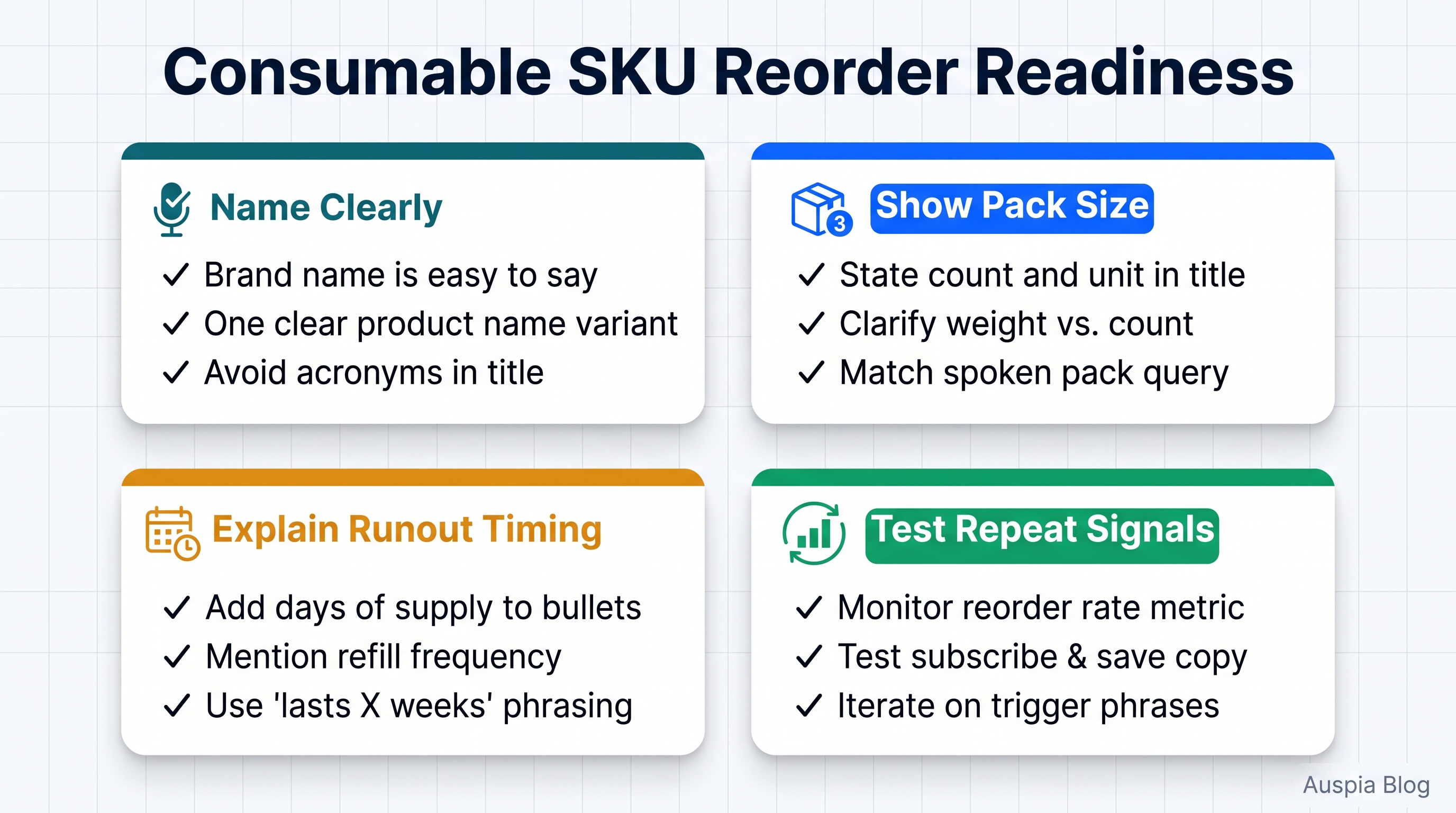
Use this checklist before pushing a consumable product into ads, subscriptions, or broader GEO work.
Readiness item | What good looks like |
|---|---|
Name clearly | Brand, product type, variant, and main use case are easy to say and remember |
Show pack size | Count, weight, size, or refill type appears in title, image, and bullets |
Explain runout timing | Listing explains how long the product typically lasts or when to replace it |
Protect variant clarity | Scent, flavor, formula, model, age range, or size is obvious |
Build trust evidence | Reviews, Q&A, and content address repeat-purchase concerns |
Support subscription logic | Subscribe & Save or routine restock language appears where relevant |
Track repeat signals | Seller monitors repeat purchase, Subscribe & Save, branded queries, and returns |
If a SKU fails two or more of these checks, it may still get first-time sales but lose reorder opportunities.
How To Rewrite Reorder Cues Without Overdoing It
Reorder copy should help buyers, not pressure them. Avoid manipulative urgency. Focus on practical clarity.
Asset | Reorder-friendly rewrite |
|---|---|
Title |
|
Bullet |
|
Image | Show all packs included, count per pack, and total count clearly. |
A+ Content | Compare single pack, bulk pack, and travel pack use cases. |
Q&A | Answer "How long does one box last?" and "Is this the same formula as the smaller pack?" |
Variation name |
|
The best reorder cue is often a factual statement: how much, how long, which variant, and for whom.
Reviews And Q&A Reveal Repeat-Purchase Gaps
A product may have a strong star rating but weak reorder clarity. Review mining helps reveal where customers hesitate on repurchase.
Look for phrases such as:
- "I bought the wrong size."
- "This is not the same as last time."
- "The scent changed."
- "I wish it came in a bigger pack."
- "The refill does not fit my dispenser."
- "I use one bottle per month."
- "This bag lasts my dog about three weeks."
These comments are not just customer service signals. They are GEO inputs. They show which product facts should be clearer for the next buyer and the next reorder.
Sponsored Products And Reorder Learning
Amazon Sponsored Products can help sellers learn which queries produce first purchase and which queries suggest repeat purchase.
Segment search term data into:
Query pattern | Meaning | Action |
|---|---|---|
Generic category | First discovery | Improve title/category relevance and main image |
Brand + product | Brand memory | Protect branded visibility and variant clarity |
Pack size | Quantity-driven purchase | Test title and image emphasis around count or size |
Refill/replacement | Reorder or compatibility need | Strengthen compatibility and replacement-cycle content |
Subscribe/save | Routine restock intent | Test subscription messaging and bulk options |
Same/again/usual | Repeat behavior language | Make product and variant naming more stable |
Paid data should not replace organic optimization, but it can show which words buyers use when they already know what they want.
Measurement: What To Watch After Reorder Optimization
Do not judge reorder GEO only by ranking. Watch signals that indicate reduced friction and stronger habit formation.
Metric | Why it matters |
|---|---|
Repeat purchase rate | Shows whether the product becomes a routine choice |
Subscribe & Save adoption | Indicates planned replenishment behavior |
Branded search terms | Shows memory and preference growth |
Variant return reasons | Reveals wrong-size or wrong-variant friction |
Q&A volume | Shows whether pre-purchase questions are declining or shifting |
Review themes | Confirms whether buyers understand size, formula, fit, and routine use |
Ad search terms | Shows which reorder phrases convert |
Conversion by pack size | Helps identify the most reorder-friendly offer |
If repeat purchase improves but returns also rise, you may have made buying easier without making the correct choice clearer. Reorder GEO needs both.
A 21-Day Reorder Optimization Sprint
Days | Work | Output |
|---|---|---|
1-3 | Identify high-repeat ASIN families | Priority SKU list |
4-5 | Audit titles, variation names, and pack-size clarity | Naming gap sheet |
6-7 | Mine reviews, Q&A, returns, and support tickets | Reorder friction map |
8-10 | Rewrite title, bullets, image callouts, and variation names where needed | Draft listing updates |
11-13 | Add A+ comparison and routine-use modules | Replenishment content |
14-15 | Update Q&A around runout, compatibility, variant, and refill questions | Risk-removal answers |
16-18 | Review Sponsored Products search term patterns | Query evidence |
19-21 | Launch a controlled test or measurement dashboard | Reorder tracking plan |
Start with one product family. If the pattern works, expand to related consumables.
Mistakes That Make Reorders Harder
Mistake 1: Renaming products too often. Frequent naming changes can weaken memory. Refresh copy carefully without breaking recognition.
Mistake 2: Treating all variants as equal. Some variants are better for first purchase; others are better for routine replenishment. Separate the strategy.
Mistake 3: Hiding size and supply length. Buyers should not need to calculate how long a product lasts.
Mistake 4: Ignoring compatibility. For filters, refills, cartridges, parts, and pet formulas, wrong-fit risk can block reorders.
Mistake 5: Overpromising routine benefits. Do not claim exact supply duration unless you can support it. Use careful language such as "about," "typical," or "depending on usage" where needed.
FAQ
What is Alexa Reorder GEO?
Alexa Reorder GEO is the process of making consumable products easier to remember, distinguish, and buy again in voice, list, and assistant-style shopping journeys.
Is reorder GEO only for Alexa?
No. Alexa is one visible behavior surface, but the same principles apply to Amazon search, shopping lists, subscriptions, ads, AI shopping assistants, and product detail pages.
Which products should prioritize reorder GEO first?
Start with products that run out predictably and have meaningful repeat-purchase value: coffee, supplements, pet food, cleaning supplies, filters, wipes, shampoo, batteries, pantry items, and office supplies.
Should sellers add the word "reorder" to every listing?
No. Use reorder language only where it helps the buyer understand routine use, refill timing, pack size, or subscription value. Do not stuff "reorder" into titles or bullets if it sounds unnatural.
How do I know if reorder optimization worked?
Track repeat purchase rate, Subscribe & Save adoption, branded search terms, return reasons, review themes, Q&A patterns, and conversion by pack size or variant.
Auspia Takeaway
Alexa Reorder GEO is about reducing repeat-purchase friction. A buyer who already likes the product should not have to decode variant names, guess pack size, search for compatibility, or remember a complicated label.
Make the product easy to say, easy to identify, easy to distinguish, and easy to replenish. That is how consumable brands turn a first purchase into a repeatable habit.
Author: Ryan Chen, Senior Amazon Operations Expert with 10 Years in Marketplace Growth at Auspia. Ryan writes about Amazon GEO, marketplace search behavior, AI-assisted product discovery, listing optimization, and operational playbooks for Amazon sellers.