The short version
Backlinks still matter in 2026, but the game has narrowed. A link is useful when it comes from a relevant page, on a real site, with real traffic or editorial standards. A link is risky when it exists only because someone sold a placement and nobody would reasonably click it.
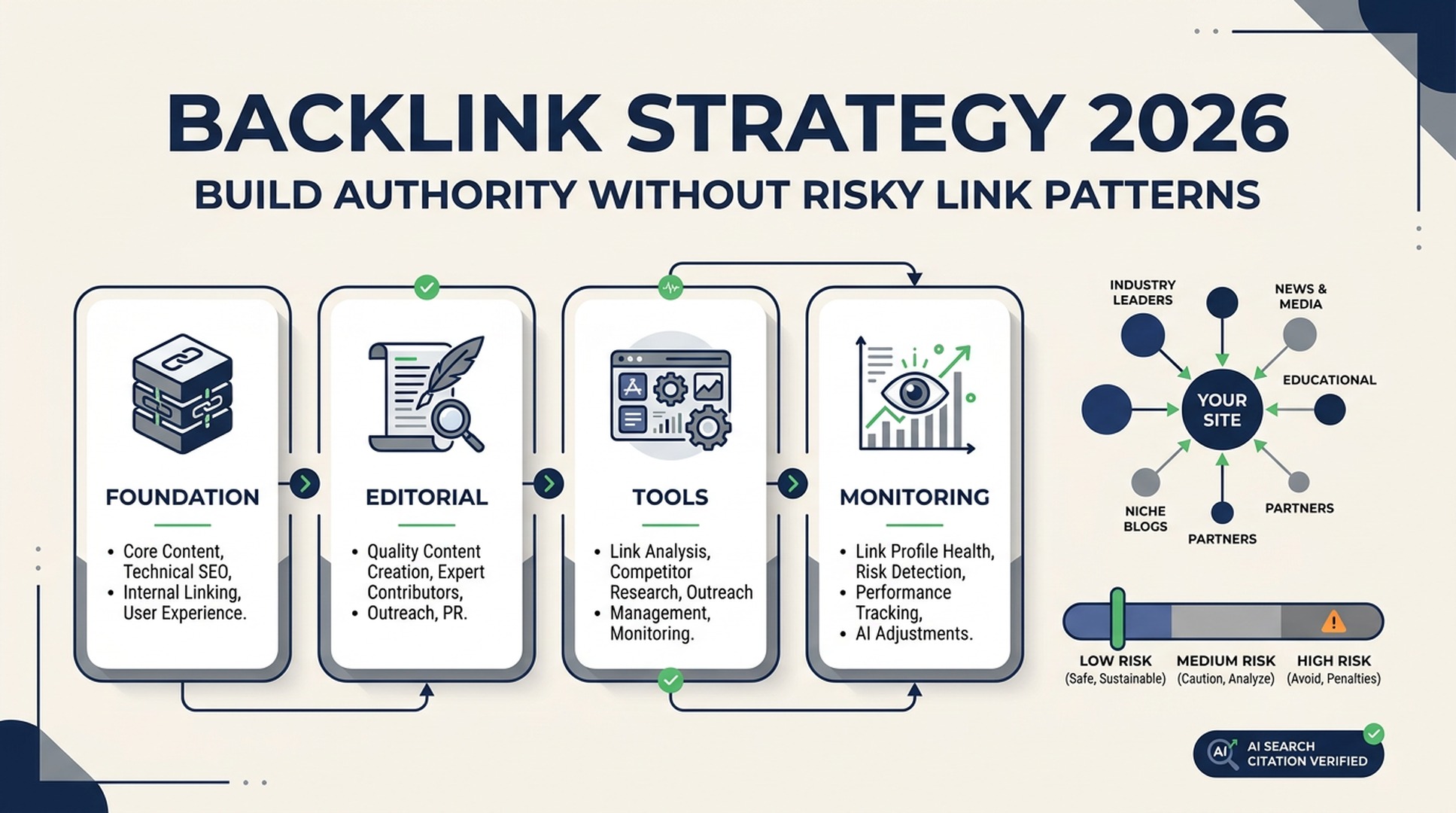
For growth teams, the goal is no longer "get more backlinks." The goal is to build a believable authority graph around the pages that need to rank, get cited, and convert. That means a mix of foundational brand links, editorial mentions, tool or data citations, expert quotes, and carefully monitored partner links.
This matters for more than classic Google SEO. AI answer systems and search assistants increasingly summarize brands by reading pages, references, entity signals, and third-party mentions. Weak links may not help. Strong, context-rich mentions can make your site easier to trust, understand, and cite.
If you only do one thing this quarter, audit your backlink profile by page intent: homepage trust, category authority, product proof, and article-level references. Then build links to the pages that actually deserve outside citations.
What counts as a backlink in 2026
A backlink is a link from another website to your website. Google can use links to discover pages, understand relationships between sites, and evaluate authority. The old mental model still helps: a good link is a vote. The 2026 version needs one extra line: a good link is a vote that makes sense in context.
A link from a respected SaaS review guide to your comparison page says something different from a random profile link on an abandoned Web 2.0 site. Both are technically links. Only one is likely to help a human, a crawler, or an AI answer engine understand why your page deserves attention.
The metrics many SEO teams use are still useful, but they should not be treated as truth:
Signal | What it tells you | What to check before trusting it |
|---|---|---|
Referring domains | How many unique sites link to you | Are they real, relevant, and indexed? |
Domain authority or domain rating | Estimated strength of the linking domain | Does the site have actual organic traffic? |
URL-level authority | Strength of the exact linking page | Is the page internally linked and indexed? |
Link placement | Where the link appears on the page | Is it in the main content or buried in boilerplate? |
Anchor text | The words used in the link | Does it look natural, varied, and reader-friendly? |
Topical relevance | Fit between the linking page and your page | Would a real reader expect this recommendation? |
Auspia's view is simple: use link metrics to shortlist opportunities, then judge the page like an editor. If the page would embarrass your brand in a sales call, skip it.
The link types worth knowing
You do not need a complicated taxonomy, but you do need to understand the difference between links that pass ranking value, links that send trust, and links that only create noise.
Link type | How to think about it | Typical use |
|---|---|---|
Dofollow | The default link type and the main target for authority building | Editorial citations, partner pages, guest articles |
Nofollow | May not pass PageRank in the old direct sense, but can still bring traffic and discovery | Communities, comments, some media sites, social platforms |
Sponsored | Required for paid placements and affiliate-style links | Sponsorships, paid articles, advertorials |
UGC | Used for user-generated links | Forums, community posts, public profiles |
Placement matters too. A contextual link inside a useful paragraph is usually stronger than a sidebar or footer link. A link from a page that already has 80 outbound links is usually weaker than a link from a focused resource page. A link from an indexed page with search traffic is safer than one from a page that no one, including Google, seems to visit.
A clean backlink portfolio has four layers
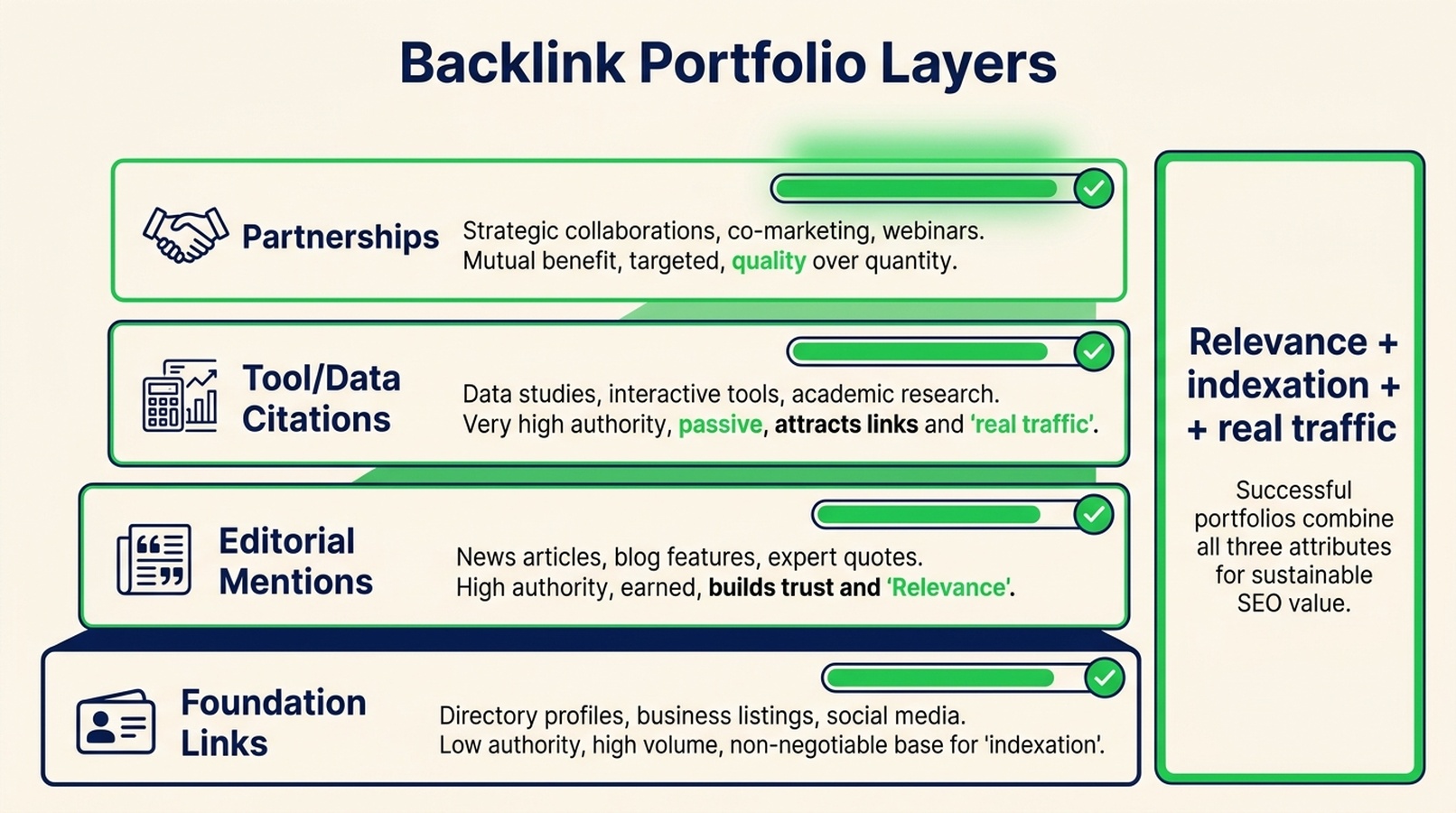
Caption: A healthy backlink profile has several layers: basic entity links, editorial mentions, linkable tools or data, and transparent partnerships.
Most teams either underbuild links or overcorrect into risky shortcuts. A healthier approach is to build four layers.
Layer 1: Foundation links
These are basic brand and entity links that help search engines confirm that your company exists. They rarely move rankings by themselves, but they help early discovery and make your footprint look normal.
Good examples include:
- LinkedIn company page, YouTube channel, GitHub organization, Crunchbase, product profiles, podcast pages, and reputable business directories.
- Founder or executive bios on conference pages, partner sites, and professional communities.
- Tool directories or startup directories where the listing is moderated and relevant.
Do not spend months here. For a new site, build the obvious foundation links in the first two weeks, then move on.
Layer 2: Editorial and expert links
These are links earned because your page, quote, data, or tool helps someone else's article. This is where durable authority comes from.
Common routes:
- Guest posts on sites with real editorial standards.
- Expert quotes for journalists and industry writers.
- Resource page submissions.
- Broken-link replacement when your content is a better substitute.
- Competitor backlink replication after manual filtering.
The catch: outreach only works when the asset is worth citing. A generic blog post rarely earns good links. A benchmark, calculator, original chart, template, glossary, or clearly argued guide has a much better chance.
Layer 3: Product, tool, and data citations
In 2026, tools and data assets are often more linkable than articles. People cite useful things. A free checker, calculator, comparison table, dataset, or teardown can attract links without asking every time.
For example, a team working on AI search visibility could build a public checklist, run a small benchmark across common AI answer surfaces, and publish the methodology. That gives writers a reason to cite the page. If you need a starting point, Auspia's AI Search Visibility Checker is the kind of asset that can support both user acquisition and link earning.
Layer 4: Partnerships and paid visibility
Partnerships, sponsorships, and paid placements can be useful when they are transparent and relevant. They become a problem when teams try to hide them as organic endorsements.
If money or material compensation changes hands, use the right relationship attribute, usually rel="sponsored". Google's link spam policies are not new, but enforcement and detection have improved. The practical rule is easy: do not build a link profile you would be afraid to explain.
How to judge a backlink opportunity
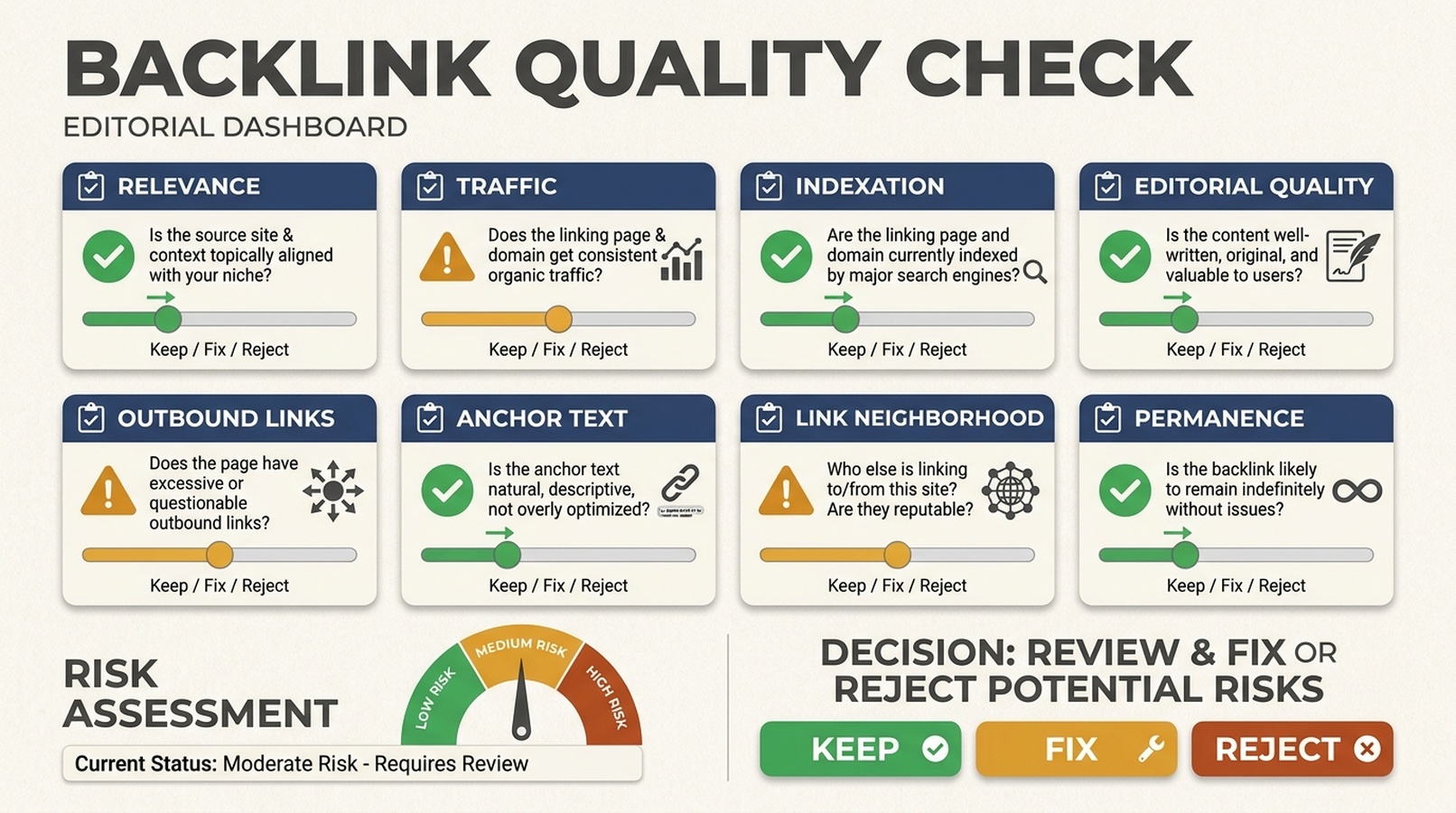
Caption: Score every backlink opportunity before outreach or purchase. Good metrics do not rescue a bad page.
Before you pitch, buy, trade, or accept a link, score the opportunity across eight checks.
Check | Good sign | Warning sign |
|---|---|---|
Relevance | The linking page discusses the same topic, audience, or problem | The site covers every niche under the sun |
Traffic | The domain or page has stable organic visibility | Traffic collapsed recently or never existed |
Indexation | The exact linking page is indexed | Google cannot find the page |
Editorial quality | Content is written for readers | Thin AI posts, spun content, or obvious link farms |
Outbound links | A modest number of useful external links | Dozens of unrelated money links |
Anchor text | Brand, URL, partial-match, or natural phrase | Exact-match commercial anchors repeated everywhere |
Link neighborhood | Other linked sites are credible | Gambling, adult, pills, crypto spam, hacked pages |
Permanence | Clear terms and replacement policy | No guarantee, no examples, no contact trail |
For paid providers, ask for samples before ordering. Check the sample pages in Moz, Ahrefs, Semrush, or another backlink tool. Look at spam score, traffic, outbound links, and page indexation. Then ask whether the final pages will match the same quality range. Many bad providers show one impressive sample and deliver something else.
The 2026 link-building methods that still work
1. Foundation backlinks for new sites
Build 20 to 40 basic brand links across legitimate profiles, directories, product pages, and owned channels. Keep the anchors mostly branded or naked URL anchors. Link to the homepage, a category page, and one or two strong resources.
This is not a ranking hack. It is housekeeping.
2. Skyscraper content with a real upgrade
The old skyscraper method was simple: find a page with many backlinks, make something better, then ask people linking to the old page to cite yours. The method still works when "better" means something specific.
Better can mean:
- More current data for 2026.
- A clearer framework or decision tree.
- Better visuals that writers can reference.
- Original examples across global markets, not recycled local anecdotes.
- A downloadable template or calculator.
Do not pitch "we wrote a comprehensive guide." Everyone writes comprehensive guides. Pitch the exact improvement.
3. Broken-link replacement
Find dead links on relevant resource pages or old articles. Recreate the missing value with your own updated page. Then contact the editor with a short note: the link is broken, your replacement is relevant, and here is why it helps their readers.
This is slow work. It scales through good prospecting, not through longer emails.
4. Guest posting with editorial standards
Guest posting is not dead. Low-quality guest posting is. A good guest post should read like something the host site would have published without you. The link should be a supporting citation, not the point of the article.
Use searches like:
Goal | Search operator examples |
|---|---|
Guest posts |
|
Resource pages |
|
Tools lists |
|
Research pages |
|
Education or nonprofit resources |
|
5. Expert quote outreach
Reporters, newsletter writers, and niche bloggers often need concise expert input. The winning response is usually specific, fast, and quotable. Include one useful claim, one data point or example, and a short bio. Skip the sales pitch.
6. Tool-led link earning
If your market is competitive, build linkable utilities. A calculator, checker, benchmark, or template often earns links more naturally than another thought-leadership post. For SEO and GEO teams, start with assets that answer practical questions: "Is this page crawlable by AI agents?" "Does this page have answer-ready structure?" "Which competitors are cited in AI answers?"
Auspia's SEO, GEO, and AEO tools are built around that same idea: useful diagnostic assets create demand, citations, and sales conversations at the same time.
7. Competitor backlink replication
Export competitor referring domains, remove junk, and group the remaining links by acquisition pattern. You are not looking for every link. You are looking for repeatable routes: review sites, partner pages, podcasts, data citations, communities, or industry directories.
The best competitor link is not the strongest metric. It is the one you can earn honestly with a better asset.
Outreach that does not sound like spam
Most outreach fails because it asks for a favor before giving a reason. Keep the first email short and specific.
Use this structure:
Subject: Broken link on your [topic] resource page

Hi [Name],

I was reading your page on [specific page topic] and noticed the link to [old resource] now returns a 404.

We recently published a 2026 version that covers [specific improvement], including [data/template/tool]. It may work as a replacement if you are updating the page:
[URL]

Either way, thought you would want to know about the broken link.

Best,
[Name]
Follow up once after three to five business days. A second follow-up is fine for high-value targets. After that, stop. If you need five reminders to get a link, the fit probably was not strong.
Also, do not rely only on email. Thoughtful comments, LinkedIn interactions, podcast appearances, community answers, and partner introductions can warm up outreach long before you ask for a link.
Where to point backlinks
Link building gets messy when every link goes to the homepage. Use the page's job to decide where links should point.
Target page | Link purpose | Anchor style |
|---|---|---|
Homepage | Brand trust and entity confirmation | Brand name, naked URL, company description |
Category or hub page | Topical authority | Partial-match terms, hub name, natural phrases |
Product or tool page | Commercial validation and referral traffic | Product name, use case, branded phrase |
Blog or research page | Citation and long-tail ranking | Article title, stat, methodology, source phrase |
Comparison page | Buying-stage proof | Brand vs category phrases, not aggressive exact-match anchors |
Keep anchor text varied. A natural profile includes brand names, URLs, article titles, image links, partial-match phrases, and a small amount of exact-match text. If 70 percent of new links use the same commercial anchor, you are creating a pattern that is easy to distrust.
How to monitor backlinks after they go live
A backlink is not done when the spreadsheet says "published." Check it.
Monthly checks:
- Is the linking page still live and indexed?
- Did the link remain dofollow, nofollow, sponsored, or UGC as agreed?
- Did the anchor text or target URL change?
- Did the linking page lose traffic or become a link farm?
- Did important links disappear?
- Are suspicious links growing around one page or anchor phrase?
Use Google Search Console for links Google reports to your own site. Use Ahrefs, Semrush, or Moz for broader monitoring. None of these tools is complete, so look for patterns rather than obsessing over one missing row.
When to disavow toxic backlinks
Most sites should not rush to use Google's Disavow Tool. Google ignores a lot of junk automatically. Disavow is mainly for serious cases: manual actions, obvious paid-link cleanup, hacked link spam, or large-scale toxic links that you cannot remove.
Consider disavow only when you see patterns like:
- Large batches of irrelevant links from hacked or auto-generated pages.
- Gambling, adult, pharma, or malware sites pointing at commercial pages.
- Foreign-language spam networks with unnatural exact-match anchors.
- A history of paid links that violates Google's guidelines.
- A manual action or credible risk of one.
If you do disavow, keep records. Try removal first when possible. Use domain:example.com for entire spam domains, and keep backups of every file you upload.
A practical 30-day backlink plan
Use this plan if you need momentum without creating risk.
Week | Action | Output |
|---|---|---|
1 | Audit current backlinks, anchors, lost links, and toxic patterns | Link-risk sheet and priority pages |
1 | Build or clean foundation profiles | 20 to 40 legitimate brand/entity links |
2 | Pick one linkable asset to improve | Updated guide, tool, benchmark, or template |
2 | Export competitor links and classify patterns | Prospect list by route, not just DR |
3 | Run resource-page and broken-link outreach | 50 to 100 targeted pitches |
3 | Pitch expert quotes to niche writers and newsletters | 10 to 20 high-fit responses |
4 | Review live links, indexation, anchors, and traffic | Keep, fix, replace, or reject list |
4 | Plan the next asset based on response data | A repeatable monthly link loop |
The best backlink programs behave like editorial operations. They publish assets worth referencing, build relationships with relevant publishers, and monitor quality after links go live.
Common mistakes
The fastest way to waste money is to buy metrics instead of pages. A DR 70 domain with no relevant traffic and a page full of casino links is not a premium opportunity. It is a liability with a nice number attached.
Other common mistakes:
- Sending every link to the homepage.
- Using the same exact-match anchor repeatedly.
- Ignoring nofollow links that bring qualified referral traffic.
- Publishing guest posts on sites that accept every submission.
- Treating AI-generated thin articles as linkable assets.
- Forgetting to check whether the linking page is indexed.
- Disavowing random low-quality links without a real risk signal.
Auspia takeaway
Backlinks in 2026 are less about volume and more about evidence. A useful link tells Google, AI search systems, and potential buyers that your page belongs in the conversation.
Build the kind of references a skeptical reader would accept: relevant pages, real editorial context, varied anchors, visible traffic, and assets worth citing. Then monitor the profile like a system, not a one-time campaign.
If you are already investing in SEO or GEO, treat backlinks as one layer of authority. Content explains what you know. Technical SEO makes it accessible. Backlinks and mentions show that other people have a reason to believe it.
FAQ
Are backlinks still important for Google SEO in 2026?
Yes. Backlinks still help Google discover pages and evaluate authority, but low-quality or irrelevant links are less useful and more risky than they used to be. Relevance, editorial context, and real traffic matter more than raw link count.
How many backlinks does a new website need?
There is no fixed number. A new site should usually start with a small set of legitimate foundation links, then earn links to its strongest pages. Ten good links from relevant sites can be more useful than hundreds of weak profile links.
Should I buy backlinks?
Paid visibility can be part of marketing, but paid links intended to pass ranking value are risky. If a placement is sponsored, label it with rel="sponsored". Avoid providers that cannot show real sites, indexed pages, traffic, and replacement terms.
What is the safest anchor text strategy?
Use mostly branded, URL, article-title, and natural partial-match anchors. Exact-match commercial anchors should be rare. A profile that looks natural to a human is usually safer than one designed only around keywords.
Do nofollow links help SEO?
Nofollow links may not pass PageRank in the same direct way as standard links, but they can still bring referral traffic, discovery, brand mentions, and secondary links. Do not ignore a relevant nofollow link from a real audience.
When should I use the Disavow Tool?
Use it only for serious link-risk situations, such as manual actions, known paid-link cleanup, hacked spam, or large toxic patterns you cannot remove. Most random low-quality links do not require disavow.