Executive Summary
GEO is not a reason to abandon SEO. It is a reason to make SEO cleaner, more evidence-based, and easier for AI answer systems to understand.
Most teams already do part of the work: crawlable pages, useful content, internal linking, schema, brand signals, reviews, and technical hygiene. The gap is that AI search systems do not only evaluate a single keyword page. They combine page content, brand mentions, citations, reviews, forum discussions, entity consistency, and crawler access before deciding which sources deserve to appear in an answer.
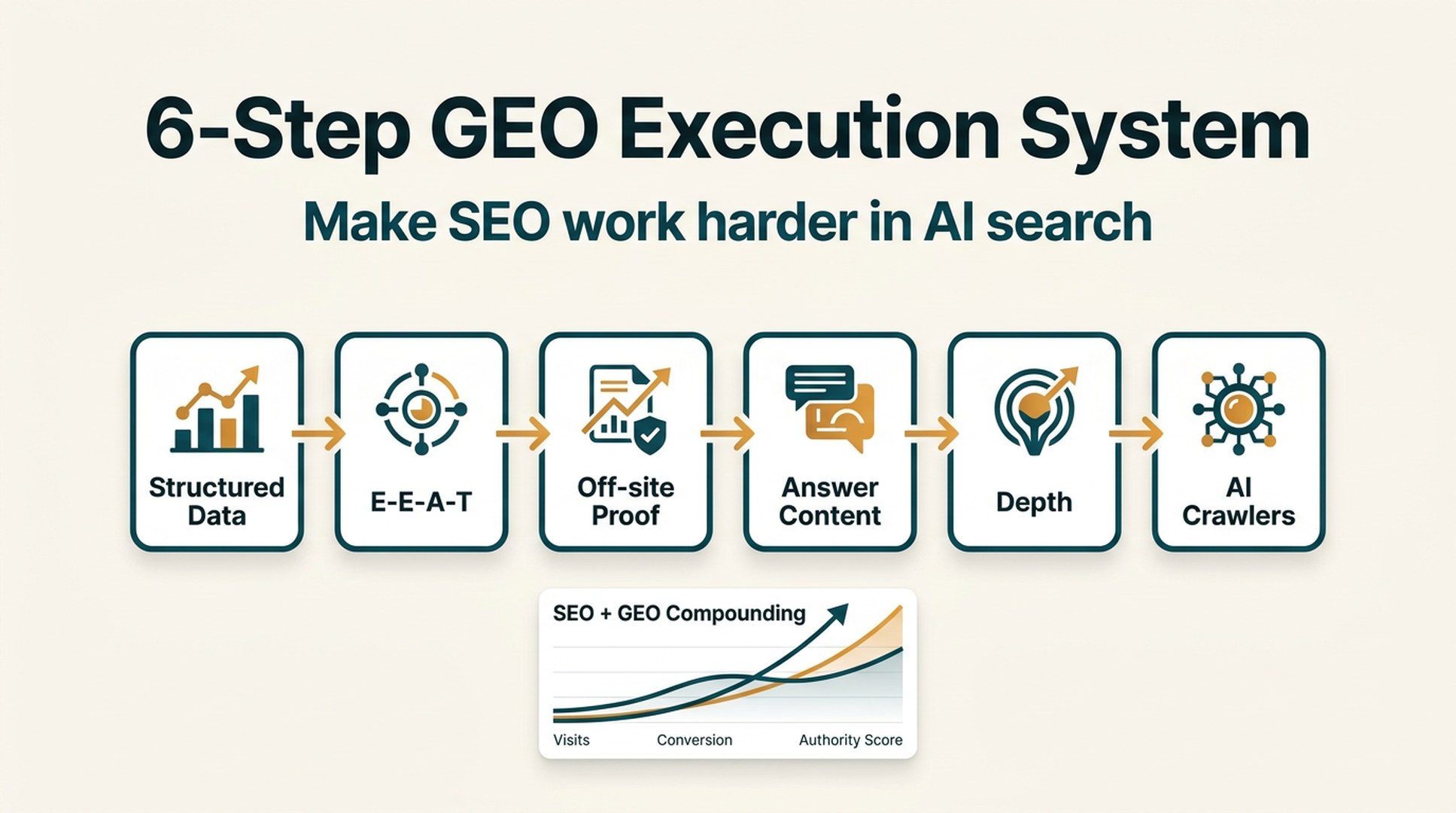
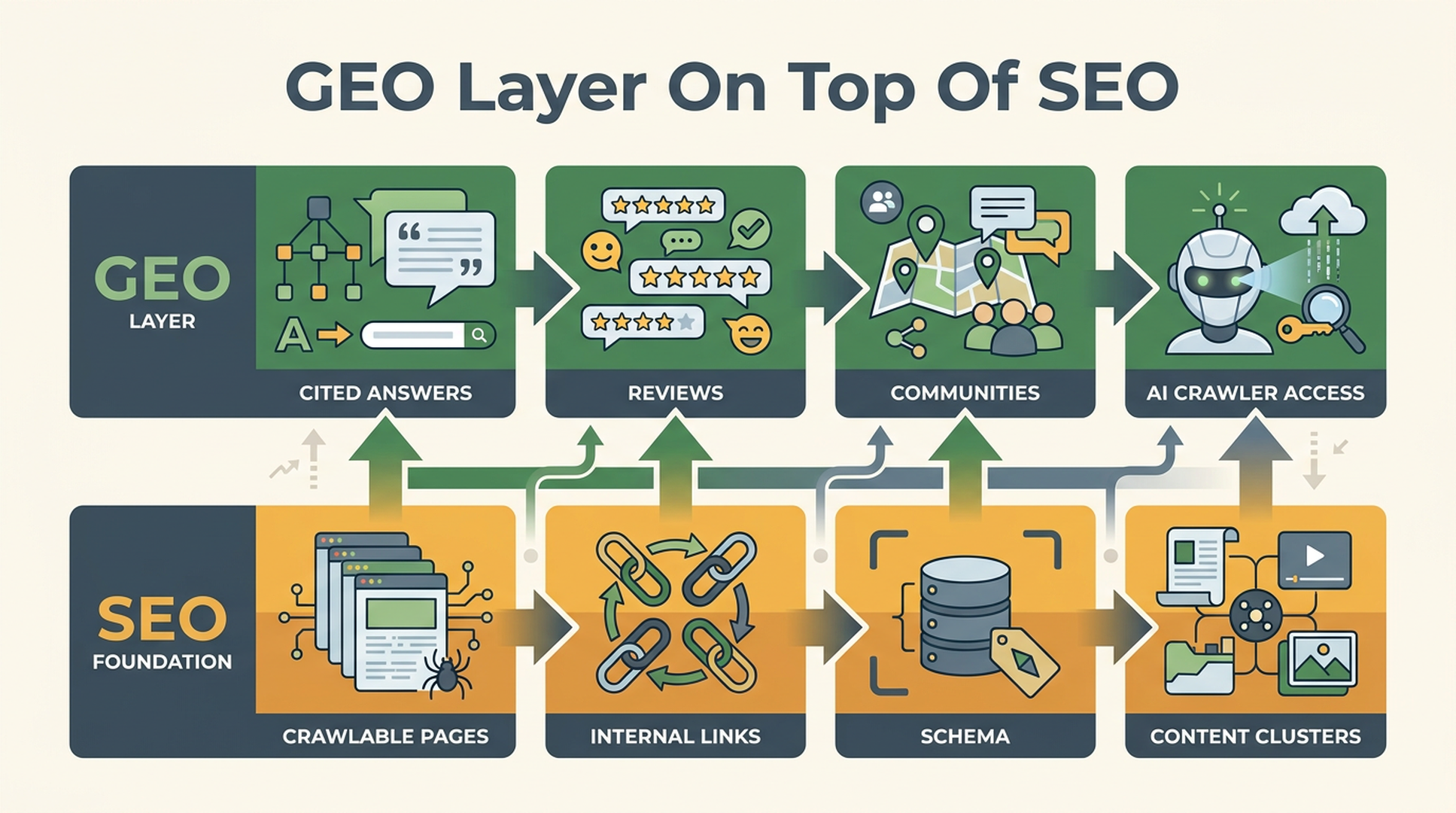
The practical move is simple: keep your SEO engine, then add a GEO layer on top. Start with six areas:
GEO workstream | What changes from classic SEO | First action |
|---|---|---|
Structured data | Make entities and page roles easier to parse | Add schema to articles, FAQs, products, authors, and organizations |
E-E-A-T | Make authorship and proof visible | Show real experts, sources, reviews, and update dates |
Off-site brand proof | Treat nofollow and unlinked mentions as useful signals | Build third-party evidence on review, community, and comparison sites |
Answer-first content | Write for extraction, not just ranking | Add direct answers, examples, and cited claims |
Content depth | Cover the question behind the keyword | Expand only where depth helps the reader decide |
AI crawler access | Let AI systems read the pages you want cited | Check robots.txt, noindex, canonical, hreflang, and llms.txt |
If you want a fast baseline before touching code, run your site through Auspia's AI Search Visibility Checker and compare it with your normal SEO audit. The overlap is where you move first.
Why GEO Makes SEO More Valuable, Not Less
The old question was: can this page rank in Google for this keyword?
The new question is broader: can a search engine, answer engine, or agent understand this brand well enough to recommend it when a buyer asks a messy question?
That change makes SEO more valuable, not less. A well-built SEO program already gives AI systems the raw material they need: indexable pages, topic clusters, clear headings, canonical URLs, structured content, and links between related ideas. GEO adds another layer: proof outside your website and content that can be lifted into an answer without guessing.
Think of it as a second entrance to the same building. Google still matters. Traditional search still sends commercial traffic. But ChatGPT, Gemini, Perplexity, Google AI features, and other answer surfaces are becoming places where buyers compare vendors before they ever click a result.
The catch: you cannot buy your way into many of those answers the way you can buy search ads. That makes durable organic signals more important. A clean SEO foundation gives your brand a chance. GEO decides whether the answer system can trust, summarize, and cite you.
Step 1: Make The Site Machine-Readable With Structured Data
Structured data is not a magic ranking button. It is plumbing. It tells machines what kind of page they are reading, what entities appear on it, who wrote it, what questions it answers, and how the page relates to products, reviews, organizations, and people.
For most business sites, do not start by adding every schema type in Google's documentation. Start with the pages that carry buyer intent:
Page type | Useful structured data | Why it helps GEO |
|---|---|---|
Blog articles | Article, Author, FAQPage where appropriate | Connects answers to a named source and specific questions |
Product pages | Product, Offer, Review | Helps AI systems understand what is sold, price context, and proof |
Service pages | Organization, Service, LocalBusiness where relevant | Clarifies who provides the service and for whom |
Comparison pages | FAQPage, BreadcrumbList, Article | Makes evaluation criteria easier to extract |
Author pages | Person, sameAs links | Supports experience and expertise signals |
A practical rule: if a human would ask "who says this?", "what is this page about?", or "can I trust this?", structured data should reduce the ambiguity.
For GEO, FAQ sections deserve special attention. A tight FAQ at the bottom of a page can turn scattered keyword variations into clean, extractable answers. Do not stuff it with fake questions. Use the questions prospects actually ask in sales calls, support tickets, review comments, and search queries.
Step 2: Make E-E-A-T Visible, Not Implied
A lot of teams assume expertise is obvious because they know their own industry. AI systems do not share that context. They need visible evidence.
That means E-E-A-T should show up on the page, not sit in a brand deck:
- Put real author names on expert content.
- Link author bios to credentials, work history, or relevant profiles.
- Add dates when freshness matters.
- Cite primary sources when making factual claims.
- Show customer proof where it fits: reviews, case studies, testimonials, public references.
- Explain how a recommendation was tested or evaluated.
This matters for normal SEO. It matters even more for GEO because answer engines often blend multiple sources. If five pages say the same thing, the page with clearer authorship, stronger proof, and better source hygiene is easier to trust.
There is a simple audit you can run: remove your logo from a page and ask whether a stranger can still tell why this source should be believed. If the answer is no, you have an E-E-A-T visibility problem.
Step 3: Build Off-Site Proof Beyond Link Equity
Classic SEO often reduces off-site work to backlinks. GEO forces a wider view.
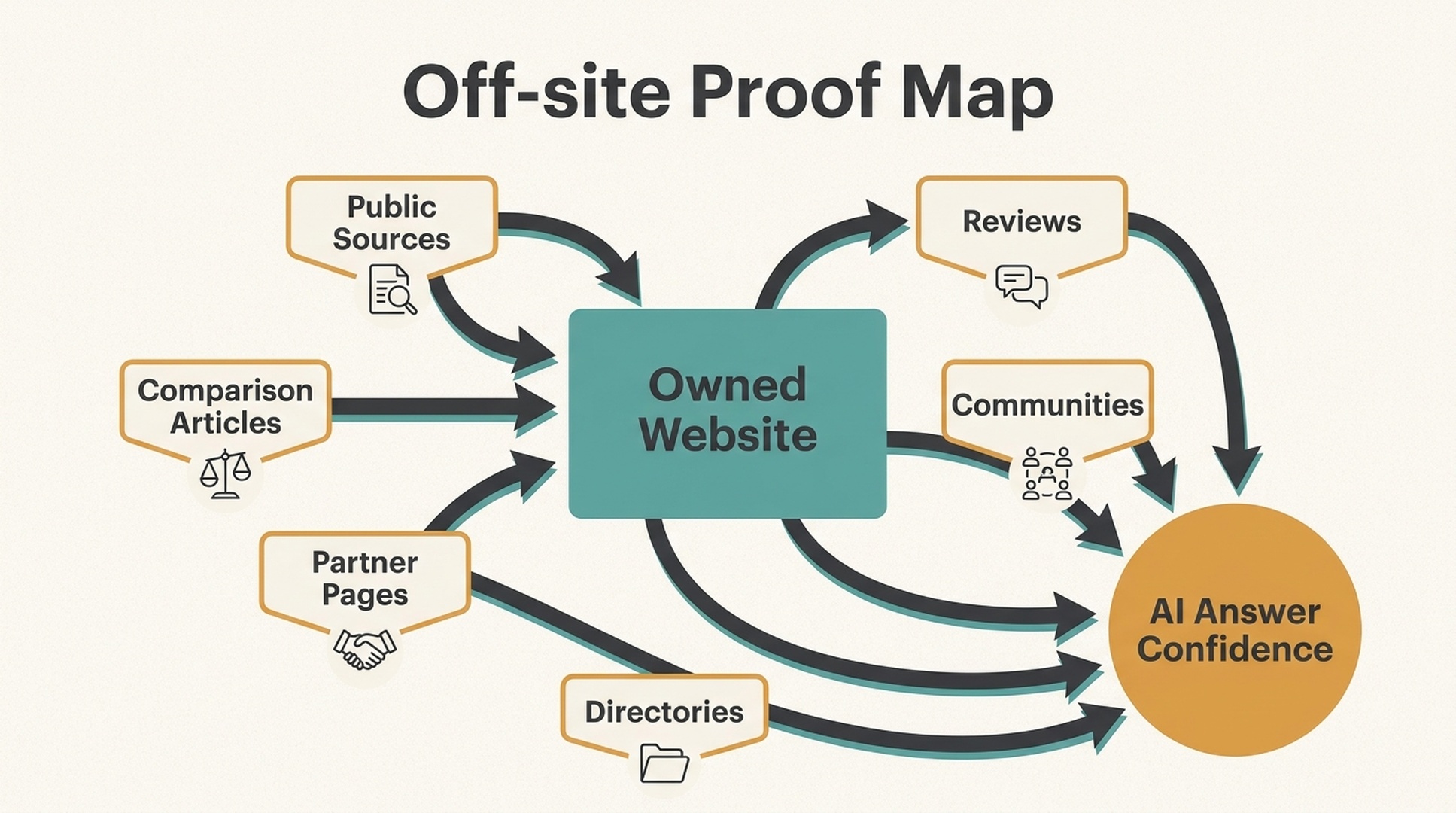
A nofollow review, a Reddit thread, a Quora answer, a software directory profile, a partner mention, or a comparison article may not pass link equity in the old sense. But it can still help an AI system understand that your brand exists, what category it belongs to, what customers say about it, and how it compares with alternatives.
That is why off-site brand proof matters:
Off-site signal | Traditional SEO value | GEO value |
|---|---|---|
High-quality backlinks | Strong | Strong, especially if context is clear |
Nofollow reviews | Limited direct link value | Useful for sentiment, trust, and product claims |
Community mentions | Mixed | Useful for real-world language and pain points |
Directory profiles | Mixed | Useful for category and feature confirmation |
Partner pages | Medium | Useful for entity relationships |
Press coverage | Depends on quality | Useful when it contains specific facts, not vague announcements |
This does not mean spamming every platform. It means building a brand footprint that matches how real buyers research. For a SaaS company, that might include G2, Capterra, Product Hunt, comparison pages, community discussions, and integration partner pages. For ecommerce, it might include review platforms, marketplace listings, creator content, and niche forums.
GEO rewards evidence that survives outside your own site.
Step 4: Write Content That Can Be Extracted Into Answers
Keyword targeting still matters. A page with no query focus usually has no commercial discipline. But GEO asks for more than keyword placement.
AI systems try to summarize. They look for clean definitions, direct comparisons, supported claims, examples, and constraints. If your content is vague, padded, or written only to repeat a keyword, it gives the model little to work with.
A GEO-ready section usually has four parts:
- A direct answer in the first few sentences.
- A short explanation of why the answer is true.
- A concrete example, checklist, or table.
- A source, proof point, or internal evidence where the claim needs support.
Here is the difference:
Weak SEO paragraph | GEO-ready paragraph |
|---|---|
"Our platform helps businesses improve content performance with advanced AI solutions." | "A content page is more likely to be cited by AI search when it gives a direct answer, names the source of its claim, and uses headings that match the buyer's question. For example, a pricing comparison page should answer who the product is for, what it costs, how it differs from alternatives, and when not to use it." |
Outbound links are part of this. Many teams avoid external links because they worry about losing users. That fear is overdone. If you make a factual claim, cite the source. A page that never links out can look self-contained, but it may also look unsupported.
Use citations the way a good analyst would: sparingly, clearly, and only where they strengthen the argument.
Step 5: Add Depth Where It Changes The Decision
Depth does not mean writing 4,000 words because competitors wrote 3,000. It means covering the parts of the question a buyer needs before they trust the answer.
For GEO, thin content often fails because answer systems need enough context to understand nuance. A short page can rank for a simple query, but it may not be the best source for a complicated comparison, implementation question, or buying decision.
Use this test before expanding a page:
- What would a beginner misunderstand after reading this?
- What would an expert challenge?
- What proof is missing?
- What alternatives should be compared?
- What risks or edge cases matter?
- What should the reader do next?
If a new section answers one of those questions, add it. If it only repeats the keyword in different clothing, cut it.
A reasonable benchmark is still useful: review the top three to five search results and note their depth, media, examples, and coverage. Then add 20% more usefulness, not 20% more words.
Step 6: Let AI Crawlers Access The Right Pages
Some GEO problems are not content problems. They are access problems.
Before blaming the article, check whether AI systems can reach the page at all. Review:
robots.txtrules for broad and named user agents.noindextags on templates and staging leftovers.- canonical tags that point to the wrong URL.
- hreflang conflicts on multilingual sites.
- blocked JavaScript or assets that hide the main content.
- paywalls, modals, or cookie walls that obscure the answer.
- whether an
llms.txtfile would help document the pages you want AI systems to understand.
Be careful here. A bad robots.txt edit can damage both SEO and GEO. Most Shopify and WordPress sites start with workable defaults. Problems usually appear after someone adds a rule without understanding how crawling, indexing, canonicalization, and localization interact.
If your team is not sure, use a crawler check before editing. Auspia's Robots.txt AI Crawler Checker is built for this exact question.
A 14-Day GEO Layer Sprint
If you already have basic SEO in place, do not start with a six-month transformation plan. Run a two-week sprint.
Day | Task | Output |
|---|---|---|
1 | Pick 10 priority pages | One list of pages tied to revenue or lead quality |
2 | Crawl technical access | Robots, noindex, canonical, sitemap, hreflang notes |
3 | Check structured data | Missing schema and validation issues |
4 | Review E-E-A-T | Authorship, citations, proof, update dates |
5 | Audit answer quality | Missing direct answers, FAQs, examples, tables |
6 | Map off-site proof | Reviews, directories, forums, partner mentions |
7 | Prioritize fixes | Impact and effort scoring |
8-10 | Rewrite the top 3 pages | Clear answers, better headings, stronger proof |
11 | Add or repair schema | Article, FAQ, Product, Organization, Person where relevant |
12 | Improve crawler access | Safe robots/canonical/hreflang fixes |
13 | Add third-party proof links | Citations, reviews, public references |
14 | Re-audit and record baseline | Screenshot, score, and next-page queue |
This sprint works because it does not treat GEO as a separate department. It makes the existing SEO asset base easier for AI systems to parse and trust.
Common Mistakes
The first mistake is treating GEO as a trick. There is no stable button that says "rank in ChatGPT." AI answer systems are still changing, and citation behavior varies by platform, prompt, and topic.
The second mistake is ignoring off-site evidence. Your website can say you are great. Buyers and AI systems look for confirmation elsewhere.
The third mistake is publishing long content with no extraction points. A 3,000-word page can still be hard to cite if it hides the answer under a soft introduction and vague claims.
The fourth mistake is blocking the wrong crawlers. Some teams try to control AI access but end up hiding useful content from the systems they want to appear in.
The fifth mistake is chasing every new term. GEO, AEO, AI search optimization, and entity SEO overlap. The label matters less than the operating discipline: clear pages, credible proof, crawlable content, and useful answers.
Auspia Takeaway
The best GEO strategy is not to throw away SEO. It is to finish the parts of SEO that many teams skipped.
Make the site readable. Make expertise visible. Build proof outside your domain. Write sections that answer real buyer questions. Add depth where it helps a decision. Keep AI crawlers from hitting avoidable walls.
That is not glamorous work. It is the work that compounds.
If you want to know where your own site stands, start with a paired audit: run a normal SEO crawl, then run an AI visibility check. The pages that fail both are your first wins.
FAQ
Is GEO replacing SEO?
No. GEO sits on top of SEO. A site still needs crawlable pages, clear topics, technical hygiene, authority signals, and useful content. GEO adds stronger emphasis on answer extraction, off-site proof, entity clarity, and AI crawler access.
Can I advertise inside ChatGPT or other AI answer systems?
Some AI platforms may test ads or commercial placements, but teams should not build their AI visibility strategy around paid access. Organic credibility, brand proof, and clear content are safer foundations because many answer surfaces do not work like classic search ads.
What is the fastest GEO improvement for an existing site?
Start with priority pages that already get SEO impressions or sales-qualified traffic. Add direct answers near the top, improve headings, add FAQ or comparison sections, cite important claims, and check whether robots.txt or noindex rules block AI crawlers.
Do nofollow links help GEO?
They can. Nofollow links may not pass traditional link equity, but the mention, review, context, or sentiment around the brand can still help AI systems understand the brand. GEO cares about evidence, not only link attributes.
How long should GEO content be?
Long enough to answer the question fully. For simple definitions, short pages can work. For comparisons, buying decisions, implementation guides, and technical topics, deeper content usually gives AI systems more context to summarize and cite.