Executive summary
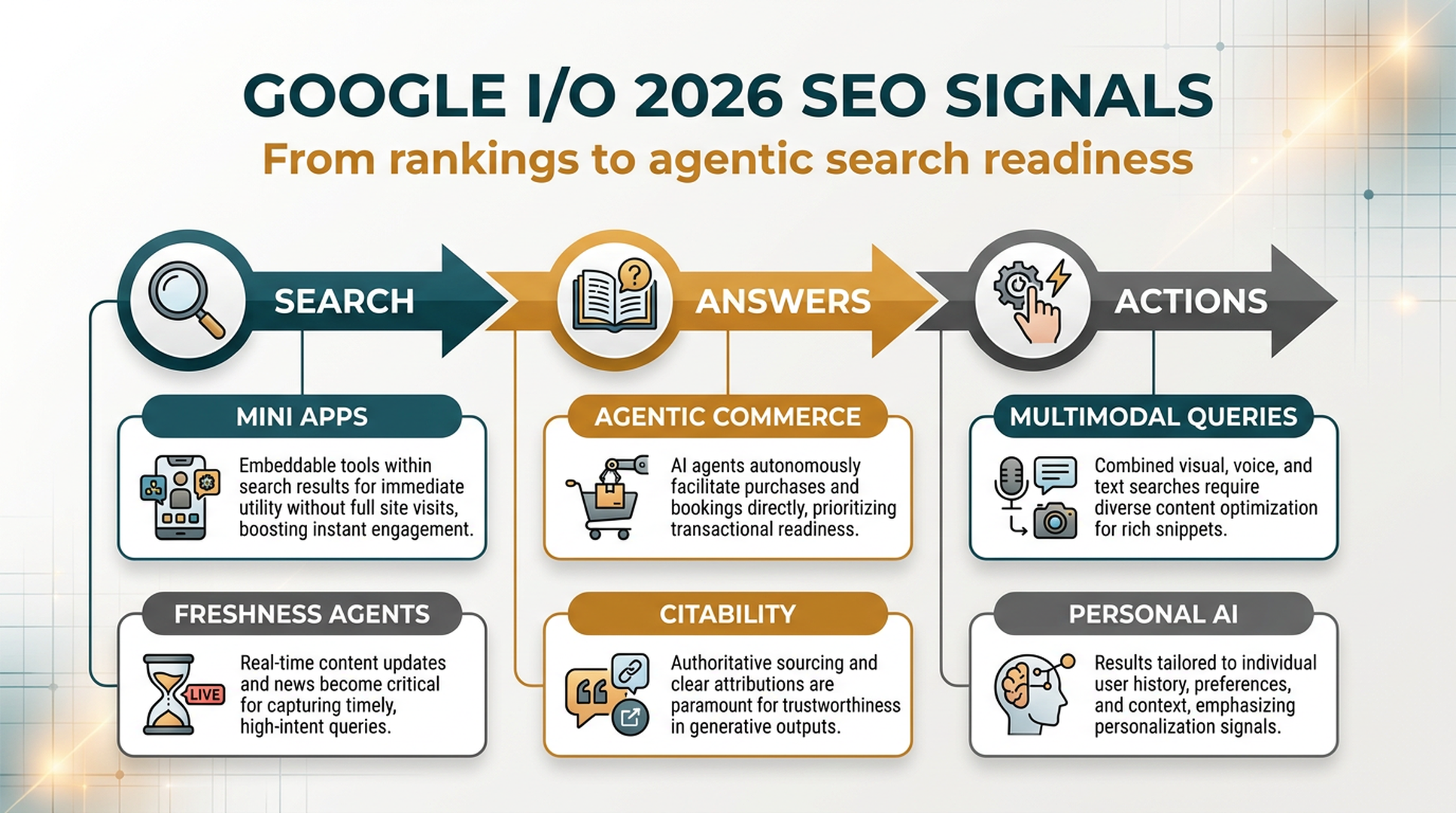
Google I/O 2026 made one thing hard to ignore: search is turning from a ranked directory into an operating layer for answers, actions, shopping, monitoring, and personal context.
For SEO teams, the uncomfortable part is not that AI answers may reduce clicks. We already knew that. The bigger shift is that Google is getting closer to a point where the search result can build the interface, compare the options, run the task, and remember the user's context. In that world, a page is no longer the final destination by default. Often, it is a data source.
Auspia's view is simple: the next SEO advantage will come from being the source that AI systems can trust, parse, cite, and act on. That means proprietary data, clean structured fields, answer-ready passages, freshness signals, and conversion paths that do not depend on a casual click from a blue link.
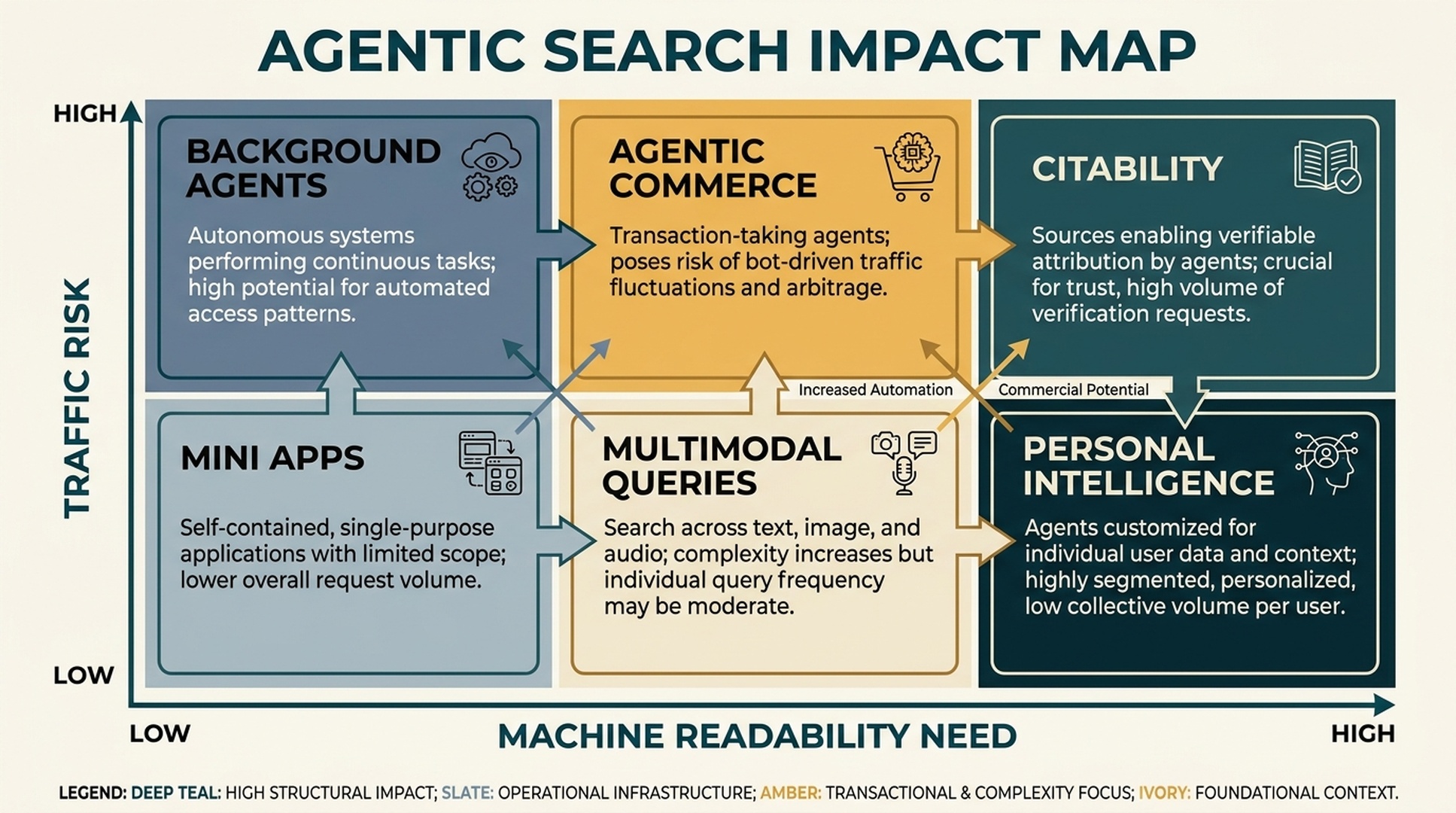
The six Google I/O search signals SEO teams should watch
The original Google I/O search segment was framed for developers and product users. For growth teams, it reads more like a risk map. Some changes threaten traffic-heavy pages right now. Others change the job description of SEO over the next few years.
Here is the working order I would use when auditing a site.
I/O signal | Main SEO risk | Teams most exposed | First response |
|---|---|---|---|
Generative interfaces and mini apps | Google answers with an interaction instead of a click | Calculator sites, converters, templates, programmatic SEO | Add proprietary data, account value, saved history, and expert interpretation |
Agentic commerce | The store becomes a product feed for an AI buyer | Ecommerce, travel, local services, lead gen | Clean product, offer, shipping, review, and service schema |
Richer search box and multimodal queries | Short keyword targeting misses real demand | Content teams built around keyword lists | Build answer blocks around jobs, constraints, comparisons, and entities |
Background information agents | Stale pages get filtered out before humans see them | Marketplaces, listings, news, SaaS comparison pages | Add freshness reviews, timestamps, and change logs |
Faster, stronger AI retrieval | Thin summaries lose citation eligibility | Affiliate, SEO content farms, generic blogs | Publish first-party data, screenshots, tests, and named expertise |
Personal intelligence in search | Public web clicks lose attention to private data answers | Brands relying on post-purchase support searches | Use email schema and clearer account/customer-service data |
1. Generative interfaces turn simple tools into SERP features
The most obvious threat is to utility pages.
If a user asks for a mortgage calculation, a file conversion, a comparison table, or a small planning tool, Google increasingly has the product incentive and the technical ability to keep that interaction inside the search surface. The result page does not need to show a list of ten websites if it can generate the widget the user wanted.
That is bad news for sites built on public formulas and thin programmatic templates. A page that exists only to calculate, convert, summarize, or reformat is easy to replace.
The practical response is boring but useful: do not panic and delete every tool page. Tools still convert well when they carry context Google cannot recreate.
For each tool page, ask four questions:
- Does the output rely on proprietary or user-specific data?
- Does the tool save history, benchmarks, projects, or team workflows?
- Does the page explain tradeoffs better than a generic answer box?
- Does the tool create a reason to sign in, export, collaborate, or continue?
A bare calculator is fragile. A calculator connected to real benchmarks, saved scenarios, expert notes, and follow-up workflows is harder to flatten into a SERP widget.
For Auspia users, this is why a tool such as an AI Search Visibility Checker should not stop at a score. The value is in the evidence: which prompts mention the brand, which competitors appear, where citations come from, and what content changes would improve visibility.
2. Agentic commerce makes feeds as important as landing pages
Agentic shopping changes the role of ecommerce SEO.
The old path looked like this: rank the category page, earn the click, persuade the buyer, capture checkout. The new path may look more like this: the user describes a need, an AI compares offers, checks availability, applies constraints, and sends the buyer toward a transaction. In some cases, the user may never browse the merchant's site first.
That makes machine-readable commerce data a growth asset. Product pages still matter, but product feeds, structured data, inventory accuracy, review data, shipping fields, return policies, local availability, and merchant trust signals matter more than they used to.
A clean product page should answer both humans and agents:
Field | Human version | Machine-readable version |
|---|---|---|
Price | Clear current price and discount terms | Offer schema, priceCurrency, priceValidUntil |
Availability | "Ships today" or "Only 3 left" | availability, inventory, pickup or delivery fields |
Fit | Who this product is for | attributes, variants, size, compatibility, use cases |
Proof | Reviews, ratings, return rate, expert notes | aggregateRating, review, author, datePublished |
Risk | Warranty, refund, shipping windows | merchantReturnPolicy, shippingDetails |
This is where many independent stores are weaker than they think. Their visual PDP may look fine, but the data layer is messy. Agents do not reward vibes. They need fields they can parse.
3. The search box is becoming a context box
Keyword research is not dead, but the keyword as a tiny compressed phrase is losing explanatory power.
A user no longer has to reduce a real problem to "best CRM" or "SEO tool." They can give the search system a screenshot, a spreadsheet, a browser tab, a video, a location, a budget, and a long natural-language question. That changes the content that gets pulled into answers.
The winning passage is often not the broadest page. It is the paragraph that matches the exact decision context.
Compare these two content patterns:
Old keyword page | Agentic search-ready page |
|---|---|
"Best AI SEO tools" repeated across headings | "If you have 5,000 indexed pages but no AI citations, start with citation gap analysis before adding more content" |
Generic feature lists | Clear conditions, constraints, examples, and tradeoffs |
One target keyword | Clusters of questions, entities, jobs, and comparison claims |
Weak author point of view | Named assumptions and practical recommendations |
This is the heart of GEO: writing pages that AI answer systems can understand and reuse. It is not about stuffing the phrase "AI search optimization" into more headings. It is about giving the model extractable facts, grounded claims, and clean context.
4. Background agents raise the cost of stale content
One of the quieter shifts is also one of the most important. If AI agents can monitor the web in the background, freshness becomes more than a ranking preference. It becomes a filter.
Think about apartment listings, SaaS pricing pages, job boards, travel deals, policy pages, vendor comparisons, coupons, event pages, and local service availability. An agent scanning these sources does not want vague content that might be outdated. It wants verified fields.
A good freshness protocol includes:
- A visible "last verified" date for pages with changing facts.
- Schema fields where relevant, especially dateModified, validThrough, priceValidUntil, and availability.
- A change log for pages that influence buying decisions.
- Scheduled refreshes for pages with prices, rankings, laws, inventory, or product claims.
- Removal or redirection of dead URLs that waste crawler and agent attention.
This is not glamorous work. It is exactly the kind of work that separates useful sites from content warehouses.
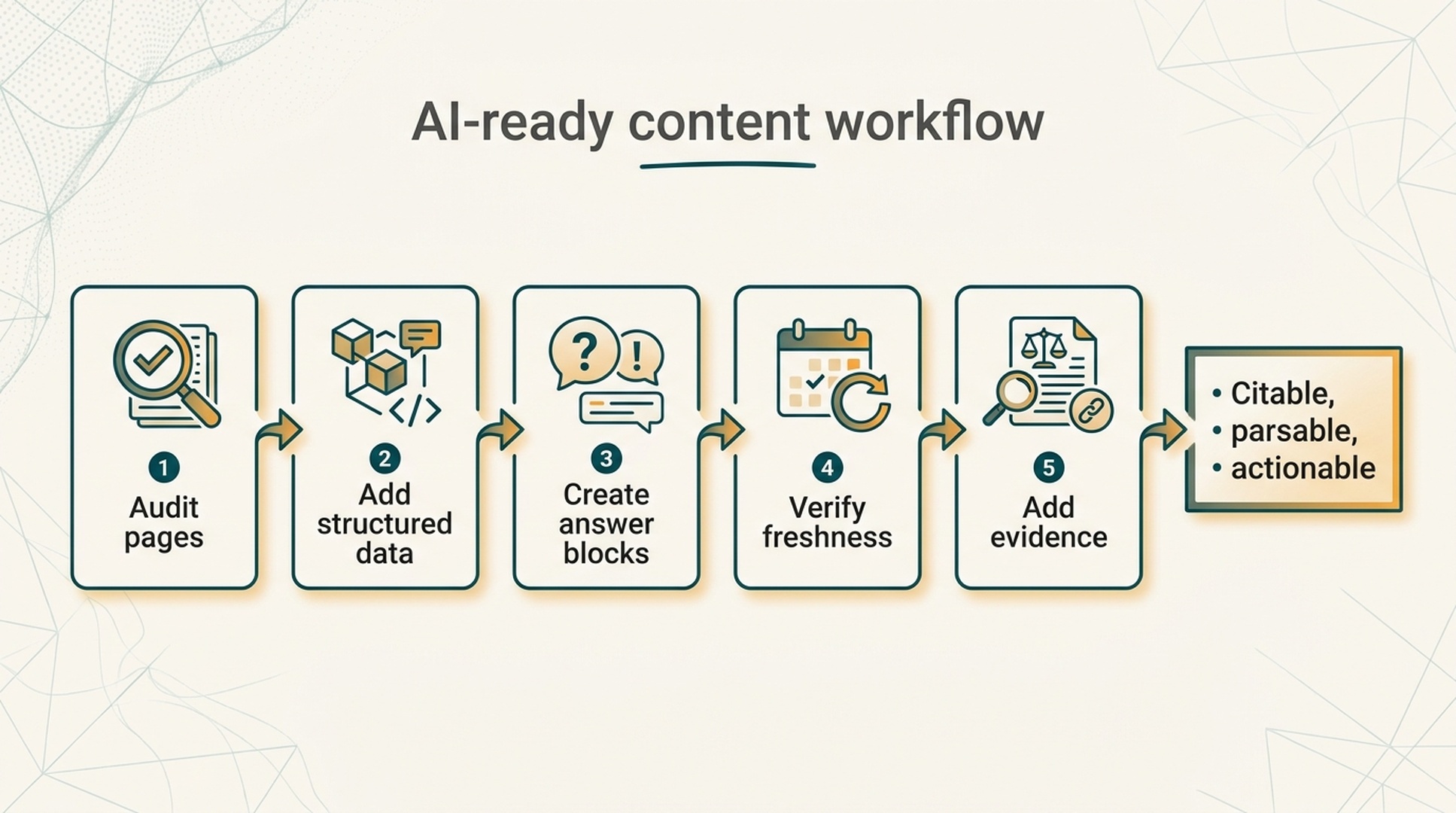
5. Faster AI retrieval increases the citability bar
When AI systems get faster, they can compare more sources before composing an answer. That sounds technical, but the SEO implication is simple: generic content has less room to hide.
A page that merely restates common advice is easy to ignore. A page with original screenshots, measured results, named authors, dated tests, customer patterns, dataset notes, or expert quotes is more likely to survive source comparison.
Run a citability audit on your most important pages. For each page, mark whether it contains:
- A short answer that can be quoted without losing meaning.
- First-party data, tests, examples, or screenshots.
- Clear definitions of entities, tools, categories, and use cases.
- Specific comparison claims with criteria.
- Author or company expertise that explains why the page should be trusted.
- External references where the claim depends on outside facts.
If the page has none of these, it may still rank for a while. But it is a weak candidate for AI citation.
6. Personal intelligence moves some searches out of the public web
Personalized search answers are less dramatic for SEO than AI shopping or generated tools, but they still matter.
When users ask about their orders, flights, bookings, receipts, subscriptions, calendar events, or personal photos, Google can answer from private data the user has authorized. Public websites do not compete directly with that result. They simply lose attention.
Brands can respond by making their customer communications easier for machines to understand. Transactional emails, order confirmations, appointment reminders, receipts, and support messages should be structured, consistent, and easy to search.
For ecommerce and service teams, email markup is no longer just a nice Gmail enhancement. It may become part of the way your brand appears inside a user's personal AI layer.
What most SEO teams will get wrong
The easy mistake is to treat this as another "AI content" moment. It is not.
Publishing more AI-written articles will not solve a shift toward AI interfaces, AI buyers, and AI monitoring. In fact, it may make the problem worse if those articles contain no evidence, no unique data, and no operational value.
The better move is to split your SEO inventory into four buckets:
Page type | Risk level | What to do |
|---|---|---|
Simple tools using public formulas | High | Add proprietary data, account workflows, exports, and expert interpretation |
Product and service pages | High | Clean schema, entity data, reviews, availability, pricing, and conversion proof |
Evergreen explainers | Medium | Add answer blocks, examples, citations, and freshness checks |
Original research and case studies | Lower | Make data easier to cite, summarize, and reuse |
Auspia's operating rule: if a page cannot be cited, parsed, verified, or acted on, it is not ready for agentic search.
A 30-day action plan
Start with the pages that already matter. Do not boil the ocean.
Week 1: export your top organic landing pages and tag each one as tool, product, category, article, comparison, listing, or support.
Week 2: identify pages exposed to generated interfaces or agentic commerce. Prioritize anything that depends on simple calculations, public data, inventory, pricing, or comparison traffic.
Week 3: run a machine-readability pass. Check schema, headings, tables, entity names, dates, prices, availability fields, internal links, and answer blocks. Auspia's Website SEO Score Checker can help spot technical and content-readiness gaps before you rewrite everything.
Week 4: add evidence. This is the part many teams skip. Add screenshots, benchmarks, field data, examples, customer questions, expert notes, and update logs. A small amount of real evidence beats 2,000 words of generic explanation.
Auspia takeaway
The next version of SEO is not only about ranking. It is also about being eligible for selection by systems that answer, compare, monitor, buy, and personalize.
That does not make websites irrelevant. It changes what a useful website has to provide.
A useful site gives AI systems clean facts and gives humans a reason to go deeper. It has data that cannot be easily copied, pages that can be parsed without guessing, and proof that a claim came from somewhere real.
If your 2026 SEO plan still starts with "find keywords, write articles, build links," it is incomplete. Keep the parts that work. Then add the missing layer: entity clarity, structured data, answer extraction, freshness, proprietary evidence, and conversion paths that survive when the click happens later, or not at all.
FAQ
Is SEO dead after Google I/O 2026?
No. But SEO is becoming less click-centered. The work now includes structured data, citation readiness, content freshness, product feed quality, and answer extraction, not just rankings and links.
What types of sites are most exposed to agentic search?
Simple tool sites, converter sites, thin programmatic SEO pages, ecommerce stores with messy feeds, local service pages with weak schema, and generic affiliate content are the most exposed.
What is the first thing an SEO team should audit?
Start with pages that already receive organic traffic and depend on simple utility, product comparison, pricing, inventory, or frequently changing facts. These pages face the highest risk from generated interfaces and AI agents.
How does GEO fit into this shift?
GEO helps content become easier for AI answer systems to understand, cite, and recommend. It focuses on answer-ready passages, entity-rich context, evidence, structured claims, and machine-readable page design.
Should brands still invest in content?
Yes, but not in generic content. Invest in pages with original evidence, clear answers, practical examples, strong entity coverage, and data that can support both human decisions and AI-generated answers.