The 2026 answer in plain English
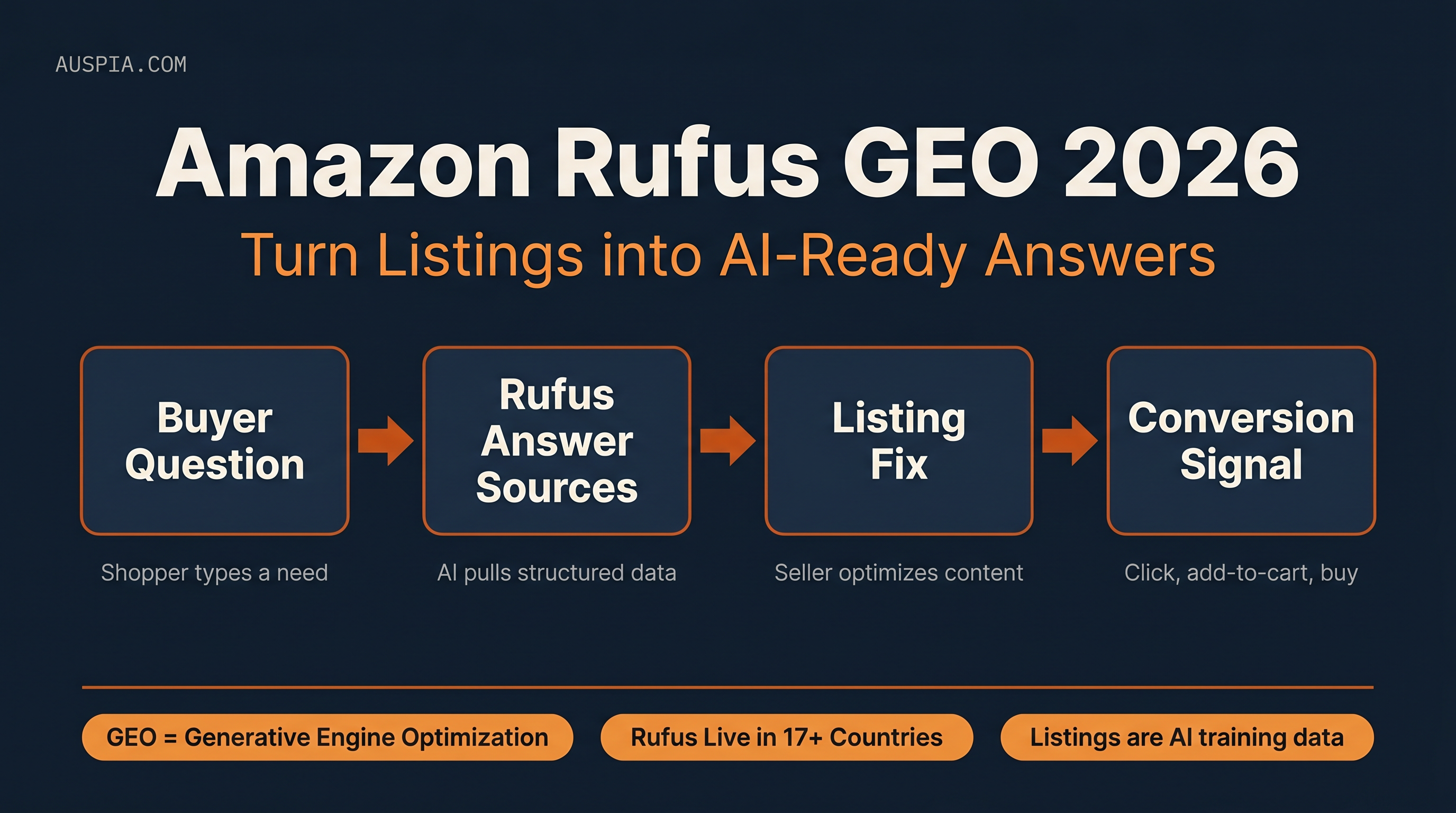
Amazon Rufus GEO is the work of making a product detail page easy for Amazon's shopping AI to understand, compare, and explain. For sellers, that means the listing can no longer be written only for keyword matching or human scanning. It also has to answer the questions a buyer is likely to ask before they click Add to Cart.
The useful shift is simple: treat every title, bullet, A+ module, Q&A answer, review theme, and image callout as a possible source for an AI-generated shopping answer. If Rufus cannot find a clear answer in those sources, it may give a weak answer, lean on competitor information, or leave the buyer with one more reason to hesitate.
Amazon has made this worth paying attention to in 2026. In a June 11, 2026 Amazon Ads article on agentic shopping, Amazon described Rufus as an expert shopping assistant used by over 300 million customers in 2025, and said the newer Alexa for Shopping experience can answer questions in the main Amazon search bar, show category and product insights in search results and product pages, generate comparisons, and surface price history. Amazon Ads also introduced Sponsored Products and Sponsored Brands prompts that can open a dialog in Rufus or answer shoppers directly on the page.
So the seller's job is not to "trick" Rufus. The job is to make the product page a better answer source.
Why Rufus changes listing optimization
Old listing work often started with this question: "Which keywords should we add?"
That still matters. But Rufus pushes a second question to the front: "Which buyer doubts does the listing resolve clearly enough for an AI assistant to repeat?"
Those doubts are usually practical. A shopper may ask:
- "Is this yoga mat good for sweaty hands?"
- "Can this power bank charge a laptop?"
- "Is this supplement third-party tested?"
- "How does this monitor compare with the cheaper model?"
- "Will this fit under an airplane seat?"
If the listing has a vague bullet like "premium material for daily use," Rufus has little to work with. If the bullet says "6 mm TPE surface with a textured grip, tested for barefoot yoga and low-sweat home workouts," the answer becomes easier to construct.
That is the core of Amazon GEO: move from generic selling language to specific, answerable product evidence.
What Rufus appears to pull from on a product page
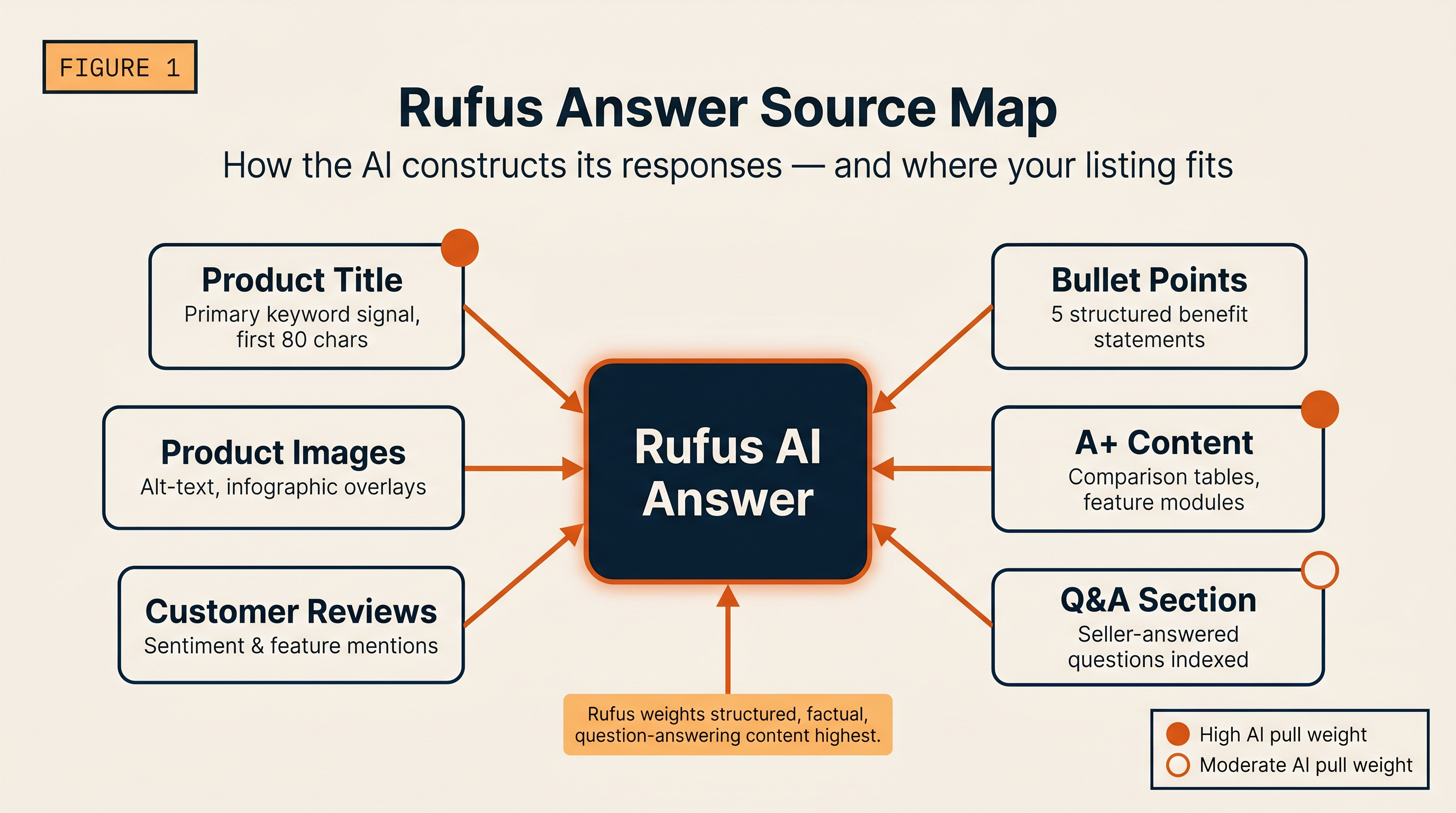
Amazon does not publish a seller-facing formula for how every Rufus answer is constructed. Sellers should avoid pretending there is a secret checklist. But the visible experience, Amazon's Rufus shopping assistant overview, and its Alexa for Shopping descriptions point to a practical model: Rufus answers from product information, customer signals, and contextual shopping data.
For listing work, start with the sources you can control or influence.
Listing source | What Rufus can learn from it | Seller action |
|---|---|---|
Product title | Product type, primary attribute, size, pack count, compatibility | Put the essential facts early; avoid stuffing |
Bullet points | Benefits, use cases, constraints, specs | Rewrite bullets as buyer-question answers |
A+ content | Comparisons, diagrams, ingredient/material explanations | Add tables and modules that clarify hard choices |
Product images | Visual proof, dimensions, use cases, warnings | Use clean callouts that match real product facts |
Q&A | Direct answers to buyer objections | Seed and maintain accurate questions where allowed |
Reviews | Repeated praise, complaints, edge cases | Mine review language, then fix page gaps honestly |
The uncomfortable part: reviews and competitor pages may explain your product better than your own listing does. That is a fixable problem, but only if you audit the listing from the buyer's question path, not from the seller's preferred talking points.
A 30-minute Rufus GEO audit
Use this sprint when a product has traffic but conversion is softer than expected, or when competitors keep showing up as the clearer choice in AI-style comparisons.
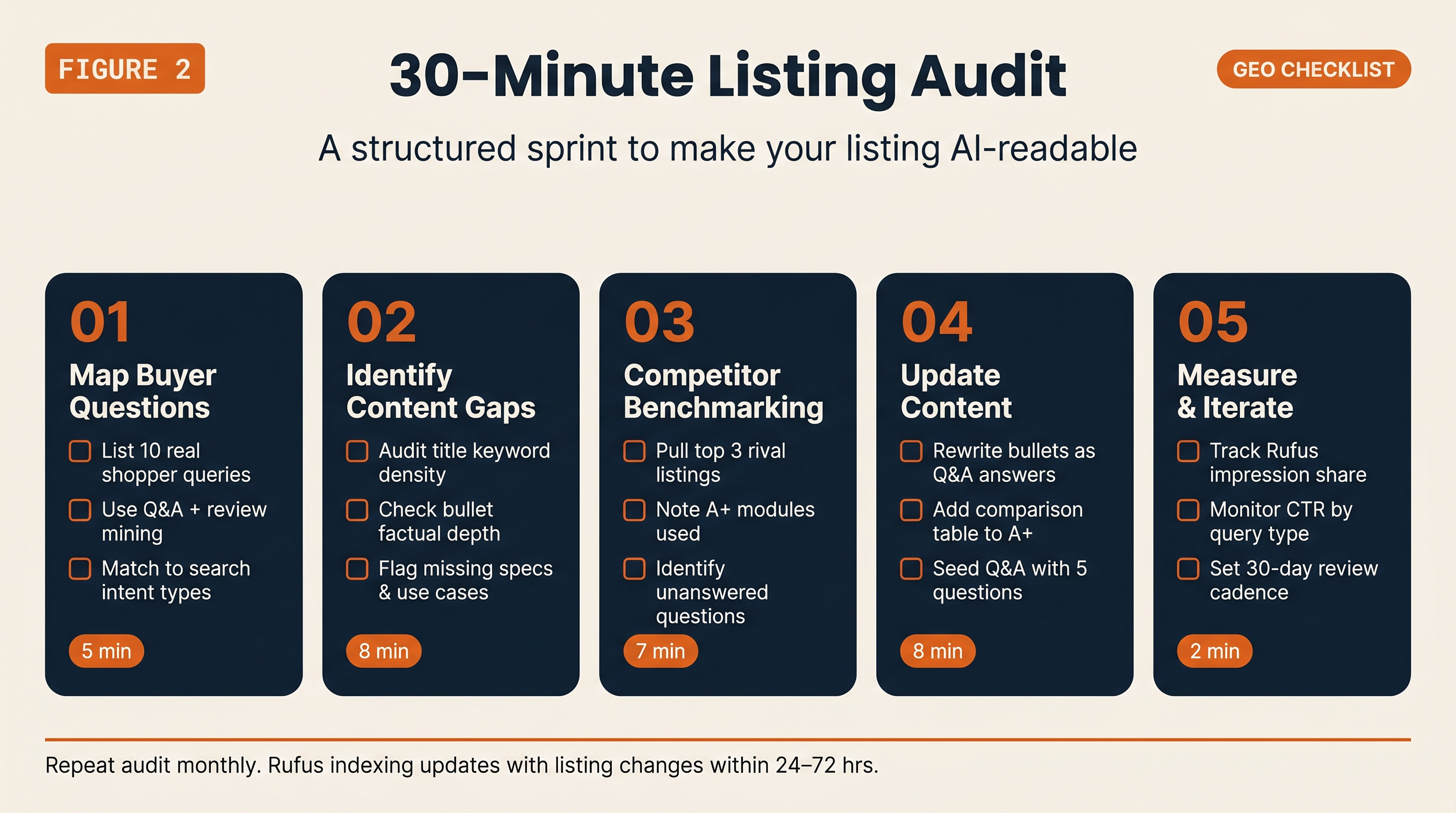
1. Ask the questions buyers would ask
Open the product page and use Rufus like a buyer, not like the brand owner. Ask broad questions first, then objection questions.
Try prompts like:
- "Who is this product best for?"
- "What are the main complaints about this product?"
- "Is this good for [specific use case]?"
- "How is this different from [competitor brand or model]?"
- "What should I know before buying this?"
Copy the answers into a simple sheet. Mark each answer as accurate, incomplete, misleading, or unsupported.
2. Find the missing answer source
For every weak Rufus answer, ask where the stronger answer should live.
If Rufus misses a compatibility point, the title or first bullet may be too vague. If it struggles with comparison, A+ content may need a table. If it cannot answer a safety or material question, the Q&A and image callouts may need clearer factual language.
Do not spread the same sentence everywhere. Put each answer where it naturally belongs.
3. Compare against two or three rival listings
Ask Rufus comparison questions against top competitors. The goal is not to copy their phrasing. The goal is to spot which claims the AI can explain about them but not about you.
Look for gaps such as:
- Competitor has clearer size, fit, or compatibility language.
- Competitor reviews repeat a benefit your page barely mentions.
- Competitor A+ content explains a tradeoff you leave ambiguous.
- Your page says "premium" while theirs names a material, test, or use case.
This is where many sellers find quick wins. The difference is often not product quality. It is answer clarity.
4. Rewrite bullets as question answers
A useful bullet does more than list a feature. It answers a buyer's silent question.
Weak bullet:
Durable, comfortable, high-quality yoga mat for daily workouts.
Stronger bullet:
Built for home yoga and floor workouts: the 6 mm cushioned TPE surface supports knees and wrists during low-impact sessions, while the textured top helps reduce slipping during dry-hand practice.
The stronger version gives Rufus more material: audience, use case, thickness, material, body-part benefit, and limitation. It also avoids claiming the mat is perfect for every workout.
5. Add one comparison asset to A+ content
For products with multiple variants, technical specs, ingredients, sizing, or use-case tradeoffs, A+ content is often the best place to make the page more AI-readable.
A simple comparison table can answer questions like:
Buyer question | A+ module to add |
|---|---|
"Which size should I buy?" | Size and fit chart |
"Is this better for travel or home use?" | Use-case comparison table |
"What is inside it?" | Ingredient/material explainer |
"How does it compare with the cheaper model?" | Model comparison grid |
"Can I use it with my device?" | Compatibility matrix |
Keep the table factual. If a claim needs proof, add the proof or remove the claim.
The content structure sellers should use in 2026
A Rufus-ready listing has a different rhythm from an old keyword-first listing.
The title identifies the product precisely. The first two bullets answer the highest-intent use cases. The next bullets handle specs, constraints, and differentiators. A+ content explains comparisons and hard-to-visualize details. Q&A covers doubts that do not fit cleanly into the sales copy. Images prove dimensions, fit, materials, and use scenarios.
Here is the practical structure:
Page area | Best role | Example for a carry-on backpack |
|---|---|---|
Title | Identify the product and core use case | Travel backpack, 40L, carry-on size, laptop compartment |
Bullet 1 | Primary buyer outcome | Fits 3-5 day trips while meeting common carry-on needs |
Bullet 2 | Compatibility or fit | Padded sleeve fits up to 16-inch laptops |
Bullet 3 | Material or durability proof | Water-resistant polyester with reinforced stress points |
Bullet 4 | Use-case detail | Opens flat for packing and airport security checks |
Bullet 5 | Constraint or care note | Not designed for checked baggage or heavy hiking loads |
A+ content | Compare variants and explain details | 28L vs 40L chart, packing layout, pocket map |
Q&A | Resolve edge-case doubts | Seat fit, airline variation, cleaning, warranty |
The constraint bullet matters. Sellers often hide limitations because they sound negative. Rufus-ready content benefits from honest boundaries because they prevent mismatched buyers and reduce disappointment after the purchase.
How to measure whether the work helped
Rufus optimization will not show up as a single clean metric in most seller dashboards. Treat it as a conversion and answer-quality experiment.
Track these before and after changes:
- Unit session percentage or conversion rate by ASIN.
- Click-through rate by query type if advertising data is available.
- Q&A volume and repeated themes.
- Review mentions related to confusion, fit, expectations, or missing information.
- Rufus answer quality for your saved prompt set.
- Competitor comparison answers for your main rivals.
Give the page enough time to settle after edits. For operational purposes, use a 7-day check for obvious issues and a 30-day check for directional performance. If the product has low traffic, wait for more sessions before drawing a conclusion.
Auspia teams can also run a prompt library around product categories and recurring buyer questions. If you already track AI search visibility for Google AI Overviews, ChatGPT, or Perplexity, the same discipline applies here: define the prompts, save the answers, score the gaps, then update the source content. For broader AI visibility checks outside Amazon, the AI Search Visibility Checker can help teams think in the same measurement pattern.
Common mistakes that weaken Rufus answers
The first mistake is using lifestyle copy where factual answers are needed. "Designed for modern life" sounds fine in a brand deck. It does not answer whether the bag fits a 16-inch laptop.
The second mistake is stuffing keywords into bullets until the sentence stops sounding like an answer. Rufus is built for shopping assistance, not just term matching. If a buyer would not trust the sentence, the AI answer probably will not be strong either.
The third mistake is letting reviews carry the page. If reviews repeatedly praise "easy assembly" but your listing never explains the assembly steps, you are making Rufus work harder than necessary.
The fourth mistake is ignoring competitor comparisons. Buyers ask comparison questions because they are close to deciding. If your page does not explain the difference, another page may do it for you.
FAQ
Is Amazon Rufus GEO the same as Amazon SEO?
No. Amazon SEO focuses on discoverability inside Amazon search and ads. Amazon Rufus GEO focuses on whether AI shopping assistants can understand and explain the product accurately when buyers ask questions. The two overlap, but they are not identical.
Can sellers directly control Rufus answers?
No. Sellers cannot directly write Rufus answers. They can improve the product information Rufus may use: title, bullets, A+ content, images, Q&A, and the underlying customer experience that shapes reviews.
Should I add 20 or 30 Q&A entries to every listing?
Only if the questions are real and useful. A bloated Q&A section full of fake or repetitive questions can hurt trust. Start with the 10 to 15 questions buyers actually ask before purchase, then expand when new objections appear.
Does Rufus optimization improve conversion rate?
It can, especially when the listing already has traffic and buyer hesitation comes from unclear use cases, specs, fit, or comparisons. It is not a replacement for pricing, reviews, delivery speed, or product quality.
What should I update first?
Start with the first two bullets, the A+ comparison module, and the Q&A answers tied to the most common buyer doubts. Those areas usually give Rufus the clearest answer material without requiring a full listing rebuild.
The takeaway
In 2026, Amazon listing optimization is no longer just a keyword and image exercise. A good product page has to work as a sales page, a product manual, a comparison sheet, and an AI answer source.
That sounds like more work, but it also gives sellers a cleaner operating rule: answer the buyer before Rufus has to guess.
Author: Ryan Chen, Senior Amazon Operations Expert with 10 Years in Marketplace Growth at Auspia. Ryan writes about Amazon GEO, marketplace search behavior, AI-assisted product discovery, and operational playbooks for Amazon sellers.