


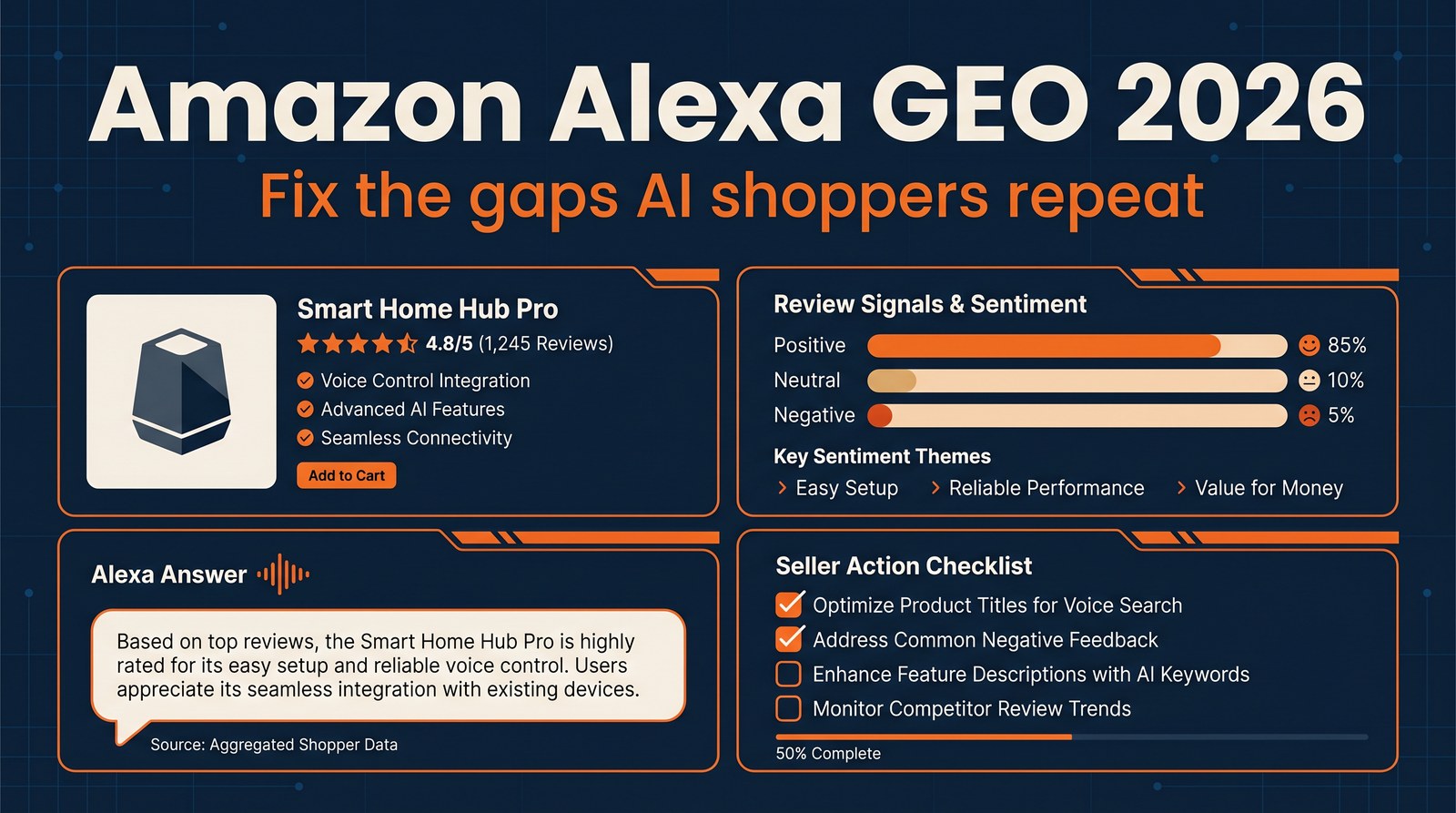
The 2026 seller note
Amazon GEO is no longer just about getting your product found. In 2026, it is also about making sure Amazon's AI shopping assistants can explain your product without turning one repeated weakness into the whole story.
Amazon says Rufus, renamed Alexa for Shopping on May 13, 2026, is trained on Amazon's product catalog, customer reviews, community Q&As, and information from across the web. That matters because the assistant does not read your listing like a shopper scrolling images at midnight. It compresses signals. If the same complaint appears in reviews, Q&A, and product photos, the assistant can surface that concern right when a buyer asks, "Is this durable?" or "Will this work in a small apartment?"
That is the new Amazon Alexa GEO problem: your listing can look attractive, rank for the keyword, and still lose buyers when the AI summary keeps repeating the defect you hoped would stay buried in the review section.
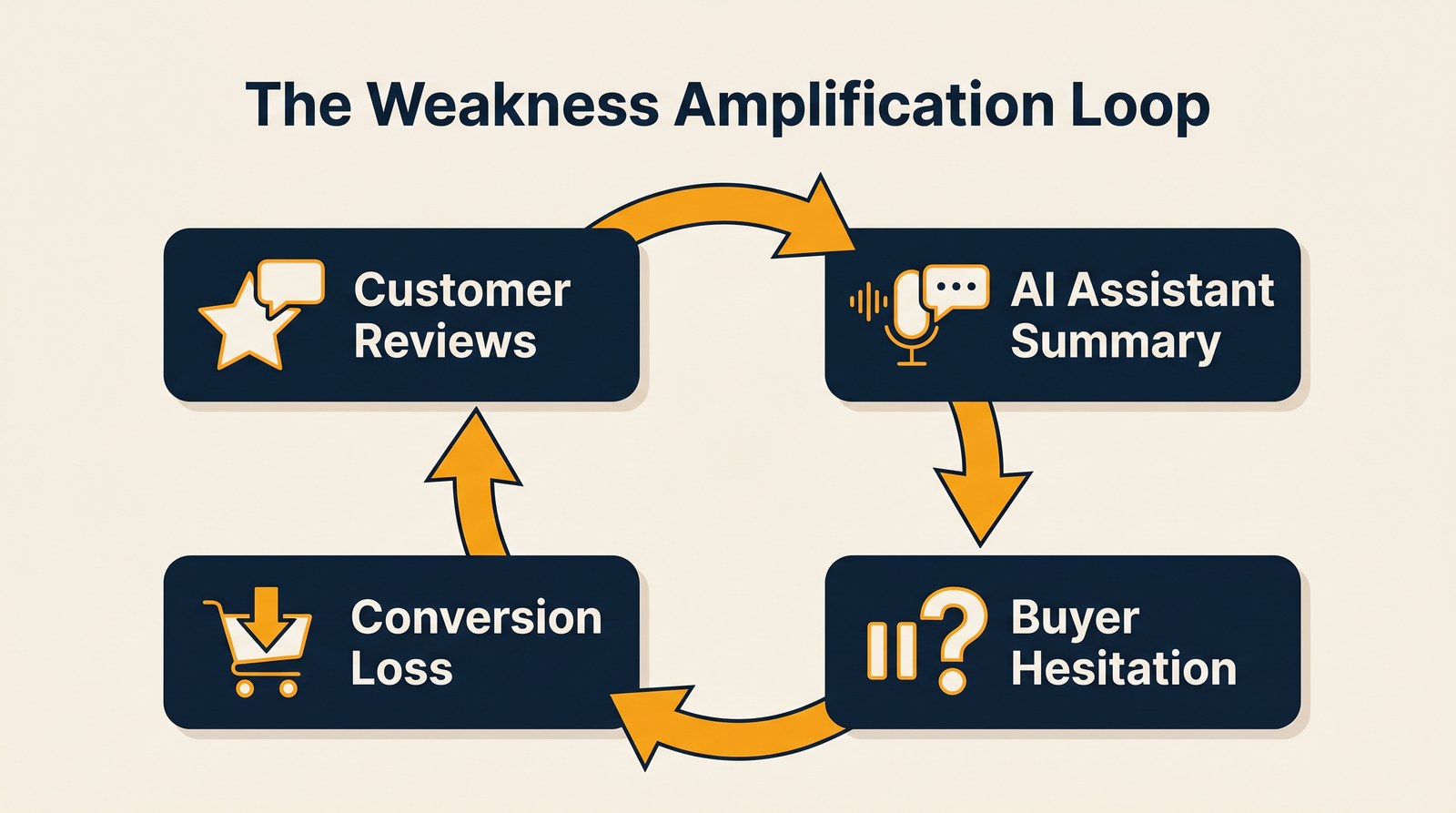
Caption: A repeated product weakness can move from reviews into AI-assisted shopping answers, where it becomes easier for every cautious buyer to notice.
What this changes for Amazon operators
The old listing audit asked a simple question: does the page persuade a human shopper?
The 2026 audit has to ask a second question: what would Alexa for Shopping or Rufus say if a buyer asked about the product's weak point?
That question changes the work. A seller can no longer treat negative reviews as a customer-service problem only. Reviews, Q&A, image claims, A+ content, comparison tables, and off-Amazon mentions all become retrieval material. The assistant may not quote every source, but it can use those signals to form an answer.
A product weakness now has three lives:
Where the weakness appears | Old seller reaction | 2026 Amazon GEO reaction |
|---|---|---|
One-star and two-star reviews | Reply, refund, monitor rating | Classify the issue and decide whether it is a product fix, expectation fix, or evidence gap |
Q&A and customer questions | Answer manually when noticed | Rewrite listing modules so the same concern is answered before the buyer asks |
Visual mismatch | Improve main image or lifestyle image | Show scale, use case, constraints, and proof so AI-assisted answers have cleaner context |
AI shopping response | Hard to see, easy to ignore | Test buyer prompts weekly and record whether the assistant repeats the weakness |
The hard part is that some products are "visual winners" and "functional risks" at the same time. A decorative product may photograph beautifully but feel unstable in use. A compact appliance may look premium but frustrate buyers with noise, setup, or cleaning. A travel accessory may sell the dream but fail on weight, stitching, or battery life.
In a pre-AI shopping flow, the buyer had to dig for those problems. In an AI shopping flow, the buyer can simply ask.
The product-strength teardown: beauty is not enough
Here is a practical way to imitate the source article's product teardown without copying its example.
Imagine a premium artificial olive tree listing. It has strong lifestyle photos, a good price range, and healthy traffic for the main keyword. The page sells the room aesthetic well. The product looks expensive enough to justify the ticket.
Then you read the reviews.
The same complaint appears again: the base feels too small, the tree can look unstable, and buyers need an extra planter or filler to make it feel finished. That does not always mean the product is bad. It may mean the listing sold the wrong expectation. But for Amazon Alexa GEO, the distinction matters less than sellers would like.
If a shopper asks, "Is this artificial tree stable?" the assistant has a reason to answer cautiously. It may mention that some customers like the look but complain about the base. Suddenly the product's prettiest feature is competing with its most repeated flaw.
This is where many Amazon teams get the diagnosis wrong. They see a conversion drop and blame ads, coupon depth, or keyword ranking. Those can matter. But if an AI assistant is repeating the same concern during the decision stage, a higher bid will not fix the leak. It may only send more shoppers into the same hesitation loop.
The weakness amplification loop
The loop is usually simple.
- A real product issue appears in reviews.
- Buyers ask related questions in Q&A or chat-like shopping sessions.
- The AI assistant summarizes the concern in plain language.
- New shoppers hear the weakness before they reach the buy box.
- Conversion drops, or the sale shifts to a competitor with clearer proof.
The seller often notices the last step first. That is why the fix feels confusing.
For Amazon GEO, the better move is to work backward from the answer the assistant might give. If the answer is fair, fix the product or reset expectations. If the answer is incomplete, add evidence. If the answer is outdated, refresh the listing, Q&A, and review-generation plan around the corrected product version.
Do not try to bury the issue with vague copy. "Premium quality" is weak evidence. "Weighted 7.5-inch base designed for indoor corners; use a decorative planter for high-traffic areas" is much more useful. It gives the human shopper a clearer expectation and gives AI systems a more precise fact to retrieve.
A 6-part Amazon Alexa GEO audit for 2026
Use this audit on any product where reviews mention the same problem more than a few times.
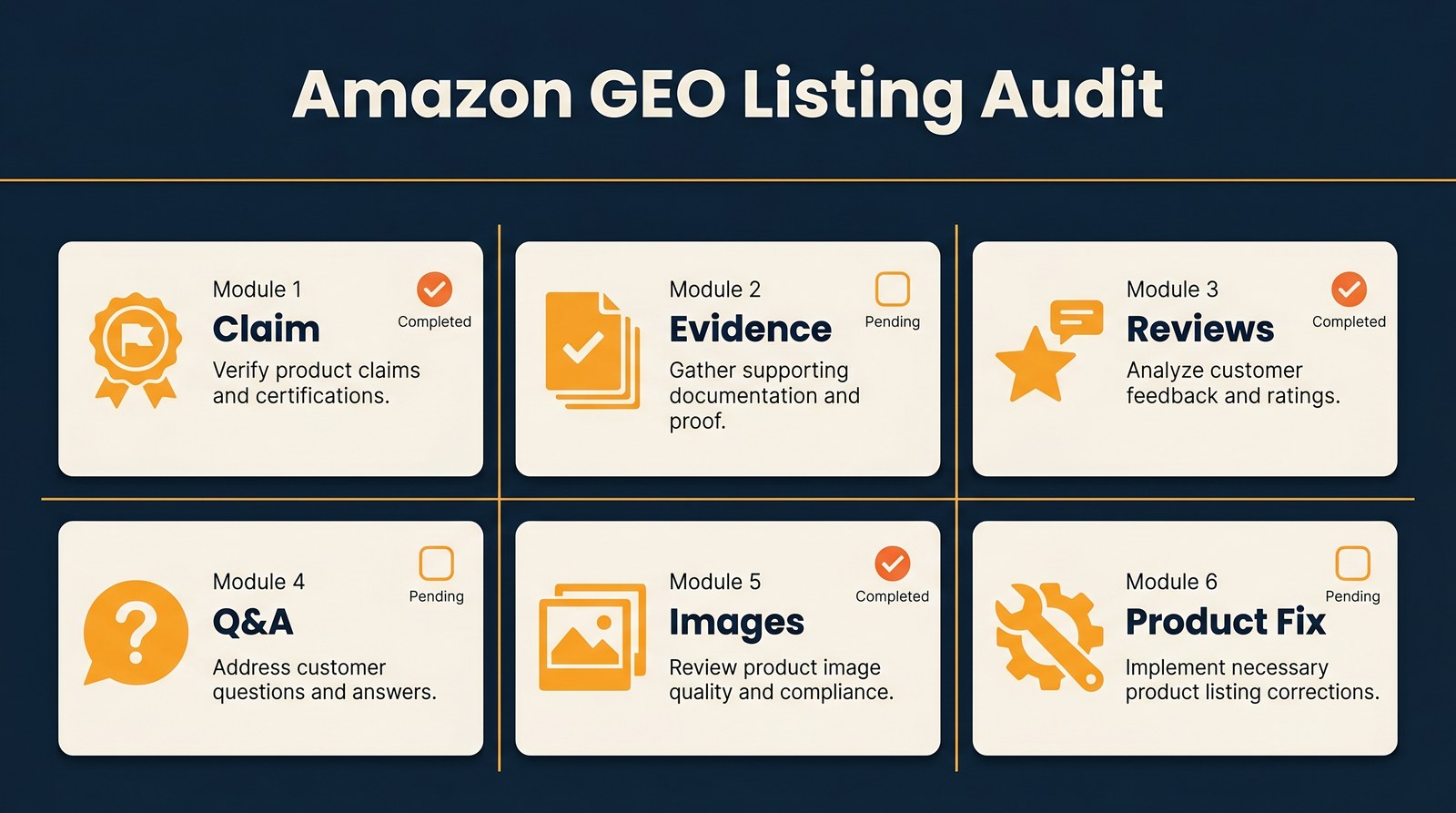
Caption: The 2026 Amazon GEO audit checks claims, evidence, reviews, Q&A, images, and the underlying product fix rather than treating listing copy as the only lever.
1. Map the claim-to-complaint gap
Take the top five claims from the listing title, bullets, A+ content, and images. Put them next to the most repeated review complaints.
A gap usually looks like this:
Listing claim | Review complaint | What to change |
|---|---|---|
"Realistic luxury decor" | Looks good but base feels cheap | Keep the aesthetic claim, add base dimensions and usage context |
"Easy setup" | Branches take time to shape | Add a setup expectation and a short shaping guide |
"Perfect for living rooms" | Too light for pets or busy hallways | Define the best use case and add stability guidance |
This is not about making the listing less persuasive. It is about making the persuasion more accurate.
2. Separate product defects from expectation defects
A product defect needs an operational fix: better base, stronger stitching, quieter motor, clearer instructions, sturdier packaging.
An expectation defect needs better positioning. If buyers expected a weighted ceramic planter but received a nursery pot, the page should say so before reviews have to explain it. If the product works indoors but not on a windy patio, say that. The conversion loss from honest constraints is usually smaller than the loss from repeated disappointment.
3. Rewrite bullets for questions, not slogans
Amazon AI shopping behavior is question-shaped. Buyers ask about durability, size, fit, compatibility, comfort, return risk, and use cases.
So rewrite at least one bullet around the anxiety itself:
Weak bullet: "Beautiful artificial olive tree for any home decor."
Stronger bullet: "Designed for indoor styling: includes a compact starter base; place inside a heavier decorative planter if used near pets, children, or high-traffic walkways."
That sentence may feel less glamorous. It is also much harder for an assistant to misread.
4. Use images to answer the concern visually
If the repeated issue is size, show scale. If it is stability, show the base next to dimensions and recommended planter setup. If it is assembly, show the sequence. If it is noise, cleaning, fit, or compatibility, show the constraint.
A visual claim without evidence is decoration. A visual that answers the buyer's doubt is GEO material.
5. Repair the Q&A layer
Community Q&A is easy to ignore because it feels messy. In an AI-assisted shopping flow, it is too valuable to ignore.
Build a small Q&A map around the top objections:
- "Is it stable without an extra planter?"
- "What are the base dimensions?"
- "Does it work in a house with pets?"
- "How much shaping is needed after unpacking?"
- "What changed in the latest version?"
Answer in plain language. Avoid legalistic copy. The goal is not to win an argument. The goal is to help a cautious buyer make a clean decision.
6. Track assistant answers like a conversion asset
Once a week, test the buyer questions that matter. Record the answer, the concern mentioned, and whether the response is more positive, neutral, or negative than last week.
A simple tracker is enough:
Prompt to test | Assistant concern | Seller action | Status |
|---|---|---|---|
"Is this product stable?" | Mentions small base | Add dimensions, photo proof, and planter guidance | In progress |
"Is it worth the price?" | Praises look, questions sturdiness | Add material proof and warranty/return clarity | Watch |
"What are common complaints?" | Repeats base issue | Product team reviewing base weight | Needs fix |
Auspia's AI Search Visibility Checker is useful for this kind of prompt-led visibility habit outside Amazon as well. The same principle applies: if AI systems summarize your brand or product category, you need to know what they repeat.
What not to do
Do not flood the listing with claims that reviews already contradict. AI assistants are built to reconcile signals, and contradiction is a signal.
Do not treat every negative review as a copywriting problem. Sometimes the product needs a version update. GEO cannot turn a shaky product into a sturdy one.
Do not wait for the star rating to collapse. The assistant may surface a repeated weakness before the average rating looks alarming.
Do not assume the main keyword tells the whole story. The dangerous prompts are often long-tail: "best artificial tree for pets," "quiet blender for early mornings," "carry-on backpack for short women," "desk chair that does not squeak." These are the prompts where buyer hesitation becomes specific.
The 2026 operating rule
For Amazon sellers, GEO is becoming a product-operations discipline. Listing copy still matters. Keywords still matter. Ads still matter. But AI shopping assistants reward products that are easy to explain, easy to verify, and hard to misunderstand.
The most useful 2026 rule is blunt: fix the weakness that AI keeps repeating.
If the weakness is real, improve the product. If the weakness is caused by a mismatch in expectations, clarify the use case. If the weakness is outdated, add current evidence. If the weakness is isolated, make sure the rest of the page gives shoppers enough context to judge it fairly.
That is how Amazon Alexa GEO should be measured. Not by whether the listing sounds optimized, but by whether the assistant can answer the buyer's hardest question without turning your product into a warning label.
FAQ
What is Amazon Alexa GEO?
Amazon Alexa GEO is the practice of making Amazon product information easier for AI shopping assistants, such as Alexa for Shopping and Rufus, to understand, summarize, and recommend accurately. It covers listing content, reviews, Q&A, images, off-Amazon signals, and product evidence.
Why do product weaknesses matter more in AI shopping?
AI shopping assistants compress large amounts of product information into short answers. If the same weakness appears across reviews and questions, the assistant may repeat it during the buyer's decision process. That can make the issue feel more visible than it was in a traditional listing scroll.
Can sellers fix this only with better listing copy?
Sometimes, but not always. If the problem is unclear positioning, better copy and images can help. If the product has a real functional defect, the seller needs a product or packaging fix. GEO works best when the page and the product tell the same story.
Which Amazon listing areas should sellers audit first in 2026?
Start with reviews, Q&A, bullets, image captions, A+ content, and the product's most common buyer prompts. Look for repeated contradictions between what the listing promises and what customers report after purchase.
How often should sellers test Alexa or Rufus-style shopping prompts?
For active products, test high-intent prompts weekly during launch, seasonal peaks, and after major listing or product changes. For stable products, a monthly check is usually enough unless reviews start repeating a new concern.
Author: Ryan Chen, Senior Amazon Operations Expert with 10 Years in Marketplace Growth at Auspia. Ryan writes about Amazon GEO, marketplace search behavior, AI-assisted product discovery, and operational playbooks for Amazon sellers.


