The short answer
GEO ROI is the incremental business value created when AI answer systems mention, cite, or recommend your brand, divided by the cost of becoming visible and trustworthy in those systems.
The hard part is attribution. A buyer may ask ChatGPT, Perplexity, Gemini, or Google AI Overviews for a shortlist, read the answer, then come back days later through a brand search, direct visit, referral, or sales call. If your reporting only rewards the final click, GEO will look weak even when it changed the deal.
A better 2026 model treats GEO as two things at once:
- an AI traffic tax, because brands now pay in content, technical structure, monitoring, and third-party proof just to be considered by answer engines;
- a trust asset, because every credible citation, comparison page, review, expert mention, schema block, and answer-ready page can keep working across prompts, platforms, and buying cycles.
The practical formula is:
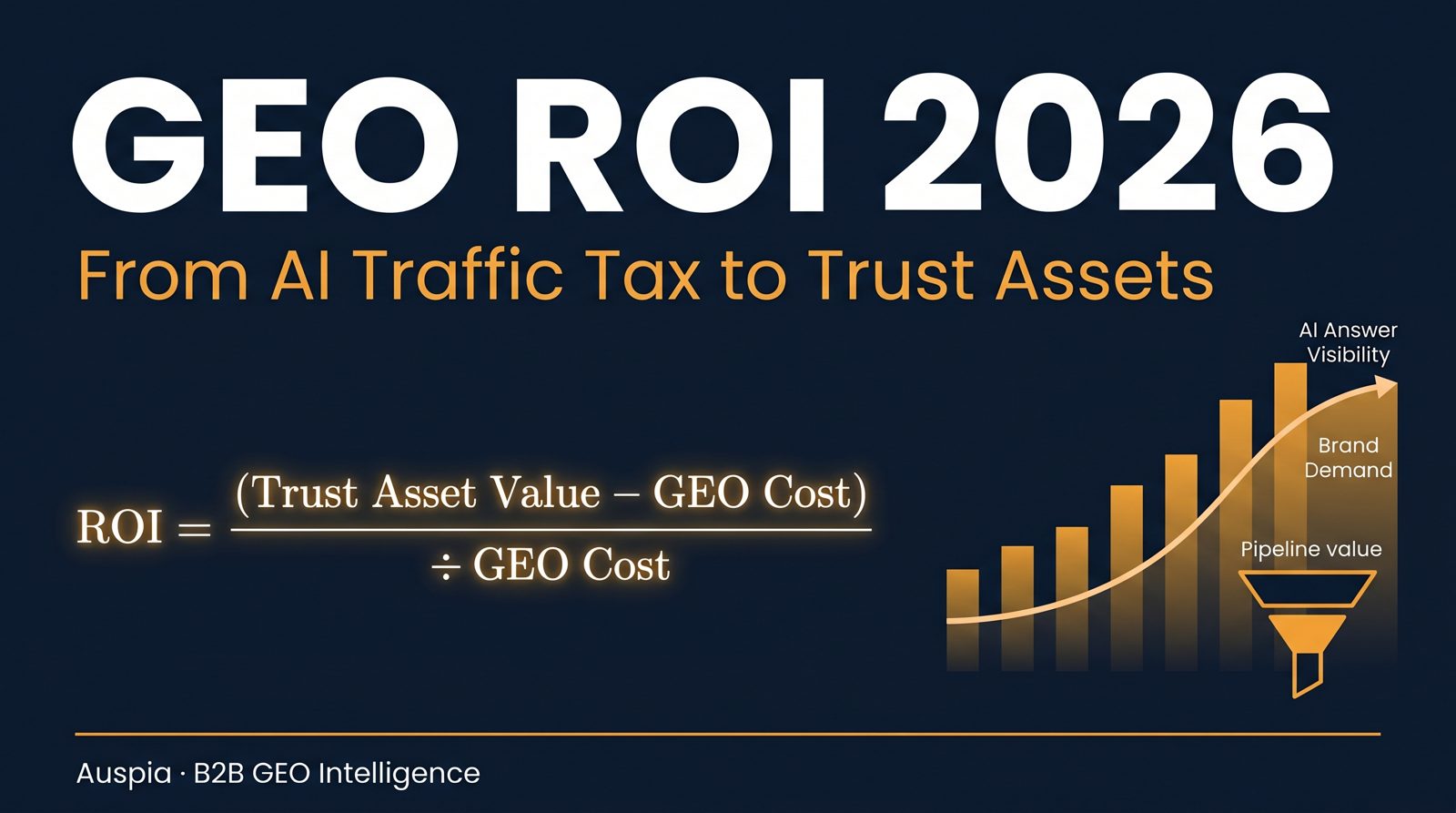
GEO ROI = (Incremental AI-influenced value - GEO investment) / GEO investment
But the real work is defining "AI-influenced value" honestly.
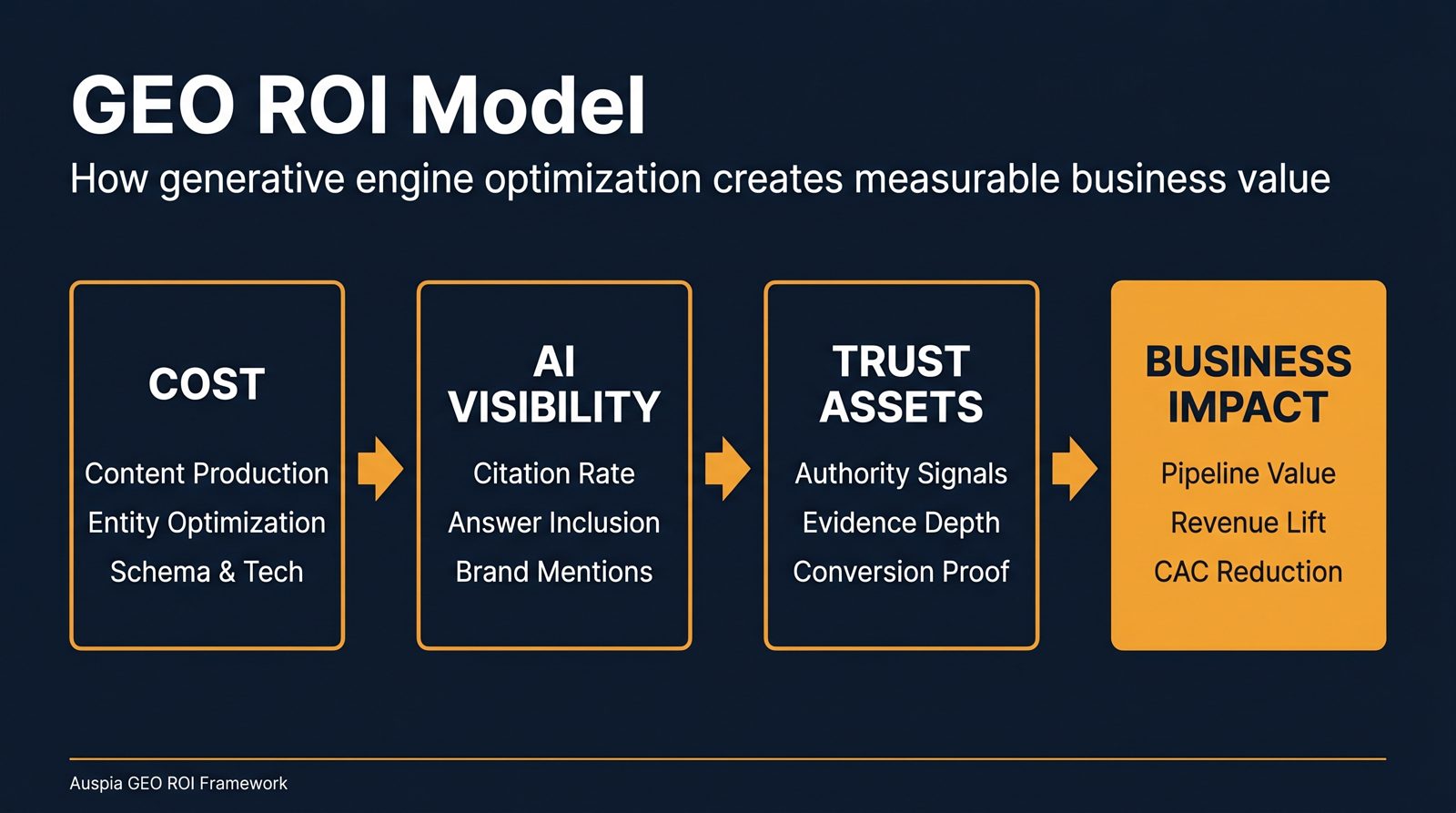
Caption: A 2026 GEO ROI model should connect AI visibility to trust assets, brand demand, and pipeline outcomes instead of relying on last-click attribution alone.
Why last-click ROI breaks for GEO
Last-click attribution assumes the channel that delivers the final session deserves most of the credit. That worked poorly for SEO. It works even worse for GEO.
AI answer journeys are messy. A buyer might:
- ask an AI assistant for "best enterprise data catalog tools";
- see three recommended brands and two cited sources;
- search one brand name later on Google;
- read a comparison page;
- ask a colleague in Slack;
- book a demo from a direct visit.
In analytics, that may appear as branded organic search or direct traffic. The AI answer that shaped the shortlist disappears.
This is why GEO ROI needs leading indicators and lagging indicators. Leading indicators show whether AI systems can find, understand, and trust you. Lagging indicators show whether those signals are turning into demand, pipeline, and revenue.
The four-part GEO ROI model for 2026
Use four layers. Do not try to collapse everything into one dashboard too early.
ROI layer | What it measures | Example metric | Why it matters |
|---|---|---|---|
Cost | What you spend to become AI-readable and cite-worthy | Content, schema, audits, monitoring, expert reviews | Defines the denominator of ROI |
Visibility | Whether AI systems mention or cite you | Share of AI answers, citation rate, source inclusion | Shows if the market can see you |
Trust asset value | Whether your proof is strong enough to support recommendation | Reviews, case evidence, third-party mentions, entity consistency | Explains why AI systems may choose you |
Business impact | Whether AI-influenced users convert better | Brand search lift, direct traffic quality, demo rate, pipeline influenced | Connects GEO to growth |
This model is deliberately conservative. It does not pretend every AI mention creates revenue. It asks whether visibility, trust, and demand are moving together.
Step 1: calculate the GEO investment base
Start with cost. Teams often skip this because they want to talk about AI visibility first. That is a mistake. ROI needs a clean denominator.
Track costs in three buckets.
Cost bucket | What to include | Typical behavior |
|---|---|---|
Technical readiness | Schema, crawlability fixes, llms.txt, robots.txt review, page speed, content rendering, analytics setup | Mostly fixed or project-based |
Content and proof | Product pages, comparison pages, FAQs, original data, reviews, case studies, expert explainers, third-party contributions | Ongoing |
Measurement and operations | Prompt monitoring, citation tracking, dashboard work, analyst time, content refreshes, reputation monitoring | Ongoing |
For a small team, a first-quarter GEO pilot might include 40 hours of content strategy, 20 hours of technical work, eight new or refreshed pages, one citation audit, and a lightweight prompt-tracking process. For an enterprise team, the cost base may include legal review, analytics engineering, agency fees, customer evidence production, and sales attribution work.
The accounting does not need to be perfect. It needs to be consistent enough that the team can compare one quarter with the next.
Step 2: measure AI answer visibility before revenue
Visibility is not the final goal, but it is the first sign that GEO is working.
Build a prompt set around real commercial intent, not random vanity prompts. A useful prompt library might include:
Prompt type | Example | ROI weight |
|---|---|---|
Category shortlist | "Best tools for B2B AI search visibility tracking" | High |
Comparison | "Auspia vs [competitor] for GEO audits" | High |
Problem-solution | "How can a SaaS company improve ChatGPT recommendations?" | Medium |
Trust check | "Is [brand] a credible provider for GEO measurement?" | High |
Definition | "What is generative engine optimization?" | Low to medium |
For each prompt, record:
- whether your brand is mentioned;
- whether it is recommended or merely listed;
- whether your own site is cited;
- which third-party sources are cited;
- the sentiment or framing of the mention;
- competitor mentions in the same answer.
Then calculate weighted AI visibility:
Weighted AI visibility = sum(prompt visibility score x commercial intent weight) / total weighted prompts
A mention in a high-intent shortlist should count more than a mention in a generic educational answer. One buyer-ready citation can be worth more than 100 low-intent mentions.
Step 3: assign value to trust assets
The phrase "AI traffic tax" is useful, but incomplete. If you only think of GEO as a tax, you will underinvest in assets that compound.
A trust asset is any piece of evidence that makes an AI answer more likely to understand, verify, or recommend your brand. Examples include:
- a clear About page with consistent entity facts;
- comparison pages that explain who the product is for;
- customer evidence with specific use cases;
- third-party reviews and mentions;
- author pages and editorial policies;
- original benchmarks or data;
- structured FAQs and schema markup;
- documentation that answers implementation questions directly.
Trust assets are not the same as blog posts. A generic article may create traffic. A trust asset reduces doubt.
Here is a simple scoring model:
Trust asset | Score 0-3 | What a 3 looks like |
|---|---|---|
Entity clarity | 0-3 | Brand, category, product, audience, and claims are consistent across site and third-party profiles |
Evidence quality | 0-3 | Claims are backed by data, screenshots, customer language, or named sources where appropriate |
AI readability | 0-3 | Pages use summaries, tables, FAQs, schema, and clean crawlable HTML |
Third-party corroboration | 0-3 | Independent sources repeat the same core facts about the brand |
Conversion path | 0-3 | The page gives a natural next step without forcing a sales pitch |
The value is not just SEO value. It is sales enablement value, brand memory value, and AI retrieval value. That is why the asset lens matters.
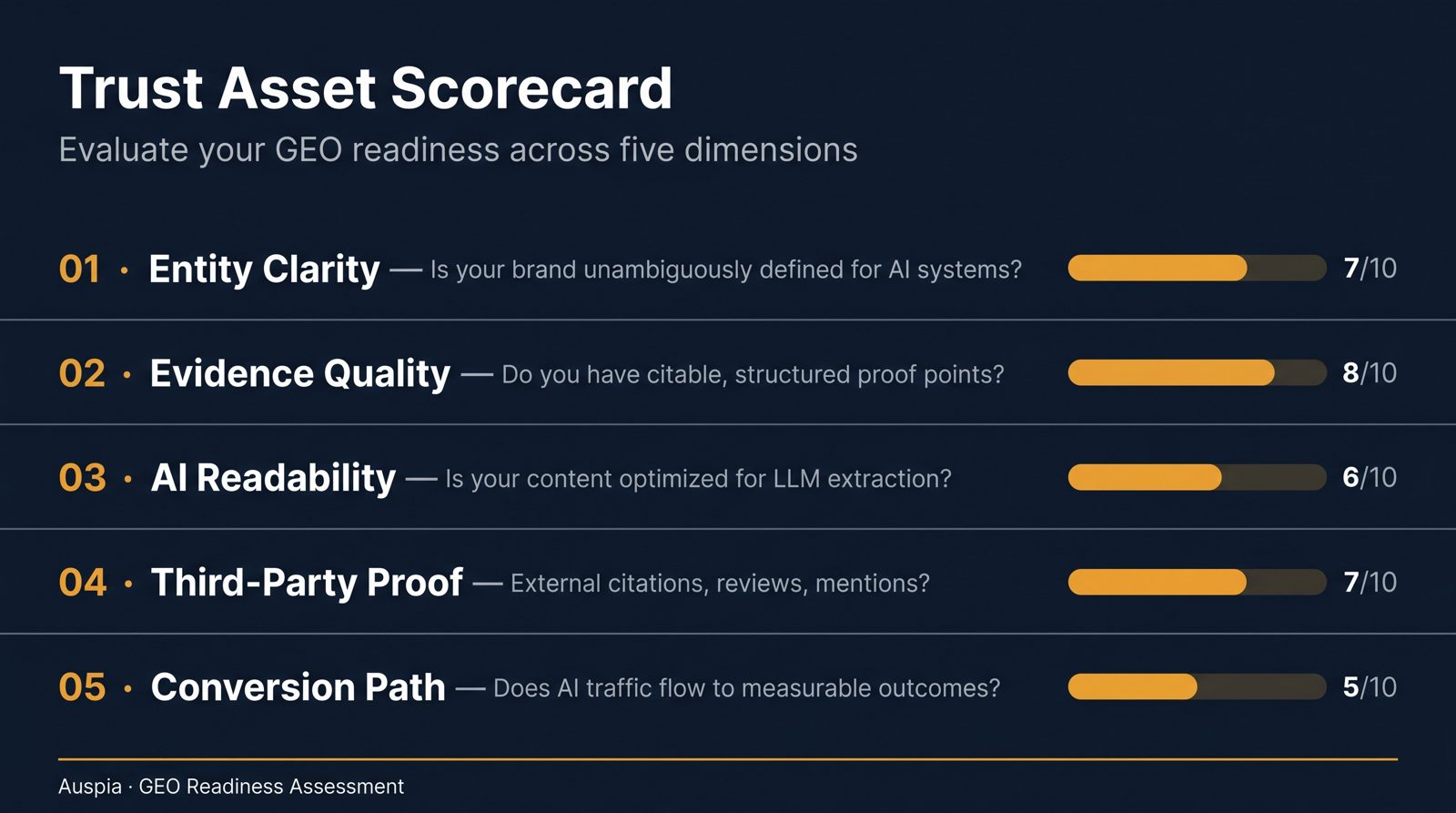
Caption: A trust asset scorecard helps teams judge whether GEO work is building durable proof, not just more pages.
Step 4: connect GEO to brand demand and pipeline
Once visibility and trust signals move, look for business impact.
The most useful lagging metrics are usually not "AI referral sessions." Some AI platforms send limited referral traffic. Some users never click. Some come back later through another channel.
Watch these instead:
Metric | What to compare | Why it is useful |
|---|---|---|
Brand search volume | Pre-GEO baseline vs post-GEO trend | Shows whether AI exposure may be creating recall |
Direct and branded organic conversions | Same period, adjusted for seasonality and paid spend | Captures buyers who return outside the AI platform |
Demo or signup quality | AI-exposed segments vs site average where detectable | Shows whether AI-preeducated visitors convert better |
Sales conversation source notes | Mentions of ChatGPT, Perplexity, Gemini, AI Overviews, or "AI recommendation" | Adds qualitative attribution |
Competitor displacement | Prompt share-of-answer before and after | Shows whether you are entering buying shortlists |
This is where many teams get impatient. GEO often needs a 90- to 180-day window because content has to be crawled, cited, repeated, and trusted. Monthly reporting is still useful, but quarterly trend analysis is fairer.
A practical ROI calculation example
Suppose a B2B SaaS team spends $48,000 over six months on GEO:
Investment item | Cost |
|---|---|
Technical cleanup and schema | $8,000 |
Content refresh and new comparison pages | $18,000 |
Customer proof and review asset production | $10,000 |
Monitoring, reporting, and analyst time | $12,000 |
Total | $48,000 |
During the same period, the team sees:
Impact signal | Conservative assigned value |
|---|---|
Incremental branded organic pipeline linked to high-intent prompt clusters | $72,000 |
Two sales opportunities where buyers mention AI shortlist discovery | $38,000 weighted pipeline value |
Conversion-rate lift on refreshed comparison pages | $24,000 estimated value |
Reduced paid search dependence on the same comparison terms | $12,000 avoided spend |
Total AI-influenced value | $146,000 |
The ROI estimate is:
($146,000 - $48,000) / $48,000 = 204%
This number is not perfect. It should not be presented as forensic revenue attribution. It is a management estimate, built from conservative assumptions and documented evidence.
The point is to make GEO visible enough to fund, not to pretend the model is cleaner than it is.
How to maximize GEO ROI
The fastest way to improve ROI is to stop treating every prompt, page, and mention equally.
Prioritize high-intent prompts
Start with prompts that could change a buying shortlist:
- "best [category] tools for [use case]";
- "[product A] vs [product B]";
- "top [industry] solution providers for [audience]";
- "is [brand] trustworthy for [problem]?";
- "what should I choose if I need [specific constraint]?".
These prompts deserve better pages, fresher evidence, and closer monitoring than broad definition queries.
Turn one proof asset into many AI-readable surfaces
A single benchmark, case study, or expert guide can become:
- a comparison page;
- a FAQ section;
- a schema-supported article;
- a sales enablement one-pager;
- a short video script;
- a third-party contribution;
- a support or documentation page.
That is content leverage. The same proof gets reformatted for different retrieval paths.
Make trust machine-readable
If a customer quote, certification, benchmark, or review matters, do not bury it in a design-heavy page that AI crawlers struggle to parse. Add plain-language summaries, structured data where appropriate, descriptive headings, and consistent entity names.
For teams working on GEO, the boring details matter: crawlability, clean HTML, internal links, schema, and concise answers. AI systems cannot recommend evidence they cannot read.
Refresh winners, not only losers
When a page starts appearing in AI answers, improve it. Add clearer summaries, update examples, strengthen evidence, and make the conversion path easier. Winning pages are often the cheapest pages to compound.
Common ROI traps
The first trap is counting mentions instead of commercial visibility. A brand can appear in many low-value answers and still miss the prompts that shape buying decisions.
The second trap is treating GEO as a one-off campaign. It is closer to SEO plus analyst operations plus reputation management. The model changes, competitors react, and AI answers drift.
The third trap is ignoring negative or weak mentions. If AI systems describe your brand with outdated positioning, missing features, or weak proof, that is a conversion problem even when the mention count looks good.
The fourth trap is asking finance to trust a black box. Write down the assumptions behind the ROI model. Separate measured data from estimated value. Use ranges when needed.
A simple 30-day GEO ROI setup
If you do nothing else this month, build this baseline:
Week | Action | Output |
|---|---|---|
1 | Build 30 high-intent prompts across category, comparison, trust, and problem-solution queries | Prompt library with intent weights |
2 | Run the prompts across your priority AI answer surfaces | Baseline mention, citation, and competitor share |
3 | Audit the top 10 pages AI systems should cite | Trust asset scorecard and fix list |
4 | Connect reporting to business signals | Brand search baseline, direct conversion baseline, CRM source-note field |
This gives you a starting line. Without it, every ROI conversation becomes opinion.
Where Auspia fits
Auspia is built for teams that need to turn GEO from a vague initiative into a measurable workflow. If you want a quick baseline, start with the Auspia GEO Score Checker. It can help you review whether a page is AI-readable, citation-ready, and strong enough to support GEO measurement work.
Use it before you invest heavily in new content. Many teams do not need more pages first. They need to know whether their existing pages can be understood and trusted by AI answer systems.
FAQ
What is a good GEO ROI benchmark in 2026?
There is no universal benchmark yet. A useful target is improvement over your own baseline: higher weighted AI visibility, stronger branded demand, better conversion quality, and more AI-influenced pipeline over a 90- to 180-day window.
How long does GEO take to show ROI?
Most teams should measure GEO in quarters, not weeks. Technical fixes can help quickly, but citation patterns, third-party corroboration, and brand recall usually need 3 to 6 months to show up clearly.
Should AI referral traffic be the main GEO metric?
No. AI referral traffic is useful when available, but it misses users who learn from an AI answer and return later through brand search, direct traffic, or a sales conversation.
Is GEO more like SEO or paid search?
GEO borrows from both, but it behaves more like a trust-building system. Like SEO, it compounds. Like paid search, it should be measured against commercial intent. Unlike both, part of the value happens inside an AI answer before a click exists.
What should a small team measure first?
Start with 20 to 30 high-intent prompts, brand mention rate, citation rate, competitor share, branded organic conversions, and a simple trust asset score for your most important pages.
Author: Ethan Marlowe, GEO Measurement Lead Across 500+ Prompts at Auspia. Ethan writes about prompt tracking, citation reporting, visibility dashboards, and AI answer quality checks.