Direct answer
In 2026, SEO, AEO, and GEO are no longer three competing acronyms. They describe three different jobs in the same AI search stack.
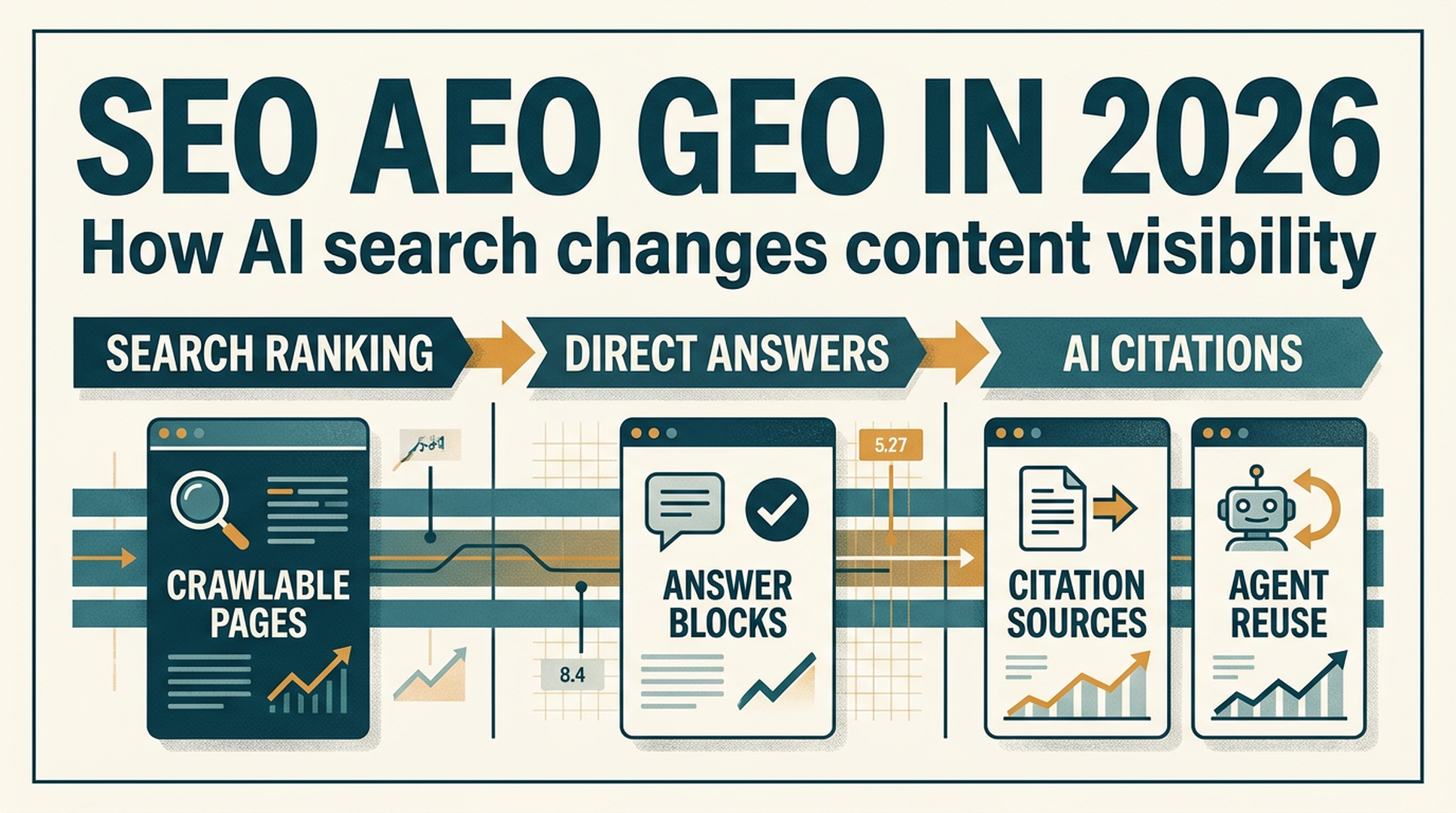
SEO helps a page get crawled, indexed, ranked, and clicked in search results. AEO helps a clear answer block get selected by answer engines, snippets, voice assistants, and AI summaries. GEO helps a brand become a trusted source that large language models and AI agents cite, mention, or reuse when they generate longer answers.
The mistake is treating AEO and GEO as the same thing. They overlap, but they are not the same operating model. AEO is usually about the best answer to one question. GEO is about whether your wider body of work is trusted enough to be used as source material.
For growth teams, the practical answer is simple: keep SEO as the crawlable foundation, add AEO blocks for high-intent questions, then build GEO evidence so AI systems can recognize your brand as a reliable source in the category.
Caption: SEO, AEO, and GEO optimize different parts of the discovery journey: ranking, answer selection, and AI citation.
Why this matters in 2026
The search journey used to be predictable. A user typed a keyword into Google, scanned blue links, clicked a few pages, and assembled an answer. That journey created the classic SEO playbook: keyword research, technical health, content depth, internal links, backlinks, and conversion paths.
AI search changed the middle of the journey.
A user can now ask ChatGPT, Perplexity, Claude, Gemini, Google AI Overviews, or an embedded assistant a full question such as:
"Which AI agent frameworks should a small SaaS team compare before building an internal research agent?"
The system may summarize options, compare tradeoffs, cite sources, and suggest next steps without the user visiting ten pages. In some cases, the answer engine still sends traffic. In other cases, it absorbs the click. Either way, content is no longer competing only for a ranking position. It is competing to be extracted, trusted, cited, and reused.
That is where SEO, AEO, and GEO split.
One-sentence definitions
Use these definitions when your team needs a fast shared language.
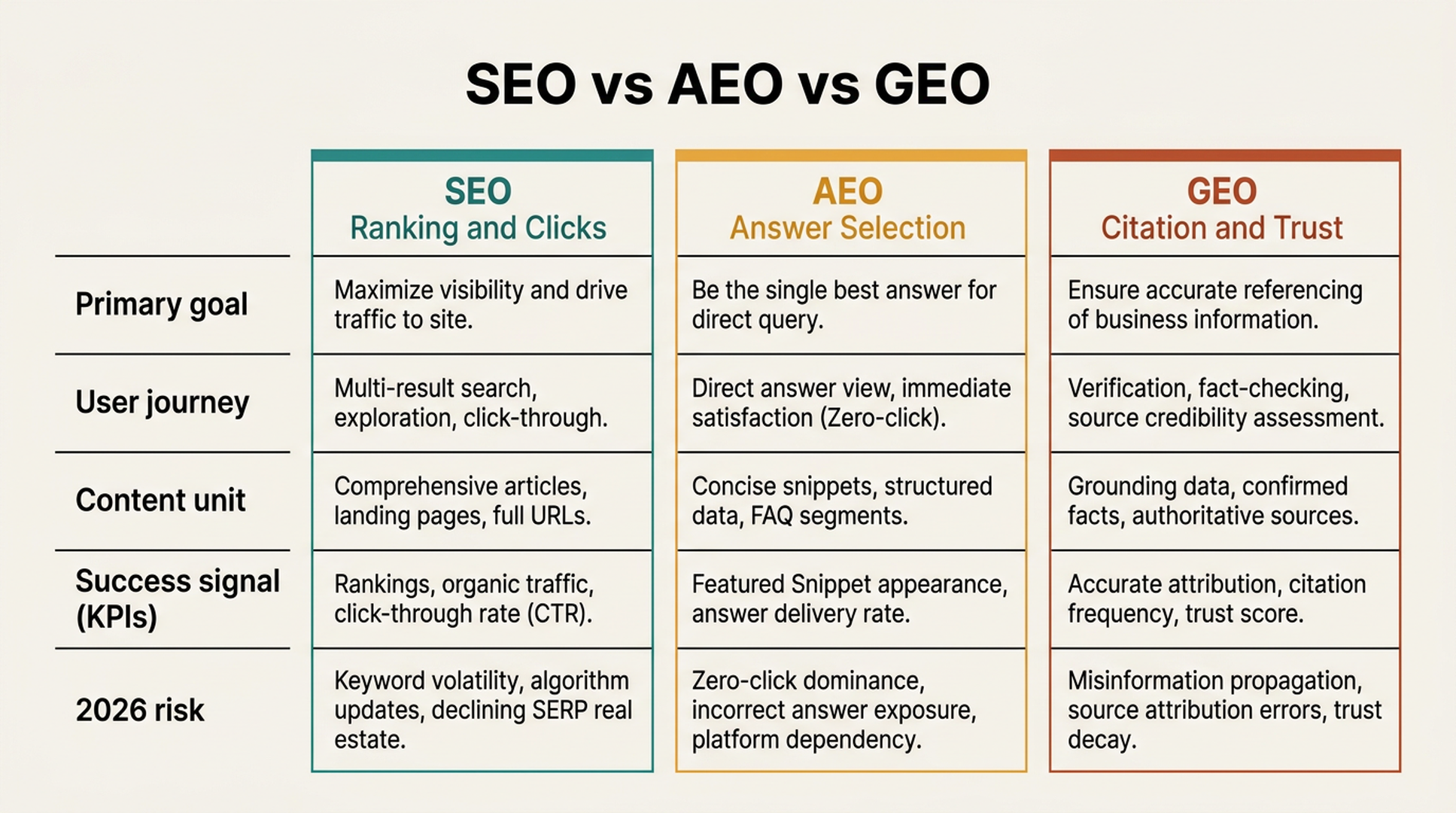
Discipline | One-sentence meaning | Main win |
|---|---|---|
SEO | Make pages discoverable and competitive in search result pages. | Ranking and clicks |
AEO | Structure content so answer engines can lift the clearest response. | Answer inclusion |
GEO | Build enough topical authority, entity clarity, and evidence for generative systems to cite or mention you. | AI citations and brand trust |
A useful shortcut:
- SEO asks: can search engines find and rank this page?
- AEO asks: can an answer engine extract a clear answer from this page?
- GEO asks: does the broader AI ecosystem trust this brand or source enough to use it?
None of the three replaces the others. Weak SEO makes it harder for AI systems to access your content. Weak AEO makes your pages harder to quote or summarize. Weak GEO means your best answers may still lose to sources with more visible authority.
SEO in 2026: still the crawlable foundation
SEO is not dead. It is just no longer the whole game.
A page still needs to load, be indexable, match search intent, answer the query, earn trust, and fit into a coherent site structure. If your robots rules block important crawlers, your JavaScript hides core content, your pages are thin, or your internal links are messy, AI search optimization has a weak base.
In practice, SEO still owns:
- technical accessibility and indexation
- keyword and intent mapping
- page architecture and internal links
- content quality and freshness
- structured data where it clarifies entities and page purpose
- authority signals from links, mentions, and known sources
For AI-era search, SEO also does one more job: it makes your content machine-readable before any answer engine or agent tries to use it.
If you want a quick health check before doing AEO or GEO work, run the site through a tool such as Auspia's Website SEO Score Checker. Fix crawl, indexation, metadata, and page structure issues before asking why AI systems are not citing you.
AEO in 2026: win the answer block
AEO, or Answer Engine Optimization, focuses on direct answers.
This includes AI summaries, featured snippets, "people also ask" style results, voice answers, product assistants, help center bots, and any system that wants a short, reliable response. The user may never click. The goal is for your answer, wording, data point, definition, or step list to become the answer unit.
AEO works best when the page contains answer-ready blocks:
- a direct answer near the top
- clear question-based headings
- short definitions before longer explanation
- tables that compare options without forcing the reader to infer the structure
- step lists with constraints, not just vague advice
- FAQ entries that answer real user questions
- source-backed claims where the answer depends on facts
Example: a page targeting "What is answer engine optimization?" should not begin with three paragraphs about digital transformation. It should answer the question in the first few lines, then explain use cases, examples, and mistakes.
AEO is tactical. It can work at the page level. One well-structured article can win an answer box for a narrow question even if the brand is still small.
GEO in 2026: become source material for AI systems
GEO, or Generative Engine Optimization, is broader. It is about being recognized as a reliable source across AI-generated answers.
A generative engine does not only pick one neat paragraph. It may synthesize multiple sources, compare products, infer categories, rewrite advice, produce a report, or guide an agent through a task. In that environment, your brand needs more than one answer block. It needs an evidence footprint.
GEO work usually includes:
- a clear entity profile for the brand, product, people, and category
- consistent descriptions across the site, profiles, docs, directories, and third-party mentions
- original assets such as benchmarks, checklists, templates, calculators, case studies, and data tables
- topical clusters that cover the problem from different angles
- pages that explain methodology, limitations, and update cadence
- references from sources outside your own domain
- crawl permissions and content formats that AI systems can parse
AEO can help you become the answer. GEO helps you become one of the sources behind the answer.
This is slower. It also creates a stronger moat. A competitor can copy one FAQ format. It is harder to copy a brand's library of evidence, mentions, tools, and category expertise.
The AEO vs GEO mistake most teams make
The most common mistake is saying, "We are doing GEO" when the team is only adding FAQ sections to blog posts.
FAQ blocks can help AEO. They do not automatically create GEO authority.
Here is the real difference:
Question | AEO answer | GEO answer |
|---|---|---|
Unit of work | A page section, answer block, FAQ, definition, table | A domain, brand entity, topic cluster, external evidence network |
Time horizon | Faster, often page-level | Slower, usually portfolio-level |
Main output | The answer engine extracts your response | The generative engine cites, mentions, or relies on your source |
Best for | Definitions, how-to questions, comparisons, support answers | Category authority, product recommendations, expert analysis, agent workflows |
Failure mode | Answers are too vague or buried | Brand is invisible, inconsistent, or unsupported by evidence |
If the page answers a question cleanly, that is AEO progress. If AI systems repeatedly associate your brand with the topic and use your work as supporting evidence, that is GEO progress.
How the three work together
Think of the system as a stack, not a menu.
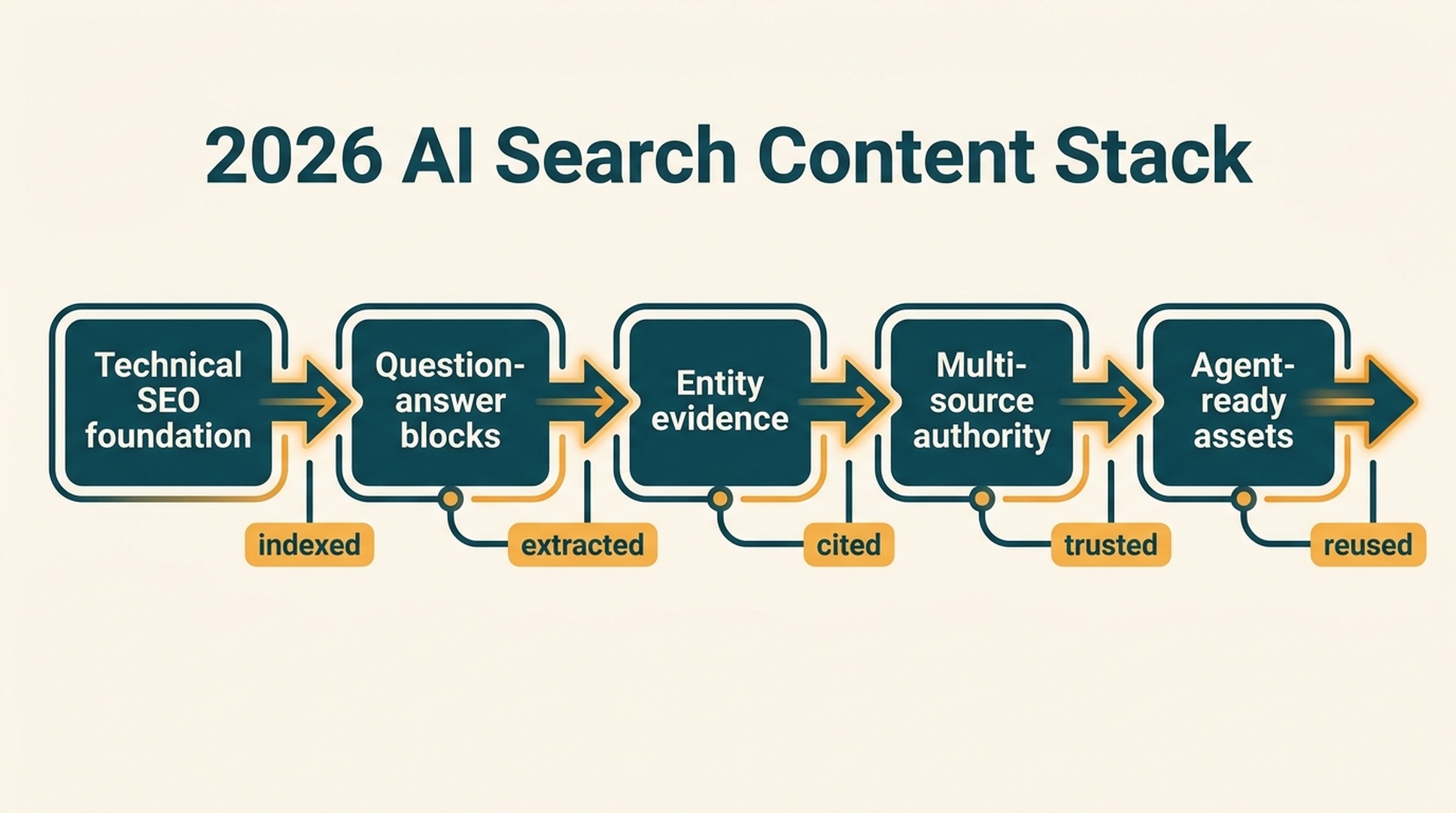
Caption: A 2026 AI search program needs a crawlable foundation, answer-ready content, entity evidence, authority signals, and agent-ready assets.
Layer 1: technical SEO foundation
Make important pages crawlable. Check robots rules, canonical tags, page speed, mobile rendering, internal links, and sitemap coverage. AI search visibility often fails for boring reasons.
Layer 2: intent-mapped content
Map topics to real user jobs. Do not publish ten generic posts around the same keyword. Build pages that answer different questions: definition, comparison, workflow, checklist, examples, mistakes, tools, and measurement.
Layer 3: answer-ready blocks
Add short, extractable answers where they naturally fit. A good answer block should stand on its own, but the page around it should provide depth.
Layer 4: entity and evidence signals
Explain who you are, what category you belong to, what you have built, how your methodology works, and where your claims come from. Add author pages, company descriptions, product pages, case studies, and original assets.
Layer 5: agent-ready reuse
In 2026, content is not only read by humans. It is also parsed by agents. Create assets that agents can use: checklists, comparison tables, CSV-friendly data, templates, documentation, changelogs, and clear permission files such as llms.txt when appropriate.
Auspia's AI Search Visibility Checker is useful here because it helps teams see whether their brand shows up in AI answer environments, not only in traditional rankings.
A practical 2026 workflow for growth teams
Use this workflow when you are building an AI search program from scratch or refreshing an old SEO content library.
Step 1: separate your query set
Split your target queries into three groups.
Query type | Example | Primary discipline |
|---|---|---|
Search discovery | "best customer support software for startups" | SEO |
Direct answer | "what is an AI crawler" | AEO |
Source and recommendation | "which vendors are credible for AI search visibility tracking" | GEO |
A query can belong to more than one group, but the primary job matters. A product comparison page should not be written like a glossary entry. A definition page should not pretend to be a category leadership report.
Step 2: fix the crawlable base
Before rewriting content, make sure the page can be discovered and understood. Check indexation, title tags, headings, schema, canonical rules, and internal links. If you care about AI crawlers, review robots rules and crawler access as well.
Step 3: add answer modules
For high-intent questions, add direct answer modules:
- "Short answer" sections
- compact definitions
- comparison tables
- step-by-step lists
- "when to use" and "when not to use" blocks
- FAQ entries based on actual sales, support, or search questions
Keep the language plain. Answer engines do not need your brand manifesto before the answer.
Step 4: build evidence clusters
Pick the topics where you want to be cited, not just ranked. Then build a cluster with different kinds of assets:
- an evergreen explainer
- a comparison page
- a measurement guide
- a checklist or template
- a tool or calculator
- a case study or experiment
- a methodology page
This is where GEO starts to separate from AEO. The cluster tells AI systems, "This source has more than one page on the topic, and the pages connect to real evidence."
Step 5: measure visibility beyond clicks
Traditional SEO reporting looks at rankings, impressions, clicks, and conversions. Keep those metrics. Add AI-era signals:
- brand mentions in AI answers
- citations in AI search tools
- answer inclusion for target questions
- share of voice across prompt sets
- assisted conversions from branded and direct traffic
- sales calls where prospects mention AI tools as the discovery source
Do not expect perfect attribution. AI search reporting is still young. Use repeated prompt sets and manual review to spot directionally useful movement.
What to do if you only have one month
If your team has 30 days, do not try to "do GEO" across the entire site. Start narrower.
- Pick one commercial topic where AI visibility would matter.
- Audit the top 10 pages that already rank or convert.
- Fix technical issues that block crawling or understanding.
- Add direct answer blocks to the strongest pages.
- Create one comparison table, one checklist, and one methodology section.
- Publish or refresh one supporting asset that gives AI systems something original to cite.
- Track 20 to 50 prompts weekly across ChatGPT, Perplexity, Gemini, and Google AI search surfaces.
That is enough to learn. It also avoids the common trap of publishing 40 shallow posts with no evidence behind them.
Common mistakes
Treating AI search as a content formatting problem
Formatting helps, but it is not the strategy. A clean FAQ section will not save weak claims, thin pages, or an unknown brand.
Killing SEO too early
Some teams hear "zero-click search" and assume organic search no longer matters. That is reckless. Search rankings still feed discovery, links, brand familiarity, and many AI source pathways.
Writing for bots and forgetting the buyer
AI systems summarize content for humans. If the original page is vague, over-optimized, or unconvincing, the extracted answer will not help the business.
Measuring only traffic
Traffic can fall while brand mentions in AI answers rise. Traffic can also rise from pages that never build authority. Track both human visits and AI visibility signals.
Confusing mentions with trust
One AI answer mentioning your brand once is not proof of authority. Look for consistency across prompts, tools, dates, and use cases.
Auspia take
The 2026 search program is not "SEO versus AI." It is SEO plus answer design plus source authority.
SEO earns access. AEO earns answer inclusion. GEO earns trust across generated responses.
That order matters. Most teams should not jump straight into broad GEO campaigns before their pages are crawlable, their answers are extractable, and their entity signals are consistent. Start with the foundation, then build answer assets, then invest in the evidence that makes your brand worth citing.
2026 checklist
Use this checklist before calling a page AI-search-ready.
Check | SEO | AEO | GEO |
|---|---|---|---|
Page is crawlable and indexable | Yes | Required base | Required base |
Main question is answered in the first section | Helpful | Yes | Helpful |
Headings match real user questions | Helpful | Yes | Helpful |
Tables or lists clarify comparisons | Helpful | Yes | Yes |
Claims have sources, examples, or methodology | Helpful | Helpful | Yes |
Brand/entity description is consistent | Helpful | Helpful | Yes |
Page belongs to a larger topical cluster | Yes | Helpful | Yes |
AI visibility is measured with prompt sets | Optional | Yes | Yes |
FAQ
Is GEO replacing SEO in 2026?
No. GEO depends on many of the same foundations that make SEO work: crawlable pages, clear entities, useful content, links, and authority signals. The difference is the output. SEO aims for rankings and clicks. GEO aims for citation, mention, and reuse inside generated answers.
Is AEO the same as featured snippet optimization?
Featured snippets are one form of AEO, but the category is wider. AEO also applies to AI summaries, voice answers, product assistants, help center bots, and any answer engine that needs a concise response.
Can a small site win AEO results?
Yes, especially for narrow questions. A small site with a clear, well-structured answer can beat a larger site that buries the answer. GEO is usually harder for small sites because it requires a broader evidence footprint.
What should a team optimize first?
Fix SEO basics first, then add answer-ready modules to pages with search demand or buyer intent. After that, build GEO assets around the topics where you want the brand to be trusted.
How do you measure GEO?
Track whether AI systems mention, cite, or rely on your brand across a stable set of prompts. Review multiple tools and dates. Combine that with branded search, direct traffic, assisted conversions, and sales feedback.
Final thought
The brands that win AI search in 2026 will not be the ones that memorize the newest acronym fastest. They will be the ones that make their content easy to crawl, easy to answer from, and credible enough to cite.
That is the real shift: ranking is still useful, but trust is becoming the bigger distribution channel.