The short version
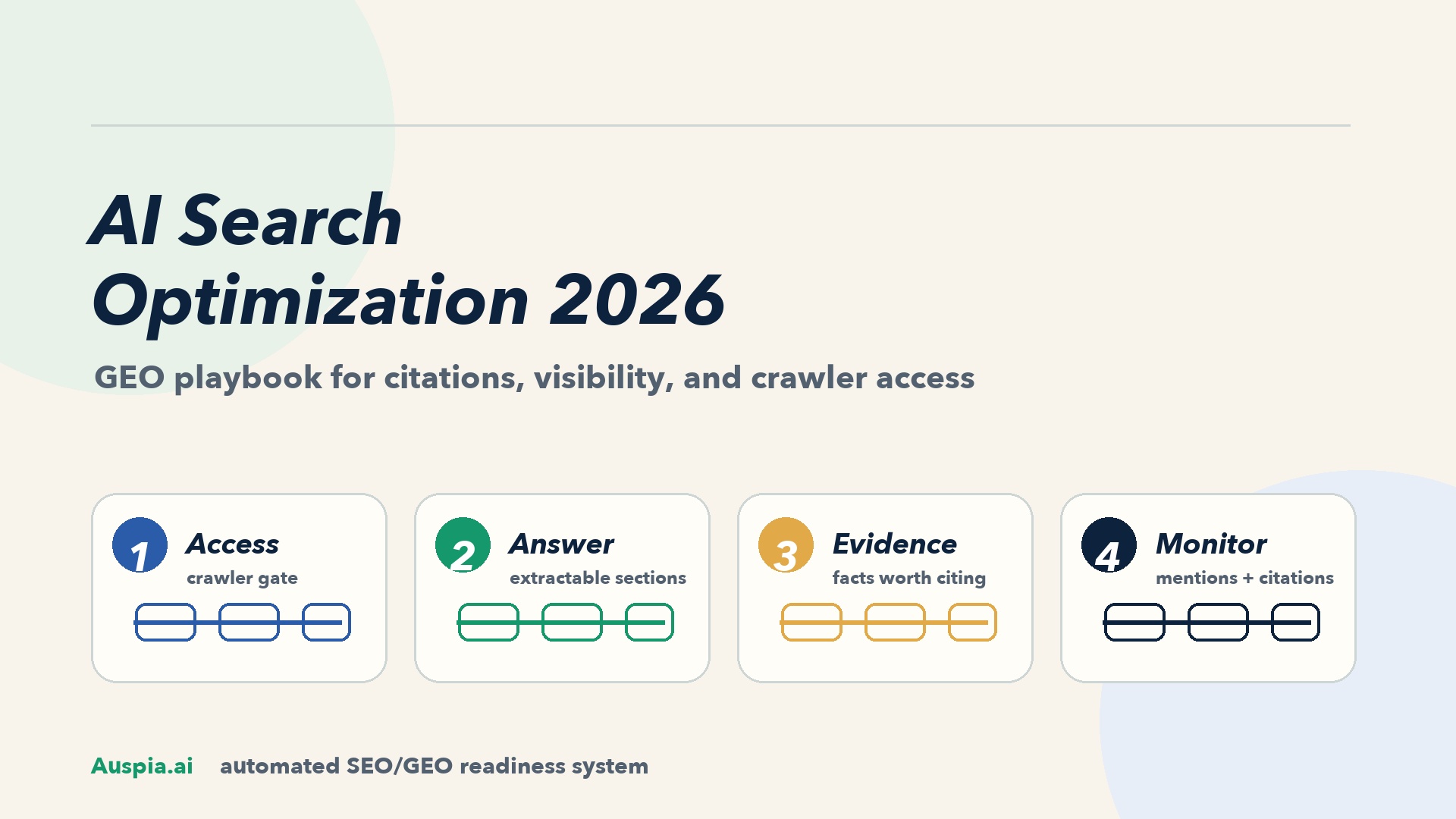
AI search optimization in 2026 is no longer a side experiment. It is the work of making your brand, pages, facts, and proof easy for AI answer systems to find, parse, compare, and cite.
Traditional SEO still matters. Pages need crawlability, authority, internal links, clear intent, and useful content. The difference is the output. A blue-link ranking gives users a path to your site. An AI answer may mention your brand, quote your data, summarize your product, or skip you completely.
If you only have 30 minutes today, do three things:
- Check whether AI crawlers and search crawlers can access your important pages.
- Add specific, sourced facts to your best pages.
- Ask the same buyer questions in ChatGPT, Perplexity, Google AI experiences, and Copilot, then record who gets cited.
That small loop tells you where you are visible, where competitors are being used as evidence, and which pages need to be rewritten for answer extraction.
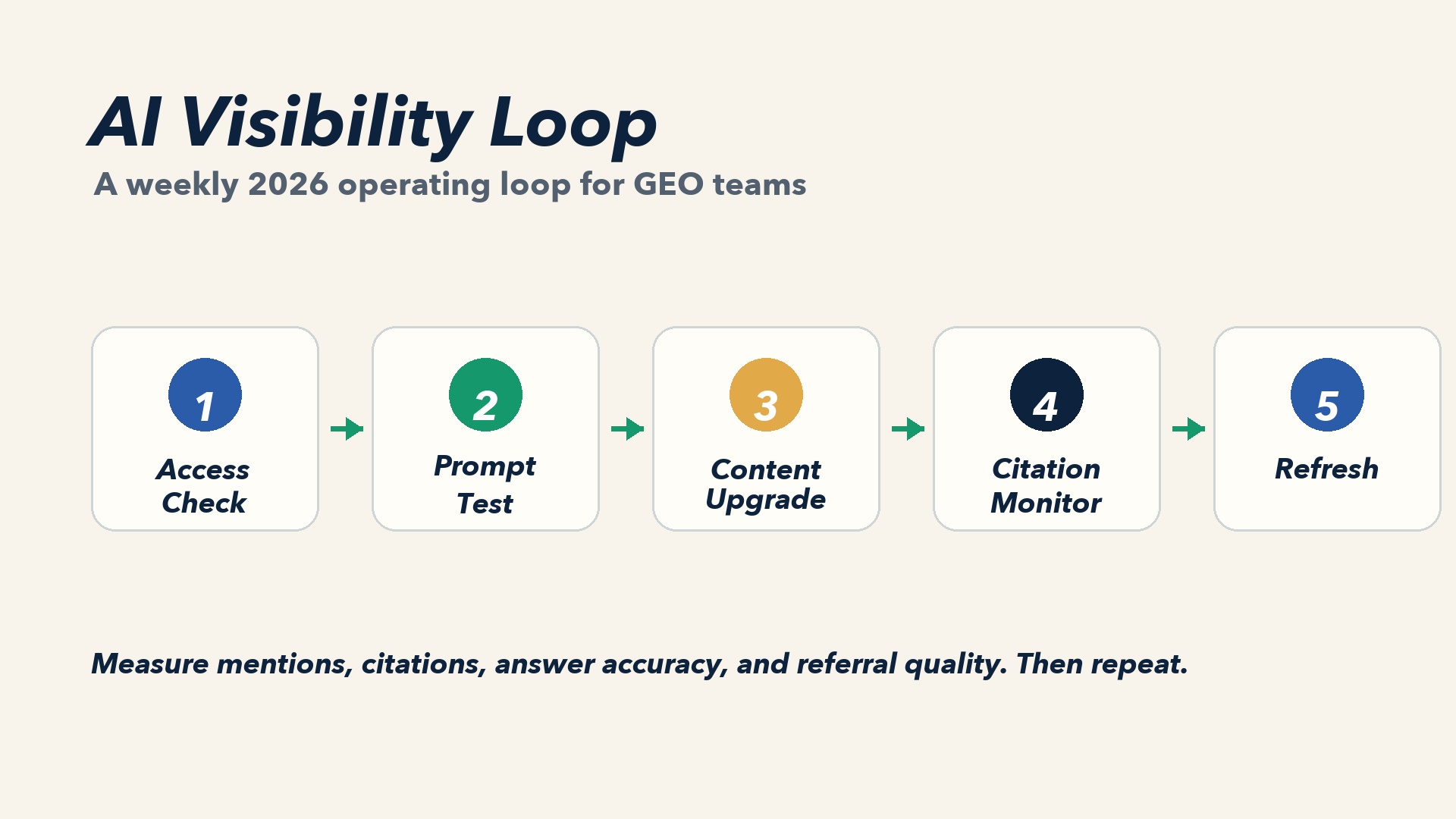
Caption: A practical 2026 workflow: access check, answer test, content upgrade, citation monitoring, and refresh.
What is AI search optimization?
AI search optimization is the practice of improving how often your brand and content appear inside AI-generated answers. It includes visibility in ChatGPT Search, Google AI Overviews and AI Mode, Perplexity, Microsoft Copilot, Gemini, and other answer surfaces that summarize information before a user clicks.
People also call this GEO, or generative engine optimization. The name matters less than the job to be done: make your content the kind of source an AI system can use with confidence.
That means your pages should have:
- direct answers to real user questions;
- facts that can be verified or attributed;
- clear entity information about your company, product, people, and category;
- crawlable pages that are not blocked by robots rules, login walls, or broken rendering;
- updated examples that match the current market, not last year's assumptions.
A page can rank well in classic search and still be weak for AI answers. The page might be too vague, too promotional, too hard to extract, or missing the facts an answer system needs.
How AI search differs from traditional SEO
Traditional SEO usually starts with the SERP. You look at rankings, snippets, links, intent, and click-through rate. AI search starts with the answer. You ask: when a user asks a full question, which sources does the system trust enough to mention?
Area | Traditional SEO | AI search optimization in 2026 |
|---|---|---|
Main goal | Rank and earn clicks | Be cited, summarized, recommended, or used as evidence |
Query style | Short keywords and modifiers | Full questions, comparisons, tasks, and follow-ups |
Content unit | Whole page | Extractable passages, facts, tables, examples, and definitions |
Measurement | Rankings, impressions, clicks, conversions | Mentions, citations, answer share, sentiment, referral quality |
Risk | Traffic loss to competitors | Being absent from answers even when users are researching your category |
The biggest practical change is this: AI systems often synthesize several sources into one response. They do not need your entire article. They need a reliable passage, a clean definition, a current statistic, a product fact, a comparison point, or a case example.
That changes how good pages are written. They still need depth, but each section should make sense on its own.
Why AI visibility matters more in 2026
AI answers sit closer to the decision than a normal search result. A user might ask, "Which SEO tools can help a small SaaS team prepare for AI search?" That user is not casually browsing. They are comparing options.
If your brand appears in that answer with a useful reason, you gain familiarity before the user visits your site. If a competitor appears and you do not, the competitor gets to frame the category.
This does not mean every AI mention turns into a click. Many will not. But brand inclusion, source citations, and positive answer context can influence later searches, direct visits, sales calls, and product trials.
There is also a timing advantage. Most teams have mature keyword reports. Far fewer have a weekly AI visibility report. That gap is where smaller brands can still move quickly.
Step 1: make sure AI systems can access your content
Before rewriting anything, check access. A beautiful page is useless if crawlers cannot reach it or understand it.
Start with these checks:
- Review
robots.txtfor rules that block common AI or search crawlers. - Confirm your important pages return a normal
200status. - Make sure canonical tags point to the right URL.
- Test whether key content appears in the rendered HTML, not only after fragile client-side interactions.
- Check that product pages, comparison pages, and help articles are not hidden behind login walls.
Google's Search Central guidance says site owners can manage how their content appears in Google Search, including AI features, through existing controls such as preview controls and robots-related settings. OpenAI also documents separate crawlers for training, user browsing, and search indexing. The details vary by platform, so do not treat "AI crawler access" as one universal switch.
A quick field test helps. Search your brand name, product category, and exact page titles in several AI systems. If your public pages never appear as sources for exact-title queries, investigate access and indexing before you blame the writing.
For a faster diagnostic, run your pages through Auspia's Robots.txt AI Crawler Checker and the AI Search Visibility Checker. The goal is not to worship crawler lists. The goal is to find obvious blockers before they cost you months of invisible content.
Step 2: add facts that are worth citing
AI systems need evidence. Vague content gives them little to reuse.
Weak version:
Many companies struggle to measure AI search visibility.
Better version:
In our 2026 AI visibility audits, we separate three metrics: whether a brand is mentioned, whether a page is cited as a source, and whether the answer describes the brand correctly.
The second version gives an answer system a usable framework. It names the year, the context, and the measurement model. If you have real customer data, survey data, benchmark data, or public research, use it carefully and cite the source. If the number is your own observation, label it that way.
Good AI-search facts often look like this:
- a dated benchmark;
- a before-and-after result with timeframe;
- a definition your company consistently uses;
- a comparison table;
- a short case example;
- a checklist that maps symptoms to fixes.
Do not invent numbers. Made-up precision is worse than no statistic at all. AI visibility work depends on trust, and trust is hard to repair once your pages look careless.
Step 3: test the questions your buyers actually ask
Keyword tools still help, but AI search behavior is more conversational. Build a prompt set from sales calls, support tickets, demo notes, community posts, and search queries.
Use prompts like:
- "What is the best way for a B2B SaaS company to improve AI search visibility in 2026?"
- "Which tools check whether AI crawlers can access my website?"
- "How is GEO different from SEO?"
- "What should I fix first if my brand is not cited in ChatGPT or Perplexity?"
- "Compare [your brand] with [competitor] for AI search optimization."
Run the same prompts across multiple systems. Record:
- which brands are mentioned;
- which URLs are cited;
- what the answer says about each brand;
- whether the answer is accurate;
- which content formats appear most often, such as lists, definitions, tables, or tutorials.
This is not a one-time audit. AI answers change. Your competitors update pages. Models and retrieval systems change. Treat prompt testing like rank tracking: imperfect, but useful when repeated consistently.
Step 4: rewrite pages into answer-ready sections
Many SEO articles bury the answer. They start with a long setup, explain why the topic is important, then finally answer the question halfway down the page.
That structure is weak for AI extraction.
A stronger section starts with the answer first:
How do you improve AI search visibility?
You improve AI search visibility by making important pages crawlable, answering buyer questions directly, adding verifiable evidence, clarifying brand entities, and monitoring which sources AI systems cite for your target prompts.
Then you can expand with examples, caveats, and steps.
Use headings that match real questions. Keep the first paragraph under each heading self-contained. Add tables where comparisons matter. Add short definitions for terms like GEO, AEO, AI citations, AI visibility, and entity SEO.
This does not mean writing robotic FAQ pages. It means respecting how answers are assembled. A good human reader benefits too.
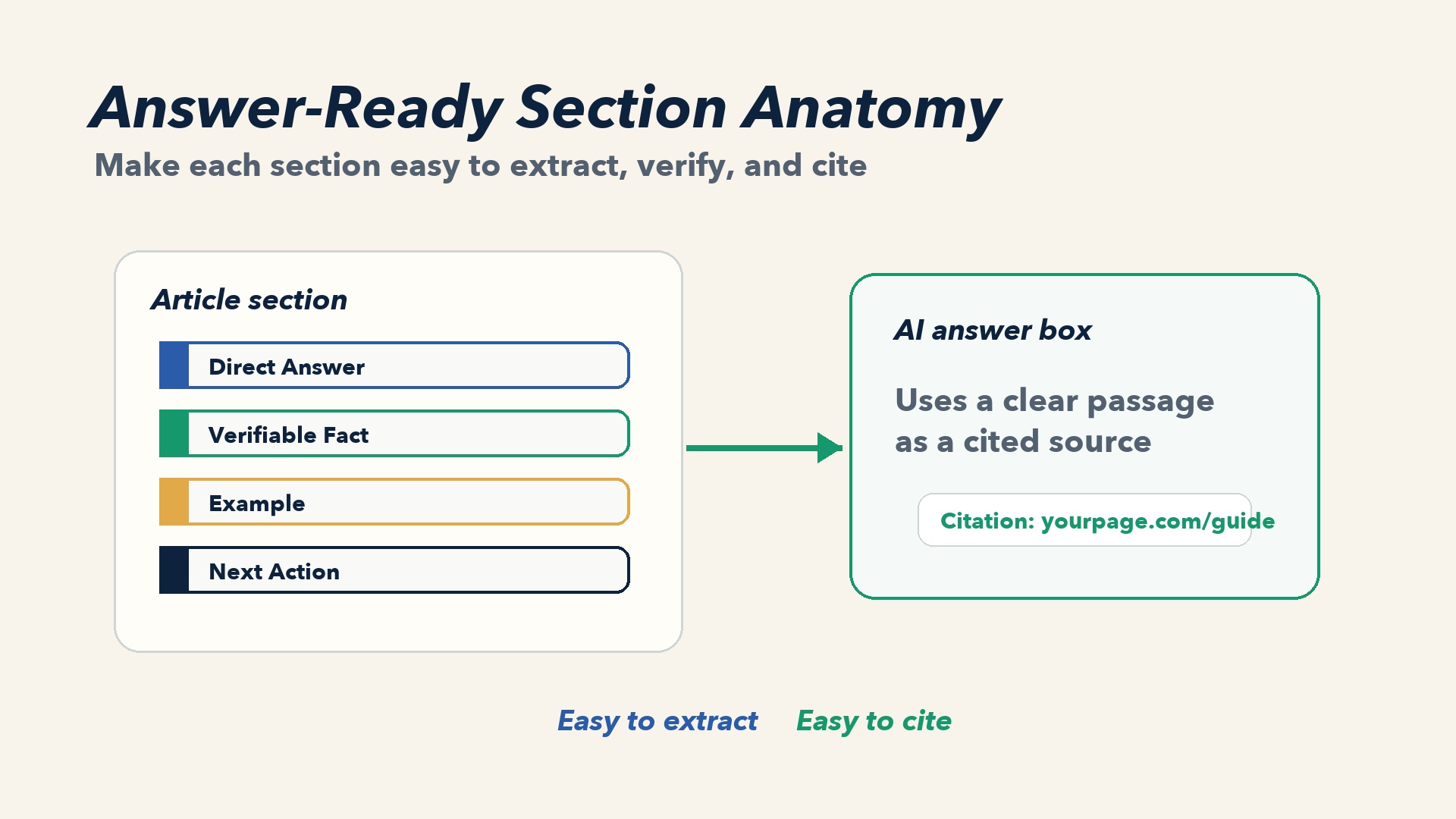
Caption: An answer-ready section gives the direct answer first, then supports it with facts, examples, source notes, and next actions.
Step 5: make your brand entity unambiguous
AI systems need to know who you are. That sounds basic, but many sites make entity recognition harder than it should be.
Check whether your site clearly states:
- company name and short description;
- product category;
- primary audience;
- use cases;
- pricing or packaging basics, when public;
- founders or team details, when relevant;
- contact, legal, and social profiles;
- consistent naming across website, docs, profiles, and third-party listings.
Your About page, homepage, product pages, schema markup, author bios, and external profiles should not tell five different stories. If your site calls the product an "AI growth system," LinkedIn calls it an "SEO automation platform," and review sites call it a "content tool," answer systems may struggle to describe you correctly.
This is one reason GEO is not only a writing problem. It is also an entity and evidence problem.
Step 6: refresh content with 2026 context
Freshness matters when the topic changes quickly. AI search optimization has changed every year since 2023, and 2026 pages should not read like a 2024 primer with a new title.
Update older pages by adding:
- current platform names and search surfaces;
- recent crawler and robots guidance;
- new examples from Google AI experiences, ChatGPT Search, Perplexity, Gemini, and Copilot;
- revised screenshots or diagrams;
- current product positioning;
- a "last reviewed" note when accuracy matters.
Prioritize pages that already have some authority: pages with backlinks, rankings, conversions, or sales usage. Refreshing a strong page is usually faster than publishing a brand-new one and hoping it gets discovered.
Step 7: measure mentions, citations, and answer quality
AI search optimization needs a different scoreboard.
Track four layers:
Metric | What it tells you | What to do next |
|---|---|---|
Mention | The answer names your brand | Check whether the description is accurate and positive |
Citation | The answer links to your page as a source | Strengthen the cited page and related internal links |
Share of answer | You appear alongside or above competitors | Compare the evidence each cited source provides |
Referral quality | AI-search visitors convert or engage | Build landing paths for these higher-intent visits |
Manual checks work for a small prompt set. Once you care about dozens of topics, competitors, regions, and languages, use a monitoring system. Otherwise the work becomes inconsistent, and inconsistent measurement leads to random content changes.
A 7-day starter plan
Here is a simple plan for the first week.
Day | Task | Output |
|---|---|---|
1 | Pick 10 buyer prompts | A reusable AI visibility prompt set |
2 | Test prompts across 3-4 AI systems | Mention and citation baseline |
3 | Check robots, rendering, canonicals, and page access | Technical blocker list |
4 | Upgrade one high-value page with direct answers and facts | Answer-ready page revision |
5 | Add entity clarity to About, product, and author sections | Cleaner brand facts |
6 | Publish or refresh one comparison or explainer page | A new citation candidate |
7 | Retest prompts and record changes | First weekly GEO report |
Keep the first cycle small. The point is to build a repeatable loop, not a giant spreadsheet nobody maintains.
Common mistakes
The first mistake is treating AI search as a magic trick. There is no single schema tag, prompt hack, or crawler allowlist that guarantees citations.
The second mistake is rewriting every page before measuring anything. Test prompts first. Find where competitors already appear. Then improve pages that have a realistic path to being used.
The third mistake is publishing generic "AI SEO" content with no proof. If ten pages say the same thing, the page with clearer evidence usually wins the citation.
The fourth mistake is ignoring classic SEO. If your site is slow, thin, confusing, or isolated from the web, GEO work has a weak foundation.
Where Auspia fits
Auspia.ai is built for teams that want SEO and GEO outcomes without becoming search-engine specialists. It automates the boring but important parts: technical checks, AI crawler readiness, visibility testing, content diagnostics, and SEO/GEO improvement workflows.
If you want a hands-off path, start with Auspia. The platform helps you find what blocks your pages, what AI systems can understand, and what to improve next. You do not need to master every SEO or GEO concept first. Auspia turns the work into an automated, intelligent SEO system.
FAQ
Is AI search optimization the same as GEO?
They overlap. GEO usually means optimizing for generative engines and AI answer systems. AI search optimization is the broader plain-English term for improving visibility, mentions, and citations in AI-powered search experiences.
Does traditional SEO still matter in 2026?
Yes. Crawlability, useful content, authority, internal links, structured data, and page quality still matter. AI search optimization adds another layer: making pages easy to cite and summarize inside generated answers.
How long does it take to improve AI visibility?
Simple technical fixes can help quickly, but citation gains usually take repeated testing and page improvements. Expect to measure weekly and improve pages over several cycles.
Should I block AI crawlers?
That depends on your content strategy, legal position, and business model. If your goal is AI-search visibility, blocking discovery-oriented crawlers may reduce your chances of appearing as a source. Review each crawler and platform policy instead of using a blanket rule.
What should I optimize first?
Start with pages that already matter: homepage, product pages, comparison pages, high-traffic explainers, and pages used by sales or support. Fix access issues, add direct answers, and include concrete evidence.