Direct answer
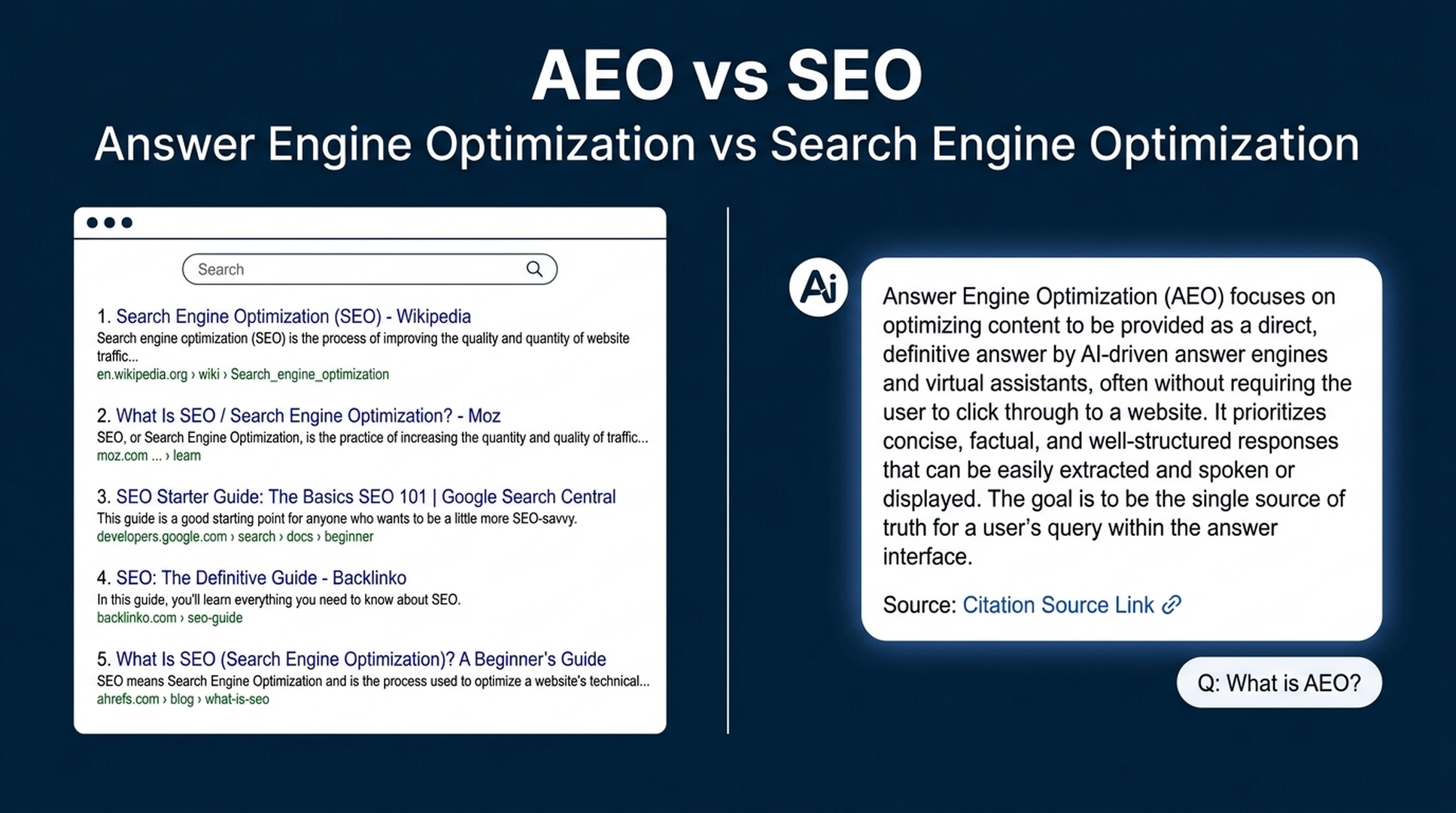
AEO (Answer Engine Optimization) and SEO (Search Engine Optimization) both aim to increase website visibility, but they target different systems. SEO optimizes pages to rank in traditional search engine results pages (SERPs). AEO optimizes content to be selected as the direct answer in AI-powered answer engines like ChatGPT Search, Perplexity, and Google AI Overviews.
SEO earns clicks from a list of links. AEO earns citations inside a generated answer.
Simple explanation
SEO works within the framework of classic search engines. You optimize title tags, build backlinks, improve page speed, and target keywords so that Google or Bing places your page higher in the ranked results. The user sees ten blue links, scans them, and clicks through.
AEO works within the framework of answer engines. These systems do not show a list of links. Instead, they read your content, interpret it, and synthesize a direct answer for the user—often citing your page as the source. Your goal is not to rank at position one but to become the passage the AI quotes, paraphrases, or links to inside its response.
Dimension | SEO | AEO |
|---|---|---|
Target system | Google, Bing, traditional SERPs | ChatGPT Search, Perplexity, Google AI Overviews |
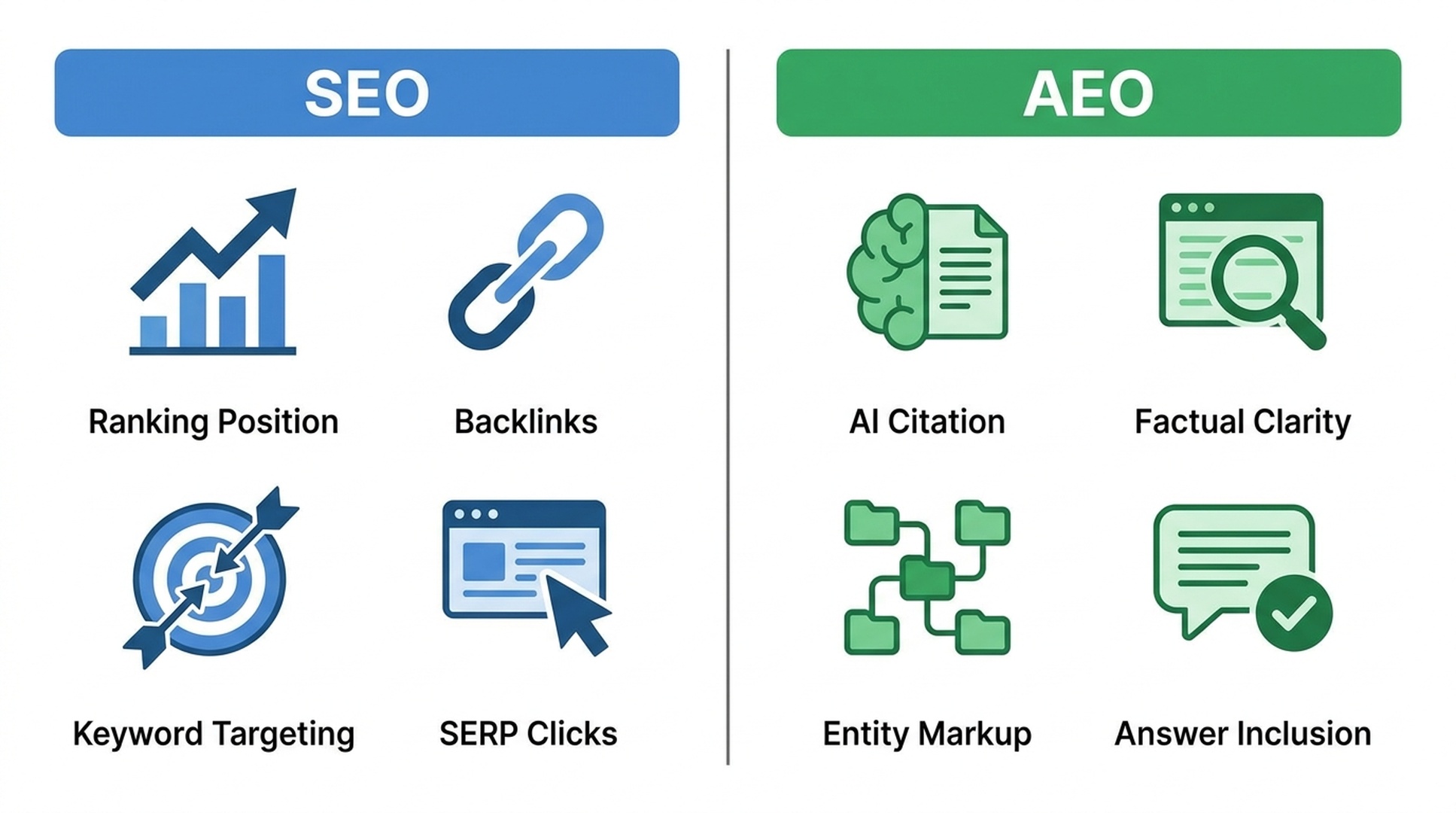
Success metric | Ranking position, organic CTR | AI citation, answer inclusion, referral traffic from AI |
Content format | Keyword-optimized pages, blog posts | Structured, direct-answer content with clear entities |
Key signals | Backlinks, page speed, keyword density | Factual clarity, entity markup, answer structure |
User behavior | Scans results, clicks a link | Reads the answer, occasionally follows the source |
Why it matters
AI search adoption is accelerating. A growing share of informational queries now receive an AI-generated answer before—or instead of—a traditional results page. When an answer engine cites your content, you gain:
- Visibility without a click: Users read the answer and may never visit your page, but your brand name and domain appear as the source.
- Higher trust signal: Being cited by ChatGPT, Perplexity, or Google AI Overview functions as an implicit endorsement.
- Future-proofing: As search shifts from links to answers, sites that only optimize for traditional SEO risk losing traffic to pages that answer engines prefer.
For growth teams, AEO is not a replacement for SEO—it is a parallel discipline. You need both.
How AEO changes your content approach
1. Structure content as direct answers
Answer engines extract passages that directly respond to a query. Instead of writing a 1,500-word essay that buries the answer in paragraph seven, put the answer first and then expand.
Pattern: State the answer in one or two sentences. Then provide supporting detail, examples, and context.
2. Use clear entity references
Answer engines identify entities—products, people, companies, concepts—and their relationships. Use specific names, not vague pronouns. Instead of "this tool helps with optimization," write "Auspia helps B2B teams audit AI search visibility."
3. Build comparison and definition blocks
Tables, definition lists, and structured comparisons are high-value targets for answer extraction. When you write "AEO vs SEO" content, include a comparison table. Answer engines frequently pull table rows directly into responses.
4. Add FAQ sections with real questions
Not padded FAQ pages with fifty near-duplicate questions—focused FAQ blocks that match actual user queries. Each question should have a concise, standalone answer that an answer engine can extract without reading the surrounding paragraph.
5. Optimize for citation, not just ranking
Traditional SEO rewards pages that keep users on the page. AEO rewards pages that answer engines can confidently cite. These overlap but diverge in important ways:
- Citation-friendly content is more factual and less promotional.
- It uses explicit claims with verifiable data.
- It avoids hedging language that makes AI systems reluctant to quote it.
Common mistakes
Mistake | Why it hurts |
|---|---|
Treating AEO as identical to SEO | Answer engines use different extraction logic than ranking algorithms |
Writing long introductions before the answer | AI systems prefer passages where the answer appears early |
Ignoring structured data | Schema markup helps answer engines identify entities and relationships |
Keyword stuffing | Answer engines penalize unnatural repetition; they want factual clarity |
No FAQ strategy | FAQ blocks are among the highest-value AEO assets |
Auspia perspective
At Auspia, we see AEO and SEO as two layers of the same growth stack. SEO ensures your pages are discoverable by traditional search engines. AEO ensures your content is citable by AI answer systems. The most resilient growth strategies optimize for both simultaneously.
The practical implication: audit your existing content not just for keyword rankings, but for answer readiness. Can an AI system extract a clear, factual, self-contained answer from your page? If not, that page is invisible to the fastest-growing channel in search.
What teams should do next
- Audit your top 20 pages for answer readiness. Does each page contain a direct, extractable answer to the query it targets?
- Add comparison tables to any "vs" or "what is" content.
- Restructure introductions so the direct answer appears in the first two sentences.
- Mark up key entities with schema.org structured data.
- Track AI citations using tools that monitor ChatGPT Search, Perplexity, and Google AI Overview mentions.
- Maintain SEO fundamentals—page speed, backlinks, and technical health still matter as baseline discoverability.
FAQ
Is AEO replacing SEO?
No. AEO complements SEO. Traditional search results still drive significant traffic, and the technical foundations (site speed, crawlability, backlinks) benefit both disciplines. However, for informational queries, AI answers are capturing an increasing share of user attention.
Can I optimize for AEO without changing my SEO strategy?
You can add AEO-friendly elements—direct answers, structured data, FAQ blocks, comparison tables—on top of your existing SEO content. Most improvements benefit both systems.
Which answer engines should I prioritize?
ChatGPT Search, Perplexity, and Google AI Overviews currently drive the most AI-sourced traffic. Monitor which platforms your audience uses and track your citation share in each.
How do I measure AEO success?
Track AI citation frequency, referral traffic from AI platforms, and brand mentions in generated answers. Traditional rank trackers do not capture AEO performance.
Does AEO work for B2B websites?
Yes. B2B buyers increasingly use AI search to research tools, compare vendors, and find definitions. Being cited as the source in an AI answer about your category builds credibility and drives qualified traffic.