Direct answer
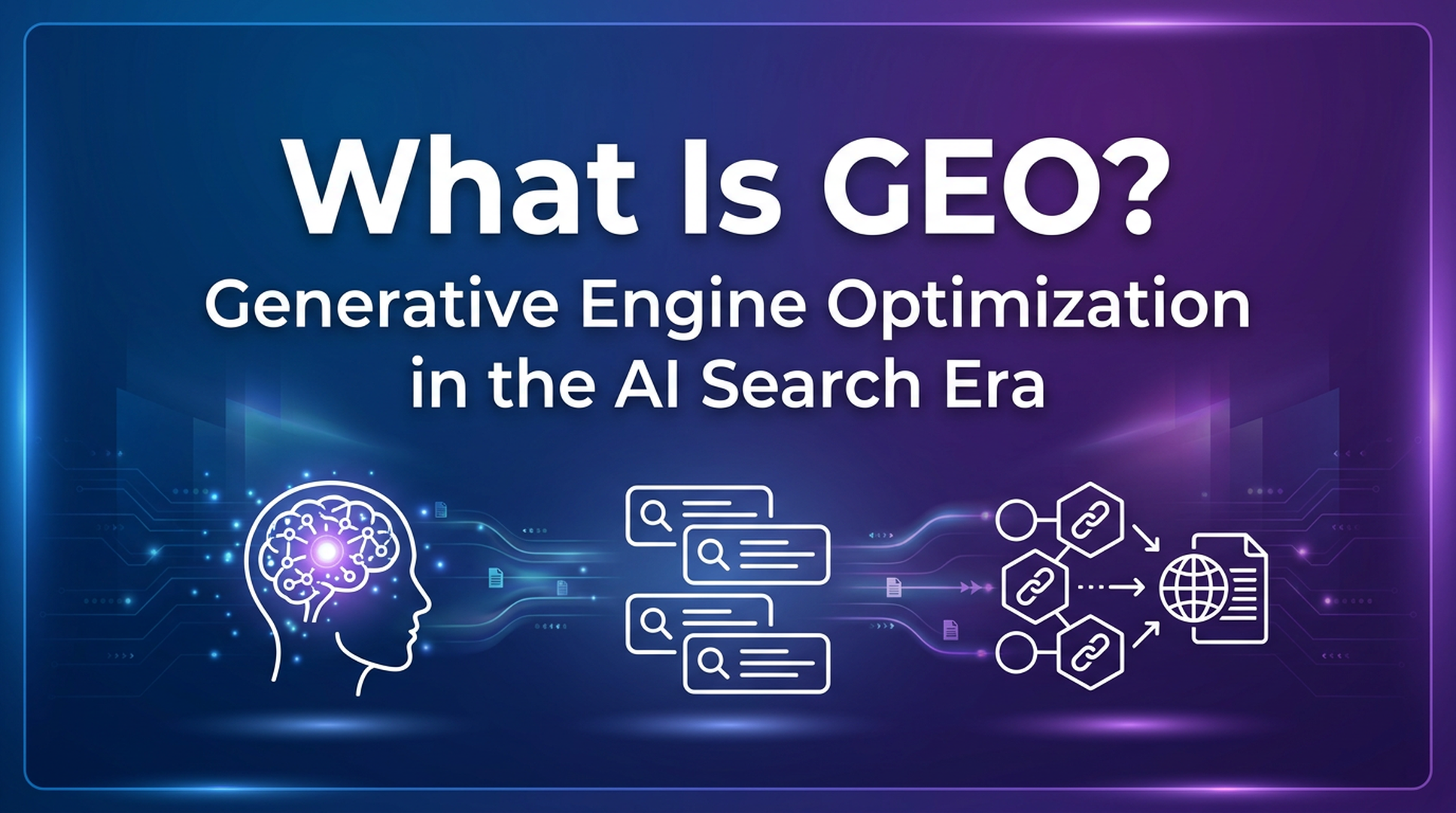
GEO (Generative Engine Optimization) is the practice of optimizing content so that AI-powered search engines—like ChatGPT Search, Google AI Overviews, and Perplexity—understand, adopt, and cite your content as a source. While traditional SEO focuses on ranking in blue-link search results, GEO focuses on becoming the trusted source that AI models reference in their generated answers.
In short: SEO gets humans to click your link. GEO gets AI to quote your content.
Why GEO matters in 2026
AI search adoption is accelerating faster than most teams anticipated. According to Semrush research from 2025, Google AI Overviews trigger rates doubled within two months—rising from 6.49% of queries in January to 24.61% by July. That's a 200% increase in AI-mediated searches.
But here's the catch: while AI search impressions grew by 49%, click-through rates dropped by roughly 30%. Seer Interactive's data shows organic CTR falling from 1.76% to just 0.61%—a 65% decline. Google is transforming from a search engine into an answer engine. If your content doesn't appear in AI summaries, your brand gradually disappears from view.
The question is no longer "How do we rank higher?" but "How do we get chosen by AI?"
What is GEO, exactly?
GEO stands for Generative Engine Optimization. It's a content optimization strategy designed for AI search engines powered by large language models (LLMs). The core goal: become a trusted source that AI models cite when generating answers.
Traditional SEO mindset: You write an article hoping it ranks on Google's first page so users click through to your site.
GEO mindset: You write an article hoping AI models cite it as a source, driving users to click the citation link back to your site.
Example: Suppose someone asks an AI, "What's the best project management tool for remote teams?"
- SEO approach: You write a blog post targeting "best project management tools" and hope it ranks #1.
- GEO approach: You write a comprehensive comparison with clear data, structured headings, and expert insights—so AI models cite your analysis directly in their response.
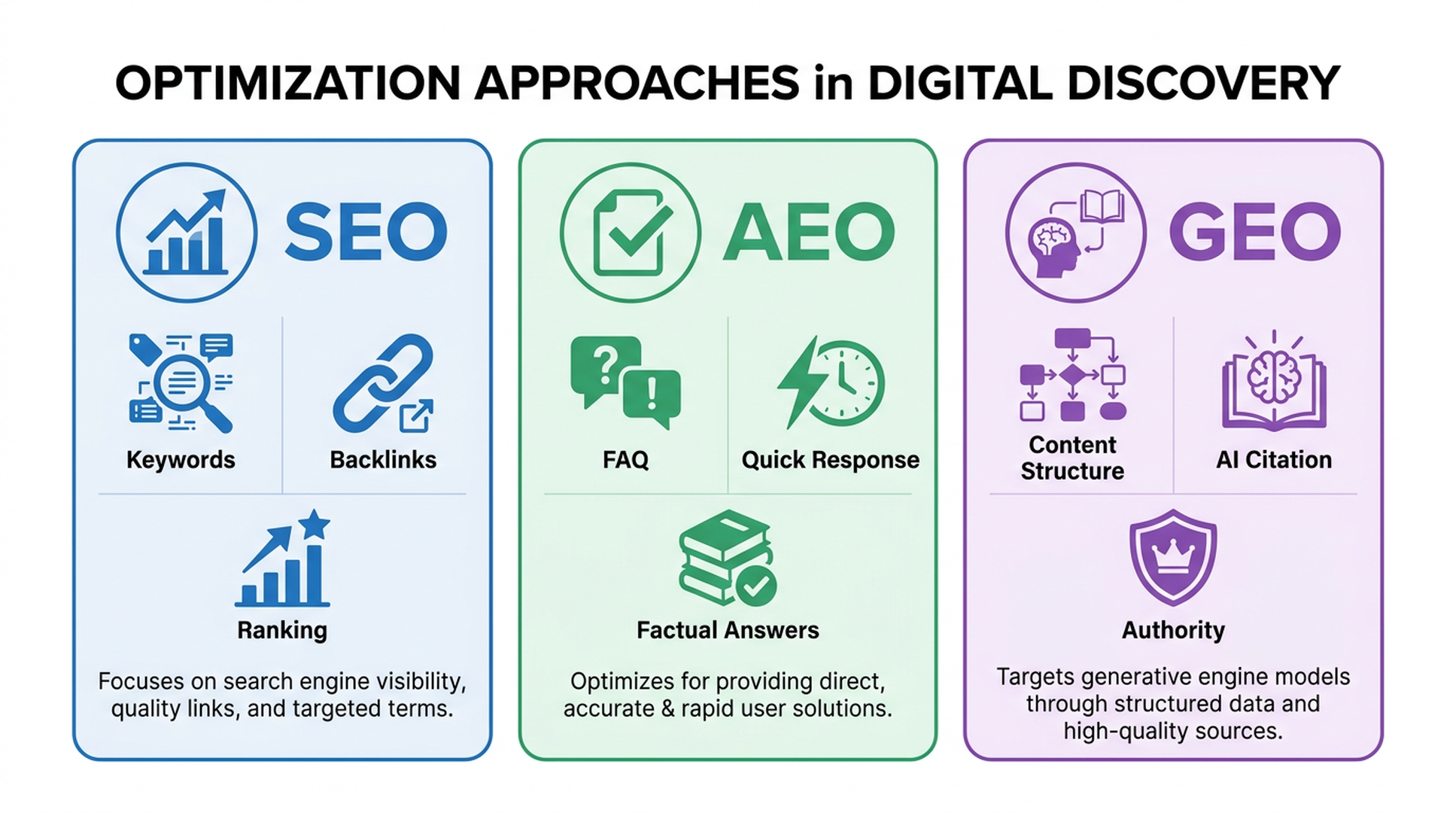
SEO vs AEO vs GEO: What's the difference?
These three optimization approaches target different search behaviors:
Approach | Target | User Behavior | Success Metric |
|---|---|---|---|
SEO | Blue-link rankings | Users search keywords, scan results, click links | Ranking position, organic CTR |
AEO (Answer Engine Optimization) | Factual, closed-ended questions | Users ask specific questions, expect single answers | Being quoted in AI responses |
GEO (Generative Engine Optimization) | Open-ended, advisory questions | Users ask "how to" or "what should I use," expect recommendations | Being cited as a source in AI-generated answers |
AEO handles factual, closed questions like "What's the price of Slack?" Users want one correct answer fast. AI pulls from FAQ sections and structured data.
GEO handles open-ended, evaluative questions like "Compare Slack, Microsoft Teams, and Notion for a 50-person startup." Users want recommendations with reasoning. AI synthesizes from multiple sources and cites them.
GEO encompasses both AEO and traditional SEO. It's the umbrella discipline for AI search visibility.
Core optimization principles: Building on SEO foundations
Despite AI changing the rules, SEO remains the foundation. Research shows that websites ranking #1 have a 25% probability of being selected as an AI reference source. But ranking alone isn't enough. AI models now evaluate content using E-E-A-T criteria: Experience, Expertise, Authoritativeness, and Trustworthiness.
1. Provide scarce authenticity that AI cannot generate
AI excels at synthesizing existing information but lacks real-world experience. Creators should emphasize human-generated insights:
- First-hand testing: Share specific details from actual product usage, not just feature lists.
- Case studies with process: Don't just show results—document the implementation journey, including failures and pivots.
- Original data: Conduct surveys, analyze internal metrics, or publish proprietary research that AI can't replicate.
Example: Instead of writing "Our SaaS tool increases productivity by 30%," publish a detailed case study showing how a specific customer reduced onboarding time from 14 days to 5 days using your platform, including screenshots and interview quotes.
2. Build authority signals and external validation
AI algorithms reference external signals to assess content reliability. Actively pursue:
- High-quality backlinks: Earn mentions from authoritative industry publications, not just link exchanges.
- Cross-domain citations: Get referenced by academic institutions, industry analysts, or major media outlets.
- Expert bylines: Ensure content is attributed to recognized experts with verifiable credentials.
3. Optimize entity recognition and sentiment association
Brand consistency across the web directly influences AI recommendation willingness:
- Entity consistency: Ensure your brand name, product names, and key personnel are consistently referenced across Wikipedia, news articles, social platforms, and industry databases.
- Positive sentiment monitoring: Track and maintain brand reputation across the web. Positive associations directly improve AI recommendation rankings.
4. Structure content for modular extraction
AI doesn't just crawl entire pages—it performs granular "chunk-level processing." Optimize for extraction:
- Modular sections: Ensure each section can stand alone as a self-contained answer.
- Precise answers: Make sure individual paragraphs can directly answer specific questions in 30-50 words, increasing the chance of being extracted as featured snippets.
5. Strengthen semantic embedding and topical relevance
Help AI categorize your content correctly through textual optimization:
- Rich vocabulary: Naturally incorporate synonyms, industry terminology, and related keywords throughout the content.
- Entity relationships: Increase contextually relevant "entity" associations to deepen content depth and topical authority.
Practical techniques: Writing AI-friendly content
To get content adopted by AI, structure and directness are critical.
1. Use Q&A structure and question-based headings
AI search queries are typically phrased as questions. Set H2 or H3 headings as specific questions (e.g., "What is generative engine optimization?") followed immediately by a 30-50 word concise answer. This increases the probability of being extracted as a summary.
2. Leverage lists, tables, and data
AI prefers structured data:
- Bullet lists: For presenting features, benefits, or key points.
- Numbered lists: For step-by-step instructions and how-to guides.
- Data tables: For product comparisons, feature matrices, or performance benchmarks.
Structured content is easier for AI to extract and compare.
3. Build topical authority through content clusters
AI tends to cite sources with demonstrated depth in a specific domain. Build content clusters:
- Pillar pages: Comprehensive overview covering the full scope of a topic.
- Cluster articles: Deep-dive pieces addressing specific subtopics, typically 2,000+ words each.
- Internal linking: Connect cluster articles to pillar pages to reinforce topical authority.
Long-form content consistently outperforms short content in AI search visibility.
4. Deploy structured data markup
Use Schema markup (FAQPage, Product, Article, HowTo) to provide explicit signals to AI. This is essentially telling AI: "This is the question, this is the answer," reducing interpretation errors.
5. Maintain core web vitals
Even in the AI era, page load speed, stability, and mobile-friendliness remain baseline requirements. Slow-loading pages hinder AI crawler efficiency and reduce the likelihood of being indexed promptly.
The Auspia perspective
At Auspia, we see GEO not as a replacement for SEO but as its evolution. The most resilient growth strategies optimize for both simultaneously. Traditional SEO ensures your pages are discoverable by search engines. GEO ensures your content is citable by AI systems.
The practical implication: audit your existing content not just for keyword rankings, but for AI citation readiness. Can an AI system extract a clear, factual, self-contained answer from your page? If not, that page is invisible to the fastest-growing channel in search.
What teams should do next
- Audit your top 20 pages for AI citation readiness. Does each page contain a direct, extractable answer to the query it targets?
- Add comparison tables to any "vs" or "what is" content.
- Restructure introductions so the direct answer appears in the first two sentences.
- Deploy FAQ schema on key product and service pages.
- Track AI citations using tools that monitor ChatGPT Search, Perplexity, and Google AI Overview mentions.
- Maintain SEO fundamentals—page speed, backlinks, and technical health still matter as baseline discoverability.
FAQ
What does GEO stand for?
GEO stands for Generative Engine Optimization. It's the practice of optimizing content so AI-powered search engines understand, adopt, and cite it as a trusted source.
How is GEO different from SEO?
Traditional SEO focuses on keyword rankings and backlinks to earn clicks from search results. GEO focuses on content structure, semantic clarity, and authority signals so AI models cite your content in generated answers. SEO targets human click behavior; GEO targets AI citation behavior.
Why are click-through rates declining in the AI era?
CTR decline is driven by "zero-click searches." When Google AI Overviews or ChatGPT Search provide complete answers directly in the results page, users don't need to visit websites. Data shows CTR for informational queries dropping 30-60% after AI intervention. Brands must secure explicit citations in AI summaries to maintain visibility.
How can I increase the chance my content gets cited by AI?
The most effective approach is using question-answer structure and content chunking:
- Set headings as specific questions.
- Provide a precise 30-50 word definition paragraph immediately below each heading.
- Use lists and tables for comparison content.
- Deploy FAQPage Schema structured data.
Why does E-E-A-T matter for GEO?
E-E-A-T (Experience, Expertise, Authoritativeness, Trustworthiness) is the ultimate metric AI uses to evaluate source credibility. AI models need to avoid generating "hallucinations" or spreading misinformation, so they prioritize sources with verifiable expertise, authority endorsements, and first-hand experience. High-trust content is more likely to be incorporated into AI knowledge graphs.