Quick answer: what GEO is now
Generative Engine Optimization (GEO) is the work of making a brand, page, product, or expert source easier for AI answer systems to understand, trust, cite, and recommend.
That sounds close to SEO, but the target is different. SEO mainly asks, "Can we rank for this query and earn the click?" GEO asks a colder question: "When an AI system compresses ten sources into one answer, do we become part of that answer?"
That is why GEO matters in 2026. Search is no longer a neat list of blue links. Buyers now ask ChatGPT, Gemini, Perplexity, Claude, Google AI Overviews, Reddit threads, YouTube summaries, and vertical agents before they ever land on a vendor site. The page still matters. The page just has to do more jobs than it used to.
This article is a practical history of GEO: where it came from, why the term spread, what changed after AI answers became mainstream, and what a serious team should build instead of buying a cheap "AI mention" package.
The short history of GEO
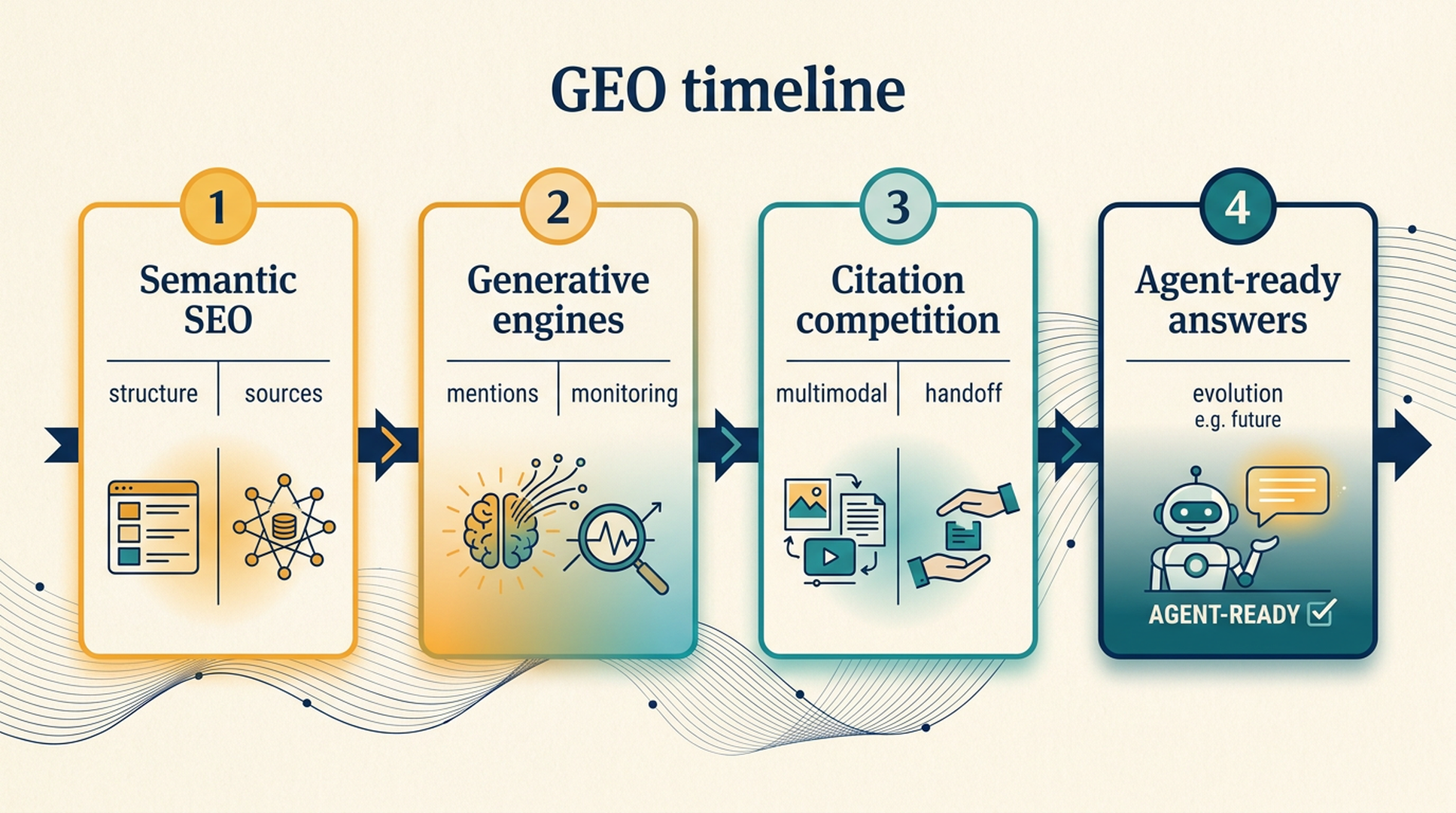
GEO did not appear out of nowhere. It is the result of four shifts that were already happening inside search.
Period | What changed | What teams optimized for | GEO lesson |
|---|---|---|---|
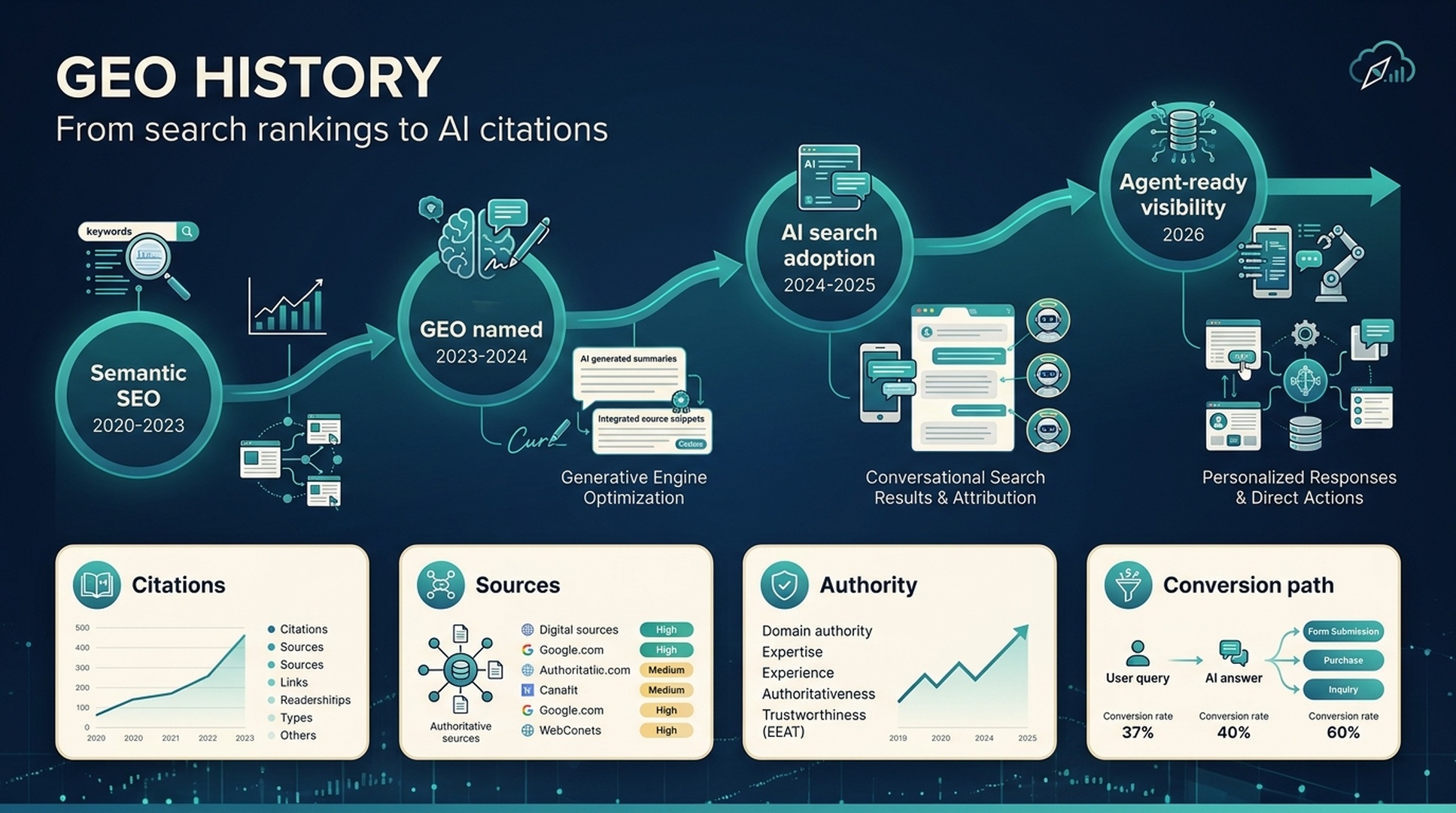
2020-2023 | Search engines got better at semantic understanding | Helpful pages, schema, entities, topic clusters | Machines needed clearer meaning, not just keywords |
Late 2023-2024 | The term "Generative Engine Optimization" entered research and SEO circles | Being visible inside generated answers | Citations and answer inclusion became measurable goals |
2024-2025 | AI answers moved into mainstream search and research workflows | Authority, freshness, third-party proof, retrievable content | Pages had to compete as sources, not only destinations |
2026 onward | Agents and multi-step workflows changed the funnel | Brand trust across answers, tools, docs, reviews, and handoff pages | GEO became an operating system, not a one-page trick |
The academic trigger is worth naming. The paper "GEO: Generative Engine Optimization" was posted on arXiv in November 2023 by researchers from Princeton University, Georgia Tech, the Allen Institute for AI, and IIT Delhi. The paper tested how content changes could affect visibility in generative engine responses. It did not create the whole market, but it gave the market a name.
The commercial trigger came later. Google expanded AI Overviews across more countries and languages, Perplexity normalized cited AI answers, and ChatGPT moved from a chat box into search-like behavior. By 2025, Google said AI Overviews had more than 1.5 billion monthly users. Pew Research Center also found that people were less likely to click traditional result links when an AI summary appeared. The exact numbers will keep changing, but the direction is obvious: answers are absorbing more of the click.
Phase 1: semantic SEO set the foundation
Before GEO had a name, good SEO teams were already doing part of the work.
They used schema markup. They built FAQ sections. They grouped pages by topic instead of chasing one keyword per page. They cleaned up author bios, product specs, comparison tables, and internal links. They made pages easier for Google to parse.
That was not yet GEO. The goal was still to rank and win the click.
But semantic SEO trained teams to think in entities, intent, and information structure. Those habits now matter even more. AI systems do not simply read a page title and a few headings. They pull snippets, reconcile claims, compare sources, and decide which names deserve to appear in a short answer.
If your content is vague, thin, or hard to retrieve, the model has no reason to carry it forward.
Phase 2: GEO became a named discipline
The first wave of GEO conversation was narrow and technical. People asked questions like:
- Does adding statistics increase the chance of citation?
- Do expert quotes help?
- Do clearer summaries make a page easier to include in an AI answer?
- Do authoritative claims work better when they are backed by sources?
These are useful questions, but they led to a bad shortcut: some teams started treating GEO as a formatting hack.
Add a definition. Add a table. Add schema. Add an FAQ. Wait for the AI mention.
That sometimes helps, especially on messy pages. But it is not enough. A generative engine is not only looking for a neat paragraph. It is choosing between sources. If your competitors have stronger third-party evidence, fresher data, clearer product pages, and better brand recognition, a polished FAQ will not save you.
Auspia's view is simple: GEO starts on the page, but it is decided across the source graph.
Phase 3: AI answers turned GEO into a growth problem
Once AI answers became visible to normal users, GEO stopped being an academic curiosity.
A buyer researching "best payroll software for remote teams" may now see an AI answer that names three products, summarizes tradeoffs, and cites a handful of review pages. A founder asking "how to reduce cloud costs" may get a synthesized checklist from documentation, blog posts, GitHub issues, and vendor guides. A procurement team may ask an AI assistant to compare suppliers before opening a single website.
This changes the job of content.
Traditional SEO content tries to attract the user after the search. GEO content tries to shape the answer before the user clicks. That is a different kind of leverage.
For B2B companies, the effect is sharp because research happens before the sales call. If your brand is absent from the AI answer layer, you may never know how many deals started without you.
Phase 4: agent-ready GEO is the next version
The next version of GEO is not just "get cited in a chatbot."
Agents are beginning to perform multi-step tasks: shortlist vendors, check documentation, compare pricing pages, inspect reviews, read changelogs, fill forms, and recommend next actions. That means GEO has to cover more than articles.
A serious 2026 GEO program needs:
Asset | Why it matters for AI visibility |
|---|---|
Clear product and service pages | Helps models understand what you actually sell |
Comparison and alternative pages | Gives AI systems language for tradeoffs |
Documentation and support content | Lets agents verify features and implementation details |
Third-party mentions and reviews | Gives external proof beyond your own site |
Structured data and crawl access | Reduces retrieval friction |
Fresh expert content | Shows that the brand still has current knowledge |
Measurement prompts | Tracks whether AI systems mention, cite, or ignore you |
This is where cheap GEO packages usually fall apart. They promise mentions, but they do not fix the evidence layer. They publish generic content, but they do not map the buyer questions. They add schema, but they do not check whether AI crawlers can access the right pages.
What GEO is not
GEO is young enough that people are still selling almost anything under the name. A few boundaries help.
GEO is not a replacement for SEO. If your site has poor crawlability, weak topical coverage, slow pages, and no authority, AI visibility will be fragile too.
GEO is not prompt manipulation. You do not control the user's prompt, the model's retrieval set, or the answer interface. You can only improve the probability that your brand is a useful source.
GEO is not only content writing. Content matters, but so do reviews, documentation, PR, data, citations, partnerships, product clarity, and brand consistency.
GEO is not a guaranteed ranking system. AI answer surfaces vary by model, location, account state, freshness, and query phrasing. Anyone promising fixed placement is selling certainty they do not have.
The operating system for GEO
The best way to run GEO is to treat it as a repeatable operating system.
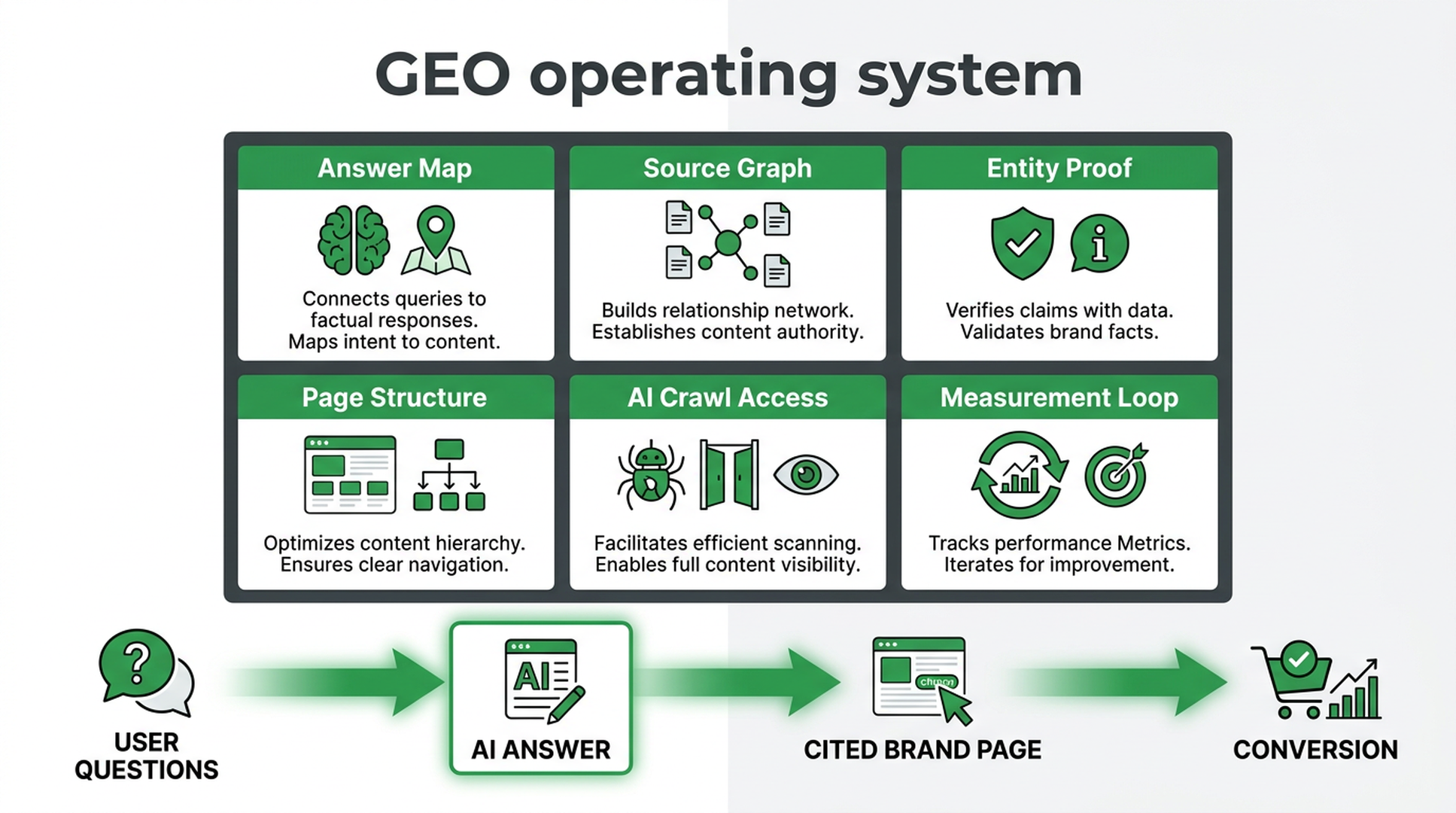
Start with six workstreams.
Workstream | What to do | Output |
|---|---|---|
Answer map | List the questions buyers ask AI tools before purchase | Prompt library by funnel stage |
Source graph | Identify which pages and third-party sites AI systems cite today | Citation and competitor map |
Entity proof | Make brand, product, people, and category facts consistent | Entity brief and source references |
Page structure | Rewrite pages so answers, evidence, and next steps are easy to extract | GEO-ready landing pages and articles |
AI crawl access | Check robots rules, llms.txt, schema, and blocked resources | Technical access checklist |
Measurement loop | Re-test prompts across models and track mention quality | Monthly AI visibility report |
Auspia has tools for parts of this workflow, including the AI Search Visibility Checker, LLMs.txt Generator / Checker, and Robots.txt AI Crawler Checker. Use tools to create evidence, not to decorate a report.
A practical GEO checklist
If you are starting from zero, do not begin with a 60-page strategy deck. Begin with the questions that already affect revenue.
- Choose 20 high-intent questions your buyers ask before they buy.
- Test those questions in Google AI Overviews, ChatGPT, Perplexity, Gemini, and Claude.
- Record which brands are mentioned, which sources are cited, and which claims repeat.
- Compare your own pages against the cited sources.
- Rewrite weak pages with direct answers, evidence, examples, tables, and clear next steps.
- Add structured data where it actually describes the page.
- Strengthen third-party proof through credible mentions, reviews, directories, partner pages, and expert contributions.
- Check that AI crawlers can access the pages you want discovered.
- Re-test monthly, because answer surfaces change.
The first useful metric is not "traffic from AI." That data is still incomplete for many teams. Start with mention rate, citation rate, sentiment, source ownership, and conversion path coverage.
Common mistakes
The first mistake is copying SEO content and calling it GEO. A 2,000-word guide can still fail if it never gives a crisp answer or proof.
The second mistake is optimizing only your own website. AI systems often trust third-party pages more than brand pages, especially for comparisons and recommendations.
The third mistake is chasing volume queries too early. GEO is most useful where the answer can change a business outcome: vendor shortlists, pricing research, implementation questions, risk comparisons, and category definitions.
The fourth mistake is treating one model as the truth. ChatGPT, Gemini, Perplexity, Claude, and Google AI Overviews do not behave the same way. Test across surfaces.
The fifth mistake is buying fake authority. Low-quality guest posts, synthetic reviews, and thin directory listings may create noise, but they rarely create durable trust.
Auspia takeaway
GEO is not magic. It is the next layer of search work after semantic SEO.
The teams that win will not be the ones that stuff "AI-friendly" phrases into old pages. They will be the ones with clear entities, useful answers, accessible content, external proof, and a measurement loop that shows where AI systems already trust them and where they are invisible.
If you do one thing this week, run a small AI visibility audit. Pick ten buyer questions, test them across three AI answer surfaces, and write down who gets cited. That spreadsheet will tell you more than most GEO sales decks.
FAQ
What is GEO in simple terms?
GEO means improving your content and brand evidence so AI answer systems are more likely to mention, cite, or recommend you when users ask relevant questions.
How is GEO different from SEO?
SEO focuses on ranking pages in search results. GEO focuses on being included in generated answers, summaries, comparisons, and agent workflows. The two overlap, but they measure different outcomes.
Does GEO replace traditional SEO?
No. Technical SEO, content quality, authority, and crawlability still matter. GEO builds on those foundations and adds answer inclusion, citation quality, and AI visibility measurement.
Which companies need GEO first?
B2B software, professional services, ecommerce categories with heavy comparison behavior, local services with reputation-driven decisions, and any company where buyers ask AI tools before contacting sales.
Can GEO results be guaranteed?
No. AI answer systems change by model, query, location, freshness, and retrieval behavior. A good GEO program improves the odds and measures progress, but it should not promise fixed placement.