The short version
A page can rank well in Google and still be invisible when a buyer asks ChatGPT, Perplexity, Gemini, or Google AI Overviews for advice.
That gap is the reason GEO exists.
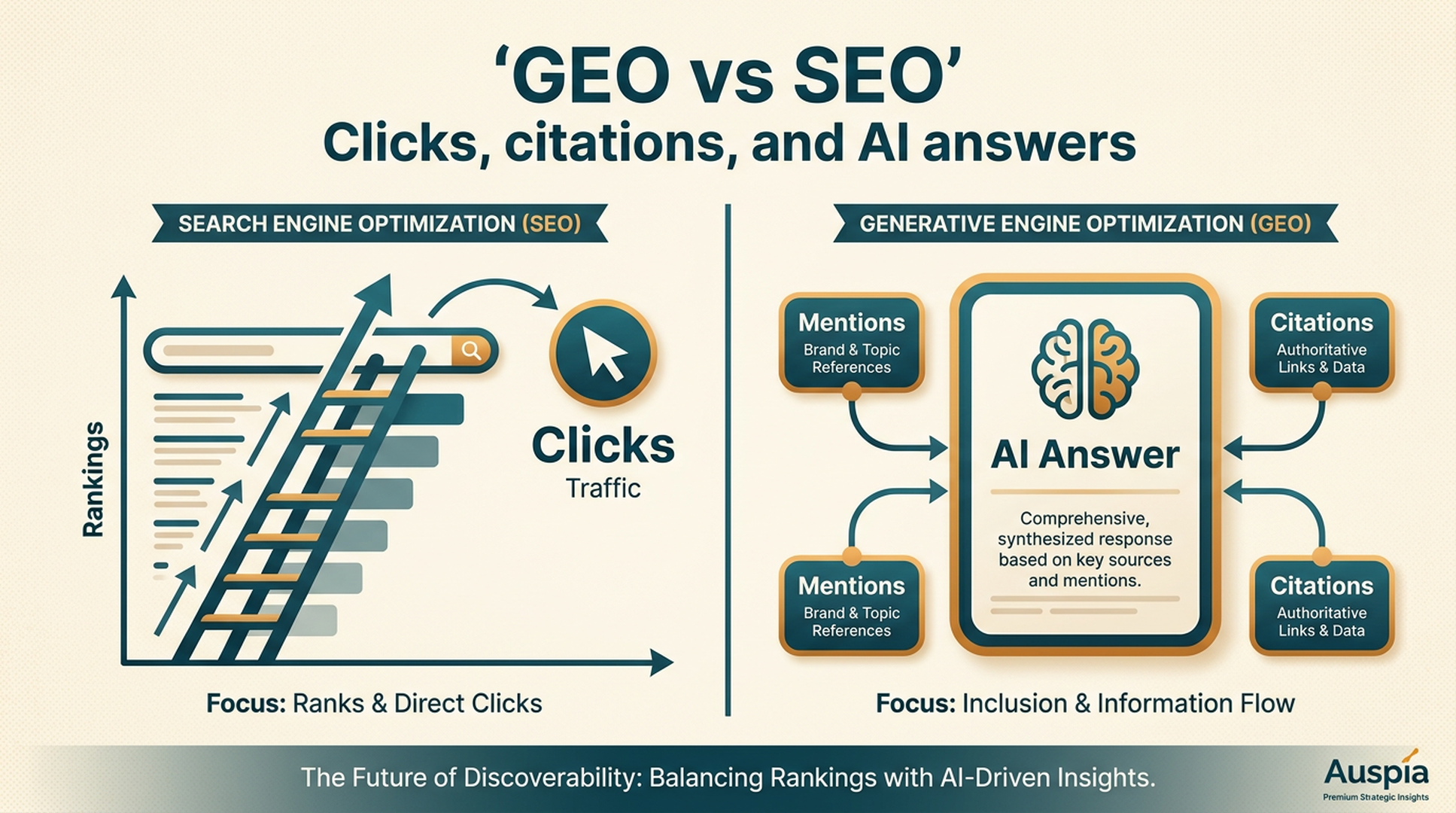
SEO helps your pages compete for rankings and clicks. GEO, or Generative Engine Optimization, helps your brand, pages, data, and point of view become usable sources for AI-generated answers.
The goal is different:
- SEO asks: can we rank and earn the click?
- GEO asks: can AI systems understand, trust, cite, and recommend us?
You still need SEO. Search engines are not going away. But the discovery path is changing. More users now ask AI tools for summaries, recommendations, comparisons, and next steps before they visit a website. If your content is not structured for that journey, it may never enter the answer.
This guide explains how GEO works, where it differs from SEO, and what a team can do this week to improve AI-search visibility.
Why GEO matters now
Here is the uncomfortable situation many teams are starting to notice.
They have blog posts that rank. They have product pages that get some search traffic. They may even have decent domain authority.
Then a buyer asks an AI assistant a simple question:
- "What are the best tools for measuring AI search visibility?"
- "How do I create an llms.txt file?"
- "Which SEO checklist should a SaaS team use before launching a new site?"
- "What is the difference between GEO and SEO?"
The AI answer mentions competitors, old articles, community posts, review sites, or third-party guides. The brand with the ranking page is missing.
That matters because the brand is absent from a growing layer of discovery.
AI answers change the job of content. Your content no longer needs only to attract a crawler and persuade a human visitor after the click. It also needs to be legible to systems that retrieve, summarize, compare, and cite information.
GEO is the practice of making that possible.
What is GEO?
GEO stands for Generative Engine Optimization. It is the work of improving how a brand or website appears inside AI-generated answers.
A simple definition:
GEO is the process of making your content easier for AI answer systems to understand, trust, cite, and recommend.
It does not replace SEO. It sits next to SEO and borrows a lot from it: technical accessibility, topic coverage, structured content, entity clarity, authority signals, freshness, and useful pages.
The difference is the output.
In SEO, success often looks like a high ranking, an impression, a click, and a conversion path on your site.
In GEO, success may look like:
- Your brand is mentioned in an AI answer.
- Your page is cited as a source.
- Your product is included in a comparison.
- Your definition is reused in a summary.
- Your data point shapes the answer even if the user does not click immediately.
- A user searches your brand later after seeing it in an AI recommendation.
That last point matters. GEO often creates zero-click influence first and measurable traffic later.
How AI systems choose sources
GEO makes more sense when you understand the rough path an AI answer follows.
Not every AI product works the same way, and the details vary by model, browsing mode, retrieval system, and user context. Still, many answer experiences follow a pattern like this.
1. The system interprets the user's intent
A search keyword is short. An AI prompt is often messy and specific.
A user might ask, "What should a small marketing team do to show up in ChatGPT answers without hiring a big agency?"
That is not just a keyword. It includes a role, a budget constraint, a channel, and an implied need for practical steps.
AI systems try to infer that intent before forming an answer. Content that only targets a narrow keyword may miss the broader question.
2. The system retrieves or recalls relevant information
Some AI answers rely on model knowledge. Some use live web search. Some use retrieval-augmented generation, where the system pulls documents or snippets before writing the answer.
This is where technical accessibility still matters. If pages are blocked, thin, outdated, or hard to parse, they are less useful as retrieval candidates.
3. The system weighs quality and trust
AI systems tend to favor sources that are clear, consistent, useful, and supported by other evidence.
They may look for signals such as:
- Clear definitions and direct answers.
- Consistent entity information across the web.
- Recent and well-maintained pages.
- Third-party mentions, reviews, citations, and references.
- Original examples, data, or expert explanations.
- Neutral language that can be safely summarized.
- Structured formatting that reduces ambiguity.
This is where many marketing pages fail. They are written to persuade, not to be understood. AI systems often struggle with vague claims like "the most powerful platform for modern teams" because there is no concrete fact to reuse.
4. The system generates a combined answer
The final answer may blend several sources. Your page might be cited, summarized, partially used, or ignored. Your brand might appear as a recommendation, a comparison option, or a background example.
That means GEO is not only about publishing more pages. It is about creating source material that survives the AI summary step.
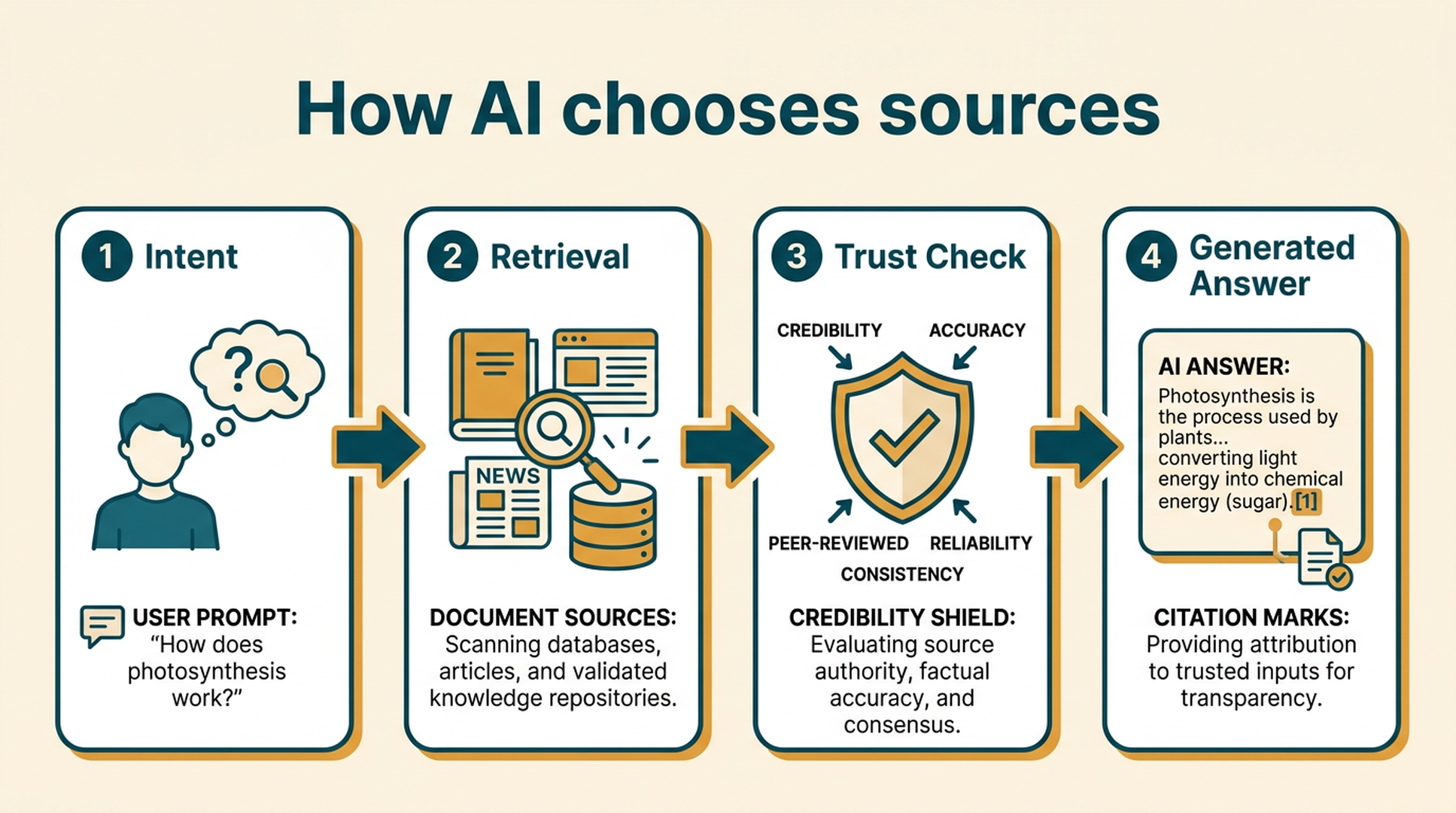
GEO works by improving the information that AI systems can retrieve, trust, and reuse in generated answers.
SEO vs GEO: the practical differences
SEO and GEO overlap, but teams should not measure or execute them as if they are identical.
Dimension | SEO | GEO |
|---|---|---|
Main goal | Rank in search results and earn clicks | Be understood, cited, mentioned, or recommended in AI answers |
Discovery surface | Search engine results pages | ChatGPT, Perplexity, Gemini, Claude, Google AI Overviews, and other answer systems |
Optimization unit | Page, keyword, internal link, SERP snippet | Information unit, entity, source, claim, definition, comparison, answer block |
Query style | Keywords and long-tail searches | Natural-language prompts and multi-part questions |
Content style | Pages built for ranking and conversion | Pages built for retrieval, summarization, trust, and answer reuse |
Authority signals | Links, content quality, technical health, user behavior | Entity consistency, citations, source quality, third-party evidence, clarity, freshness |
Measurement | Rankings, impressions, clicks, CTR, conversions | Mention rate, citation rate, sentiment accuracy, answer position, branded demand |
Risk | Algorithm updates and competitive SERPs | Opaque citations, answer variability, hallucinations, missing attribution |
The shortest distinction is this:
SEO is about earning the click. GEO is about earning the answer.
That does not mean clicks stop mattering. It means the path to the click may start earlier, inside an AI conversation.
Three differences teams should care about
Difference 1: the traffic path is less visible
In SEO, the user searches, sees a result, clicks, and lands on your page. The path has leaks, but the tracking is familiar.
In GEO, the user may ask an AI tool, read the answer, ask follow-up questions, compare vendors, and then search for your brand later. The original influence may not show as a clean referral.
This changes reporting. Teams should watch more than sessions from AI tools. They should also track branded search, direct traffic, sales-call notes, demo-form discovery fields, and changes in high-intent query visibility.
A zero-click AI mention can still have value if it increases trust and later demand.
Difference 2: AI uses information units, not only pages
SEO often rewards the best page for a query. GEO often extracts a piece of a page.
An AI answer may use:
- One definition from your glossary.
- One table from your guide.
- One example from your case study.
- One statistic from your research page.
- One comparison paragraph from your product page.
This means every section needs to stand on its own. A buried answer inside a 3,000-word article is weaker than a clear definition, a short table, and a direct answer block.
GEO-friendly writing is not longer writing. It is cleaner writing.
Difference 3: authority is broader than backlinks
Backlinks still matter, especially because they help pages get discovered and trusted. But AI answer systems also respond to broader evidence.
For GEO, authority can come from:
- Consistent brand descriptions across your site and third-party profiles.
- Citations from trusted industry pages.
- Clear authorship and expertise.
- Original data or repeatable methods.
- Reviews and community discussions.
- Documentation that answers specific user questions.
- Fresh updates when a topic changes.
This is why GEO cannot live only in the blog team. It touches SEO, PR, product marketing, documentation, reviews, partnerships, and analytics.
What GEO-friendly content looks like
A GEO-ready page is easy for both humans and AI systems to parse.
It usually has these traits:
- A direct answer near the top.
- Clear H2 and H3 headings.
- Short sections that each answer one question.
- Definitions written in plain language.
- Tables for comparisons.
- Lists for steps, criteria, or examples.
- Specific claims instead of broad marketing language.
- Sources for data, benchmarks, or external facts.
- Updated dates when freshness matters.
- Entity clarity: who you are, what you do, who you serve, and how you differ.
Here is a simple example.
Weak answer:
Our platform empowers modern teams to unlock smarter AI visibility with a seamless growth workflow.
Better answer:
Auspia helps marketing teams check whether their brand appears in AI search answers, identify missing source signals, and prioritize pages that improve GEO visibility.
The second version is plainer, but an AI system can actually use it.
Four actions you can take this week
1. Turn key pages into answerable pages
Pick five important pages: homepage, main product page, one comparison page, one glossary page, and one high-traffic article.
For each page, add or improve:
- A one-paragraph direct answer.
- A short definition section.
- A table or checklist.
- A clear "who this is for" statement.
- A set of real questions buyers ask.
This helps AI systems extract and reuse the page.
2. Build a prompt library
List 40-60 questions your buyers might ask an AI tool before they know your brand.
Group them by intent:
Prompt Group | Example |
|---|---|
Problem | "How do I know if my brand appears in ChatGPT answers?" |
Category | "Best tools for AI search visibility tracking" |
Comparison | "Auspia vs other GEO tools" |
Workflow | "How should a SaaS team run a GEO audit?" |
Technical | "Do I need an llms.txt file for AI crawlers?" |
Test those prompts in the AI tools your audience uses. Record whether your brand appears, whether the answer is accurate, and which sources are cited.
If you need a quick starting point, use Auspia's AI Search Visibility Checker to see where the gaps are.
3. Create citeable assets
AI systems need material worth citing. Thin opinion posts are easy to ignore.
Create assets such as:
- Original definitions.
- Benchmarks.
- Checklists.
- Comparison tables.
- Methodology pages.
- Public templates.
- Research summaries.
- Step-by-step playbooks.
A citeable asset should answer a question cleanly enough that another writer, analyst, or AI system can reference it without guessing what you mean.
4. Clean up your entity signals
AI systems need to know what your brand is.
Check whether your brand description is consistent across:
- Homepage.
- About page.
- Product pages.
- LinkedIn profile.
- Review sites.
- Crunchbase or company directories, if relevant.
- Documentation.
- Press mentions.
- Author bios.
If one source says you are an SEO tool, another says you are a content platform, and another says you are an AI agency, answer systems may struggle to classify you.
Entity consistency is boring work. It also pays off, because confused brands rarely get clean recommendations.
A simple GEO readiness checklist
Use this checklist before you call a page GEO-ready.
Check | Pass? |
|---|---|
The page answers the main question in the first 150 words. | |
The page has clear H2/H3 headings that match real user questions. | |
Important definitions are written in plain language. | |
Claims are specific and verifiable. | |
The page includes at least one table, checklist, or structured summary. | |
Product or brand positioning is stated clearly. | |
External data or claims are attributed. | |
The content avoids vague promotional phrases. | |
The page is crawlable and not blocked for relevant bots. | |
The page is connected to related internal pages. |
This checklist will not guarantee AI citations. Nothing can. But it improves the odds that your content can be retrieved, understood, and reused.
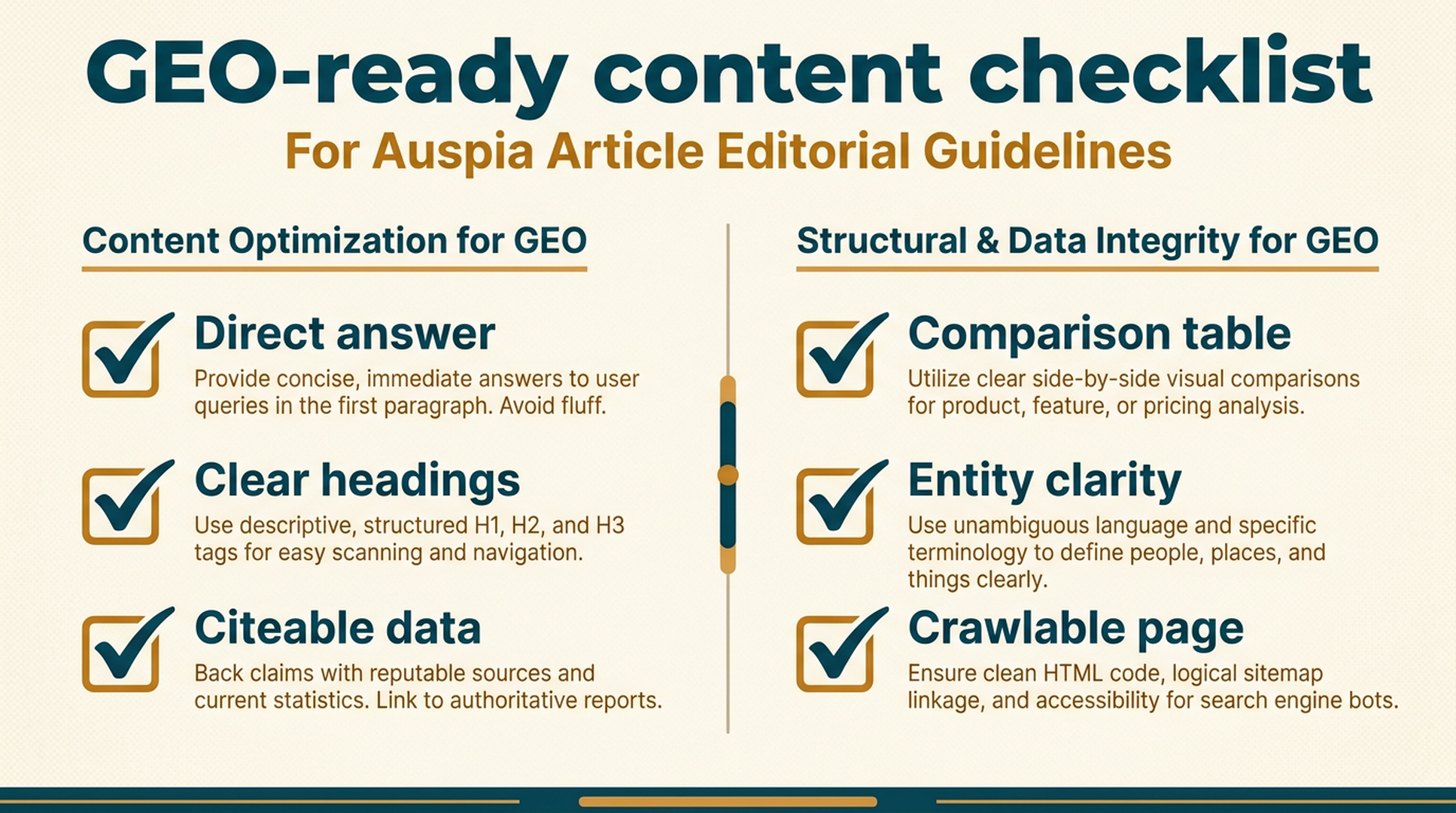
Use the checklist to turn existing SEO pages into cleaner source material for AI answer systems.
How to measure early GEO progress
Do not wait six months to check whether GEO is working.
Start with a monthly scorecard:
Metric | What to track |
|---|---|
Mention rate | How often your brand appears across target AI prompts |
Citation rate | How often your pages are cited or linked |
Sentiment accuracy | Whether the AI describes you correctly and positively |
Answer position | Whether you appear early, late, or only as a minor mention |
Branded demand | Changes in branded search, direct traffic, and demo-form discovery notes |
This is more honest than a screenshot. One answer is an anecdote. A repeated prompt set is a benchmark.
Auspia takeaway
SEO is still necessary. GEO is becoming necessary for the same reason: users follow the easiest path to an answer.
For years, that path was a search results page. Now it is often a generated summary, a conversational recommendation, or an AI-assisted comparison.
The move is not to abandon SEO. It is to make your best SEO assets easier for AI systems to use.
Start with the basics:
- Make your pages answerable.
- Build a prompt library.
- Create citeable assets.
- Clean up entity signals.
- Track AI visibility over time.
If a buyer asks an AI system about your category tomorrow, your goal is simple: the answer should understand who you are, when you are relevant, and why you deserve to be included.
FAQ
Is GEO replacing SEO?
No. GEO builds on SEO, but it optimizes for a different discovery layer. Teams still need crawlable pages, strong content, links, and technical health. GEO adds AI answer visibility, citations, entity clarity, and prompt-based measurement.
What is the biggest difference between SEO and GEO?
SEO is usually measured through rankings and clicks. GEO is measured through AI mentions, citations, answer accuracy, sentiment, and downstream demand signals such as branded search or direct traffic.
Can small websites do GEO?
Yes. Small websites can compete if they publish clear, specific, well-structured content around niche questions. Original examples, templates, data, and expert explanations help smaller sites become useful sources.
How long does GEO take to show results?
Early visibility changes can appear within weeks, especially in live-search AI tools. Durable improvements usually need a 60- to 90-day window because content, citations, third-party mentions, and entity signals take time to influence answer systems.
What should I optimize first for GEO?
Start with your most important buyer questions. Rewrite the pages that should answer those questions, add clear definitions and structured summaries, then test the same prompts across AI tools each month.