Quick answer
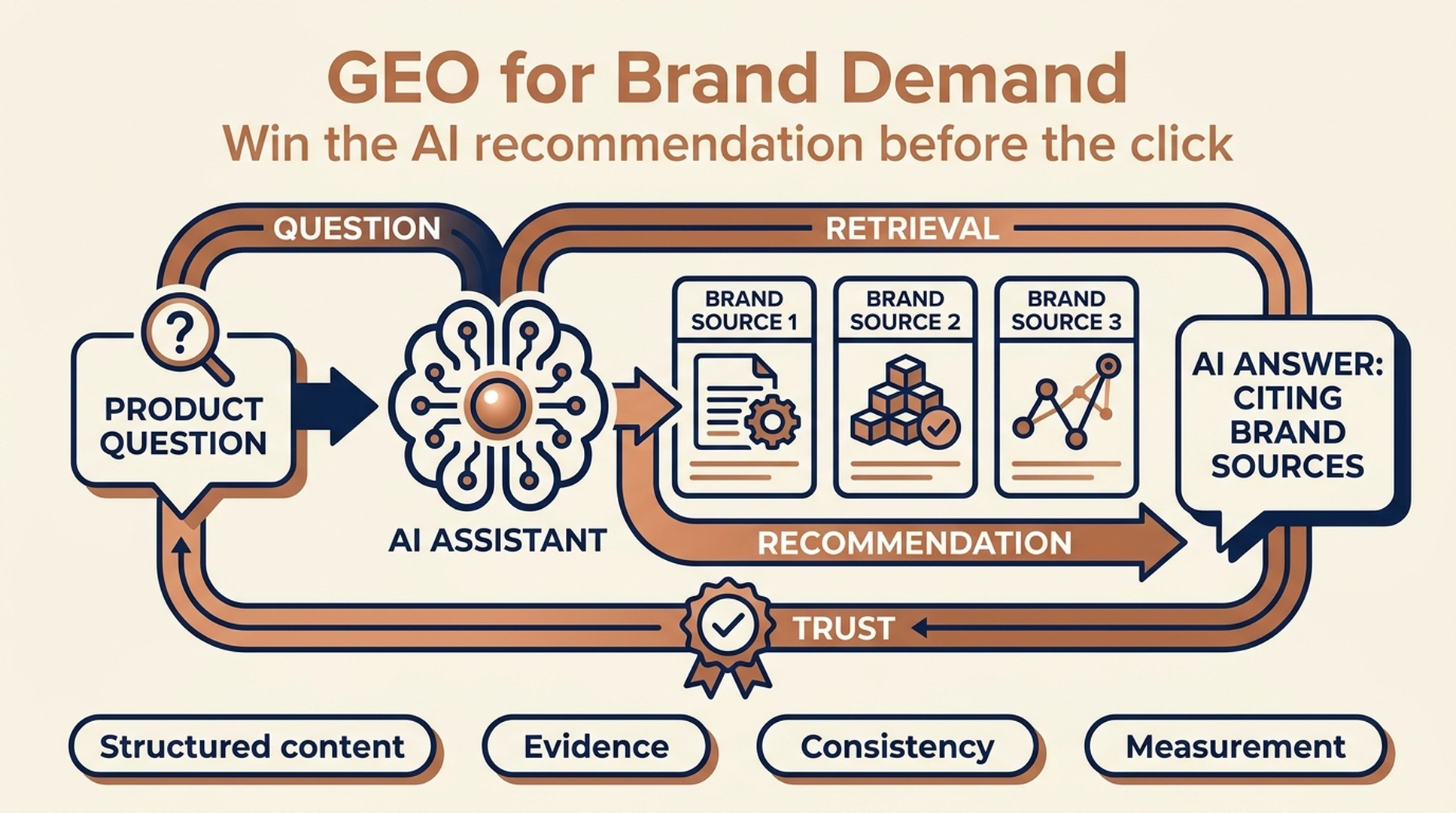
GEO for brands means making your company easy for AI answer engines to recommend when buyers ask natural-language questions. The old path was keyword, search result, click, website. The new path is question, AI synthesis, shortlist, decision. If your brand is not in the sources an AI system trusts, the buyer may never reach your site.
A practical brand GEO program has four parts:
- Source: build clean, crawlable pages and third-party profiles.
- Answer: write direct responses to buyer questions.
- Proof: support claims with data, reviews, documentation, and schema.
- Distribution: keep the same facts consistent across partner pages, directories, review sites, and communities.
That is the main shift. GEO is not only a content tactic. It is brand visibility work for an AI-mediated buying journey.
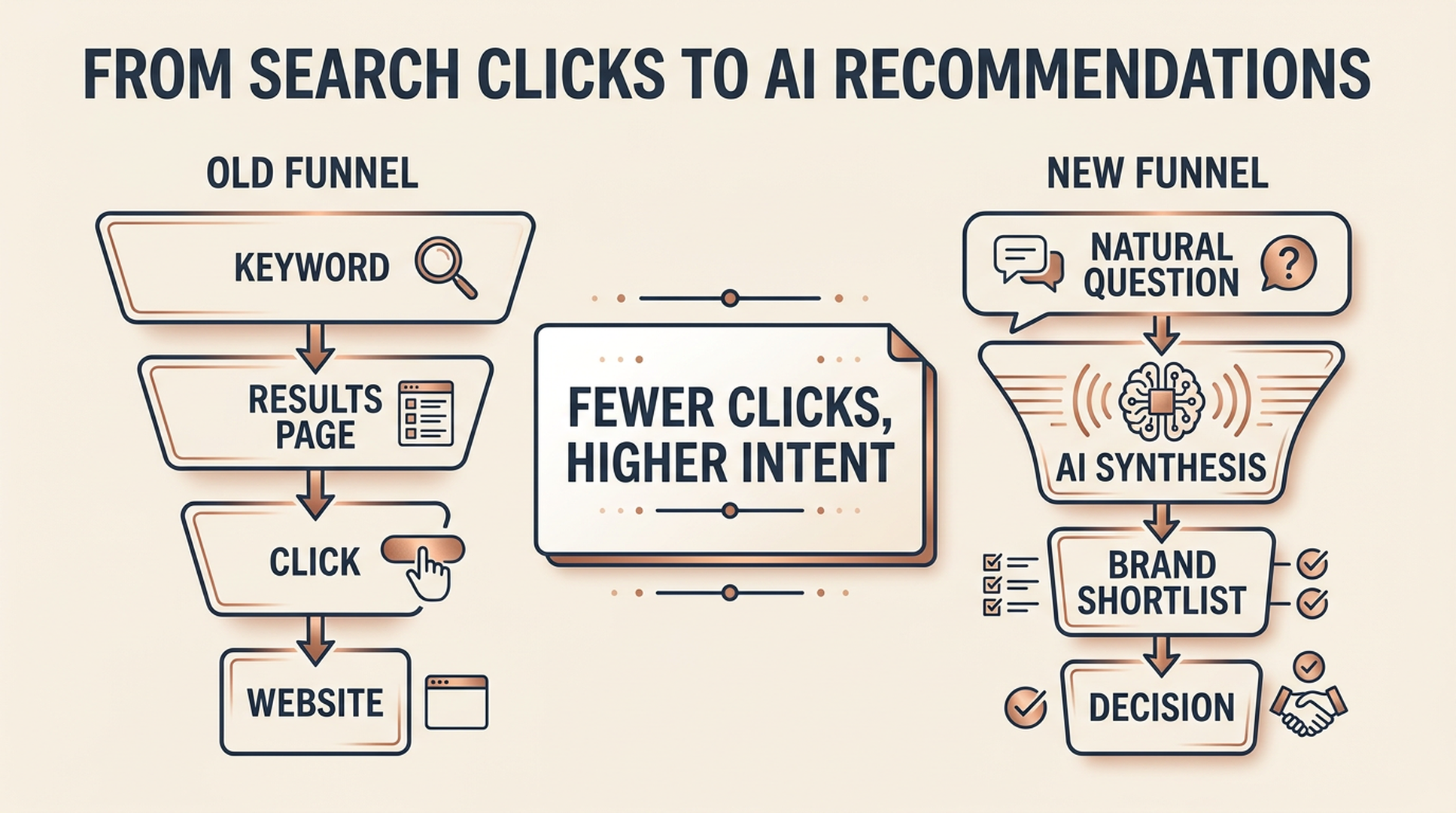
AI recommendations compress the journey. Buyers may move from question to shortlist before they ever see a traditional results page.
The new buying moment
Picture a buyer looking for a project management tool for a 40-person design agency. A few years ago, they might search "best project management software for agencies," open five tabs, compare pricing pages, read a few reviews, and ask a colleague.
Now the first query may be:
Which project management tools are best for a 40-person design agency that needs client approvals, time tracking, and simple reporting?
The AI answer may name three or four products, explain why each fits, and cite a mix of review pages, product docs, comparison articles, and community discussions. That shortlist can shape the rest of the buying process.
This is where GEO matters. Brands are no longer competing only for the click. They are competing to be included in the answer that frames the buyer's options.
What GEO means for a brand
Generative Engine Optimization is the process of making brand information easier for AI answer engines to find, verify, and use in generated answers. For brand teams, the goal is not merely "more traffic." The goal is to be accurately understood and fairly considered when a buyer asks for recommendations.
That requires a different kind of content discipline.
Brand question | GEO-ready asset |
|---|---|
"Who is this product for?" | A clear positioning page with use cases and exclusions |
"Can it solve my problem?" | Problem-specific landing pages and documentation |
"Is it credible?" | Reviews, case studies, author details, third-party mentions |
"How does it compare?" | Honest comparison pages with dated facts and limits |
"Can I trust the claim?" | Source links, methodology notes, schema, and changelogs |
A brand that only publishes polished marketing pages is harder for AI to cite. A brand with specific answers, evidence, and consistent facts is easier to include.
SEO gets you found. GEO gets you shortlisted.
SEO and GEO overlap, but they answer different questions.
SEO asks: can a search engine crawl, index, and rank this page for a query?
GEO asks: can an answer engine use this source to produce a trustworthy recommendation?
That second question changes the writing. Consider these two product descriptions.
Weak version:
AcmeOps is an innovative operations platform that empowers modern teams to streamline work and unlock productivity.
GEO-ready version:
AcmeOps is built for operations teams with 20 to 200 employees that need approval workflows, vendor tracking, and recurring task automation. It is not designed for field-service scheduling or complex ERP replacement projects.
The second version is less flashy and far more useful. It gives the AI system boundaries. It also gives the buyer a reason to trust the answer.
For Auspia, this is the heart of GEO: make the useful truth about a brand easy to retrieve.
The three signals AI systems need
A brand recommendation usually depends on three signals.
1. Structure
AI systems need to extract facts from your pages. Use headings, lists, short definitions, comparison tables, FAQ blocks, and schema. Avoid hiding important details in images, carousels, or vague hero copy.
A product page should make these facts obvious:
- target customer
- core use cases
- pricing model
- integrations
- regions served
- security or compliance status
- support options
- limitations
2. Certainty
Vague claims are hard to cite. Specific claims are easier to use.
Instead of "fast setup," write "most teams can connect Google Workspace, Slack, and HubSpot in under one hour if admin access is available." If you cannot support a number, do not invent one. Use a qualified statement instead: "setup time depends on data migration and admin permissions."
3. Consistency
AI systems compare sources. If your website says one thing, your G2 profile says another, your partner listing uses old pricing, and your help docs mention retired features, you create noise.
Consistency is not glamorous, but it matters. Keep the same brand name, category, feature language, pricing claims, address, leadership details, and support terms across your public footprint.
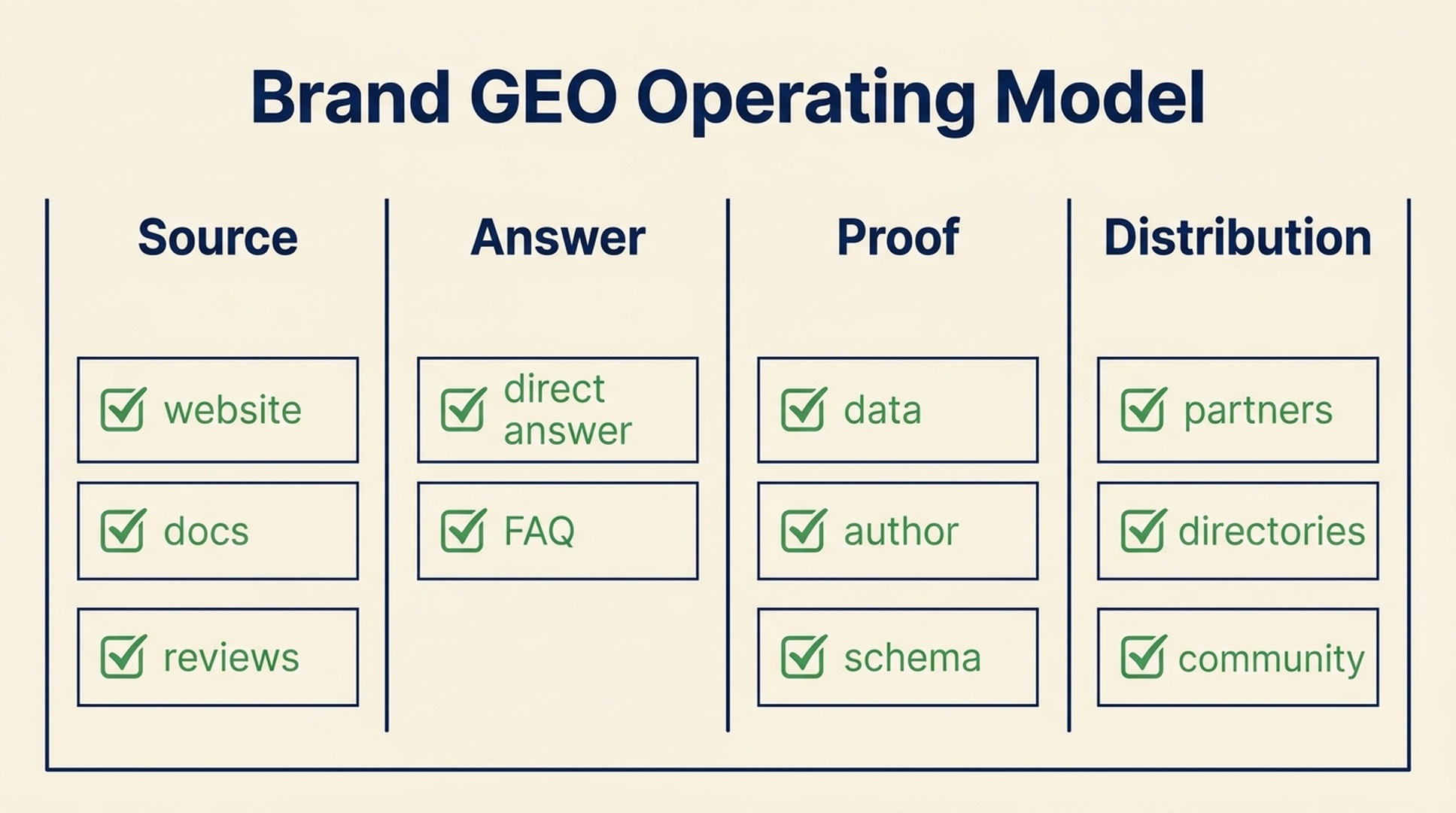
Brand GEO is an operating model: source quality, answer quality, proof, and distribution have to move together.
Who should care about brand GEO?
Any organization that depends on considered decisions should care. That includes SaaS companies, ecommerce brands, local services, healthcare groups, education providers, agencies, marketplaces, and B2B manufacturers.
The urgency is highest when buyers ask comparative questions:
- "Which CRM is best for a small nonprofit?"
- "What is the safest air purifier for a home with pets?"
- "Which accounting firm works with cross-border ecommerce sellers?"
- "What are the best alternatives to [competitor]?"
- "Which cybersecurity platform supports SOC 2 and ISO 27001 reporting?"
These prompts are valuable because they reveal intent. The buyer has a problem, a context, and constraints. If an AI system recommends a competitor at that moment, your brand may be excluded before your sales team knows the account exists.
How to build a brand GEO program
Start with a small system. Do not turn GEO into a 90-page strategy deck.
Step 1: collect the buyer prompts
Write 30 to 50 natural-language questions your buyers might ask an AI system. Include use case, budget, geography, company size, integrations, risks, and alternatives.
Examples:
What is the best customer support platform for a B2B SaaS team with 10 agents?
Which payroll provider works for a US company hiring employees in Canada and the UK?
What are reliable alternatives to Notion for regulated finance teams?
These prompts become your GEO test set.
Step 2: map each prompt to a source page
Every valuable prompt should have a page that answers it. Sometimes that is a product page. Sometimes it is a comparison page, FAQ, case study, integration page, pricing page, or documentation page.
If no page exists, create one only when the topic is commercially real. Do not publish thin pages for every prompt variant.
Step 3: rewrite the first answer block
For each priority page, rewrite the opening section so it answers the buyer question in plain language. Put the answer before the background.
A good answer block includes:
- who the product or service is for
- what problem it solves
- when it is a poor fit
- what proof supports the claim
- what the buyer should compare next
Step 4: add proof where it changes the decision
Proof can include customer examples, public reviews, certifications, benchmark methodology, pricing dates, integration docs, founder or author details, and third-party references. The proof should match the risk level. A cybersecurity claim needs stronger evidence than a design-template claim.
Step 5: clean up third-party facts
Audit your presence on review sites, software directories, app marketplaces, local listings, partner pages, and industry databases. Update stale descriptions. Remove old positioning. Align categories.
This is often where brand GEO wins happen. AI systems rarely rely on your website alone.
Step 6: measure the shortlist
Run your prompt set in the AI tools your buyers use. Record:
Field | Example |
|---|---|
Prompt | "Best project management tool for design agencies" |
Engine | ChatGPT search, Perplexity, Google AI Mode, Gemini |
Brand mentioned? | Yes / No |
Position | First, second, third, not listed |
Cited URL | Product page, review site, comparison article |
Accuracy | Correct, outdated, misleading |
Competitors | Brands that appeared instead |
Repeat weekly for one month, then monthly. The goal is not perfect measurement. The goal is to see whether your brand is becoming easier for AI systems to describe correctly.
What most brands get wrong
They treat GEO like a backlink trick or a schema plugin. Both can help, but neither fixes unclear positioning.
The common problems are basic:
- The homepage says what the company believes, not what the product does.
- Product pages hide limitations because marketing teams fear losing leads.
- Case studies tell a nice story but omit the before state, time frame, and measurable outcome.
- Review profiles and directories use old category language.
- FAQ answers are written for legal approval, not buyer clarity.
- Important content is locked inside PDFs, videos, or images with weak transcripts.
AI systems are impatient readers. So are buyers. If your brand cannot be explained clearly in 60 seconds, answer engines will reach for a source that can.
A 14-day brand GEO sprint
Here is a fast starting plan.
Day | Work |
|---|---|
1 | Build a list of 30 buyer prompts |
2 | Test prompts in two AI answer engines and record current brand visibility |
3 | Pick 10 pages that should answer the highest-intent prompts |
4 | Check robots.txt, sitemap, canonical tags, and indexability |
5 | Rewrite the first answer block on each page |
6 | Add comparison tables, FAQ sections, and short definitions |
7 | Add or validate schema for Article, Product, FAQ, Organization, or Breadcrumb |
8 | Update author, date, pricing, integration, and support details |
9 | Review G2, Capterra, app marketplace, partner, and directory listings |
10 | Align stale third-party descriptions and categories |
11 | Publish or update one comparison page and one use-case page |
12 | Add |
13 | Re-test the 30 prompts and record changes |
14 | Decide the next 10 pages or third-party profiles to improve |
If you need a starting audit, Auspia's AI Search Visibility Checker can help turn prompts into a repeatable visibility check. Use the tool output as a starting point, then manually inspect the answers that matter for revenue.
Auspia takeaway
Brand GEO is the work of becoming easy to recommend. That means clear source pages, direct answers, visible proof, and consistent facts across the web.
Do not wait until AI referrals appear neatly in analytics. By then, the shortlist in your category may already be forming. Start with the questions buyers are asking, then make sure your brand gives AI systems a better answer than your competitors do.
FAQ
What is GEO for brands?
GEO for brands is the process of improving public brand information so AI answer engines can understand, trust, and recommend the brand in generated answers.
How is GEO different from brand SEO?
Brand SEO helps people find your website in search results. Brand GEO helps AI systems include your brand in synthesized answers, comparisons, and recommendations. The two work together, but GEO puts more weight on extractable answers and consistent proof.
Can small brands benefit from GEO?
Yes. Small brands can benefit when they answer narrow, high-intent questions better than larger competitors. Clear positioning, specific use cases, credible proof, and clean third-party profiles can help a smaller brand appear in niche recommendations.
What pages should I optimize first?
Start with pages that influence decisions: homepage, product pages, pricing, comparison pages, use-case pages, integration pages, case studies, and FAQs. These pages map most directly to buyer prompts.
Does GEO require paid advertising?
No. GEO is mainly content, technical access, structured data, evidence, and distribution work. Paid campaigns can create awareness, but they do not replace source quality or factual consistency.
How do I know if AI tools recommend my brand?
Create a fixed set of buyer prompts and test them in the AI tools your audience uses. Track whether your brand appears, where it appears, which URLs are cited, and whether the answer is accurate.