Executive summary
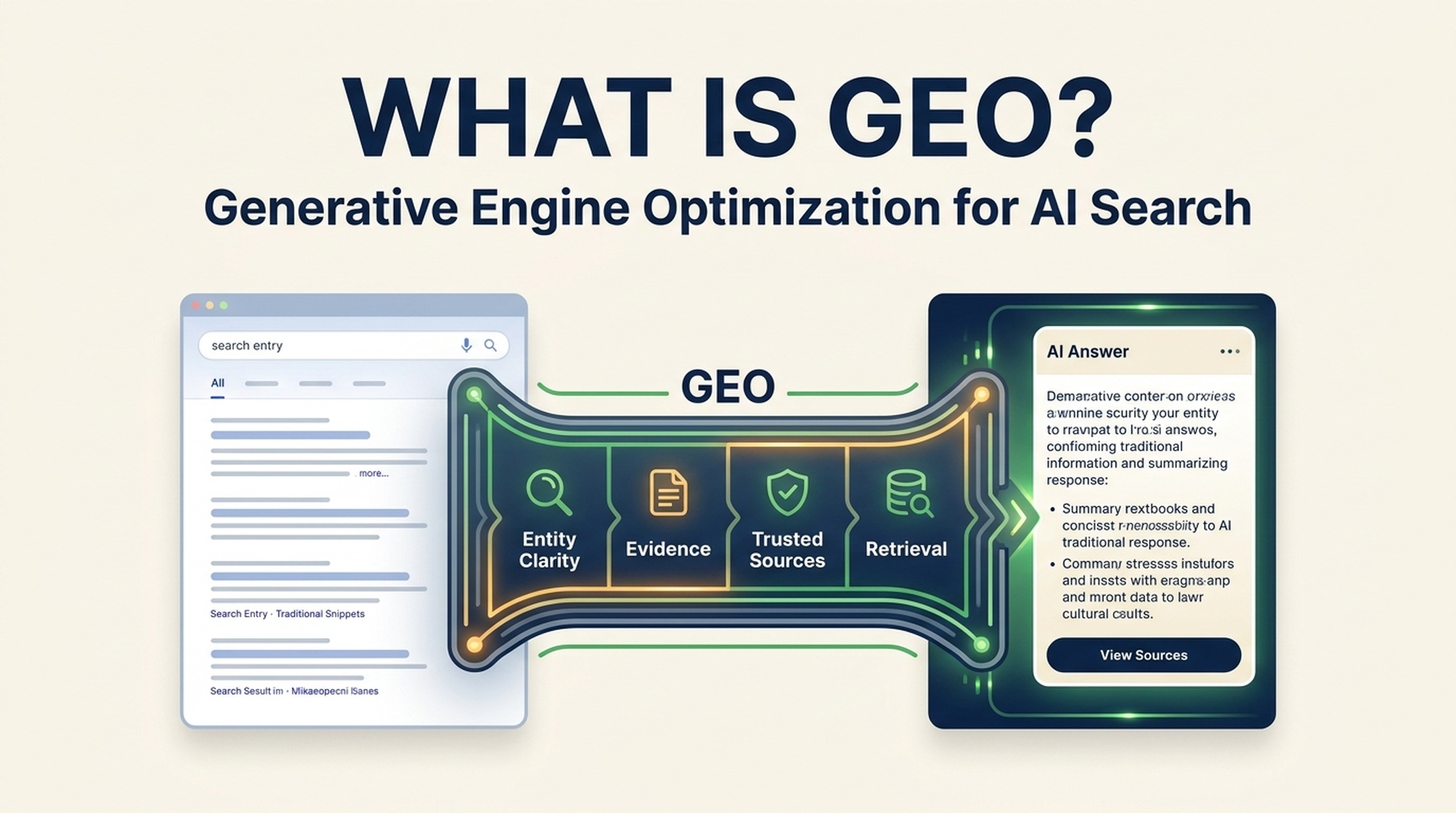
GEO stands for Generative Engine Optimization. It is the practice of making your brand, pages, and proof assets easier for AI answer systems to retrieve, understand, trust, cite, and recommend.
Traditional SEO asks: “Can our page rank in a list of search results?” GEO asks a different question: “Can an AI system confidently use our information inside an answer?”
That shift matters because search behavior is no longer limited to typed keywords and blue links. Users now ask ChatGPT, Perplexity, Gemini, Google AI Overviews, Copilot, Claude, and other AI interfaces for direct answers, comparisons, buying shortlists, implementation advice, and summaries. In this environment, visibility is not only about being clicked. It is also about being included in the answer.
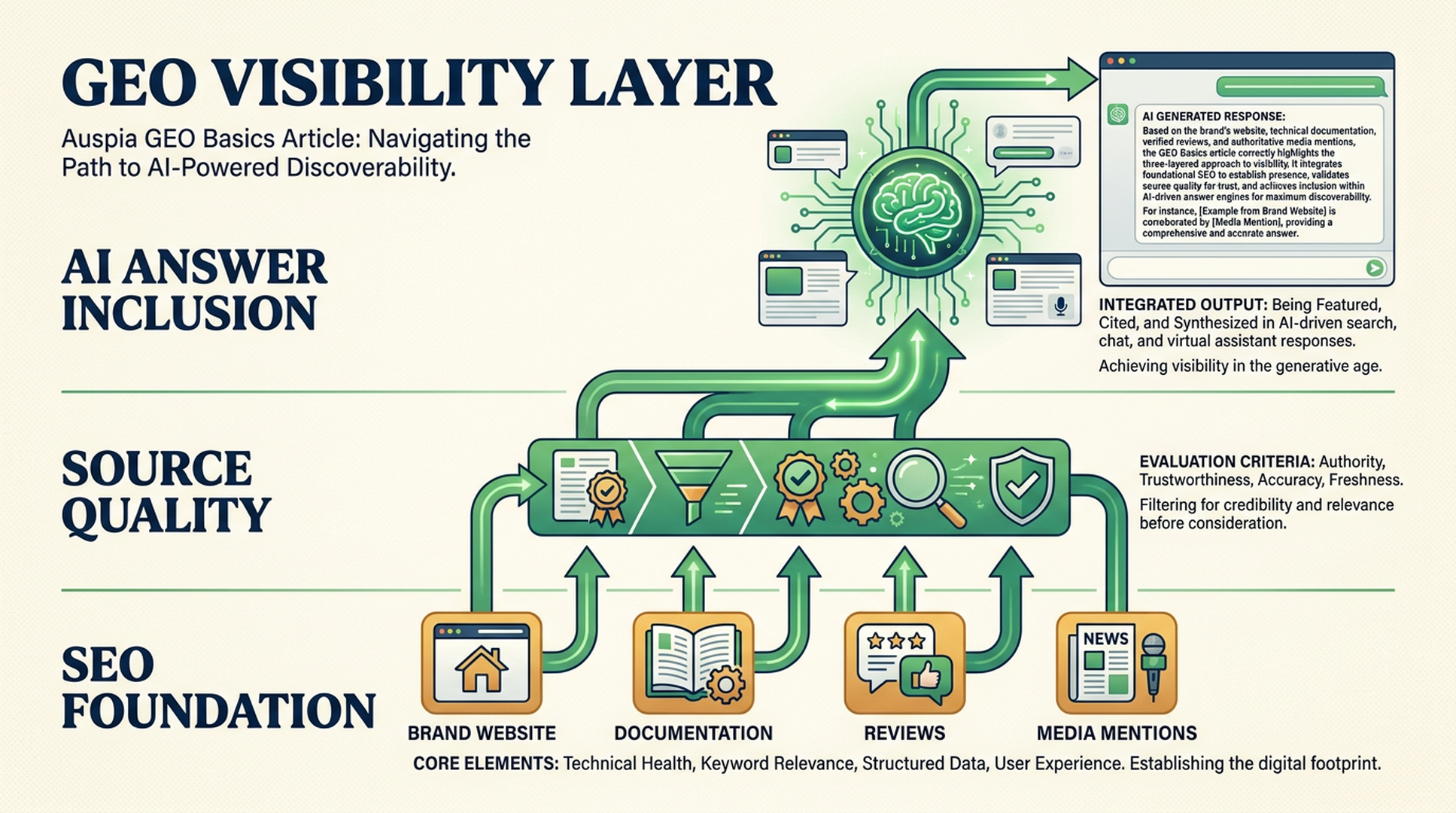
The practical takeaway: GEO is not a replacement for SEO. It is a new visibility layer on top of SEO, content strategy, entity clarity, third-party proof, and technical accessibility.
What GEO means in plain English
GEO means Generative Engine Optimization.
A “generative engine” is an AI-powered system that does more than return a ranked list of links. It generates an answer by drawing from models, retrieved web sources, structured data, known entities, and sometimes real-time search results.
GEO is the work of making your information useful to that answer-generation process.
A simple definition:
GEO is the practice of improving your brand’s chance of being accurately represented, cited, or recommended in AI-generated answers.
The term was formalized in the academic paper “GEO: Generative Engine Optimization”, first released as a preprint in 2023 and later associated with KDD 2024 work by researchers from Princeton University, Georgia Tech, IIT Delhi, and the Allen Institute for AI. The paper framed GEO as a visibility problem for content creators in generative engines and reported that certain content improvements, such as adding citations, statistics, and authoritative language, could improve visibility in generated responses.
For growth teams, the academic definition is useful, but the operating definition is even simpler:
If AI systems are becoming the front door to research and decisions, GEO is how you make sure your brand is a credible source behind that door.
Why GEO became urgent
GEO became urgent because user behavior changed.
For years, the dominant pattern looked like this:
- A user searched a keyword.
- A search engine returned a list of links.
- The user clicked a result.
- The website had a chance to explain, persuade, and convert.
AI search compresses that journey.
A user can now ask a question such as:
- “Which project management tools are best for a remote design team?”
- “How should I choose an AI SEO platform?”
- “What are the risks of switching from HubSpot to Salesforce?”
- “Which cybersecurity vendors support mid-market healthcare companies?”
The answer may include a short list of vendors, a comparison table, cited sources, buying criteria, and implementation warnings before the user visits any website.
That is why GEO matters. The first impression may happen inside an AI answer, not on your homepage.
Several platform shifts made this practical rather than theoretical. Google launched AI Overviews in the United States in May 2024 and later expanded the feature internationally, including a rollout to more than 100 countries reported in October 2024. OpenAI launched ChatGPT Search in October 2024, bringing web search into the ChatGPT interface. Perplexity, Microsoft Copilot, Gemini, and other answer engines also trained users to expect synthesized answers instead of only link lists.
When users ask AI systems for decisions, AI systems need sources. GEO is the discipline of becoming one of those usable sources.
GEO vs SEO: the core difference
SEO and GEO overlap, but they optimize for different visibility moments.
Dimension | SEO | GEO |
|---|---|---|
Primary interface | Search result pages | AI-generated answers and citations |
User behavior | Search keywords, scan links, click pages | Ask questions, compare answers, request recommendations |
Visibility goal | Rank and earn clicks | Be retrieved, trusted, cited, or recommended |
Optimization unit | Webpage and keyword intent | Source quality, answer fragments, entity clarity, proof |
Common tactics | Technical SEO, keyword research, internal links, backlinks, page quality | Structured answers, citations, evidence, third-party proof, consistent brand facts, retrieval hygiene |
Success metric | Rankings, organic sessions, CTR, conversions | AI mentions, citations, answer accuracy, source inclusion, branded recommendation share |
SEO helps search engines find and rank your pages. GEO helps AI answer systems understand whether your information deserves to be used.
A useful shorthand:
SEO is about being found in search results. GEO is about being trusted inside AI answers.
This does not mean SEO is less important. Strong crawlability, clean architecture, useful content, internal links, and authoritative pages still support GEO. If AI systems cannot access or understand your pages, they are less likely to use them. GEO adds a new layer: the page must also be answerable, verifiable, and citation-worthy.
What AI systems look for when deciding whether to use your brand
No outside team knows the exact ranking and citation logic of every AI search product. The systems differ, change frequently, and often combine retrieval, reranking, language-model synthesis, and safety checks.
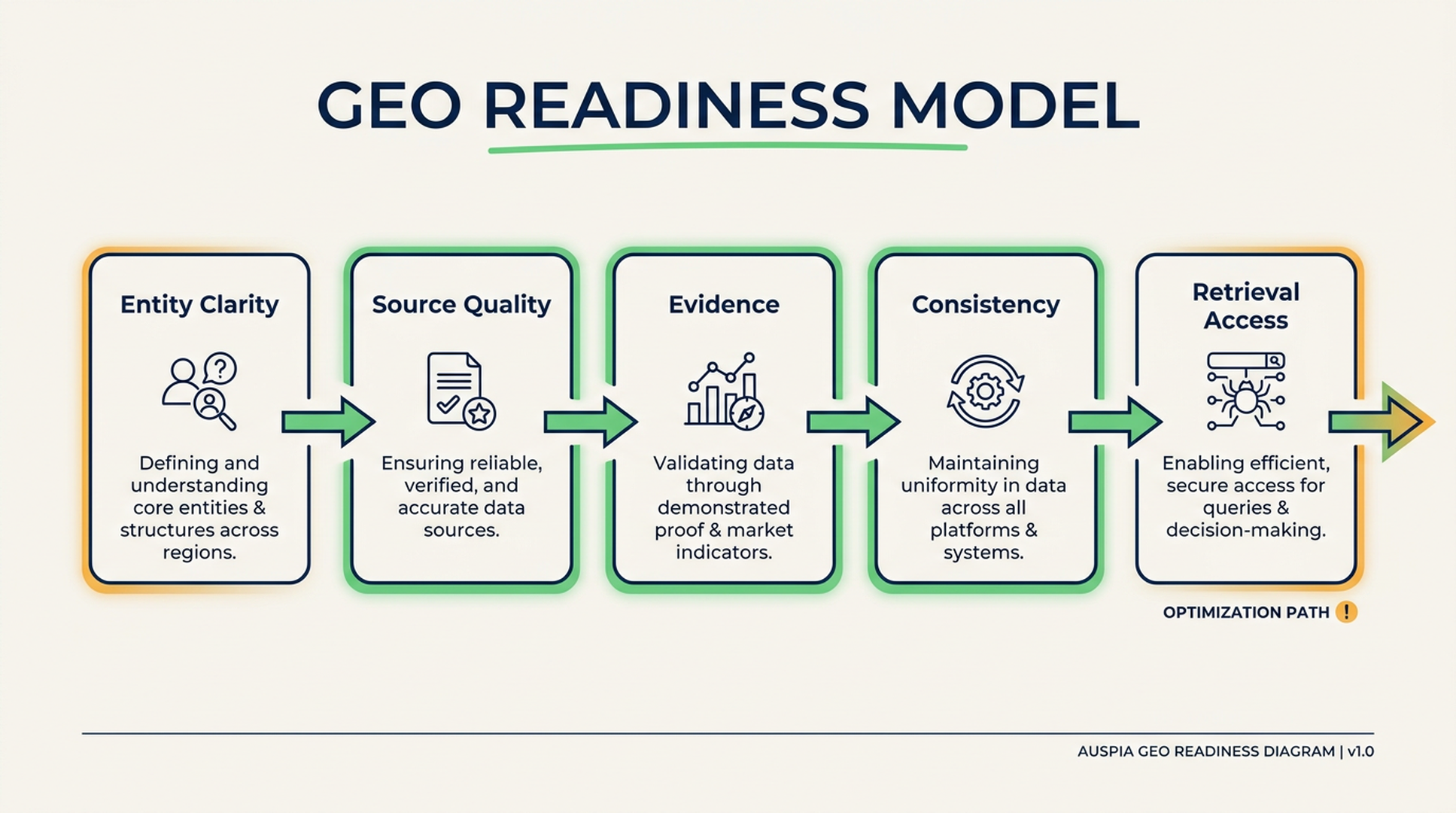
But for practical GEO work, the same signals matter again and again.
1. Entity clarity
Can the system understand who you are, what you do, who you serve, and which category you belong to?
If your website calls the product an “AI growth platform,” review sites call it an “SEO tool,” LinkedIn says “marketing automation,” and documentation says “content operations,” AI systems may struggle to classify the brand correctly.
2. Source quality
Does the page provide useful, specific, and non-generic information?
Thin claims, vague slogans, and keyword-stuffed pages are hard to use. Pages with definitions, examples, limitations, comparison tables, methodology notes, and current details are more useful.
3. Evidence
Can the claim be supported?
Evidence can include citations, statistics, screenshots, case studies, customer examples, changelogs, author expertise, and third-party references. The original GEO research found that adding citations, quotations, and statistics can improve visibility in generated responses, though results vary by domain.
4. Consistency across sources
Do your owned and third-party sources agree?
AI systems may compare your website, documentation, directories, media mentions, reviews, community discussions, and social profiles. Inconsistent facts reduce confidence.
5. Retrieval accessibility
Can the right pages be crawled, indexed, and parsed?
Robots rules, sitemaps, canonical tags, JavaScript rendering, structured data, internal links, and page speed all still matter. GEO cannot fix content that AI systems cannot reach.
What companies should do first
GEO sounds abstract until you turn it into a simple operating workflow. Start with four steps.
Step 1: Map the questions AI users ask before buying
Do not start with your homepage slogan. Start with buyer questions.
Examples:
- “What is the best tool for [job]?”
- “How do I compare [category A] vs [category B]?”
- “What are the risks of [implementation]?”
- “Which vendor is best for [industry, company size, or region]?”
- “What should I check before buying [software/service]?”
Each important question should map to a page that answers it directly.
Step 2: Create answer-ready pages
A GEO-ready page should include:
- A direct answer near the top.
- A clear definition of the core topic.
- Structured sections with descriptive headings.
- Evidence close to the claim it supports.
- Tables or lists where they help comparison.
- A concise FAQ based on real buyer questions.
- Updated facts and a visible editorial or product owner where appropriate.
If a user can understand the answer quickly, an AI system has a better chance of extracting the useful part.
Step 3: Build source authority beyond your own website
Owned content is necessary, but not enough.
AI systems often draw confidence from third-party sources: reputable publications, partner pages, review platforms, app marketplaces, documentation ecosystems, community answers, podcast transcripts, YouTube descriptions, GitHub repositories, and analyst mentions.
The goal is not spammy distribution. The goal is a consistent source graph.
Your brand name, category, product description, target audience, pricing logic, and proof points should stay consistent wherever the brand appears.
Step 4: Monitor AI answer accuracy
Do not only ask, “Did AI mention us?” Ask better questions:
- Did the AI answer describe the brand correctly?
- Which source did it cite or appear to rely on?
- Which competitor was included instead?
- Which fact was wrong, outdated, or missing?
- Which page should exist but does not?
- Which third-party source is influencing the answer?
Use those findings to update your content and source ecosystem.
A simple GEO readiness checklist
Use this checklist before investing in a large GEO program.
Area | Question | First fix |
|---|---|---|
Brand entity | Can AI systems identify your company and product category? | Standardize names, descriptions, organization schema, and profiles. |
Buyer questions | Do you answer the questions users ask AI before buying? | Create pages for the top 10 decision questions. |
Evidence | Are claims backed by sources, examples, or data? | Add citations, screenshots, case constraints, and methodology notes. |
Structure | Can paragraphs be extracted as answers? | Add definitions, lists, tables, summaries, and FAQs. |
Third-party proof | Do independent sources confirm your claims? | Improve review profiles, partner pages, media mentions, and directories. |
Technical access | Can crawlers access the right content? | Review robots rules, sitemap, canonical tags, structured data, and internal links. |
For a quick diagnostic, teams can start with an AI search visibility checker to see where a brand appears, where it is absent, and which questions need stronger source pages.
Which companies should care about GEO first?
Every company with a public website should understand GEO, but some teams should move faster.
GEO is especially important if:
- Buyers research heavily before contacting sales.
- The product has a high contract value or long decision cycle.
- Customers compare multiple vendors before choosing.
- The category is complex, technical, regulated, or trust-sensitive.
- Your audience includes executives, analysts, developers, marketers, or procurement teams who already use AI tools.
- Your brand depends on expertise, credibility, and clear differentiation.
B2B SaaS, professional services, ecommerce categories with high consideration, healthcare-adjacent technology, cybersecurity, fintech, education, local services, and AI tools all fit this pattern.
You do not need to rebuild everything at once. Start with the questions that shape revenue.
Common mistakes in early GEO programs
Mistake 1: Treating GEO as “publish more blog posts”
More content does not automatically create more AI visibility. Thin content can create more confusion. Focus on pages that answer important questions better than anything else you currently publish.
Mistake 2: Copying SEO tactics without adapting them
Keyword research still helps, but AI answers are built around natural questions, entities, comparisons, and evidence. A page can rank and still be useless as an AI source if it does not contain extractable answers.
Mistake 3: Ignoring third-party sources
If review sites, directories, partner pages, or media mentions describe your brand incorrectly, AI systems may repeat those errors. GEO includes source cleanup beyond your own domain.
Mistake 4: Overpromising results
No one can guarantee that a specific AI system will recommend a brand for a specific query. GEO improves readiness and source quality. It does not create deterministic rankings.
Mistake 5: Forgetting SEO fundamentals
If the page cannot be crawled, indexed, linked, and understood, it will struggle in both SEO and GEO. Technical SEO remains the foundation.
Auspia takeaway
GEO is not a buzzword to chase after SEO. It is the next visibility layer for a world where users ask AI systems to help them decide.
The companies that win will not simply ask, “How do we get mentioned by AI?” They will ask:
- Are we easy to understand?
- Are our claims supported?
- Are our best answers crawlable?
- Are third-party sources consistent with our own pages?
- Are we answering the questions buyers actually ask?
Auspia’s view is that GEO should sit beside SEO, AEO, content strategy, and brand trust. It is partly technical, partly editorial, and partly reputational.
The first step is simple: choose one high-intent buyer question and build the best answer source your company can publish. Then make sure the same facts are consistent across your website, documentation, and third-party profiles.
That is how GEO starts to compound.
FAQ
What is GEO?
GEO stands for Generative Engine Optimization. It is the practice of making brand information easier for AI answer systems to retrieve, understand, cite, and recommend in generated responses.
Is GEO the same as SEO?
No. SEO focuses on ranking pages in traditional search results. GEO focuses on source inclusion, answer accuracy, citations, and recommendations inside AI-generated answers. The two overlap because both require accessible, useful, trustworthy content.
Why is GEO important in 2026?
AI-powered search interfaces are now part of mainstream research behavior. Users increasingly ask AI tools for summaries, comparisons, vendor recommendations, and buying advice. Brands that are not represented accurately in those answers may lose visibility before a click happens.
What is the first GEO task a company should do?
Map the top buyer questions in your category, then check whether your website has direct, evidence-backed pages that answer them. If not, create or update those pages before chasing advanced tactics.
Can GEO guarantee AI recommendations?
No. AI systems are probabilistic, change frequently, and use different sources. GEO cannot guarantee a recommendation, but it can improve the quality, consistency, and accessibility of the information AI systems may use.